
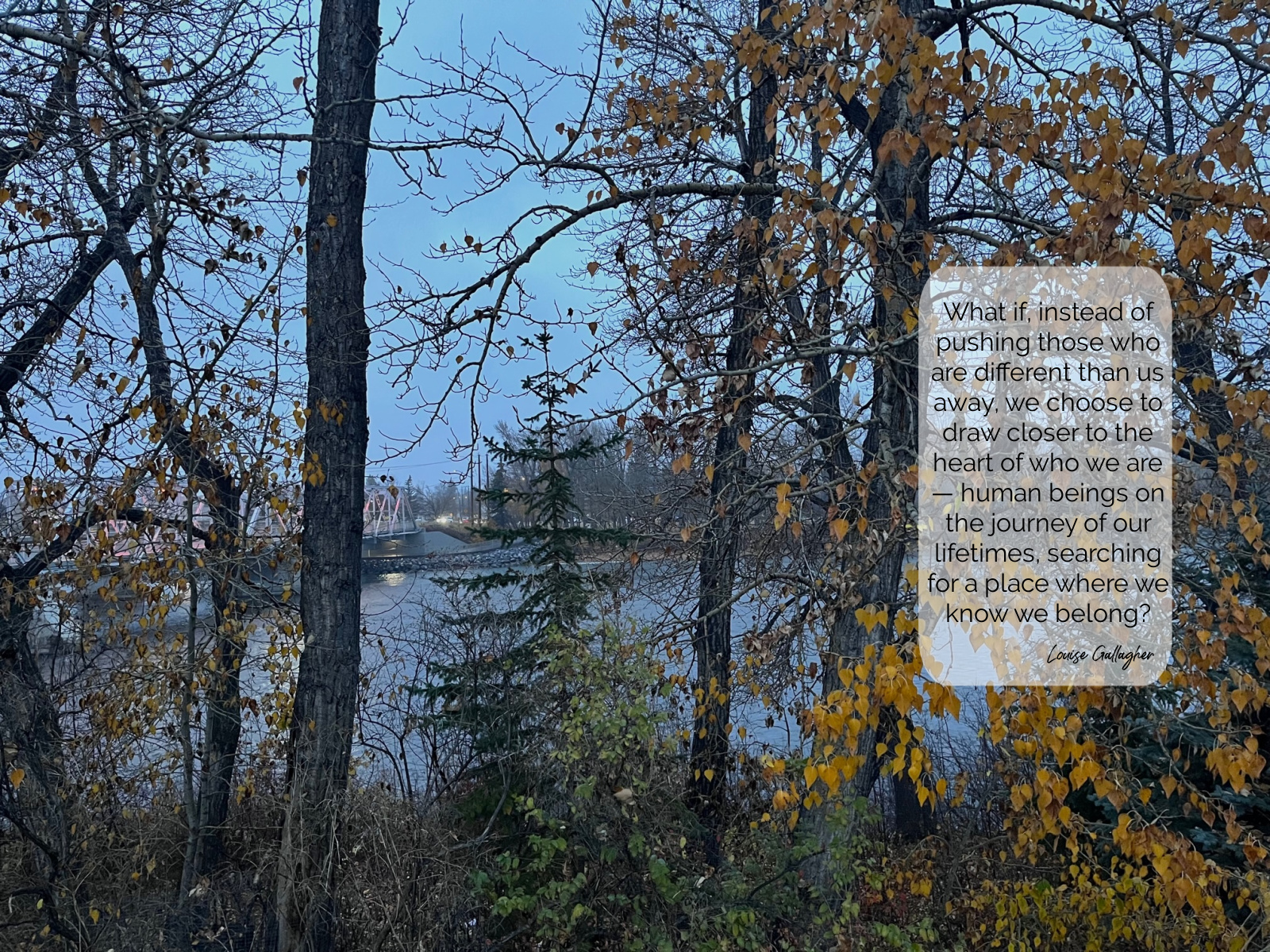
As I sit here at my desk in dawn’s breaking light, wrapped in the warmth of a cozy morning, I watch the cars’ headlights on their daily journey eastward as they cross the bridge from the ‘other side’ of the river to ‘my side’. It’s a familiar scene, but today it symbolizes something more profound. In a world where distant conflicts weigh heavily on my heart and mind, I’m reminded of our innate human tendency to categorize and separate people based on who we are and what/who fits within an often ill-defined set of criteria we’ve never taken time to challenge or questione. We label them as ‘others’ when they don’t quite fit into the same box we do, whether it’s because of their economic status, social background, demographic, or beliefs.
We humans have a knack for dividing people into categories. It’s like we’re wired with an ‘us vs. them’ switch. We judge folks by the color of their skin, their financial situation, or their level of education. It’s not because we want to exclude them, but somehow, it’s more we don’t want to INclude them because we they’re different than us. Unfortunately, this tendency results in our seeing ‘the others’ as separate, distant, not quite part of our group and in severe circumstances, not quite human because of prejudice and dehumanization.
This ‘othering’ habit creates invisible walls of intolerance and exclusion. It stands in stark contrast to the ideals of belonging and acceptance, becoming a major obstacle in building a fair and just society.
Now, let’s be real. Even if you, like me, grew up with parents who encouraged you to walk through life with an open heart and an inclusive nature, you might find that most of your close friends look a lot like you in terms of appearance, faith, and financial background. It’s not a deliberate choice; it just sort of happens.
But here’s the thing: if we genuinely want inclusivity, we need to step outside our comfort zones. We must embrace the vibrant diversity that surrounds us. Sure, it can be uncomfortable, and it might even feel unfair to expect someone to be your “teacher” just because they’re different, with loving tolerance, we can learn to understand, and create space for their ‘different’ to become less different and more… normal. The fact is, the only way to break through those invisible barriers to diversity is by opening doors to the unknown and walking through our ignorance to understanding.
To move beyond ‘othering,’ we must confront our discomfort head-on. We need to actively seek out experiences and perspectives that challenge our assumptions. It’s not always easy, but it’s undoubtedly worthwhile. This is how we develop greater tolerance, understanding, and empathy for others, especially when global events might lead us to misplace our discomfort through prejudice, racial intolerance, and, in some cases, violence.
In a world where divisions and prejudices often run deep, I’ve come to understand that recognizing and combating our natural inclination to ‘other’ people is essential. By consciously embracing diversity, seeking different viewpoints, and addressing our own biases, we can make significant progress toward a more inclusive and compassionate society.
Ultimately, to create a world where everyone experiences belonging, we must work together to break down the invisible walls of ‘othering’ and construct bridges of understanding and empathy. Regardless of our differences in appearance, education, faith, or skin color, we all share this planet. Why not live on it as one human race, where everyone belongs?
We’re all in this world together. What if together, we choose to make this moment the one where we come together to build bridges of tolerance and understanding, rather than walls of animosity and aggression?
What if, instead of pushing those who are different than us away, we choose to draw closer to the heart of who we are—human beings on the journey of our lifetimes, searching for a place where we know we belong?
 Dare Boldly
A remarkable post and one that needs more time for me to respond. I will be back. (In bed with a monster cold and more, but on the up, I hope)
LikeLiked by 1 person
I look forward to your return Kiki — hope you’re feeling much, much better soon! ❤ ❤ ❤
LikeLike
Elgie,
I understand we are more than 99% alike biologically – so that’s 1% left for differences – and there are many more flavours than Baskin-Robbins and more varieties than Heinz’s 57. The differences that are the largest part of our troubles are not the ones people speak of openly – they are the ones not talked about much. Before I met a Metis man at a conference, I thought I’d never met one before, but surely I had. Before I met ‘______’ fill in the blank of any colour, race, religion, gender/alphabet – and the same will be true for many people because they assume large differences beyond ethnic dishes or nationalistic traditions. But, when we find out they have lives full of mostly the same things we do, their faith or the foods in their fridge are nuances and flavours more than they are differences. The issue I’ve seen most, in my life and with people I know who talk about – if the parents in a family don’t promote knowing, playing with and socializing with people who are different, how will their kids know? We need more ‘like speech’ than ‘hate speech’ and to meet people face-to-face whenever we can – they’ll be 1% different, and 99% just like us. Cheers, Mark … p.s. … like you and me, 99% the same – only your 99% looks much better on you than my 99% looks on me
LikeLiked by 1 person
Ahhh yes. Mark — Waht the world needs now is… more ‘life speech’ than ‘hate speech’ — Let it be so. Please.
And haha — Thanks for the compliment on my 99% 🙂 🙂 🙂
LikeLike
Beautifully written post and above all so deep and filled with truth.
What a world the world would be if we got rid of all these boxes and
barriers.
As you say, live in harmony together on this planet we love. 🌻
Miriam
LikeLiked by 1 person
It truly would be miraculous Miriam! ❤ ❤ ❤
LikeLike
Well written Louise. 💐 Being curious about differences and embracing new people and experiences break down the barriers between us. However, when we come to realise that separateness comes from our own conditioning, and that ultimately we are all together as beings of spirit, then the differences become irrelevant. We see ourselves in all others.
“ The sun shines down, and it’s image reflects in a thousand different pots filled with water. The reflections are many, but they are each reflecting the same sun. Similarly, when we come to know who we truly are, we will see ourselves in all people.” ~ Ammachi
LikeLiked by 1 person
Such a powerful response Val — this statement, “We see ourselves in all others.” resonates deeply.
As does the Ammachi quote. Thank you. ❤
LikeLiked by 1 person
Lovely piece of prose Louise. If only we could put your vision in a vaccine or in the current lingo – “Is there an app for that?”.
LikeLiked by 1 person
Ahhh! an App would work June — that way those who don’t like vaccines would feel included! ❤
LikeLiked by 1 person