When I was a little girl, I had a deep fascination with riddles. It was my father who helped me develop it by sharing his passion for riddles and puzzles, particularly for math-based ones. It was the math based ones that always presented me with unique and often daunting challenges. He’d present a riddle, and I’d spend hours engrossed in solving it, using basic arithmetic at first, and later delving into more complex operations as I learned the intricacies of multiplication and division tables. Sometimes, the satisfaction of uncovering the answer came naturally, while other times, he had to offer hints – sometimes one, two, and sometimes more – before I could reach the solution.

Our family road trips were often marked by my father’s determination to ‘reach the destination,’ leading us to drive late into the night. My mother, aware of my curiosity and love for riddles, would seat me in the front beside my dad in our trusty VW Vanagon. There, I would keep him alert, peppering him with questions and attempting to crack the riddles he posed.

My fondness for riddles and puzzles persists to this day. I remain an inquisitive soul, constantly seeking answers and unafraid of challenges, especially when they involve words and language, which I find more accessible than numbers.

This morning, as part of my daily ritual, I tackled the New York Times puzzles — at least the word based ones; Wordle, Spelling Bee, The Mini, Letter Boxed and the newest one which I really like, Connections. This morning, on a whim I decided to venture into Sudoku, a realm I rarely explore, given my preference for words over numbers. Surprisingly, I realized that my initial misconception was that Sudoku was all about numbers, when in fact, it’s all about patterns.

Patterns have always held a special allure for me. I can perceive them, intuitively understand them, and appreciate their significance. Patterns resonate with me on a deep level.

So, here’s what I learned venturing into turf I usually avoid. When I think something is all about ‘one thing’ and thus, avoid it, I am limiting my experience of things outside of what I know. And, while familiarity can be a good thing, to really stretch your imagination, your mind and thinking, to move you outside your comfort zone, stepping into the the things you say, you can’t do, don’t like, have no understanding of or whatever you tell yourself to avoid experiencing something new or different, you must challenge your perceptions and inner beliefs.

If, like me, you’re captivated by the idea of unraveling the intricate puzzle that is your inner self and embarking on a journey to discover who you truly are and all you’re capable of, imagine this — Adventure. Hidden Treasure. Boundless riches await! This voyage you’re embarking on into the vast limitless mystery of your true potential is the adventure of your lifetime! You are about to set sail into the uncharted waters of your own being, delving into the depths of what you don’t yet know about yourself—those undiscovered territories you’ve never dared to explore. Much like Christopher Columbus daringly voyaged to discover new lands, you, too, must have the courage to navigate the unexplored aspects of your own beliefs and truths.

Because, when we risk divine into the unknown, life opens up in all its wonder, possibility, and awe, inviting us to explore the infinite realms of our own potential.

“What about you? Are you drawn to the intrigue of puzzles? Do you have a curiosity that beckons you to explore the depths of your existence beyond what you think you know? Are you ready to embark on a voyage into your own undiscovered patterns, embracing the wonder and awe that await?

I invite you to share your thoughts in the comments below. I relish the opportunity to learn about the unique, fascinating, and magnificent aspects that make each of us who we are.

And if you’re intrigued by the idea of rewriting the story of your life and bringing alive all your potential, by delving into your inner landscape through creative exploration, I invite you to join me on January 8th for an exciting journey. Through the use of art-making, creative expression, self-reflection, and a collective approach, ‘The ReWrite Journey’ still has a space available for one more ‘priestess’ to enter and co-create a circle of endless possibilities!

The Journey Home: From Self-Awareness to Self-Reconciliation

Centuries ago, Aristotle wrote, “The most important relationship we can all have is the one you have with yourself. The most important journey you can take is one of self-discovery. To know yourself, you must spend time with yourself, you must not be afraid to be alone. Knowing yourself is the beginning of all wisdom.”

I’d add, “Yet, without seeking to empower self-awareness through self-reconciliation, self-awareness hangs, like an unripened pear, in fruitless possibility.”

Recently, while on my solo trip to Ireland, someone mentioned that they hate travelling alone. “I think it’s because I don’t really like my own company,”

Their comment surprised and intrigued me. I wrote the question in my journal, “Do I like my own company?”

Yes, was my immediate response.

What is it about your own company you enjoy? was my next question.

That one didn’t evoke an immediate response. I decided to make a list of all the things I liked about being with me.

  • I enjoy sitting watching people,.
  • Being alone gives me space to savour silence
  • I like how I’m comfortable just ‘being’ without having to be doing.
  • I enjoy making up stories about other people’s lives, and when I’m alone, I have all the time I need to do that.
  • I meet strangers where they’re at when I’m travelling on my own and get to hear their stories
  • I don’t feel like I have to be ‘on’ when I’m travelling alone. I can choose to talk to someone or not, choose to go out, or not, choose what pleases me at any given time.

After reflecting on my own appreciation for solitude, I began to realize that this contentment I find in my own company is intimately tied to a deeper journey—one that involves self-knowledge and the transformative power of self-reconciliation.

Having spent much of my adult life peeling back the layers of my psyche, the insights I’ve acquired into my inner workings, have helped me gain a profound understanding of who I am, beauty and the beast, yin and yang, dark and light, good, bad and indifferent.

However, on its own, self-knowledge doesn’t guarantee personal transformation. It’s just the beginning of a more profound journey. Imagine it as the map that shows you where you are, but it doesn’t tell you how to navigate the challenging terrain ahead.

Without seeking to empower self-awareness through self-reconciliation, it’s as if we stand at the edge of a vast challenging terrain, separated from where we are by a vast field of possibility. We want to know those possibilities but, fear of the unknown holds us back from taking the first step into the uncharter territory laid out before us. In many ways, this uncharted wilderness represents the aspects of ourselves that we’ve shied away from, the emotions we’ve suppressed, and the contradictions we’ve ignored. It’s a territory filled with uncertainty, and the journey within can seem daunting.

To bridge the gap between where we stand and the heart of our internal divide, we must cultivate courage and self-compassion. Courage to face our inner demons, and self-compassion to understand that it’s okay to have flaws, imperfections, and contradictions. Much like a seasoned explorer who equips themselves with the right tools and knowledge, we too can prepare for this journey.

First, we must arm ourselves with self-awareness, which acts as our compass. It helps us navigate the intricate pathways of our psyche. Self-awareness allows us to identify the areas where we feel divided within ourselves, pinpointing the sources of inner conflict.

Next, we need the flashlight of mindfulness. Mindfulness enables us to shine a light on the dark corners of our thoughts and emotions. It helps us observe our inner landscape without judgment, fostering a sense of curiosity and acceptance.

But perhaps the most crucial tool in our kit is self-compassion. It’s the warm embrace we offer ourselves when we encounter the challenges of self-reconciliation. Self-compassion reminds us that we are human, and like all humans, we are a complex tapestry of experiences, desires, and contradictions.

____________________________

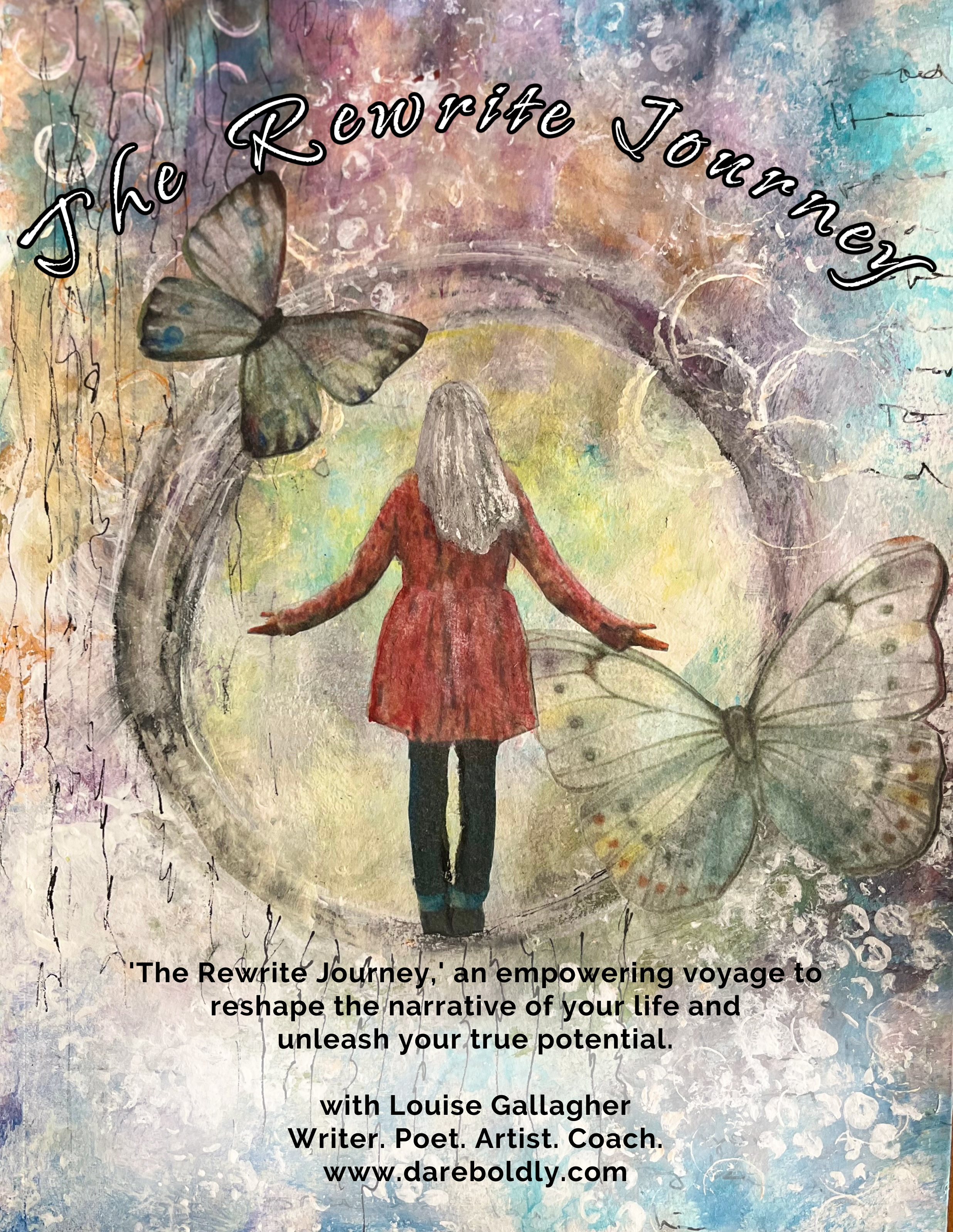
The ReWrite Journey

As I develope the courseware for The ReWrite Joureny which I’ll be launching in January, I’l be exploring specific strategies and practices that will guide us deeper into the internal divide. We’ll learn how to reconcile the conflicting parts of our identity, heal past wounds, and emerge from this wilderness as more integrated, authentic, and self-aware individuals empowered to write a life-story that gives us the courage to shine bright, no matter how dark the times..

So, fasten your metaphorical hiking boots, gather your tools, and get set to embark on the journey of your lifetime as we tread, light of foot and heart, into the heart of the internal divide, where true self-reconciliation awaits.

From The Poetry Circle

We gathered, four of the six women who form the nucleus of this circle, a sacred bond birthed in the tentative days of lockdown. Ali Grimshaw, the poetic voice behind the blog, Flashlight Batteries, has been our unwavering compass, mentor, muse, and cherished confidante throughout these three transformative years of gathering, listening, writing, and sharing.

We hail from across North America. Me, the lone Canadian, in Alberta, the others scattered between Washington State and Alabama. In the quiet moments when one or two are absent, their absence echoes within the circle, a subtle but palpable void. Yet, even in our incompleteness, the muse unfailingly graces us with her nimble wordplay.

Last night, I reveled in the company of my fellow poetry voyagers, letting the words flow like a river unburdened by dams. Together, we wove the tapestry of our verses, sharing the stories that had been etched onto our pages.

Hand in motion, ink streaming, the pen glided across the page as if orchestrated by an invisible poetic symphony, a melody only discernible to my subconscious.

It was an experience, divinely restorative, freeing the spirit from its earthly confines, and fulfilling the soul’s deepest longing.

To those who feel the call of these poetic moments, if your heart yearns to connect its lyrical embrace with other poetic souls dancing, the invitation is open, it’s as delicate as the whisper of a muse’s sigh inviting you to release the words and let the words flow: If the call of poetry beckons to your soul, send me an email, and together, we shall weave verse into the tapestry of our lives.

The List That Will Never Be Written
by Louise Gallagher

There will never be a complete list
of all the moments and places
that have consumed my breath
with awe
just as there will never be
an ending
to love
or the illusion of the moon 
rising 
at dusk
or the life-giving cry
a newborn makes
upon leaving
the safety of the womb.

Why should there be?

In the capturing of every tiny moment
Awe escapes
leaving behind only the cold hard facts
of a life lived
without witness to 
the beauty
of a sunrise stealing
its breath away.

There will never be a complete list
of all the moments and places
that have consumed my breath
as long as I take notice
of the awe
that steals my breath away.

What if we choose to draw closer to one another?

As I sit here at my desk in dawn’s breaking light, wrapped in the warmth of a cozy morning, I watch the cars’ headlights on their daily journey eastward as they cross the bridge from the ‘other side’ of the river to ‘my side’. It’s a familiar scene, but today it symbolizes something more profound. In a world where distant conflicts weigh heavily on my heart and mind, I’m reminded of our innate human tendency to categorize and separate people based on who we are and what/who fits within an often ill-defined set of criteria we’ve never taken time to challenge or questione. We label them as ‘others’ when they don’t quite fit into the same box we do, whether it’s because of their economic status, social background, demographic, or beliefs.

We humans have a knack for dividing people into categories. It’s like we’re wired with an ‘us vs. them’ switch. We judge folks by the color of their skin, their financial situation, or their level of education. It’s not because we want to exclude them, but somehow, it’s more we don’t want to INclude them because we they’re different than us. Unfortunately, this tendency results in our seeing ‘the others’ as separate, distant, not quite part of our group and in severe circumstances, not quite human because of prejudice and dehumanization.

This ‘othering’ habit creates invisible walls of intolerance and exclusion. It stands in stark contrast to the ideals of belonging and acceptance, becoming a major obstacle in building a fair and just society.

Now, let’s be real. Even if you, like me, grew up with parents who encouraged you to walk through life with an open heart and an inclusive nature, you might find that most of your close friends look a lot like you in terms of appearance, faith, and financial background. It’s not a deliberate choice; it just sort of happens.

But here’s the thing: if we genuinely want inclusivity, we need to step outside our comfort zones. We must embrace the vibrant diversity that surrounds us. Sure, it can be uncomfortable, and it might even feel unfair to expect someone to be your “teacher” just because they’re different, with loving tolerance, we can learn to understand, and create space for their ‘different’ to become less different and more… normal. The fact is, the only way to break through those invisible barriers to diversity is by opening doors to the unknown and walking through our ignorance to understanding.

To move beyond ‘othering,’ we must confront our discomfort head-on. We need to actively seek out experiences and perspectives that challenge our assumptions. It’s not always easy, but it’s undoubtedly worthwhile. This is how we develop greater tolerance, understanding, and empathy for others, especially when global events might lead us to misplace our discomfort through prejudice, racial intolerance, and, in some cases, violence.

In a world where divisions and prejudices often run deep, I’ve come to understand that recognizing and combating our natural inclination to ‘other’ people is essential. By consciously embracing diversity, seeking different viewpoints, and addressing our own biases, we can make significant progress toward a more inclusive and compassionate society.

Ultimately, to create a world where everyone experiences belonging, we must work together to break down the invisible walls of ‘othering’ and construct bridges of understanding and empathy. Regardless of our differences in appearance, education, faith, or skin color, we all share this planet. Why not live on it as one human race, where everyone belongs?

We’re all in this world together. What if together, we choose to make this moment the one where we come together to build bridges of tolerance and understanding, rather than walls of animosity and aggression?

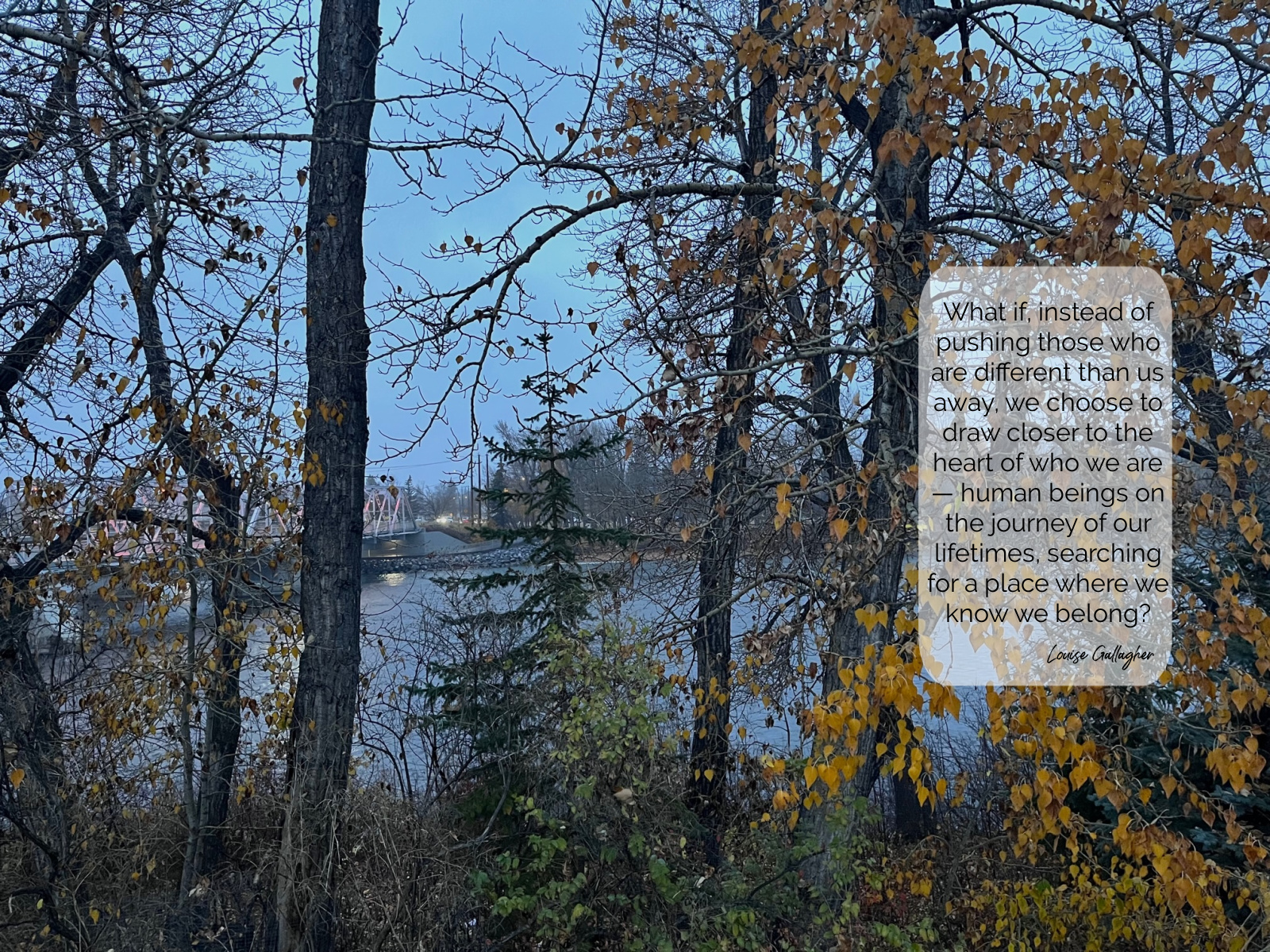
What if, instead of pushing those who are different than us away, we choose to draw closer to the heart of who we are—human beings on the journey of our lifetimes, searching for a place where we know we belong?

The Rewrite Journey – Transforming the stories we tell on ourselves.

Years ago, I received an invitation to speak at a conference for crisis support workers in the gender-based violence sector. The organizers informed me that my talk would be a part of the ‘Survivor’s Stories’ segment of the conference.

I hesitated. “Thank you, but no thanks,” I replied. “I was a victim of abuse, and yes, I survived. But to label me, or anyone who has endured violence and emerged from it with their life, as a ‘survivor’ denies the truth of who we are and all we’re capable of. I was undoubtedly a victim of his abuse. However, beyond all he did to try to diminish me, I must step into my power by claiming my role as a victor. Victors have agency, power, strength, and courage. Believe me, it takes courage not only to walk away but also to reclaim and rebuild your life after abuse. It takes a victor’s mentality.”

The organizers agreed not to introduce me as a victim or survivor.

I felt victorious.

Each day, life presents opportunities to rewrite the narrative of our lives, to shift the story we tell ourselves and others from victimhood to victory, victim to victor.

What’s your narrative?

What stories do you tell yourself? Do they pave the way for a life filled with fulfillment, abundance, joy, and love? Or do they keep you anchored down in regret, playing small and feeling unfulfilled or worthless?

If it’s the latter, perhaps it’s time to consider rewriting your narrative.

The art of rewriting your narrative is a journey of self-discovery and transformation. It’s a journey where you become both the author and the protagonist—a voyage to rediscover the poetry of your soul and craft a narrative that reflects your true magnificent essence.

In a world that often confines us within predefined roles and expectations, reshaping our stories empowers us to unlock our full potential. Crafting a new story of your life starts with a willingness to shed labels, no matter how comforting or familiar they may be, and to journey unlabelled and unburdened by limiting beliefs that would otherwise hinder you from living life on your terms.

Here are seven steps you can take to rewrite your narrative to tell your victor story.

  1. Self-Reflection and Awareness: Sit quietly. Breathe. Reflect on your life journey, on the stories you’ve told yourself about who you are and what you’re capable of. Identify any negative or limiting narratives that have held you back. Awareness is the first step toward change.
  2. Challenge Negative Beliefs: Once you’ve identified the negative beliefs that have shaped your narrative, challenge them with kindness and curiosity. Ask yourself, “Do these beliefs lift me up or pull me down?” Explore if they’re ‘fact based’ or assumption-riddled or inherited expectations. Replace them with affirming and empowering thoughts.
  3. Set Empowering Intentions: Craft a clear vision of the human-being you want to become. Set intentions that reflect your true desires and values. Define the qualities, strengths, and achievements that resonate with your authentic self. Visualize this new narrative as if it has already become your reality.
  4. Take Action and Embrace Growth: Rewrite your narrative by taking deliberate actions aligned with your new intentions. Step out of your comfort zone, embrace challenges, and welcome personal growth. Every step you take toward your aspirations reinforces your rewritten narrative.
  5. Surround Yourself with Supportive Allies: Seek out a supportive community of friends, mentors, or therapists who can provide encouragement and guidance on your journey. Share your rewritten narrative with those who believe in your potential and can help you stay on track. Their support will bolster your confidence.
  6. Celebrate Your Achievements: As you make progress, celebrate your achievements along the way, no matter how small they may seem. Acknowledge your successes and use them as evidence that your new narrative is becoming a reality. This positive reinforcement can be a powerful motivator.
  7. Practice Self-Compassion: Remember that rewriting your narrative is a process that may involve setbacks and moments of self-doubt. Be gentle with yourself during these times. Practice self-compassion and remind yourself that change takes time and effort. Treat yourself with the same kindness you would offer a friend facing a similar challenge.


Embracing My Next Decade: Setting the World Ablaze in My 70s

She dares to live as if age is not a limitation, but an invitation to live it up with passion, purpose and profound significance.

I never thought I’d be charting a course for my next decade while stranded on the narrow roads of Ireland with a flat tire, but sometimes life’s unexpected twists force us to pause, reflect, and reevaluate our journey. It was in that moment of inconvenience, standing at the edge of a lake shimmering in the breathtaking beauty of the Irish landscape, that I realized the need to drive less, rest more, and dive deep into the boundless possibilities of my future.

As I approach my 70s, I’ve been pondering how to live life to the fullest. How can I unleash the creativity that simmers within me, yearning to break free? How do I wake up every morning with unwavering belief in the promise of a better tomorrow, immersing myself in passion and purpose, prose and artisitic expression?

The question that echoes in my heart is this: How do I craft the best chapter of my life yet?

Come December 9, the turning of the calendar will usher in a new decade, laden with the wisdom of years gone by and the thrilling anticipation of what lies ahead. The choice to seize this opportunity, to truly live it up, is solely mine to make—or to disregard.

I stand at a crossroads where I can defy societal expectations that often suggest older adults are merely biding their time. The world seems to imply that whatever we’re doing at ‘this age’ is mere inconsequential chatter, like flotsam on the surface of life. I wholeheartedly reject that notion. I choose to be noisy, to be loud, and dare I say it, to be obnoxious in my determination to declare: “It’s not over yet, baby! I’m ready to set the world on fire!”

This is my time, my moment, to embrace life with open arms and an open heart. It’s a time to cherish the unique perspective that comes with age, a perspective that is enriched by decades of experiences and lessons learned. My journey ahead is not a passive drift towards the sunset; it’s a blazing trail, illuminating the path for others to follow.

In this next chapter of my life, I am committed to leaving an indelible mark. I will pour my heart and soul into every endeavor, chase my dreams with fervour, and nurture my creativity like a precious flame. I won’t just exist; I will thrive. I will embody the belief that there’s still so much to contribute, create, and achieve, because age is not a limitation—it’s an opportunity.

So, here’s to the future, to embracing the uncharted territory that lies ahead with a fierce determination to make every day count. It’s a future filled with possibilities, and I intend to explore them all. Armed with a deeply seated love of self and humanity, a spirit embued with compassion, and a belief in the possibility of better, I declare that my 70s will be a decade of purpose, passion, and profound significance.

Watch out world! The 70s are calling and there’s no stopping me now!

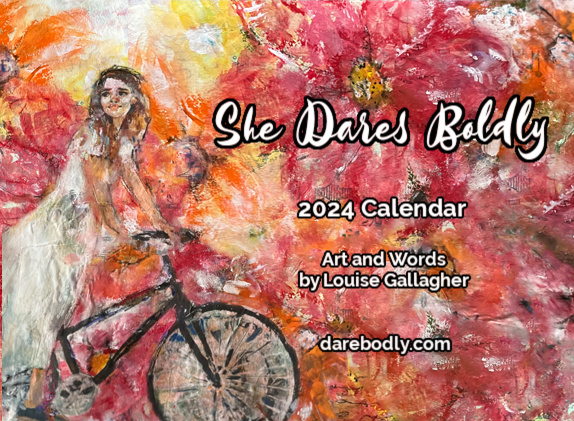
Reconnecting with Creativity: The She Dares Boldly 2024 Calendar Journey

2024 Calendar Cover — 11 x 6 inches

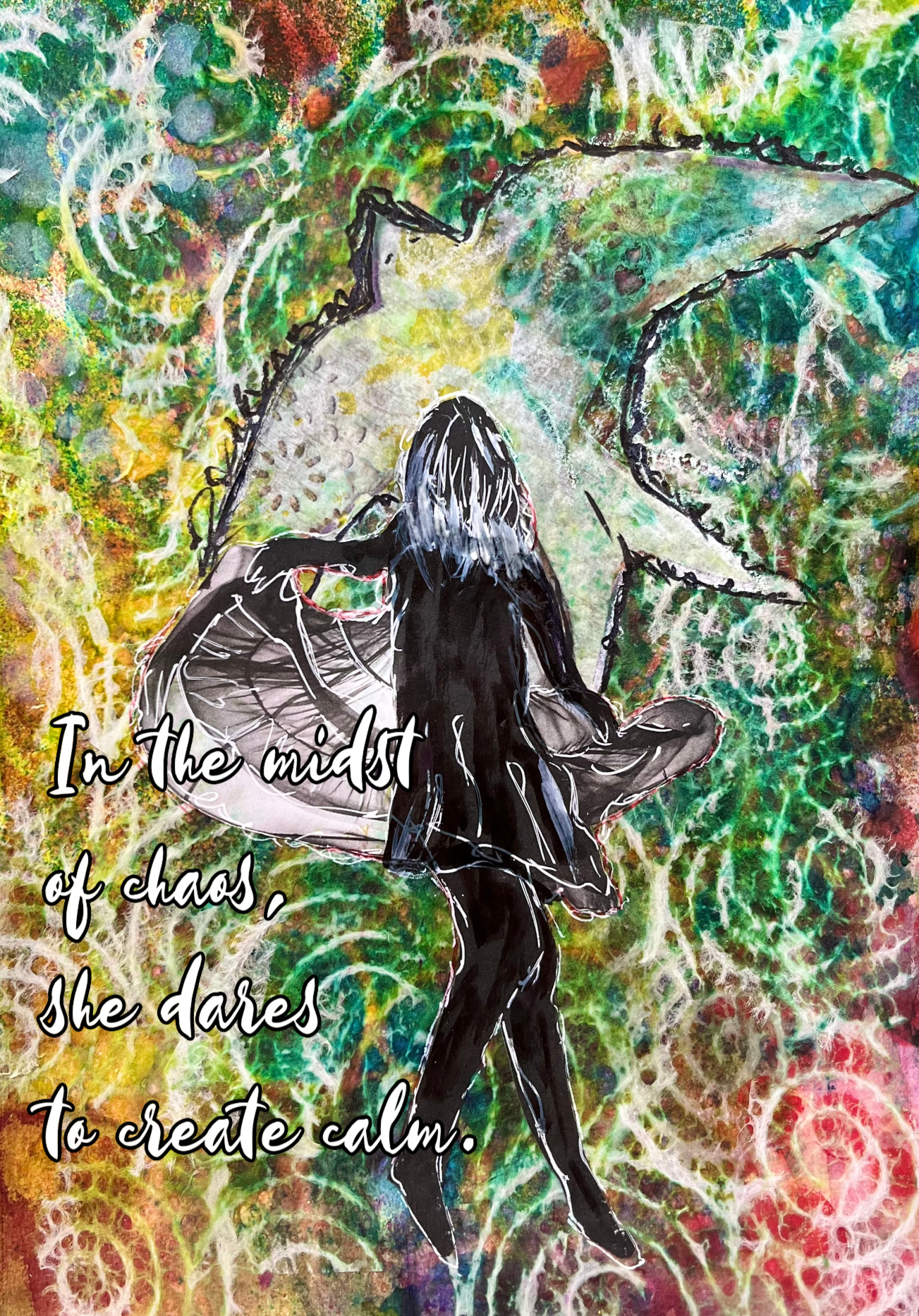
In the midst of uncertainty, I can sometimes become lost in the confusion and chaos. That’s why the February page for my 2024 She Dares Boldly calendar speaks so emphaticaly to me. “In the midst of chaos, she dares to create calm.”

In the midst of my uncertainty, I am choosing to create calm through creative expression.

Ms February

Which is why I’ve made a decision. After many request, I’ve chosen to overcome my hesitancy. The She Dares Boldly 2024 calendar is a definite “go.” This decision didn’t come easily, as I’ve found myself pulled in different directions and faced with unexpected obstacles. But now, with my newfound determination strengthening my spine, and calmness easing my pounding heart, I’m excited to share the journey of creating this calendar.

My hesitance to commit to the calendar project stemmed from several factors. Over the past few months, I haven’t spent much time in my studio. My work computer took over the space last spring, and the inconvenience of moving it every time I wanted to create became a bigger impediment than I initially thought. Plus, summer isn’t typically when I find myself in the studio.

However, as I began to compile the artwork for the calendar, reality struck: I need to produce five new images and quotes before I can send the calendar to the printer. This became my motivation to rekindle my creative spirit.

First things first, I relocated my work computer back to its original desk. It’s a small adjustment since my current contract ends at month’s end, and the computer will be moving along. This change cleared the way for the magic to happen.

Then came the weekend when two women emerged: Ms. February and Ms. June. These were not just months; they represented the rebirth of my creativity. The act of splashing paint, finger-painting, layering colors, and textures ignited my soul. It was a soul-nourishing experience, one that reminded me of the sustaining power of creative expression.

Ms. June

I had forgotten.

Creative expression is a gift—one we can choose to use or lose. The beauty of art-making is that you don’t actually lose the ability; you merely forget how vital it is for mental health and well-being.

I had forgotten.

But over two days of playful interaction with paint, I was once again immersed, feeling alive, refreshed, and replenished. Yet, there’s a challenge ahead: discipline. Alongside preparing the calendar for printing, I need to tackle marketing tasks to ensure it’s ready for the holiday season. Simultaneously, I don’t want to lose momentum on the play I started writing during my time in Ireland. Additionally, there are a few loose ends to tie up for the not-for-profit I’ve been working with before my contract concludes.

Discipline becomes a fragile concept, especially when I’m immersed in the studio. However, knowing what I’m working toward and what it means to me to achieve my goals is essential.

For me, releasing my calendars (and any creative output for that matter) into the world brings immense joy. I relish the way people respond to them, how the quotes attached to the images resonate with them. It fills my heart with joy.

And so, I return full circle to the calendars.

Creating them brings me joy.

And that’s a wonderful thing!

Stay tuned for more updates on the She Dares Boldly 2024 calendar—it’s eager to make its mark on the world!

Between Comfort and Chaos: Reflecting on War and Privilege

I lie in the bath, my feet playfully peeking through the bubble-laden surface. Immediately, I’m reminded of my friend Lavern, who often shares photos of his feet relaxing against the backdrop of the sparkling Okanagan lake.

I snap a photo of my feet, but do not post it.

Two months ago, Lavern’s family summer home was consumed by the ravenous Adam’s Lake Fire in B.C. Years of dedication, sweat, and equity had turned their house into a cherished home. When the evacuation order came, they joined the convoy of desperate families fleeing the flames, their vehicles laden with memories, pets, and hope.

Lavern’s escape bore an extra layer of pathos. As part of the local volunteer fire brigade, he combatted the very inferno that razed his home.

This year, nature’s fury has felt unbridled—fires, floods, tornadoes, hurricanes—each disaster leaving scars on our landscapes and hearts. Yet, for many like Lavern, there’s solace in the knowledge that they can rebuild, even if the journey is long and tough.

There are so many million others in this hurting world whose journey is even tougher. The catastrophes they face are man-made—bombs, bullets, and wars that annihilate not just buildings but the spirit of communities. No fortress stands invincible to a missile, no hand can stop a bullet, just as no belief can truly justify the horror we inflict upon one another.

The world’s landscape is marred with unease. In our quest for territory and power, we seem to forget that peace cannot bloom from the soil of conflict. While some invoke divinity to defend violence, our shared humanity is overshadowed.

As I reclined in my bath this morning, insulated from the world’s chaos, I was hit with a profound realization: moments of peace, like this, are a privilege. And they’re not universal.

I took a photo of my feet sticking out of the bubbles in my bath this morning. Wrapped in the warmth of my home, my thoughts were distant from the cacophony of war, far from the dread of a bomb’s descent.

It’s moments like these that starkly remind me of the divide between safety and chaos, between peace and turmoil. Such simple, unassuming moments are luxuries that many in our world are denied. As I wrap myself in the comfort of my sheltered sanctuary, I’m enveloped by a deep gratitude for my safety, but also a profound sorrow for those living in the horrific reality of the dangers surrounding them.

Lest we forget, while some of us bask in comfort, countless others are engaged in a relentless fight for mere survival. As we sit blithely, passing judgments, laying blame, taking sides, or lashing out at commentators for dissenting views, there are mothers mourning as they pull the lifeless bodies of their children from ruins. Lost children wander amidst the chaos, their tiny hearts pounding, their trembling  bodies overwhelmed by hunger, thirst, and fear.

This is the harrowing face of war. After the deafening roars of guns have ceased and the final bombs have fallen, both victors and the vanquished are left with the somber task of laying their loved ones to rest. And long after the dust has settled, their hearts will continue to ache, bearing the weight of all that man’s conflicts have stolen.

If we are to make real peace with one another, let us not make it through war.

On faith and memory

My Catholic roots are deeply intertwined with the tapestry of my childhood. Though I do not weave them through the warp and weft of my life today, they have always served as a solid foundation, enabling me to navigate life with a sense of peace, security, and boundless freedom.

I vividly recall the Friday evening Rosaries. The rhythmic clicking of the beads as they slipped through my mother’s fingers echoed the cadence of her whispered prayers. With each Hail Mary, I would impatiently await the end, yearning to run outside and play with my sister.

On Saturday afternoons, the serene ambiance of the church would embrace us as my sister and I assisted our mother with the flowers for the altar, ensuring their freshness for Sunday mass. While my sister had the honor of carrying the week-old vases, I was delegated the task of sorting. Perhaps my mother had her reasons to doubt my dexterity (or perhaps lack of attention) when carrying breakable objects.

These memories have left an indelible mark. Even today, discarding withered flower arrangements, as I had to do when I returned from my trip, feels almost sacrilegious. The wilted petals and stagnant water resonate with silent prayers, pleading to be left undisturbed.

In my child’s memory, Sunday morning masses were full of chaos and confusion. The whirlwind of preparing four children, adorned in their Sunday best with my mother always winning out on what I was to wear, contrasted sharply with the solemnity of the mass. But Easter Sunday was special. It wasn’t the prolonged service that captivated me but the excited of a new Sunday hat and dress, my shiny patent leather shoes, and delicate lace gloves.

The church’s aesthetics enthralled me. From the priest’s ornate gold rimmed robes to the grandeur of the statues, I would sit and stare until my mother poked me with a whispered, “Pay attention”. It is perhaps in the church where the seeds of my feminist nature were planted. Amidst all the allure, the gendered confines of the church stung. Why couldn’t girls, equally devout and capable, serve at the altar?” I would ask my mother, only to be hushed with a sharp retort to be quiet or stop asking questions.

My childhood was also marked by innocent transgressions and the subsequent confessions whispered into the darkness of a confessional booths screen behind which an unseen priest sat. I knew my litany of sins by hear and practiced them with my sister to ensure we didn’t sound exactly the same: bickering with my sister, disobeying my mother or father, and the unintentional swallowing of water before the mass in the days when eating or drinking anything before consuming the holy wafer was a big no-no.

Post-mass Sundays had their rituals too. Breakfast awaited, and my father’s culinary feats were nothing short of legendary. Invitations to join were frequent, and few could resist.

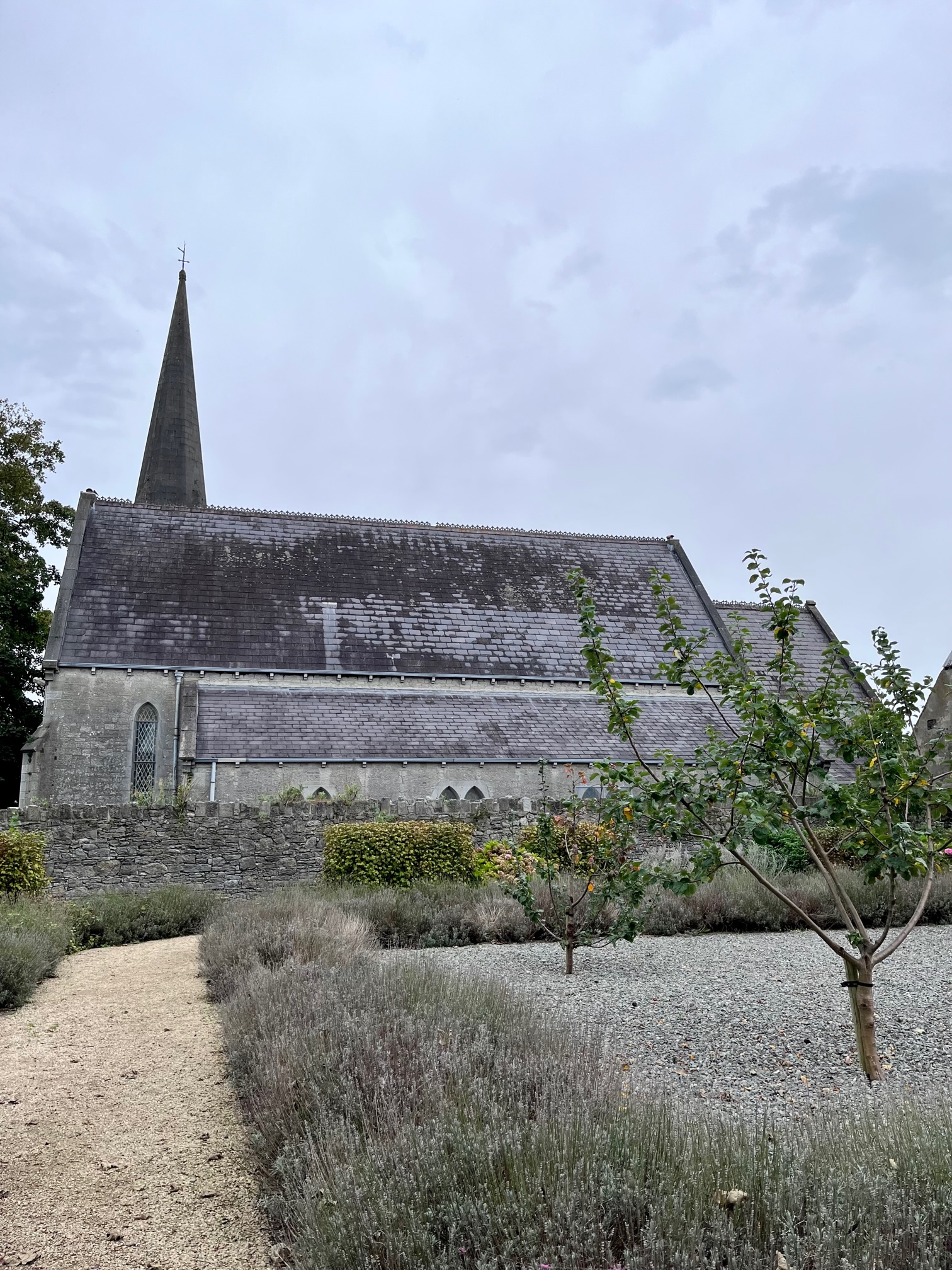
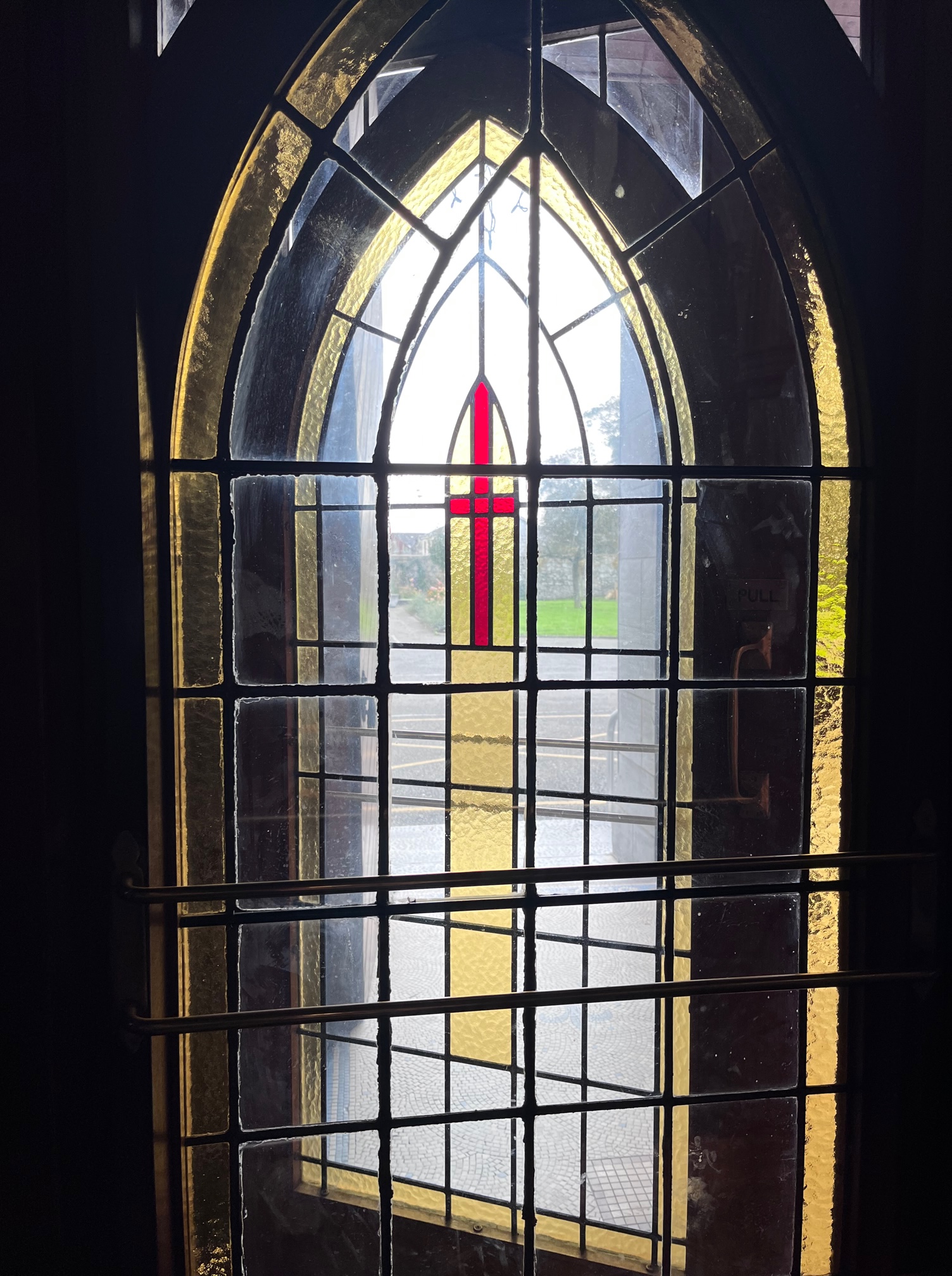
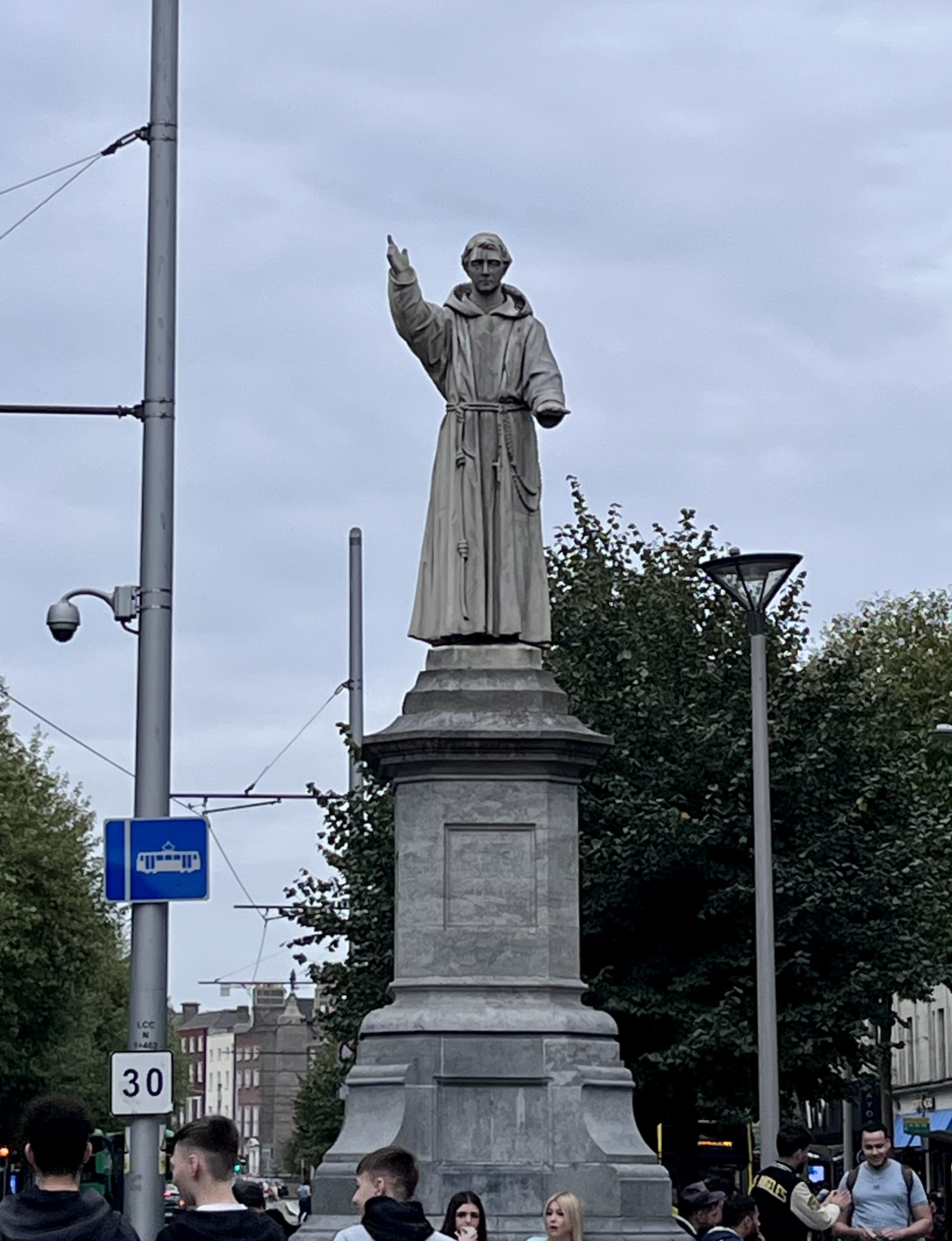
My recent journey to Ireland rekindled these poignant memories. The landscape is dotted with majestic cathedrals and humble churches, their spires reaching towards the heavens, silent witnesses to centuries of devout worship. It’s impossible not to feel the profound depth of Catholic faith imbued in the very heart of the Irish people. The ubiquity of crucifixes, gracing everything from homes to local stores, speaks volumes of a culture where the sacred and the secular seamlessly converge.

In this nation, where belief threads through every aspect of life, I found echoes of my past. The sanctity I witnessed in Ireland, in the daily lives of its people, reflected my own childhood filled with the mysticism of faith and the embrace of family.

These reminiscences emphasize the profound influence of my roots. Although I’ve distanced myself from the strict religious practices of my youth, the spiritual foundation laid during those years keeps me grounded. I firmly believe that life, with all its mysteries, wonders, and challenges, is divinely orchestrated. It’s a gift to be treasured, a journey to be celebrated with joy and love, no matter your spiritual beliefs or credo.

Baking scones at 4am

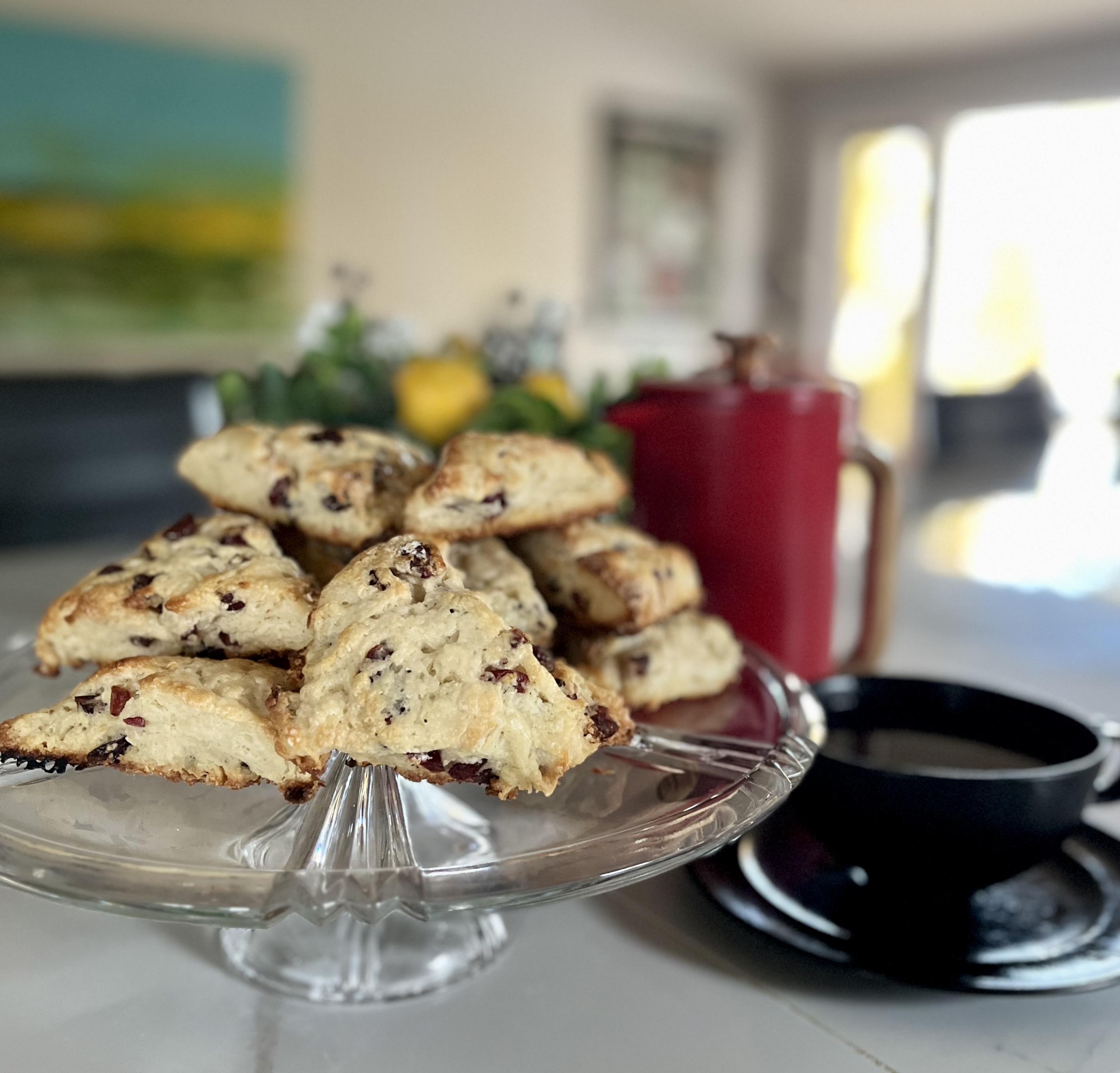
Jetlag has a peculiar way of rearranging one’s schedule. It was 4 a.m., and there I was, wide awake, having been stirred from slumber at 2:30. Not having spent much time doing anything domestic while on my travels, the kitchen beckoned. Before I knew it, flour, sugar, and butter were sprawled across the island, with my hands deep in a bowl of flour, sugar and butter, crumbling butter into pea-sized morsels.

Doesn’t everyone bake scones at 4am?

Thankfully, my journey home had been uneventful — truly the best kind of flight.

Upon landing, my beloved was waiting, with our imitable Sheepadoodle, Beaumont, peeking out from the backseat. We were en route to a Thanksgiving dinner with dear friends; a quick stop at home wasn’t on the agenda.

I held onto my wakefulness as long as I could, staying alert till 7 p.m. — or what felt like 2 a.m. back in Dublin. But then, sleep’s sweet lure proved irresistible. A brief hour-long nap on a sofa later, I tried to rally, but by 9:30 p.m., I was soundly asleep in my bed.

Ahhh, the sweet comfort of one’s own bed and surroundings!

However, the early hours found me awake again.

Though an unconventional choice, baking seemed fitting. After all, I couldn’t very well unpack or start laundry, not with Beaumont and C.C. peacefully asleep beside me.

Post my baking escapade, I snatched a few more precious hours of sleep and, when morning broke, Beaumont and I headed out to wander the paths along along the riverbank, the landscape painted with the fiery hues of autumn.

The season of long shadows is upon us. The sun barely grazes the horizon, as though even it yearns for winter’s rest. The mornings greet us with a cool embrace, but by midday, warmth seeps in.

This is a time for introspection, for prepping home and soul for the impending icy gusts of a prairie winter.

For now, I cherish my walks by the river. Though its name might not resonate with the historical echoes of the Liffey, its melody is just as enchanting.

It’s the thing about rivers, no matter where in the world you go, the poetry of the river flows freely.