We Are All Woven in Time

Morning light dances
River flows endlessly by
Love’s presence endures

Light dances upon the water’s surface, where the river, bordered by ice, flows freely. When my gaze fixates on this dance of light, the river appears deceptively still, a mirage of tranquility amidst its constant motion.

This illusion mirrors life itself. Often, it feels as if time has stalled, yet subtle markers – a passing birthday, a fading memory – remind me that life is in perpetual motion. Nothing remains static. Life, like energy, is ever-moving, evolving, and transforming.

Around this time, four years ago, our family gravitated towards a tender reality – the dimming light in our mother’s life at 97 years old. She sensed her earthly journey nearing its close. She spoke of loved ones lost and a divine presence that had been her constant companion, waiting in the wings to reunite her with them.

In her last days, each breath she took seemed to suspend time. It was as though her breaths could continue indefinitely, even as her heart quieted. After 97 years of what she often described as a life of loss and worry, my wish wasn’t for her to stay but for her to see the legacy of love she wove through life’s tapestry of hardships, sorrows, and joys.

Throughout my life, my mother’s vision was often clouded by darkness, her joy overshadowed by a lifelong battle with depression. I recall, as a child, yearning to craft a bridge of words that could lead us from her tormented moments – like those standing in the kitchen, when she held a knife to her breast and cried threats of self-harm – into a realm of unceasing light.

It took years to understand that I would never be powerful enough to build that imaginary bridge for my mother. And longer still to realize that despite my resilience, darkness touched me too. It was a therapist’s simple question many years ago about my own quiet depression that cracked open my self-awareness, challenging my perceptions and inviting introspection.

Since then, much has shifted. The icy hold on my constant smile has thawed, giving way to authentic emotions. Embracing both joy and sorrow, light and darkness, I’ve grown to love all parts of myself – and my mother. Understanding that to appreciate the light fully, we must also honour the darkness by falling in love with all of it — darkness, light and the shadows between.

Watching the light dance on the river this morning, I saw life’s constant flow – the passage of time, the interplay of light and darkness. And through it all, Love, in all its manifestations, moving unbounded, weaving through every moment, cradling me in the eternal circle of Life woven in time through my mother’s loving hands.

How to rewrite your stars.

In the quiet of each morning, I am greeted by the unwritten story of the day ahead—a narrative waiting to be crafted with intention and purpose. In these moments, I am reminded of the ReWrite Journey course I have the honour of guiding—a course designed to delve into the art of storytelling, our storytelling.

Every Monday evening, in the sanctuary of our virtual circle, seven women, a collective of seekers and storytellers, explore the contours of our Origin Stories. It is here that we acknowledge our agency, summon our strength, celebrate our courage, and distill the wisdom from life’s intricate journey. This is the groundwork of the course, The ReWrite Journey I’ve created, a journey of reflection and empowerment.

Every choice we make—every word, every action—becomes a sentence, a paragraph, a chapter in the ongoing story of our lives. As we begin to chart our paths forward, we set markers—goals and dreams that beckon us with the promise of fulfillment and transformation.

In the ReWrite Journey course, we don’t just look back; we also cast our gaze forward, rewriting our trajectory with markers that serve as beacons towards a future we dare to design. What kind of story do we aspire to live out? What are the empowered choices we will make to propel us towards our envisioned horizon?

As we write and create, we ask… What if, instead of drifting on the currents of habit, we took the helm with hyper-conscious awareness, navigating our existence with the recognition that we are here, now, fully capable of scripting the grand narrative of our lives? What if today, we chose to live out the greatest story ever told, our own, with every choice a stroke of the author’s pen?

What if?

________________

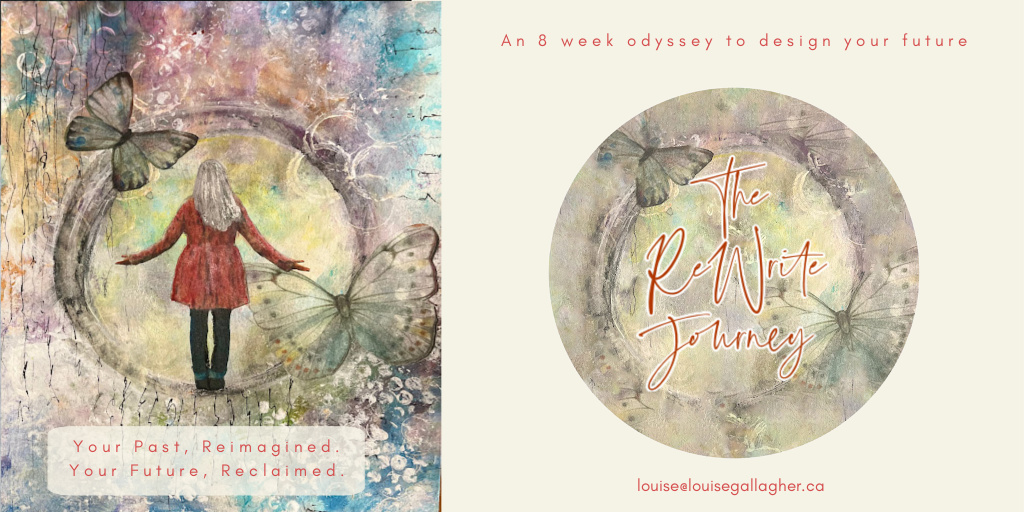
Gratitude is the foundation of so much joy in my life. I am deeply grateful for the seven women who have joined me in this, the inaugral session of The ReWrite Journey: Your Past, Reimagined. Your Future, Reclaimed. The ReWrite Journey is a transformative eight-week odyssey that weaves the wisdom of the past into the tapestry of a future rich with possibility.

The ReWrite Journey offers a sanctuary for women of all walks of life who seek to embrace the vibrant threads of their experience and weave them into a future tapestry, vibrant with the hues of their wildest dreams and richest aspirations.

Mystic Misty Morning

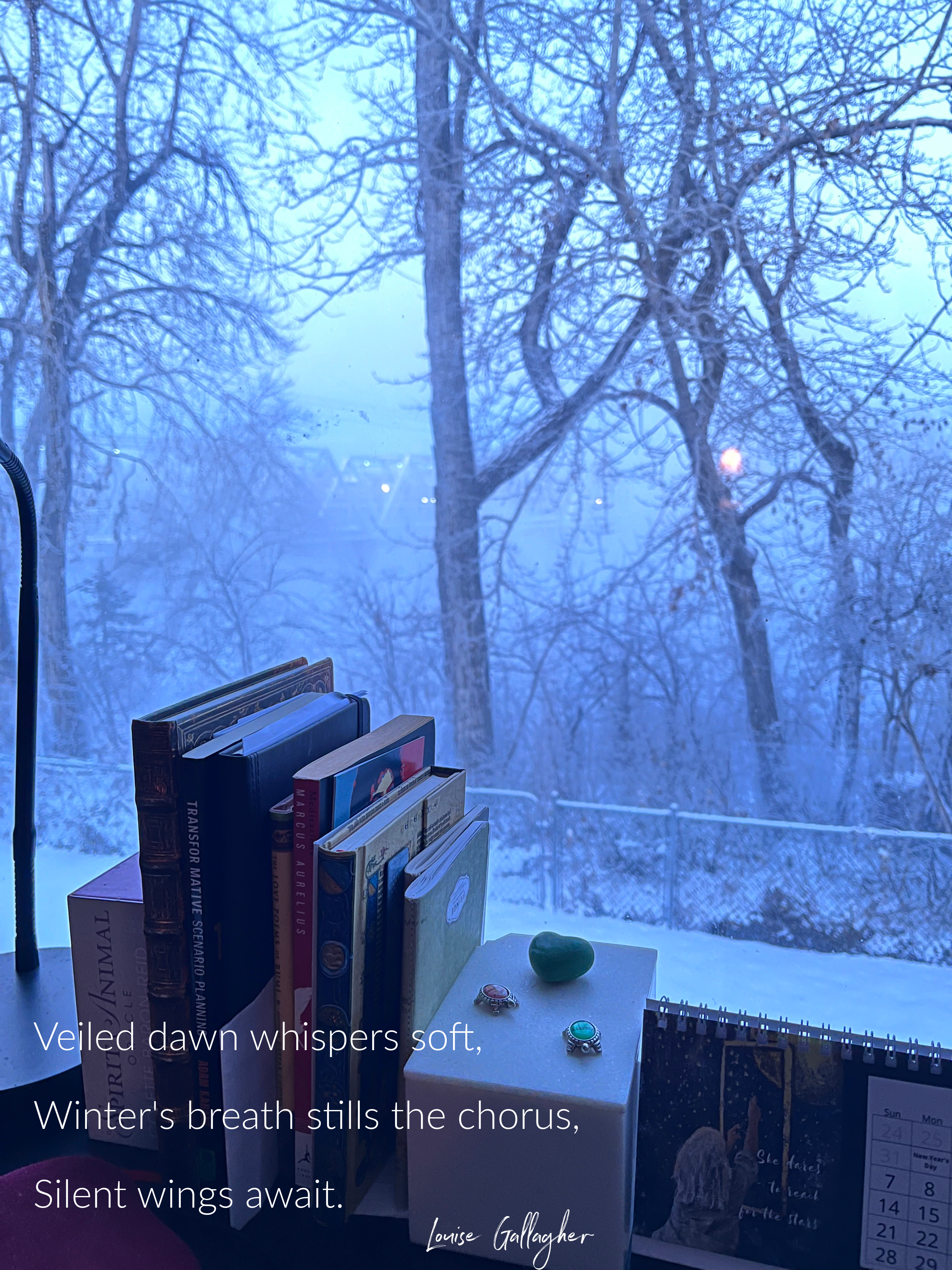
Veiled dawn whispers soft,
Winter’s breath stills the chorus,
Silent wings await.

The world outside is veiled in a mist, a natural shroud rendering the familiar unfamiliar. Beyond my window, trees stand still, their dark branches etched like delicate filigree against the dawn’s pale blue canvas.

Wrapped in the warmth of my shawl, I am seated at my desk, the hum of the furnace mingling with the ethereal voices of Stile Antico’s “Sanctus: Benedictus”—holy and blessed, they sing.

As the morning unfolds, a silent mist glides over the river, rising and swirling like whispered prayers sent to watching angels.

In this quietude, my heart sends out its own prayers:

  • For the safety of all on this chilled day.
  • For the homeless to find sanctuary against the bone-biting cold.
  • For the caregivers, whose tireless efforts are lifelines in the dark waters of despair.
  • For the disheartened, whose dreams and hopes seem to dissipate like morning fog.
  • For wars to cease, and peace to settle softly upon the earth, quelling the violence and awakening awe in every heart.

I pray, too, for a path to peace to unveil itself before war extinguishes our collective breath.

_________________

I am in the midst of a 21-day journey—a course on prayer—chosen as spontaneously as the mist chooses its path each morning.

Prayer was my mother’s refuge, a legacy she passed to my sister, Jackie, who embraced it as naturally as breathing. As for me, prayer felt like an admission of weakness, a legacy of a rigid Catholic upbringing where an omnipresent God watched but seldom seemed compassionate. Vulnerability, I believed, was an invitation for wounds rather than healing.

Yet, as this new decade of my life unfolds, I am driven to challenge such relics of belief. Prayer, I am discovering, is not a weakness but a communion; vulnerability, not an exposure to harm, but an opening to grace.

It’s in the act of surrender that I’m finding unexpected strength. In the willingness to let go of my resistance to question the unexamined tenets I’ve held—not because they serve me, but because their familiarity is a deceptive comfort.

Like the mist that conceals yet reveals, I am learning to navigate through the opacity of my doubts and fears. To trust in the insights that come from not knowing, from being present in the discomfort of exploration.

Change, like the ever-shifting mist, is constant. And in its midst, I find that prayer, too, has found its steadfast place in my life.

Namaste

What if you could be someone else’s miracle?

Have you ever pondered the essence of a miracle? Is it alchemy, divine intervention, or something else that manifests the wonder of dreams coming true, prayers being answered, and wishes fulfilled?

What if the real magic lies in simple acts? Following your intuition to do someone a favour, show kindness to a stranger, or support a friend in need could be all it takes.

What if you could be someone else’s miracle?

Several years ago, while working at an adult emergency homeless shelter, Terry, a client in his 50s, was diagnosed with terminal cancer. His humor, willingness to pitch in, and help out where needed made him well-liked and known by all.

During his final Christmas season, a charity came in to conduct their Christmas Wish List. Terry’s wish was to visit New Orleans during Mardi Gras, not for the party (though he loved to party). For Terry, it was the resilience of the city that called to him. “If New Orleans could come back from Katrina the way it did, maybe if I go there, I’ll be able to come back from this cancer,” he told the young woman who interviewed him for the Wish List.

Touched by his story, she organized with a group of co-workers and friends to raise money to send Terry to New Orleans.

Terry never made the trip, but in her efforts to galvanize community around him, local media became interested in Terry’s story. A few days after an article about Terry appeared in the local newspaper, I received a call from a woman informing me she was married to Terry’s brother, Larry. Terry had been put into care when he was 8. Larry had spent his adult life trying to find his baby brother.

And that’s where the real miracle of Christmas began.

I told Terry about the phone call from his brother’s wife, and five days later, after almost 34 years of searching, Larry and Terry were reunited.

But the miracle didn’t stop there.

Terry had a profound fear of dying alone. In his final moments, it was his long-lost brother Larry who held his hand, a testament to the power of connection and kindness.

And though he never made it to New Orleans, we did hold a Mardi Gras-themed party for him at a local Southern-style pub where over 50 people came to celebrate him and bid him farewell.

It was all a miracle. A miracle that was created by the actions of many people listening to their intuition, compelling them to take action to make a difference in a homeless man’s life.

And, in the end, this quiet, funny, affable man whose life story led him to spend his final years in a homeless shelter was celebrated nationwide. Shortly after his death, Maclean’s Magazine dedicated The Last Page, a monthly feature about notable Canadians who had recently passed away, to Terry’s story.

Truly a miracle.

So, I leave you with this thought: Are you ready to be a miracle in someone’s life? Will you choose to be a force of grace in the world today?

Choose Love. Walk with Grace.

As my husband drops me off at the airport he comments on how early I am for my 11am flight to Vancouver – just over two hours. “It helps me stay calm when travelling,” I tell him.

And it’s true. Rushing only causes my blood to rush faster through my veins, speeding up my heartbeat and my thoughts. None of which helps keep me grounded in the moment, present to my surroundings, embodied within my whole being.

Seated at my Gate, I sit across from a woman in traditional African dress. She looks tired. Doesn’t speak English. I know as she showed me her boarding pass, pantomied, “Here? Yes?” to which I nodded my head in affirmation. I wonder how far she’s travelled. I wonder if her feet will get cold in her open-toed slip-ons. They match her dress and headdress beautifully. They may not match the weather in Vancouver.

I am off to visit my eldest daughter, grandchildren, son-in-love as well as my sister, Anne who lives on Gabriola Island. My youngest daughter flew in yesterday. Anne after breaking her knee-cap in May, developed a blood clot in her leg and cannot fly. Which means, she cannot come to our sister’s Celebration of Life on December 9. It is especially hard as she hasn’t been able to travel since the break, and couldn’t visit Jackie while she was in hospital.

As I travel west, I carry with me memories and thought of my sisters and my brother. My daughter and I were talking about how hard this loss is. And yes, it is. Yet, even though it’s hard, I have the choice to do the hard with grace and in Love. And that is what I do. Choose Love. Walk with grace.

My eldest daughter and I wrote Jackie’s obituary over the weekend. It is strange writing that word, ‘obituary’ in relation to my eldest sister. It is not a word I expected to write beside her name for many years to come.

And that is the crux of it. As it always is. We thought we had more time. More time to savour meals together, laughter, moments of joy, of shenanigans, of communion with the ones we love.

And then we don’t.

It is a lesson in Love. Cherish the ones who are close to us. Shower love all over your path, where ever you go and always, choose to do the hard with grace as your constant companion.

Namaste.

Obituary: Jacquline (Jackie) Marie Louise Trafford

What’s Your Story? Understanding the Power of Our Personal Narratives

My sister remains in ICU though she is slowly gaining consciousness. But, here’s the challenge. I was telling myself a story about how helpless I am, how scared and worried I feel.

That story isn’t creating ‘the more’ I want in my life or in my sister’s healing journey. Which is why this morning, I asked myself, Is this story I’m telling myself creating better in my world today or is it acting as a barrier to my being fully present with and for her journey through recovery? ‘Cause, though I am not powerful enough to change my sister’s health, the story I tell myself about it all can either strengthen or weaken me. And if the story I’m telling myself is leaving me feeling discombobulated (and it was), helpless,or as happens in other situations, like a victim or loser, there is only person who can change it. Me.

Have you ever stopped to ask yourself, particularly in those moments where you’re feeling like the victim of someone else’se bad behaviour or like life is ganging up on you or those you love, “What story am I telling myself about what’s going on?”

Each of us narrates our life’s journey, often casting ourselves in specific roles – the hero, the victim, or even the villain. These stories are more than mere reflections; they actively shape our reality, influencing our emotions, decisions, and interactions with others, as well as how we feel about ourselves..

Our personal narratives are a tapestry woven from our experiences, beliefs, and emotions. They are intricate and deeply personal, often rooted in our earliest memories. These stories provide a sense of identity and continuity, offering a framework through which we view the world and our place in it.

While these narratives can be empowering, they can also be limiting. When we cast ourselves as perpetual victims or unacknowledged heroes, we might find ourselves trapped in patterns of behavior that prevent personal growth. Our stories might justify feelings of resentment, anger, or sadness, holding us back from forgiveness, empathy, or change.

The first step to reshaping our story is recognizing its existence and influence. This requires introspection and honesty. What roles do we often assign ourselves? How do these roles affect our relationships and choices? Are we stuck in a narrative that no longer serves us?

Once we recognize our narrative patterns, we have the power to rewrite them. This doesn’t mean denying our past or our feelings. Instead, it’ involves reframing’s an invitation to reframe our experiences in a way that empowers us. What if, instead of the victim, we see ourselves as survivors or even victors? Or, instead of the overlooked hero, we view ourselves as quietly influential?

The most empowering narratives are those where we acknowledge our agency and potential. They are stories where challenges are opportunities for growth, and where our past doesn’t dictate our future. In these narratives, we are neither solely victims nor heroes but complex individuals capable of change and growth.

When we shift our stories, the world around us shifts too. We start responding differently to situations, engaging more positively with others, and opening ourselves to new experiences. A new narrative can lead to a more fulfilling, connected, and joyful life.

What story do you want to tell about yourself? It’s an important question that can lead to transformational growth as long as you remember that you are the author of your narrative. Someone else isn’t writing your life story for you. You are. And, because you are the author of your story, you have the power to edit, to rewrite, and to change the course of your story.

To change your story, checkout what story you’re telling about yourself and the circumstances in your life today, and then, choose a narrative that empowers, inspires, and propels you toward your best life yet. Because, no matter your age, your story won’t change until you decide to change it.

Episode 40: Dare Boldly – Age is More Than Just a Number

Is age truly just a numerical label? As we accumulate years, it’s impossible not to notice how society’s definition of what it means to be ‘young’ or ‘old’ affects us. The number of years we’ve orbited the sun does more than just increase; it also alters our own perceptions and the perceptions of those around us about age-related expectations. But how valid are these age-related judgments?

As I approach my 70th decade and am writing and talking more about age and aging, I am constantly confronted with societal attitudes towards aging. The adage “age is just a number” is frequently tossed around, yet paradoxically, society at large seems to dismiss this concept in practice. The lack of celebration for the wisdom, milestones and achievements of older adults stands in stark contrast to the fanfare associated with youth. This discrepancy creates needless hurdles that impede the success and contributions of an entire age group.

The truth is, aging should be a cause for celebration, not a source of dread. There’s an inherent beauty in the accumulation of years, a tapestry of wisdom and experience that can only be woven over time. Instead of evading the topic of age, we must confront it head-on, acknowledging that age, in the grand scheme, holds no weight in assessing an individual’s potential or abilities.

Consider the untapped opportunities that lie within the older generation. If we can strip away our entrenched biases and altered expectations, we can unlock a reservoir of potential. Let’s be be bold and audacious! Let’s embrace the myriad possibilities that do not fade with time. Age is a mere chronology; it should never be a barrier to aspirations or accomplishments.

To sculpt a society that celebrates every stage of life, not just those deemed to be in their ‘prime’ we must be willing to carve out space for each of us to live the truth of ‘age is just a number’. If we are to celebrate the spectrum of age in all its glory, then we must encourage everyone to dare boldly, irrespective of the year on their birth certificate. Let’s inspire change where age is not a limiting factor but another facet of our shared human experience. Let’s all, Dare Boldly, no matter our age, in a world where age does not define us.

From The Poetry Circle

We gathered, four of the six women who form the nucleus of this circle, a sacred bond birthed in the tentative days of lockdown. Ali Grimshaw, the poetic voice behind the blog, Flashlight Batteries, has been our unwavering compass, mentor, muse, and cherished confidante throughout these three transformative years of gathering, listening, writing, and sharing.

We hail from across North America. Me, the lone Canadian, in Alberta, the others scattered between Washington State and Alabama. In the quiet moments when one or two are absent, their absence echoes within the circle, a subtle but palpable void. Yet, even in our incompleteness, the muse unfailingly graces us with her nimble wordplay.

Last night, I reveled in the company of my fellow poetry voyagers, letting the words flow like a river unburdened by dams. Together, we wove the tapestry of our verses, sharing the stories that had been etched onto our pages.

Hand in motion, ink streaming, the pen glided across the page as if orchestrated by an invisible poetic symphony, a melody only discernible to my subconscious.

It was an experience, divinely restorative, freeing the spirit from its earthly confines, and fulfilling the soul’s deepest longing.

To those who feel the call of these poetic moments, if your heart yearns to connect its lyrical embrace with other poetic souls dancing, the invitation is open, it’s as delicate as the whisper of a muse’s sigh inviting you to release the words and let the words flow: If the call of poetry beckons to your soul, send me an email, and together, we shall weave verse into the tapestry of our lives.

The List That Will Never Be Written
by Louise Gallagher

There will never be a complete list
of all the moments and places
that have consumed my breath
with awe
just as there will never be
an ending
to love
or the illusion of the moon 
rising 
at dusk
or the life-giving cry
a newborn makes
upon leaving
the safety of the womb.

Why should there be?

In the capturing of every tiny moment
Awe escapes
leaving behind only the cold hard facts
of a life lived
without witness to 
the beauty
of a sunrise stealing
its breath away.

There will never be a complete list
of all the moments and places
that have consumed my breath
as long as I take notice
of the awe
that steals my breath away.

What if we choose to draw closer to one another?

As I sit here at my desk in dawn’s breaking light, wrapped in the warmth of a cozy morning, I watch the cars’ headlights on their daily journey eastward as they cross the bridge from the ‘other side’ of the river to ‘my side’. It’s a familiar scene, but today it symbolizes something more profound. In a world where distant conflicts weigh heavily on my heart and mind, I’m reminded of our innate human tendency to categorize and separate people based on who we are and what/who fits within an often ill-defined set of criteria we’ve never taken time to challenge or questione. We label them as ‘others’ when they don’t quite fit into the same box we do, whether it’s because of their economic status, social background, demographic, or beliefs.

We humans have a knack for dividing people into categories. It’s like we’re wired with an ‘us vs. them’ switch. We judge folks by the color of their skin, their financial situation, or their level of education. It’s not because we want to exclude them, but somehow, it’s more we don’t want to INclude them because we they’re different than us. Unfortunately, this tendency results in our seeing ‘the others’ as separate, distant, not quite part of our group and in severe circumstances, not quite human because of prejudice and dehumanization.

This ‘othering’ habit creates invisible walls of intolerance and exclusion. It stands in stark contrast to the ideals of belonging and acceptance, becoming a major obstacle in building a fair and just society.

Now, let’s be real. Even if you, like me, grew up with parents who encouraged you to walk through life with an open heart and an inclusive nature, you might find that most of your close friends look a lot like you in terms of appearance, faith, and financial background. It’s not a deliberate choice; it just sort of happens.

But here’s the thing: if we genuinely want inclusivity, we need to step outside our comfort zones. We must embrace the vibrant diversity that surrounds us. Sure, it can be uncomfortable, and it might even feel unfair to expect someone to be your “teacher” just because they’re different, with loving tolerance, we can learn to understand, and create space for their ‘different’ to become less different and more… normal. The fact is, the only way to break through those invisible barriers to diversity is by opening doors to the unknown and walking through our ignorance to understanding.

To move beyond ‘othering,’ we must confront our discomfort head-on. We need to actively seek out experiences and perspectives that challenge our assumptions. It’s not always easy, but it’s undoubtedly worthwhile. This is how we develop greater tolerance, understanding, and empathy for others, especially when global events might lead us to misplace our discomfort through prejudice, racial intolerance, and, in some cases, violence.

In a world where divisions and prejudices often run deep, I’ve come to understand that recognizing and combating our natural inclination to ‘other’ people is essential. By consciously embracing diversity, seeking different viewpoints, and addressing our own biases, we can make significant progress toward a more inclusive and compassionate society.

Ultimately, to create a world where everyone experiences belonging, we must work together to break down the invisible walls of ‘othering’ and construct bridges of understanding and empathy. Regardless of our differences in appearance, education, faith, or skin color, we all share this planet. Why not live on it as one human race, where everyone belongs?

We’re all in this world together. What if together, we choose to make this moment the one where we come together to build bridges of tolerance and understanding, rather than walls of animosity and aggression?

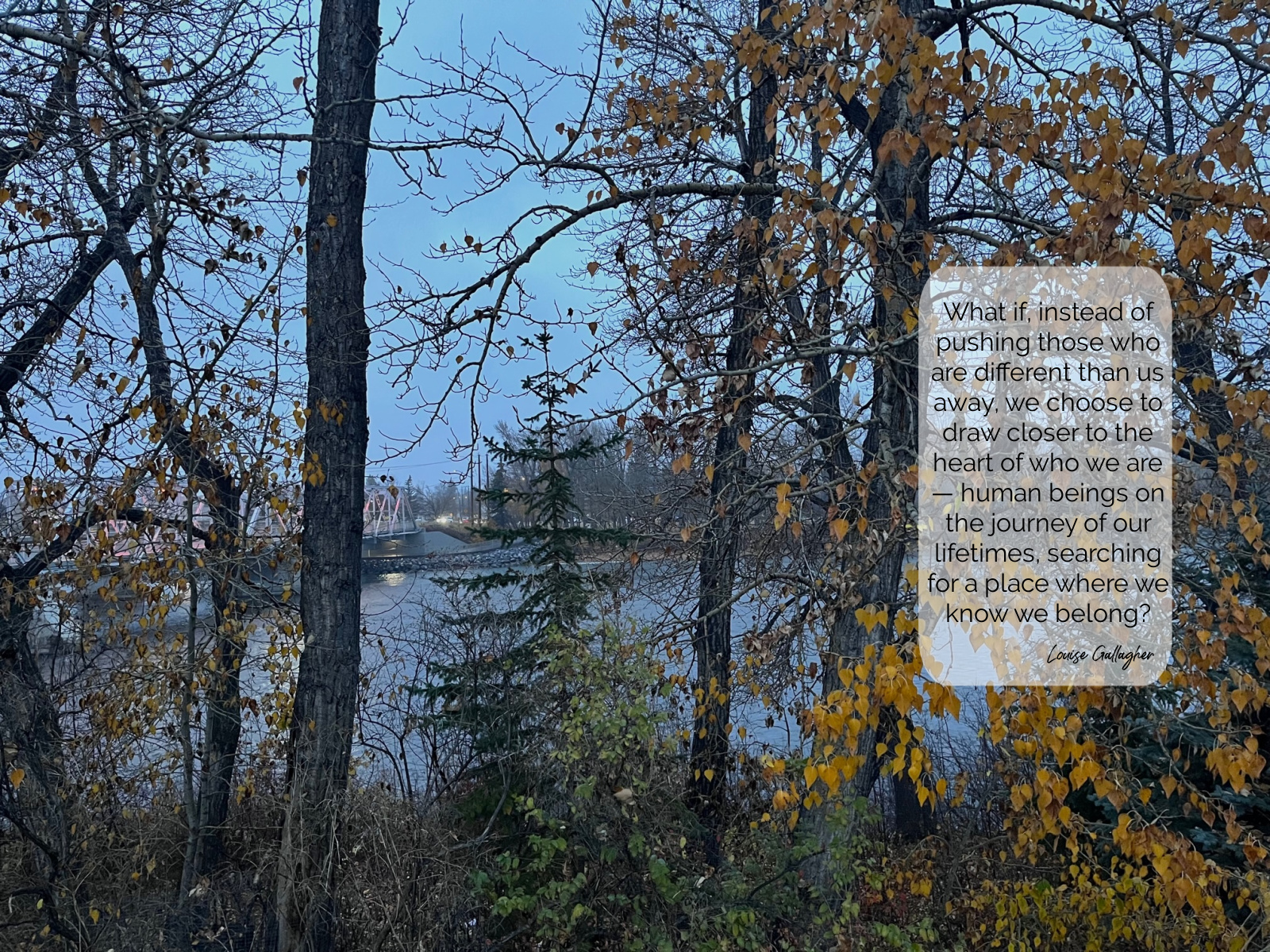
What if, instead of pushing those who are different than us away, we choose to draw closer to the heart of who we are—human beings on the journey of our lifetimes, searching for a place where we know we belong?

Is Your Personal Baggage Allowance Exceeded?

At the beginning of his book, “The Power of Regret: How Looking Backward Moves Us Forward,” author Daniel Pink shares a quote from American essayist and novelist, James Baldwin:

“Though we would like to live without regrets, and sometimes proudly insist that we have none, this is not really possible, if only because we are mortal.” – JAMES BALDWIN, 1967

When I worked at an adult emergency homeless shelter, I had the privilege of sitting with numerous individuals as they traveled the final steps on their life journey. Every one of them expressed the desire to leave this world unburdened by regret. Mostly, their regrets stemmed not from the homelessness they’d experienced, but the broken relationships with the ones they loved.

In some cases, as the end neared, they reconciled with lost family members. In others, the lost ones wanted nothing to do with their wayward family member. I have often wondered if the lost ones regret their decision.

When my mother took her last breath three years ago, I felt regret’s sting upon my psyche. There were so many things left unsaid, wounds unhealed, forgiveness neither asked for nor given.

I had to do something with those regrets. Surprisingly, it was my deceased mother who helped me most.

For about six months after she died, a vision of her visited me regularly (I know that sounds airy-fairy, but it’s the only way I can explain what happened). My mother didn’t appear as the quiet, reserved, compliant woman I knew but as the spirited Holly Golightly, Audrey Hepburn’s iconic character from “Breakfast at Tiffany’s.” Other than dark hair and eyes, about the only other trait they shared was a certain inability to identify with other people’s feelings.

In life, my mother insisted she could do no wrong, and insisted she didn’t. As her youngest daughter, I insisted she could and did. And that was the chasm that lay between us.

It was my therapist who gave me the key to healing that relationship in the afterlife. “Some relationships,” she said, “can’t be healed until the other person is gone.”

And then, my mother was gone.

And then, she appeared one day while I lay in the bath and told me she was sorry for not being a better mother. For not being able to see me in life through the lens of love, not regret.

She also told me I didn’t have to keep adding bubbles to my bathwater in the hopes she wouldn’t see my naked body. “I’m spirit,” she told me. “I can see right through you.”

As in life, I ignored her and kept pouring in the bubbles.

According to Pink, regret is not only healthy and universal; it is a valuable self-development tool. It can spur us on to learn from the past, grow in the present, and lighten the load of what we carry into the future.

Harnessed wisely, regret can help us do and create better on our life journey.

For me, my regrets around my relationship with my mother stemmed from my desire for having ‘the perfect mother.’

Being a mother, I realize there is no such thing.

Yet still, I wanted my mother to see and know me, not as that ‘bratty’ child I used to be, but as the wise, compassionate woman I strive to be today.

Over the course of the months she came to visit me from the afterlife, I realized my greatest regret was that I was neither very wise nor compassionate in my interactions with her.

To quote Dan Pink:

“Regret makes us human
Regret makes us better”

To let go of my regret and ultimately to grow as a human being, I had to choose to undo and reframe my regret so that I could forgive myself and let go of any remaining vestiges of regret I held about my mother. Fuelled by the grace of forgiveness, I am able to make wiser, more loving decisions today.

Every moral’s journey of life is marked by choices, paths taken, and roads left unexplored. Regret is an integral part of this journey, a bitter-sweet reminder of our humanity. However, it doesn’t have to weigh us down. My experience with my mother taught me that regrets can be reframed and even embraced to foster growth, healing, and compassion. Whether it’s a relationship with a parent, friend, or anyone else, we have the power to transform our regrets into wisdom. By doing so, we create space for forgiveness and love, not just for others, but for ourselves.

In the end, perhaps that’s the greatest lesson regret offers: a chance to become better, more compassionate human beings.