Mystic Misty Morning

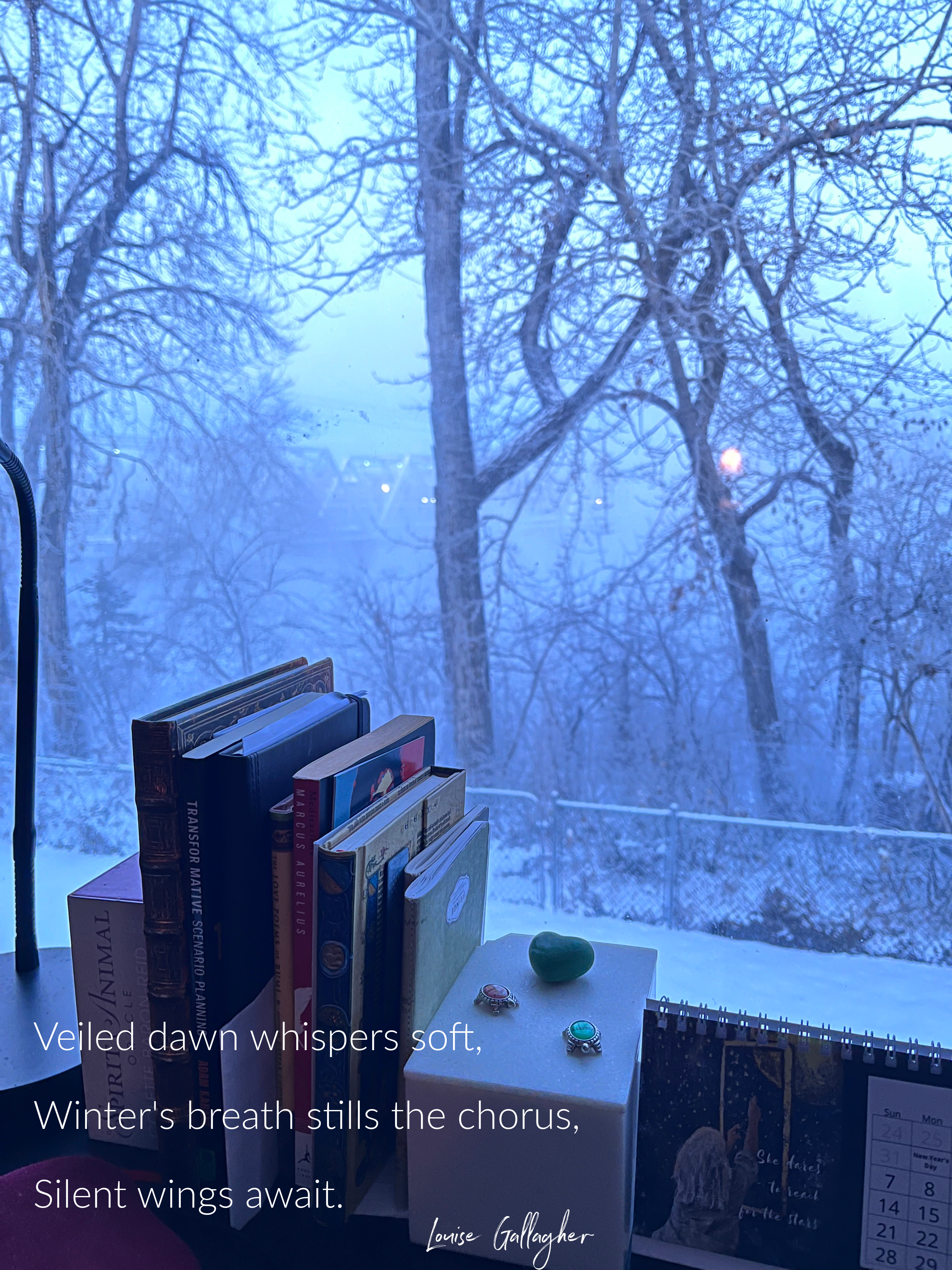
Veiled dawn whispers soft,
Winter’s breath stills the chorus,
Silent wings await.

The world outside is veiled in a mist, a natural shroud rendering the familiar unfamiliar. Beyond my window, trees stand still, their dark branches etched like delicate filigree against the dawn’s pale blue canvas.

Wrapped in the warmth of my shawl, I am seated at my desk, the hum of the furnace mingling with the ethereal voices of Stile Antico’s “Sanctus: Benedictus”—holy and blessed, they sing.

As the morning unfolds, a silent mist glides over the river, rising and swirling like whispered prayers sent to watching angels.

In this quietude, my heart sends out its own prayers:

  • For the safety of all on this chilled day.
  • For the homeless to find sanctuary against the bone-biting cold.
  • For the caregivers, whose tireless efforts are lifelines in the dark waters of despair.
  • For the disheartened, whose dreams and hopes seem to dissipate like morning fog.
  • For wars to cease, and peace to settle softly upon the earth, quelling the violence and awakening awe in every heart.

I pray, too, for a path to peace to unveil itself before war extinguishes our collective breath.

_________________

I am in the midst of a 21-day journey—a course on prayer—chosen as spontaneously as the mist chooses its path each morning.

Prayer was my mother’s refuge, a legacy she passed to my sister, Jackie, who embraced it as naturally as breathing. As for me, prayer felt like an admission of weakness, a legacy of a rigid Catholic upbringing where an omnipresent God watched but seldom seemed compassionate. Vulnerability, I believed, was an invitation for wounds rather than healing.

Yet, as this new decade of my life unfolds, I am driven to challenge such relics of belief. Prayer, I am discovering, is not a weakness but a communion; vulnerability, not an exposure to harm, but an opening to grace.

It’s in the act of surrender that I’m finding unexpected strength. In the willingness to let go of my resistance to question the unexamined tenets I’ve held—not because they serve me, but because their familiarity is a deceptive comfort.

Like the mist that conceals yet reveals, I am learning to navigate through the opacity of my doubts and fears. To trust in the insights that come from not knowing, from being present in the discomfort of exploration.

Change, like the ever-shifting mist, is constant. And in its midst, I find that prayer, too, has found its steadfast place in my life.

Namaste

The Three Sisters

The 3 Sisters Germany – Circa 1970s

As laughter and warmth filled our dining room on the evening of December 30th, it felt as if Christmas had come again just for us.

Minus the gift exchange and the date, it truly had. My brother-in-law, Jim, had spent the actual holiday visiting one of his daughters in another city, and we had faced our first Christmas since Jackie’s passing without either of them. Deciding on a Re-do with Jim was an important step in our healing, a loving gesture to bridge the gap death had left in our family circle.

The night of our Re-do, 13 people gathered around our dining room table. We cheered, toasted, and shared stories about life, travels, and the people who make it all worthwhile. With Jim present, Jackie’s absence was even more profoundly noticeable than at our dinner on Christmas night.

During the evening, a regular guest at our family and friends dinners revealed that he often rearranged the name tags I’d placed around the table to ensure he would be sitting next to Jackie. This simple yet touching act was a beautiful testament to Jackie’s quiet and caring influence.

Jackie was often the one I placed next to guests who were new to the circle. She had a natural talent for making newcomers feel at home. She could draw anyone into laughter and conversation, making them feel as though they’d been part of our group for years. This was just one of her many gifts.

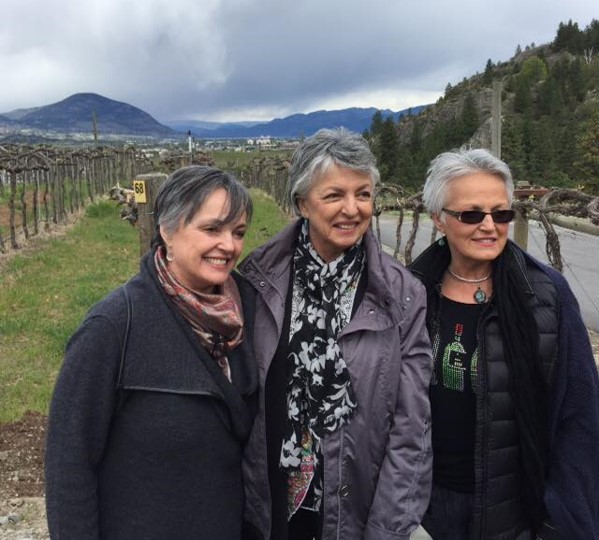
Naramatta – April 2015

As a sister, Jackie was a rock for both Anne, my middle sister, and me. Dependable, loyal, and an exceptional listener, she could be forthright in her opinions, yet her feedback was always delivered with love.

Jackie’s aversion to making waves probably explained why she got along with everyone – truly, everyone.

I was once likened to a Jack Russell Terrier for my tenacity, but Jackie was the St. Bernard of our family. She was the rescuer, offering just the right mix of comfort and support. At the reception after her memorial, many shared stories of her kindness, like greeting new neighbors or bringing food to those in need. My husband, C.C., was often a beneficiary of her thoughtfulness, especially when I was away.

Anne, our middle sister, is akin to a Cockapoo – friendly, loyal, and a lover of people and animals. Always ready for an adventure but equally content with quiet moments, Anne embodies a fierce loyalty. But once trust is broken, it’s a challenge to rebuild, yet, even when I did something to get us both in trouble when we were younger, Anne would always defend me, often taking the blame for my missteps to protect me from the ire of our parents.

Gabriola Island – 2018

Throughout the years, the loyalty and tenacity of our ‘alter-ego-dogs’ played a role in keeping our bond together. We loved one another fiercely, even in those moments where we were driving one another crazy. It is our sister-triangle that has been a cornerstone of my life throughout the years. And though Jackie was the eldest, once we aged-out of the big sister-little sister dynamics and what I called her bossy-stage, she always treated me as an equal.

Our bond involved the usual sisterly phone calls, sometimes triangulating our relationships as one or the other of us vented about something the other had done.  Yet, we always returned to the one thing that sustained us — a deeply lived commitment within each of us to keeping our sister-connection alive, no matter the miles or age that separated us.

It’s just Anne and me now. A dynamic duo rather than triangle. Still, Jackie’s essence permeates our interactions, providing a touchstone to keep our sisterly bond alive. While new stories of Jackie’s antics won’t be created, her memory continues to weave through our lives, reassuring us that she watches over us, like a guardian St. Bernard.

We held a Christmas dinner Re-do last Thursday. Neither Jackie nor Anne were at the table, but both were unmistakably present in my heart. it’s where they always are. A sisterly-bond that can never broken.

I am grateful.

I am blessed.

What if you could be someone else’s miracle?

Have you ever pondered the essence of a miracle? Is it alchemy, divine intervention, or something else that manifests the wonder of dreams coming true, prayers being answered, and wishes fulfilled?

What if the real magic lies in simple acts? Following your intuition to do someone a favour, show kindness to a stranger, or support a friend in need could be all it takes.

What if you could be someone else’s miracle?

Several years ago, while working at an adult emergency homeless shelter, Terry, a client in his 50s, was diagnosed with terminal cancer. His humor, willingness to pitch in, and help out where needed made him well-liked and known by all.

During his final Christmas season, a charity came in to conduct their Christmas Wish List. Terry’s wish was to visit New Orleans during Mardi Gras, not for the party (though he loved to party). For Terry, it was the resilience of the city that called to him. “If New Orleans could come back from Katrina the way it did, maybe if I go there, I’ll be able to come back from this cancer,” he told the young woman who interviewed him for the Wish List.

Touched by his story, she organized with a group of co-workers and friends to raise money to send Terry to New Orleans.

Terry never made the trip, but in her efforts to galvanize community around him, local media became interested in Terry’s story. A few days after an article about Terry appeared in the local newspaper, I received a call from a woman informing me she was married to Terry’s brother, Larry. Terry had been put into care when he was 8. Larry had spent his adult life trying to find his baby brother.

And that’s where the real miracle of Christmas began.

I told Terry about the phone call from his brother’s wife, and five days later, after almost 34 years of searching, Larry and Terry were reunited.

But the miracle didn’t stop there.

Terry had a profound fear of dying alone. In his final moments, it was his long-lost brother Larry who held his hand, a testament to the power of connection and kindness.

And though he never made it to New Orleans, we did hold a Mardi Gras-themed party for him at a local Southern-style pub where over 50 people came to celebrate him and bid him farewell.

It was all a miracle. A miracle that was created by the actions of many people listening to their intuition, compelling them to take action to make a difference in a homeless man’s life.

And, in the end, this quiet, funny, affable man whose life story led him to spend his final years in a homeless shelter was celebrated nationwide. Shortly after his death, Maclean’s Magazine dedicated The Last Page, a monthly feature about notable Canadians who had recently passed away, to Terry’s story.

Truly a miracle.

So, I leave you with this thought: Are you ready to be a miracle in someone’s life? Will you choose to be a force of grace in the world today?

What Grief Has Taught Me

On June 20th, 1995, as my father exhaled his final breath surrounded by family, I felt Love’s profound presence envelop the room. In that sacred moment, my father’s long-held anger, described by a friend as sometimes being like the meow of a pussycat, but more often the roar of a lion, seemed to dissolve into nothingness. Yet, in the wake of his passing, a storm of family drama ensued, igniting a fire of anger and angst amongst us, his four children. This turmoil, further fueled by the loss of our brother a year and a half later, continued to churn and ripple through our lives.

  • Through grief’s lens, I learned that anger is not the echo of the soul but a human reaction, transient and fleeting.
  • Grief also unveiled a deep truth — how easy it is to prioritize anger over surrendering to Love.

In 1997, the passing of my brother was shrouded in familial discord, casting a lengthy shadow of anger over the love I held for him. It took years to see beyond that shadow, to remember him without the filter of resentment.

  • Grief illuminated the possibility of loving someone despite the pain their actions caused you and your loved ones.
  • It also reminded me of the importance of embracing our emotions, no matter how uncomfortable. In the discomfort of our feelings, Love finds space to bridge the divide between solace and discord.

As 2020 dawned and Covid’s shadows loomed, my mother embarked on her final journey. Every day for her final two weeks, my sisters, daughters and kept a vigil by her side, sharing the watch through her final nights. In a moment of solitude, as my sister left the room in the early morning hours to grab a cup of tea, she quietly slipped away. And though she left this world in her chosen way, quietly and without a fuss, we grappled with the idea of her dying alone.

  • Grief taught me that death operates beyond the realm of human desires and needs. It is a passage that can only be taken by those who embark on the journey beyond life.
  • Grief also reaffirmed that while death waits in the wings, life demands for us to live it fully and passionately. It’s our duty to make every moment count, letting death take care of its own inevitability.

Recently, as my sister Jackie teetered on the delicate line between life and death, I found myself yearning to pull her back, to alter her destined path.

  • Grief gently reminded me of my limitations as a mortal, that the power to alter another’s journey is not within my grasp.
  • Grief has also taught me that life is a sacred covenant we enter into at birth, emerging into this world with cries and yearnings, longing for the safety of the womb that nurtured us from conception. We cannot turn back time, any more than we can return to the womb’s sanctuary.

Ultimately, in this journey through valleys shadowed by grief, I’ve discovered profound truths about life, love, and the human spirit. Every loss carved a deeper space in my heart, a space where sadness and love coexist, teaching me the resilience of the human soul.

Grief, with its unyielding tides, has been my relentless teacher, guiding me to a place of deeper understanding and compassion. It has shown me that in the midst of our deepest sorrows, there lies the potential for the greatest growth.

As I continue to navigate this unpredictable path, I carry with me the lessons learned, the love cherished, and the strength found in the heart of grief. For in the end, it is not just about learning to live with loss, but about allowing grief to teach us how to live more fully, love more deeply, and embrace each fleeting moment with the reverence it deserves.

Morning Pages: The Journey of Self-Recovery

In March 2007, I embarked on a journey as a blogger, committing to daily writing, seven days a week. This discipline persisted for about five years until life’s complexities – work, responsibilities, and the inevitable “busyness” – prompted me to reassess. Gradually, my posts became less frequent, transitioning from a Monday-to-Friday routine to a more sporadic ‘when inspiration strikes’ schedule.

However, in recently having retired from the workplace, I’ve realized the importance of consistency and discipline, not just in writing but in life. Since stepping away from formal employment, I’ve missed the structure of having to turn up, pay attention and be accountable, not just to myself but to others. For me, ‘a job’ fosters focus and self-discipline in my life. This realization was driven home during my recent solo writer’s retreat in Ireland, where I successfully reintroduced a structured routine into my life. Since returning, I have not touched the project I began on that retreat. It’s become clear: it’s time to embrace this structure once again.

Now, in my defence, amidst the horrific natural and man-made devastation, violence and wars unfolding around the globe, my sister’s health struggles have been a profound emotional journey. She remains in ICU, still in a deep sleep following major surgery over a week ago. My daily visits, standing by her bedside, sharing messages of love and support, have been emotionally draining. This exhaustion has clouded my thoughts, dampening my drive and creativity.

I’ve come to accept that I cannot alter my sister’s path. My role is to hold space for the best for her while continuing to live and create meaningfully in my own life. In this period of emotional turmoil, I confess to succumbing to self-pity. This isn’t self-reproach but a candid acknowledgment, a form of ‘tough loving-kindness’ to break free from the despair and worry engulfing me.

Which is why, in the darkness of an unseasonably warm November morning, I have chosen to mark this day as my turning point. It is time to reconnect to the practices I know create better in my world.

To begin, this morning I revisited a long-abandoned practice: my morning pages, inspired by “The Artist’s Way” by Julia Cameron. This practice of free-hand writing three pages daily was once a cornerstone of my creativity, which I had set aside when I began blogging. Today, as part of my recovery process to embrace peace, calm, balance and love in my daily living, I recommit to this and other nurturing practices.

What about you? What practices have you abandoned that once lifted and supported you? Where in your life is there a need to reconnect and recommit to self-care and activities that bring you joy and strength?

What if we embark on this journey of rediscovery and renewal together?

I’d love to hear your thoughts and ideas in the comments section below. Your words inspire me and open gateways for us to create better in the world, together.

Namaste

What’s Your Origin Story?

Superheroes have one. So do major brands like TOMS, IBM, NIKE, and charity: water. And so do I – an origin story. But there was a time when mine wasn’t serving me well, so I changed it. My origin story.

Years ago, on a personal development retreat in the heart of British Columbia’s Valhalla mountain range, I found myself reflecting by a serene lake. It was there I realized that the origin story I had been telling about myself wasn’t just inadequate; it was harmful. In my narrative, I was the victim of my parents’ poor planning, an unwelcome disappointment born the wrong sex and on the wrong day. Although I often shared this story as a ‘funny anecdote,’ the truth was far from amusing. Each retelling was like picking at the scab of a deep, painful wound.

To heal, I needed to rewrite my origin story into one that celebrated my journey and supported my life’s path. I had to craft a narrative that I loved, for this story lived in my mind, sustained solely by my own recounting.

The significance of origin stories cannot be overstated. Look at any superhero or successful brand, and you’ll find their vision, mission, and values anchored in an origin story. This narrative is more than a backstory; it shapes their identity, highlights their strengths and weaknesses, and charts their destiny. Their origin story is not just a tale of the past; it’s a guiding force for all they do.

As we navigate the journey of our lives, the profound impact of our personal narratives cannot be overstated. Unlike fictional superheroes, our lives aren’t scripted with predetermined strengths, weaknesses, and destinies. This lack of a pre-written script is not a deficit but a remarkable opportunity. It’s our chance to author our beginnings, redefine our shaping forces, and understand the currents that have carried us to our present.

There was a time when my origin story was a narrative of sorrow, marked by disappointment and loss. It weighed me down. But with care and intention, I rewrote my story into one that echoes how cherished and valued I am in this world. This new narrative celebrates my existence, setting the stage for a life brimming with abundance, passion, and joy. It underpins my raison d’être and, in good times and in challenging times, it provides direction, purpose, and focus.

Your origin story is far more than a mere collection of past events. It’s the foundation upon which your current identity rests, a rich source of insights reflecting your deepest values, fears, and aspirations. Engaging with this narrative isn’t just about revisiting the past—it’s about reclaiming it. You’re seizing the pen that drafts your life story, acknowledging that every challenge, every joy, and every lesson has played a part in shaping the extraordinary person you are today.

Now, think about your origin story; the story you tell about the times and circumstances into which you entered this world. Does it elevate you? When you recount it, do you feel like a superhero in your own life? Does it inspire you to leap with joy and dance as if no one’s watching?

If not, what if.. you wrote your own origin story? What would it be?

Then, take the leap. Write it. Create the narrative that lifts you, that transforms you from a passive character in your life story to the hero you were always meant to be.

What’s Your Story? Understanding the Power of Our Personal Narratives

My sister remains in ICU though she is slowly gaining consciousness. But, here’s the challenge. I was telling myself a story about how helpless I am, how scared and worried I feel.

That story isn’t creating ‘the more’ I want in my life or in my sister’s healing journey. Which is why this morning, I asked myself, Is this story I’m telling myself creating better in my world today or is it acting as a barrier to my being fully present with and for her journey through recovery? ‘Cause, though I am not powerful enough to change my sister’s health, the story I tell myself about it all can either strengthen or weaken me. And if the story I’m telling myself is leaving me feeling discombobulated (and it was), helpless,or as happens in other situations, like a victim or loser, there is only person who can change it. Me.

Have you ever stopped to ask yourself, particularly in those moments where you’re feeling like the victim of someone else’se bad behaviour or like life is ganging up on you or those you love, “What story am I telling myself about what’s going on?”

Each of us narrates our life’s journey, often casting ourselves in specific roles – the hero, the victim, or even the villain. These stories are more than mere reflections; they actively shape our reality, influencing our emotions, decisions, and interactions with others, as well as how we feel about ourselves..

Our personal narratives are a tapestry woven from our experiences, beliefs, and emotions. They are intricate and deeply personal, often rooted in our earliest memories. These stories provide a sense of identity and continuity, offering a framework through which we view the world and our place in it.

While these narratives can be empowering, they can also be limiting. When we cast ourselves as perpetual victims or unacknowledged heroes, we might find ourselves trapped in patterns of behavior that prevent personal growth. Our stories might justify feelings of resentment, anger, or sadness, holding us back from forgiveness, empathy, or change.

The first step to reshaping our story is recognizing its existence and influence. This requires introspection and honesty. What roles do we often assign ourselves? How do these roles affect our relationships and choices? Are we stuck in a narrative that no longer serves us?

Once we recognize our narrative patterns, we have the power to rewrite them. This doesn’t mean denying our past or our feelings. Instead, it’ involves reframing’s an invitation to reframe our experiences in a way that empowers us. What if, instead of the victim, we see ourselves as survivors or even victors? Or, instead of the overlooked hero, we view ourselves as quietly influential?

The most empowering narratives are those where we acknowledge our agency and potential. They are stories where challenges are opportunities for growth, and where our past doesn’t dictate our future. In these narratives, we are neither solely victims nor heroes but complex individuals capable of change and growth.

When we shift our stories, the world around us shifts too. We start responding differently to situations, engaging more positively with others, and opening ourselves to new experiences. A new narrative can lead to a more fulfilling, connected, and joyful life.

What story do you want to tell about yourself? It’s an important question that can lead to transformational growth as long as you remember that you are the author of your narrative. Someone else isn’t writing your life story for you. You are. And, because you are the author of your story, you have the power to edit, to rewrite, and to change the course of your story.

To change your story, checkout what story you’re telling about yourself and the circumstances in your life today, and then, choose a narrative that empowers, inspires, and propels you toward your best life yet. Because, no matter your age, your story won’t change until you decide to change it.

Embracing Resilience in the Midst of Uncertainty

Recently, I’ve felt disoriented and unfocused, a state spurred by my eldest sister’s critical condition in intensive care. It was a challenging period, filled with uncertainty and worry.

However, as the skies cleared this morning, so did my mind. Although my sister remains in the ICU, still reliant on life support, there are glimmers of hope. Each day brings small improvements, a testament to her resilience, and I find solace in each small sign of her recovery.

In moments like these, I’m reminded of John Lennon’s poignant words, ‘Life is what happens while you’re busy making plans.’ Indeed, life’s unpredictability often disrupts our carefully laid plans. But, as Saint Benedict wisely advised, the key is to ‘Begin Again.’

Embracing this philosophy, I’m moving forward, starting with updates for those who inquired about my calendars. They’re now available for shipping. You can order through PayPal HERE or, for eTransfer orders, please send me an email specifying the quantity, and I’ll forward an e-invoice. Thank you for your support!

Returning to ‘regular programming’, I had an interesting conversation during my morning walk in the park. A fellow dog-walker commented on how well I wear my age. It sparked a thought about age and aging and what each age looks like. Firstly, I honestly don’t know what 70 ‘should’ look like. The second is: Is there a ‘right’ way to age? Can we age ‘wrong’?

The fact is, age is not like going out to by a new pair of shoes which, if they don’t fit, you try another size. Age is simply a measure of our time on this planet, nothing more, nothing less.

What truly matters is how we infuse our moments with life and love. Each word, deed, and thought should reflect this. At any age, living life fully means embracing self-love and kindness. This self-love creates ripples of positivity, impacting the world around us.

So, here’s a loving thought I hope you carry forward into your day today — No matter what life brings, cherish and celebrate every moment. Every moment is an opportunity to begin again, to love yourself fully, to appreciate the road before you, with its many bumps and twists and turns, its darkness, shadows and light, and, to embrace each day, each step, each moment, with love, joy and gratitude.

Namaste

5 Essential Steps to rebuilding a habit

We often embark on a journey to develop new habits with a surge of motivation and determination. However, maintaining that initial enthusiasm is a battle against time and circumstances. It’s surprisingly easy to fall out of a habit, yet reclaiming it demands not just intention, but decisive action.

Habits, whether they are centered on fitness, reading, meditating, or any other discipline, are grounded in routine and consistency. However, life is anything but predictable. An unexpected project at work, illness, or even a change in our daily routine can disrupt our carefully cultivated habits. The problem isn’t just the break in routine, but how we perceive it. If you’re like me, you might beat yourself up for slipping, adding a layer of guilt to the challenge of restarting.

The longer we stay detached from our habit, the larger it looms in our minds, turning into a daunting task we feel less equipped to tackle as time passes. This is where the power of action comes into play.

The Power of Action

To reconnect with a lost habit, action is key. It’s not enough to simply wish to get back on track; we need to set clear, manageable goals and take tangible steps towards them.

  1. Start Small: If you were used to running 5 miles every day and took a break, don’t aim for the 5 miles on your first day back. Start with a mile, or even a brisk walk. The objective is to reignite the routine, not to set a record.
  2. Schedule It: Allocate a specific time for your habit. The act of scheduling makes your commitment more tangible and prioritizes your habit amidst other activities.
  3. Remove Barriers: Identify what’s stopping you. If you’re struggling to find time for reading, try audiobooks during your commute. For exercise, choose a time when you’re least likely to be disrupted.
  4. Celebrate Small Victories: Each day you successfully engage in your habit, no matter how small the effort, is a victory. Celebrate these moments. They are significant milestones on your journey back to consistency.
  5. Don’t Give Up on Yourself: You are worth fighting for. Rebuilding the path back to a habit can feel hard, often because of all the negative chatter that clutters up our brains about it’s all our fault, or we’re such a loser yada, yada, yada. Be gentle with yourself. Be kind to yourself. Be loving, in your thoughts and actions. Know, each step you take towards reclaiming your habit is a ‘small significance’ that will build into a big difference.

Falling out of a habit is easy and human. However, reconnecting with that habit is not just about desire; it’s about action. By starting small, scheduling your habit, removing barriers, and celebrating your successes, you can rediscover the path to your goals. Remember, the journey of a thousand miles begins with a single step. Let that step be yours today. And don’t forget, take that step in loving kindness with yourself.

Epidsode 41 – The BOW Generation — Bolder. Older. Wiser

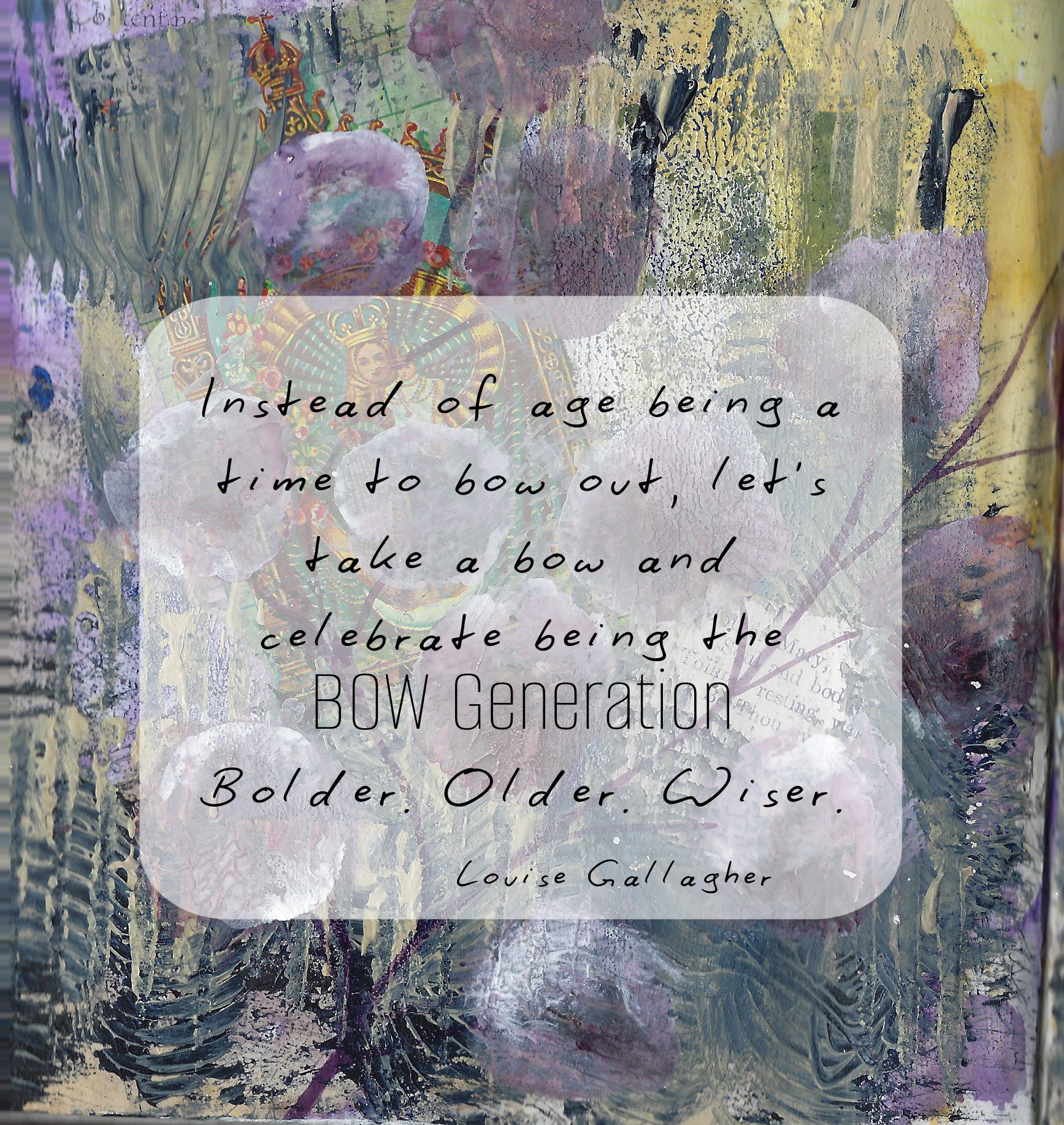
I am of that demographic often referred to as ‘Baby Boomers,’ I believe it’s time for a rebrand. Let’s step into the spotlight as the ‘Take a BOW Generation’ — a community that celebrates being Bolder, Older, Wiser.

Society often paints aging as a decline, a burdensome journey of diminishing strength and fading vitality. While it’s true that our bodies evolve with age, this narrative overlooks the profound capacity we have to contribute, regardless of the years under our belts. We can still enact change, influence perspectives, and champion new ideas that dismantle the myth of age as a harbinger of only limitations.

As members of the BOW Generation, we have the power to defy these stereotypes. Let’s assume center stage in our lives, taking a bow for our accumulated triumphs and persisting in our drive to contribute and foster transformation. In doing so, we pave the way towards a world that’s fairer, more just, and equitable for all. A world that doesn’t see aging as a barrier to contributing but an integral part of changing the world.

Because, let’s face it, age is only a barrier if we make it one. Fact is, age is simply a measure of time. As yesterday’s post suggested, the significance of the adage ‘age being just a number’ lies not in the figure itself, but in the experiences and legacies we craft with it.

I invite you to be part of the BOW Generation movement. Celebrate the boldness, the wisdom, and the insights that come with age. Share these gifts joyfully, contributing to a world that embraces every stage of life. Let’s leverage our passion, talents, and unwavering commitment to excel and create impactful, lasting contributions.

I hope you join me. I hope you too — Embrace your age. Share your wisdom. Make your mark.

Today, and every day, let’s be Bolder, Older, and Wiser together.

I hope you’re with me — I’m not ready to bow out yet. I am ready to take a BOW for all I’ve achieved. I hope you are too! I hope you are ready to keep stepping into the spotlight of all that’s yet to come with an open heart and mind!

Namaste