The Lunch Date

Processed with VSCO with au5 preset

The last time I saw him he was not looking good. I feared for him. Knew there was not a lot I could do to change the trajectory of his life and so I prayed for him that he find comfort and ease no matter where he was.

And then, he turned 65.

“My old age pension kicked in,” he told me on Friday when he dropped by my office for a visit, and to take me to lunch.

Originally he was coming for a coffee. When he called me in the morning to see if I had time for a visit, “I have lots of exciting things to tell you,” he said, I looked at my jam-packed day and didn’t see how I could do it.

But, I know this man. To try to set another date would not work. He wouldn’t call the next day as promised, not because he wouldn’t want to but rather, because he lives in the immediacy of now and to put him off would translate to, ‘she doesn’t want to have a coffee with me’.

I had no means of getting in touch with him. He doesn’t have a cell phone, nor a home phone.

He is homeless.

A veteran of the streets, he has lived for over 20 years at Calgary’s largest single’s homeless shelter.

In the end, he was late for our coffee date but in time for lunch.

“Do you want to walk over to the coffee shop at the corner?” I asked him when he arrived.

“Why don’t I buy you lunch instead?” he queried.

“You don’t have to buy me lunch” I replied.

“I want to,” was his simple answer.

Leaving his backpack in my office, we walked down the block to a cafeteria style restaurant in an office tower down the block.

Together we examined the food selections as staff and some customers checked us out. We made an interesting couple. A grey-haired woman in business attire and an older, visibly homeless, man.

When he’d arrived at my office I was relieved to see how much better he was looking. When I complemented him on his fresh haircut and trim mustache, he told me about turning 65 and getting his monthly cheque.

“I’ve got a counsellor working on getting me housed,” he said with a laugh. “It’s a slow process but I’m in no rush. I kind of like it where I’m at.”

Where he’s at is sleeping every night on a mat in the shelter’s Intox area, all his possessions in a backpack or stuffed inside a small locker. There are two keys to his locker. He has one, staff of the shelter the other.

I have known him for over 12 years. One of the first artists to come to the art program I started at the shelter when I worked there years ago, he is incredibly talented and vulnerable. Gentle of heart, a questing mind, he is proud. Sensitive and single-minded.

Once, while driving him to a play he was involved in he told me he wasn’t going to go through with it.

“No one understands,” he told me. “And they definitely don’t care.”

As we drove and I listened to his story of how the Director didn’t ‘get him’ and the whole thing about being involved in the play was futile, I asked him to tell me the lines he had written for his part in the play.

“I am a father, son, brother, uncle, friend. I am a carpenter, an artist, musician, poet. I laugh. I cry. I smile. I bleed. Which of these are diminished because I am human?”

“You will never get anyone to understand if you do not speak up,” I told him. “And if they do not hear your story, how will they learn to care?”

He continued on with that play and went on to perform in many others, including in the off-Broadway production of Requiem for a Lost Girl in New York City.

He almost chose to not go to New York too. He was having challenges getting his passport and wanted to give up on the whole adventure. I went to the passport office with him and supported him as he completed the process. That trip was one of the highlights of his life.

We all want to quit sometimes. To say, ‘why bother?’.

What this man has taught me is that fear is always present. When we reach out to others, when we step into our fears, into the broken places of our lives, the fear is still present, but it is diminished in our not being alone. In that place, anything can happen, including miracles.

On Friday, a man bought me lunch.

We chatted and laughed together. I showed him pictures of my daughters and grandson. He shared stories of his world today. Of his ‘trap line’, the regular route he travels everyday to collect bottles for extra cash. About those who save bottles just for him, about the restaurants along his route who make sure to separate the bottles from the trash and those who don’t. He talked about old times and his hopes for the future, his dream of once again being involved in Requiem for a Lost Girl should it be remounted. And the possibility of getting a home.

In sharing time together I was reminded once again how fortunate and blessed I am to do the work I do, to have had the opportunity to walk this path with so many beautiful hearts.

I had lunch with a man of Friday.

He reminded me of how beautiful the world is, no matter what side of the street we are on, when we walk together and share the stories of our lives.

I am grateful.


Where Plans Fail and Planning Matters

A week ago today, I took on a role I was not anticipating.

The Executive Director at the family emergency shelter and housing provider where I work left and I was asked to step in as Interim Executive Director.

It was not in my plan, but as Eisenhower is often quoted as having said (it wasn’t actually him but that’s another story), every plan is only as good as the first encounter with the enemy. Planning is essential, but plans are useless (that one is actually attributable to Eisenhower – he just said it a bit differently).

And that’s the thing about taking on such a big leadership role. While I am only taking on the role while the Board searches for a new ED, I don’t know how long that will take, and have committed to staying for as long as it takes to get the right person in place. Thus, I must plan accordingly.

Which is kind of exciting.

Because here’s the deal, several years ago I thought I’d enjoy the challenge of being an ED. At that time, as I explored opportunities I realized that my life vision and work vision weren’t aligned if I took on such a role.

When I joined this agency, I came because I wanted the last segment of my formal working career to be in a place where I was passionate about the mission, the people and the work. And I am.

I believe we can end child and family homelessness if we work together, build the necessary infrastructures and housing and stay focused on ensuring everything we do is bringing us closer to our goal.

I also believe we can’t do it ‘for’ the children and families experiencing homelessness. We must do it ‘with’ them, or as is often said by those with lived experience, “Nothing for me without me”.

To suddenly find myself in a place where I have authority and responsibility to move the bar closer to achieving our goals is exciting. Especially when I know I am surrounded by people I admire, trust and am in awe of their passion and commitment, are walking with me as we take each step on this journey.

Today, when I go into my office, I am taking with me a blank canvas to hang on the wall. The canvas represents where we are today, in a space where all things are possible and not all things are necessary.

It is the tension within that duality that excites me.

As we move forward over the next few months, the canvas will become a reflection of our hopes and dreams, desires and creations. What won’t be visible are the things we’ve chosen not to put on it. The things we determine don’t fit, don’t belong, don’t bring us closer to realizing our shared vision of ending child and family homelessness.

A week ago today I took on a new role. I believe it was the right thing to do.

Change requires stability and trust. I came to the organization to end my career on a high note. I found that opportunity. With this change in my focus, I get to play a leadership role in making a great organization even greater.

I’m excited and grateful.

Excited to take on a new challenge where I feel my contributions are making a difference to people and community.

Grateful for the Board’s trust in me and for staff’s willingness to walk with me as we explore all that we can do together to support children and families in crisis and all that we can do as a community to end child and family homelessness.

Namaste.

A hammock on a busy avenue

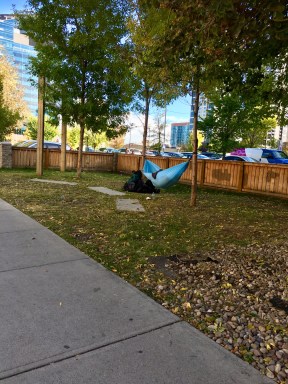
Yesterday, as I was leaving the family emergency shelter where I work, I noticed a hammock strung between two trees on the grassy area beside the parking lot across the street from our building.

There was someone in the hammock, maybe two. On the grass beneath it was a big black plastic bag and a suitcase. I could only assume the occupant’s worldly possessions.

It struck me that if that hammock was placed in someone’s backyard, its presence would evoke thoughts of comfort, coziness, lazy days of summer spent idly swinging back and forth.

Yesterday, the sight of it made me feel sad.

To have your whole world in a shopping bag. To hang your hammock, your home without a home, in a tree along a busy downtown avenue. To lie in your hammock hoping no one steals your belongings.

It just feels so sad to me. So distressing. So disturbing.

In the homeless-serving sector, we are faced every day with people whose lives are in disarray. Whose best efforts have lead them to the place they never wanted to be. Homeless.

And, just when you think you’ve seen or heard it all and encountered every aspect of this condition called homeless, you see something you never imagined.

In this case, a hammock strung between two trees on a busy downtown avenue.

I wondered about the person or persons in that hammock. What made them choose that spot? How did they get there? What resilience do they have that gave them the forethought to carry a hammock? How will they get home?

I thought about calling the DOAP team, a mobile response unit in Calgary that is operated by Alpha House to support individuals on the street who are in distress.

But the individual(s) in the hammock weren’t in distress. And they weren’t causing a disturbance.

I chose to let them be. To not disturb the delicate ecosystem they had created in that spot.

And still, the image of that hammock strung between two trees haunts me.

It is so intentional in its placement yet also a contradiction. Hammocks belong in backyards, not on busy downtown avenues.

I wonder if it will be there this morning when I arrive at work.

I wonder if in stringing that hammock between two trees they found respite from the hostile environment that a city can represent to those experiencing homelessness.

I hope the night treated them well.

I hope they came in for a meal. That between our shelter staff and the staff at the adult singles shelter next door, they found what they needed to be safe.

And if the hammock is still there, I will check with staff to see if they have already checked on their welfare. Because a hammock on a busy downtown avenue is not a sign of blissful peace.

It’s a sign that something is amiss in someone’s life.

Yesterday, I missed the sign and chose to walk on by.

Today, I’ve awoken.

Namaste.


Can you let go of fear?

Photo by Ev on Unsplash

Some time ago, I was working with a group of formerly homeless individuals to create a video about their experiences of being housed and the difference having a home made in their lives.

One of the participants, I’ll call her ‘Gladys’, when asked, “What did you fear most when you were homeless,” replied without hesitation. “Dying on the streets.”

Someone else responded with, “I’ll die and no one will find me for days.”

Another, “No one will know I’m gone.”

Gladys is living in an apartment now. In her new way of being she is supported by people who understand her fears, and who believe that with compassionate care, she can thrive in community.

Her thriving will not look like yours or mine. It will be different. But then, mine is different than yours and yours is different than someone else’s. It is our differences that create the vibrancy of our communities. It is our diversity that builds strength into the intersections of our lives.

There is possibility in our differences. There is connection.

In my life, I have done many things and learned many lessons. Some, I’d like to keep. Some I can live without. What I’ve learned most though is that all things make a difference. It’s up to me to determine what kind of difference I want to make through my experiences. And while the past is a good teacher, it can also be a lodestone.

It all depends on what I do with my experiences.

My experiences make me who I am today, but my past does not define me. I do.

When our experiences lead us to believe the past is a closed loop of repetition, repeating again and again what happened then, we close off possibility of better.

When we use our experiences of the past with the intent to inform our actions for the better today, we can create better, we can make a difference and make our world a loving kind of different place for everyone.

There are people living on our streets today, and in our emergency shelters, who have given up on believing there is another way. They live with the constant fear that dying on the streets will become their future.

In the streets they walk everyday, they have lost sight of possibility. They have lost hope for a new way of being present in the world.

There are people living in our communities today, who have given up on believing there is another way. They live with the constant fear that without high fences, without holding on to what they have, they will be unsafe in their homes and in their community.

In the streets they walk everyday, they have lost sight of possibility. They have lost hope for a new way of being present in the world.

To be present in this world in new and loving ways, we must see this world in new and loving ways.

When I see it through eyes of fear, I know fear.

When I breathe into possibility, when I open myself up to allowing possibility for another way to arise, my world becomes a reflection of what I want to create more of in the world around me.

We all know fear. We have all been touched by change and its constant hammering away at the walls of our comfort zones demanding we learn to stretch and find new moves to take us away from where we are into that place where anything is possible. To do that, we must let go of holding onto to what we know and free ourselves to let go of what we fear.

Just as Gladys is learning to let go of her fear she will die on the streets, the possibility exists for each of us to let go of our fear the future will be a repetition of the past. In letting go, we set ourselves free to create the kind of world our children will be free to live in without fearing the past will never end.

To find a new way of being present in the world today, we must we let go of believing the past is the only door we can walk through to get to a better future.

____________________________

Photo by Ev on Unsplash

Is Housing a Right?

I spoke at GlobalFest Human Rights Forum, an annual one week forum on Human Rights issues presented by UNA Canada, Calgary Branch.

It was the kick-off event. The subject matter for the evening was, Shelter.

One of the questions everyone was asked to consider was, Is housing a right?

Harvey Voogd, one of the presenters, spoke of how Medicaid was once not part of our Canadian landscape. How it wasn’t universally available. And now it is. Now, we don’t even question its necessity in the lives of all Canadians.

That’s the future I see for housing, he said.

I hope he’s right.

Imagine that future.

A future where every Canadian has access to safe, secure and affordable housing that meets their cultural, spiritual, physical and everyday needs.

Housing that is not insecure.

What an amazing future that would be.

I think about what we see today at the shelter where I work and in shelters across this country. Housing insecurity, like food insecurity, income insecurity, is debilitating. The energy needed to chase after resources to keep your family housed is exhausting.

For families in housing insecurity, getting ahead doesn’t mean going back to school or starting your own business, or getting a promotion.

It means juggling priorities like food on the table and school supplies for your kids with the need to keep a roof over their head.

It means having to decide between sending your child to school with a lunch, or having dinner on the table for when they come home.

It means not insuring your possessions to be able to afford bus fare for the month or gas in your car to get to your job on the other side of the city where public transit doesn’t run, or takes two hours each way to get there.

It means having to rely on neighbours and family for childcare and after school-care or perhaps leaving your children at home alone because you’re on the bus trying to get to, or from, a job that just pays enough to cover the rent.

Housing insecurity does not come with peace of mind or breathing room in your bank account in case of an emergency.

It does not include room to send your child to a tutoring program to help strengthen their math or language skills in school.

And it definitely doesn’t come with room to take them to the Zoo or a movie or the Science Centre where you can spend time together, learning and growing and laughing and playing being a family.

Housing insecurity is a constant struggle to make distant ends of a stretched thin bottomline expand to meet monthly commitments that never seem to be completely balanced.

Housing insecurity makes life hard. It makes it difficult to dream and believe you can make your dreams come true.

Housing insecurity is something parents try desperately to hide from their children. But when housing insecurity turns into homelessness, there is no more hiding. No more trying to pretend it’s not happening.

For children, the reality of housing insecurity turned into the loss of the home they knew can be terrifying. Horrific.

For children, housing insecurity that brings them to a family emergency shelter is not a ‘holiday’ or a camping trip as some parents desperately try to sell the notion of being in shelter to their children. It is a complete disruption of their daily lives, their sense of belonging, their need for security.

Housing is a right.

And every child needs it. Deserves it. Must have it to be able to learn and grow and develop their minds so that when they grow up, housing insecurity isn’t a part of their journey.

One day, I hope we get to a future where the right of every child to a safe home is a reality.

Namaste.

___________________________________________

There are five more events scheduled for GlobalFest Human Rights Forum.  Click HERE for info.

How the Plan to End Homelessness is failing children.

Launched in 2008, Calgary’s 10 Year Plan to End Homelessness focused on providing housing to stop the year over year growth the city had been experiencing in homelessness since 1992 when the first Homeless Point-in-Time Count was held.

Since 2008, almost 10,000 people have been housed with approximately 80% of those retaining their housing or experiencing a successful exit from homelessness.

The majority were adults, not children.

The Plan focused on adult single homelessness. Initially on the high acuity, high chronicity individuals who needed wrap-around intensive supports in housing. As the architects of the Plan began to realize that there were a large number of low-acuity but chronically homelessness individuals trapped in shelter, they shifted to housing for that demographic.

There was no plan for children and families.

Still isn’t.

And that’s who the Plan has failed. The children.

On Friday, I had to meet with the shelter management team of the family emergency shelter where I work to talk about what actions we could take over the long weekend to create safety for everyone. Staff and families.

With over 40 families in a shelter designed to accommodate 27, and no staff available over the long weekend to be able to open our satellite emergency shelter, we had to do something.

We went through the list of families. Talked about ideas, who we could call, what programs we might be able to access to find relief, at least for the weekend.

I called the domestic violence shelters. They were full.

We called everyone we could think of, asking for help. For ideas on how we could weather this long weekend and provide the families we’re sheltering, and our staff, safety. There was no help.

Desperate for solutions, we had to tell the single pregnant moms unaccompanied by children, and the couples who were pregnant but without children, that they had to leave. They could go to the single adult shelters who have room, their numbers are down. Not ideal, particularly when you’re pregnant, but we had to create safety for the children.

We had to tell the single pregnant mom without accompanying children who called that we had no room. She would have to find an alternative.

It was extremely hard on staff. As one staff told me, I can’t recall a time when we’ve ever sent families away.

But they understood. We had to keep the children safe. Over-crowding, particularly with families already in crisis, is not good for anyone.

The recent Point-in-Time Count of Homelessness showed a continued steady decline in adult single homelessness.

Family homelessness, they found, wasn’t growing.

It isn’t falling either, and, while on April 11th, when the Count was conducted there were only 27 families in the shelter, it has steadily been climbing since May to reach a recent high of 44 families, or a total of 155 individuals, in shelter.  We are doing more with less, and it is the children who will suffer.

Where is the Plan to end child and family homelessness?

Where is the focus on the children who will one day grow up to be adults? Without interventions now, without addressing the trauma and toxic stress they are facing in their everyday young lives, the research is clear. They are more likely to grow up to become homeless.

It was a tough day Friday. I am acting ED and Director Programs. As I told the staff when we met, I trust your decisions. First and foremost, we must create safety for the children.

__________________________________________

Please Note:  These are my personal reflections, opinions and questions. They are not a statement of the agency for whom I work.

Perhaps some of my frustration, and fear, comes from the call I received late Friday night. A single mother with a 3-year old child seeking shelter. She phoned the media line posted on our website and got me. I have nowhere to go, she said. Can I come there?

I gave her the phone number of the main shelter. I didn’t have the heart to tell her we were full. I’m sure the staff won’t either because no matter what, they will always find room for the children.

_________________________________________________

Photo Source:


Children and homelessness: When hugs are not just hugs

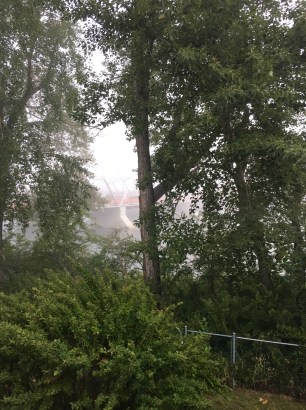
The world is misty this morning when I awaken.

An hour later, the mist rises and the world around me becomes visible.

Yet for that moment in time, it appeared to be gone. Vanished.

Like life. We travel along and suddenly encounter an unknown, a situation that doesn’t make sense, a darkness we’ve never known before.

We struggle to make sense of it. To grasp it’s meaning. To get through it.

We feel like there is no up or down. That everything is turned inside out.

That what we knew no longer is true. That who we are no longer fits.

And then, one morning we awaken and the world is right side up again.

We see the sun. Smell the flowers. Hear the sounds. And we are at peace again. Relaxed. Content with our place in this world.

Experiencing homelessness is like being in the mist. There is no sense of relief in site. No up or down. Just the great abyss of loss and despair that envelops you in its massive all-encompassing fog of hopelessness.

The fog of homelessness does not rise as quickly and effortlessly as the mist this morning.

It has staying power. Tenacity.

For children, that fog can change their entire lives. It can close off pathways to resiliency and well-being, leaving them stranded on islands of cognitive disabilities, poor impulse control, susceptible to drugs, abuse and more. It can circumvent clear-sightedness with its constant blocking of the view outside. The view beyond a family emergency shelter’s doors. The view beyond this place called homeless.

At the family emergency shelter where I work, children walk through our doors everyday. Confused. Angry. Lost, they follow their parents to this place they don’t understand, unsure of how to respond to the loss of the world as they knew it in this new world they do not know.

It is challenging. Hard. Confusing.

Supporting children through a familial experience of homelessness is vital. They need to be taught tools that build their resiliency. Tools that help them positively cope with their feelings. Tools that help them interact in a communal setting in ways that create less stress, less turmoil.

Last week, as I stood in the dining room helping staff manage dinner, a young boy came up to me and without a word gave me a big hug.

I was surprised, a little uncomfortable but in the moment thought, “How sweet.”

Later, in talking to one of our fmily support workers she was telling me of the challenges this young boy faces with understanding appropriate and inappropriate touching.

He doesn’t understand personal boundaries, she told me. Part of what we are attempting to do is to teach him what it means to have personal space and how to respect our own, and others. We need to help him understand boundaries so that he doesn’t randomly go up and hug strangers and find himself in unsafe situations.

It was like a fog lifted.

I understood.

When that young boy had hugged me, my surprise was based on my discomfort that a child I do not know would just walk up and hug me. I wasn’t sure how to respond. I wasn’t sure what the hug was all about but because I have a worldview that sees children through the lens of, “They do the sweetest things and hugs are sooo cute,” I saw his hug as ‘sweet’.

Framed in the context that he does not know or understand the use of personal boundaries or the need to ask permission to hug first, I can see that my lens was fogged up with my misunderstanding. Because of my frame, I saw him as expressing how grateful he was for the dinner he just had, or for having a place like the shelter to come to, or just that he was friendly.

In actuality, his hug was an expression of his lack of understanding of boundaries, and a deep need for attention and affection, which he will strive to get wherever he can, even from strangers.

And therein lies the challenge. To support this young boy in his early childhood development, teaching him healthy boundaries, and how to be safe in this world, is more affirming than accepting inappropriate hugs.

In the fog of my lack of understanding of the situation, I didn’t know how to respond in ways that would best support him in his development.

Out of the fog I understand the importance of stepping back from my worldview to see into the heart of what so many of the children we see at the shelter experience — a world of chaos, crisis, stress and turmoil.

A world they do not understand and will do anything possible to make sense of if only so that the fog will lift and they will feel less frightened, alone, scared.

And while it may feel like the best thing we can do is to give them all a hug, it’s not.

The best thing we can do is to build a safe container around them in which they can learn to build resiliency, healthy boundaries and powerful ways to be in this world. That way, no matter where they live, when the fog of homelessness lifts, they have the tools they need to live rich and fulfilling lives. A world in which they connect on deep and appropriate levels with the people around them. A world in which hugs are not an expression of your attachment issues but rather, an expression of your capacity to connect in healthy ways to the world around you.


Dinner at the Inn.

Photo by Jaco Pretorius on Unsplash

The first sitting is for families with infants.

There are three of them. Three mothers. Five children. One child is celebrating his 2nd birthday.

I wonder about celebrating a birthday in a homeless shelter. About the memories built. The one’s lost.

I wonder how the mother keeps up such a brave and loving face. How she manages to smile and love-on her two infant sons so beautifully in such crisis.

I do not ask.

It is not my place to do so.

I am there to help shelter staff manage the chaos that is dinner-time at the shelter.

We are understaffed. Over-capacity. Summer holidays. Sick time. Maternity leaves. And an unprecedented number of families seeking shelter.

In a building designed to accommodate 27 families, we have not been under 30 families throughout July. One night we had 40 families in shelter. That’s unprecedented.

At the same time, we are giving the 3rd floor shelter space a Big Refresh, painting it to be a more calming and supportive environment. Less institutional. More welcoming.

It’s a week long exercise to paint each of three shelter areas. The second floor was completed two weeks ago. We’ve moved onto the third. Which means the families staying on one side of the third floor are being sheltered every night at our external emergency space in the basement of Knox church throughout this week. Next week, the families on the other side will pack up and move to Knox.

It is not ideal. But we need to ensure the shelter space is renewed and clean and intentionally designed to promote healing through its environmental look and feel.

It was scheduled now because July is generally a quieter month. We didn’t know it would get this busy.

Yesterday morning, at a leadership meeting, one of the team leads talked about the chaos of dinner-time. Of trying to feed over 100 people in an hour to ensure families get nutritional meals as well as are able to get to where they need to be on time.

We’re constantly short-staffed, a team lead said.

How can I help? I asked.

Come to dinner!

Who could refuse such an invitation?

Which is why I ended up helping supervise mealtime with the team.

I was mostly just an extra body trying to keep children from racing out of the dining room without their parent(s).

Mostly, I stood in awe and watched shelter staff manage children and parents and plates of food and glasses of milk and water, wipe up spill-overs, catch plates before they hit the floor and answer the questions of the volunteers who came in to serve the meal and make lunches for the next day.

In the face of crying children, laughing children, children who would not sit and eat and children who wanted to hang off the gate installed at the entrance to the doorway to keep children from wandering out and walking out onto the busy avenue, as has happened twice in the last month, the staff are engaged. Caring. Compassionate. Kind. They share fist pumps and pick up children and carry them around as they make them laugh and help mothers navigate strollers and tote bags and coax unruly youngsters who don’t want to eat, or don’t like salad, or would rather have juice than milk.

It is, in many ways, a typical family dinner scene with young children.

Parents trying to get a child to eat more than one bite. To drink their milk. To not bounce up and down in their booster seat. To not fight with a sibling.

It’s dinner at family tables the world over.

And then, it’s not.

Because this is an emergency family shelter. A place of crisis. Of high anxiety and feelings of loss, uncertainty, fear, confusion. Of young minds developing, seeing and experiencing in a place young minds struggle to comprehend.

It is a communal space. Meals are in shifts. Twelve tables. Five chairs at each table. Families with young infants first. Knox families second so they can get on the bus at six. Second floor next. And then the remaining families on the 3rd floor in two more shifts. Each family called down via radio as tables become free.

There is no time to linger. To talk about the day’s happenings. To share stories that last more than a few moments.

This dinner time is exactly one hour and fifteen minutes long, broken up into fifteen minute segments.

Because once the families leave, the volunteers clean up, do the dishes, finish off sandwich making and get everything spruced up for the next day.

They too need to get home to families and dinner tables.

The kitchen staff need to get the prep work done for the next day and the shelter staff need to ensure families are where they’re supposed to be before the night shift turns up.

I helped in the dining room last night.

I left feeling tired. Humbled. Grateful.

Grateful the shelter is there to help families in crisis. Grateful for the amazing staff who care so deeply. Grateful to be part of such an amazing team.

Namaste.

___________________________________

Photo by Jaco Pretorius on Unsplash


The General and The Gangs

“They call me General.”

I am standing on the pavement in the parking lot beside the homeless shelter where I work.

It is the last Saturday morning of Stampede and the Kinsmen Club of Stampede City are serving up their annual pancake breakfast for guests of the shelter, and anyone who wants to drop by.

There’s no long line-up of blue-jean wearing, cowboy hat toting folk snaking around the block.

This breakfast attracts a different kind of folk. These are the people who live on the margins. The one’s who don’t tote designer bags and jeans but carry instead a less desirable label. Homeless.

Like the man in front of me.

Chiselled jaw. Hollowed out cheekbones. Dark-almost-black piercing eyes. He stands straight. Tall. Proud.

He tells me of his life. Of growing up on a Reserve and Residential School. Of spending the last four months out of prison, the longest stretch he’s ever managed to stay on the outside, he says.
It’s the booze, he tells me. As long as I don’t drink, I don’t get in trouble.

He got the name General in prison. It’s more a mark of his position. Or at least the one he once held, in a gang.

Gangs aren’t good, he mutters. I’m glad to see there aren’t any here this morning.

He tells me of losing too many friends. Of dodging too many bullets.

It sounds horrific, I say.

It is, he replies.

And then he shrugs. But what can you do? It’s about survival.

I look around at the fifty or so people seated at the tables lining the pavement.

They are all trying to survive. Trying to find their way.

And I watch the children play. They are running amongst the tables. Chasing each other. Laughing. Being kids.

It is concerning when children and adult single’s experiencing homeless mix together.

Too many drugs. Too many harsh realities edging up against a child’s developing mind, body, spirit.

This morning is calm. Everyone is enjoying the sunshine. The breakfast. The feeling of community.

Sometimes, this parking lot beside the shelter isn’t so peaceful.

Drug deals. Drug doses. Overdoses.

We are in the Beltline area of the city. Our family shelter bracketed by two emergency adult single shelters.

Their guests are also welcome at this breakfast. As are people from the community, though not many from outside the homeless community come.

There’s the limo driver who drives into the parking lot, parks his car at the far edge and walks over for breakfast.

There’s the guy in his souped up flashy blue vehicle who parks in the laneway and unfolds his muscled body out of the driver’s seat. I wonder if he’s just come back from the gym and is looking to load up on pancakes, eggs and sausage.

And the guy who walks his bike into the parking lot, a big black dog lumbering along behind him.

One of the Kinsmen tells me how this is his favourite breakfast of Stampede.

Everyone is so grateful, he says. They all say thank you. They are all so appreciative.

I look around at the gathered crowd. At the man with whom I’m speaking.

Humble. Proud. Wanting to find a better way to get through this life.

Like all of us, they are trying to make sense of their world.

Their struggles are great. It’s not just about making ends meet. They struggle to put an end to the past that haunts them, their keeps them stranded on the margins, struggling to find another way through this world that isn’t marked by poverty, lack and the hopelessness that seeps in with every breath.

There are no gangs this Saturday morning. I am grateful.

Not just for the children’s sake. For all of us.

Will you choose compassion?

I had an OpEd published in our local newspaper on the weekend. It was about homelessness and choice.

There were many voices of support. Of people applauding me for my words and insight.

I like feeling connected to people who agree with me. It’s immensely human and makes me feel good!

But what about those who wrote in to disagree? Who believe, even though I wrote that homelessness is not a choice, it’s a lack of choice, a lack of resilience, a lack of many things — that homelessness is a choice. That if people just got jobs and cleaned up, their lives would be all better.

In the face of their words, I don’t feel so connected.

Their words cause me despair.

Their view of the world causes me consternation.

In the face of their differing worldview there is a part of me that would really just like to call them names, tell them they’re wrong, tell them to ‘get a life’.

Yet, their views have as much right to be heard as mine. Their views are equally as important to the conversation as mine because in their words the truth of the world according to their view rings true.

What will I choose?

Will I choose to condemn and complain?

Or will I choose compassion.?

Will I listen to understand, not to judge?

Will I create space for common ground, rather than a battleground?

In those moments of dissent, finding compassion, acting with integrity, being present is vital.

Because if I lash back, if I choose to discount or ignore their voices, then I am creating a world where us versus them is the norm. Where my voice is the only voice that matters to me and they can damn well go… blah blah blah.

Bottomline, when I respond from a place of condemnation, I am contributing my worst, not my best.

To understand another’s point of view, to find common ground, we must stand with open mind and heart. We must listen deeply without judgement and be willing to be vulnerable.

To be vulnerable, we must choose compassion.

Namaste.