Gossamer Dread

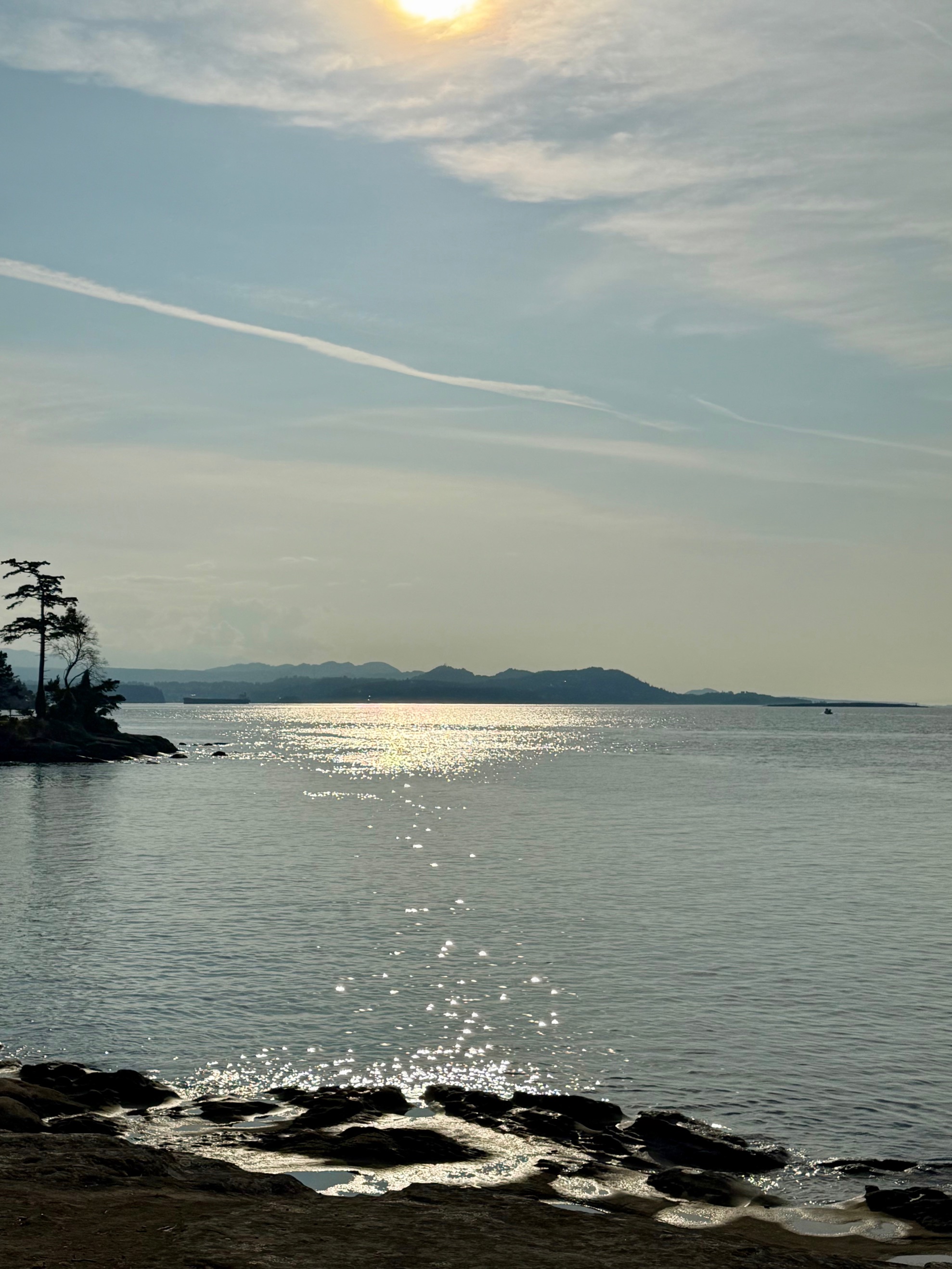
When my daughters were young and we’d spy the sun shimmering on the water, I would make up stories about the Sun Fairies who danced and played on the water’s surface, leaping and spinning in the pure, absolute delight of being warmed by sunlight and refreshed by water.

As I sat on the rocks at the ocean’s edge, the Sun Fairies danced and I fell under the spell of their enchanting song.

I wonder sometimes, how do we hold onto the magic we see through a child’s eyes? How do we treasure those moments when the wonder they see inspires us to let go of the heaviness the world sometimes brings? How do we fall from despair into the awe and delight, the mystery and the miracles of everyday?

When will we ever learn, war does not restore, it kills? Peace is not built on destroying the ‘others’ we deem unworthy of living? And, silencing the guns does not bring peace if our body – heart, belly, mind – still holds onto the belief that we were right to kill another to make our own peace in the world? When will we ever learn?

I sat at the water’s edge and watched the Sun Fairies dance and felt the ebb and flow of the tide calling me to let go of fear, to embrace the gentle power of hope, and to finally understand that true peace begins within, flowing out like these shimmering waters to embrace all beings.

Lost in these thoughts, the muse whispered sweet tantalizing urges to write it out. With grateful heart, I accepted her gift.

Gossamer Dread
by Louise Gallagher

I wrap my mind
in gossamer threads
woven
full
of dread
dripping
doom
falling
like bombs tumbling blind
from darkened skies
shielding the no-see-ums
buzzing
in my head.

Did you cower deep
below
London’s darkened streets
crumbling
above
your head
dreading
the next bomb?

Did you fear, eyes shut
tight
against the sky
raining death
in the night
as the world slept
and children
cried and
mothers pleaded
for a future they could not see
defenseless
against the bombs
tumbling blind?

When will we ever learn?
Our humanity is not immune
to war.
Where Does Your Voice Find Refuge?

The news remains bleak. World peace feels elusive. History echoes with the clang of wars waged by those who crave land, power, control, dominance. Consensus crumbles beneath the weight of age-old conflicts, each side fighting to shape the world in its own image. I’ve wrestled with these heavy thoughts, searching for a flicker of hope in what often feels like overwhelming darkness. The struggle feels relentless.

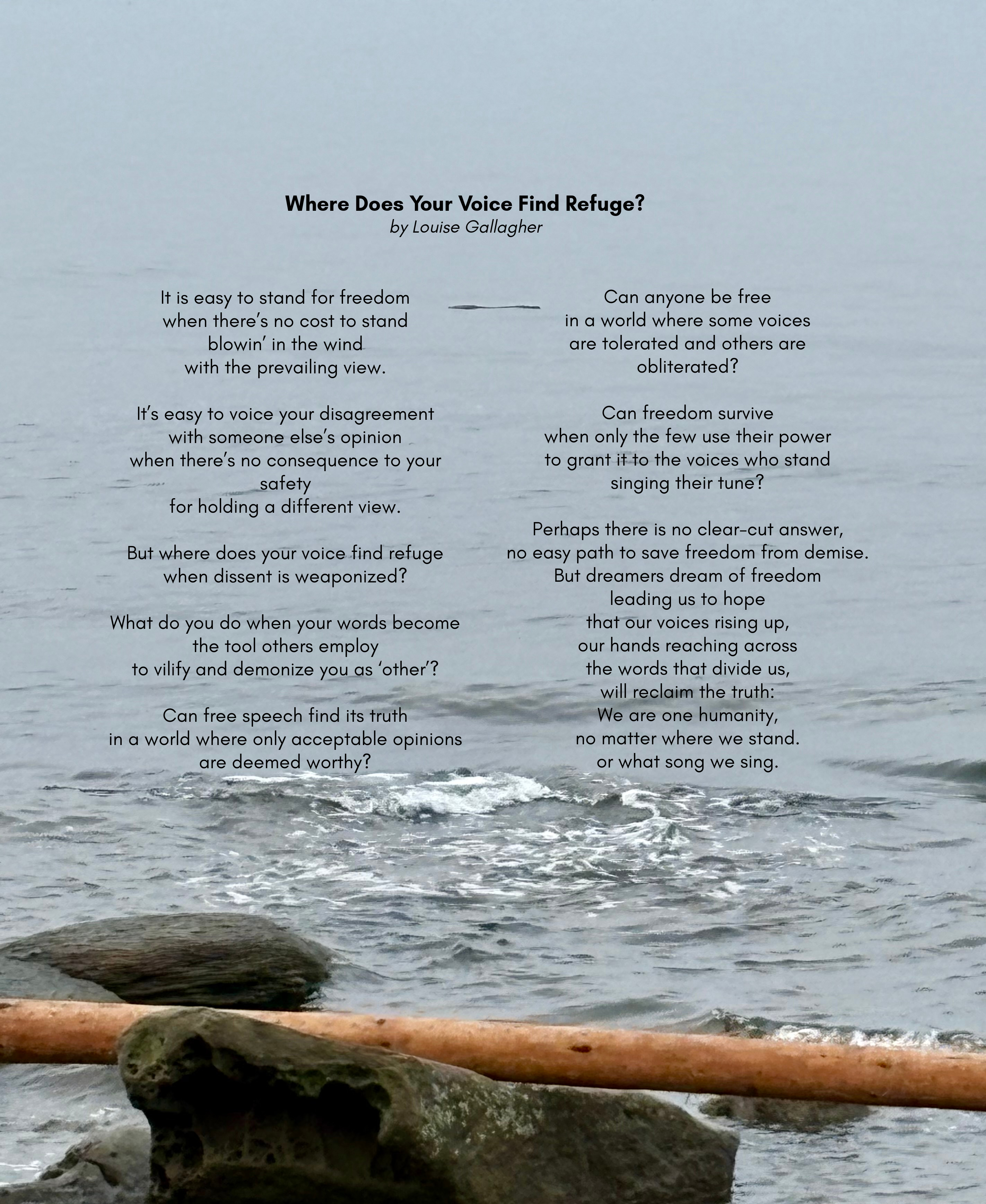
Where Does Your Voice Find Refuge?
by Louise Gallagher

It is easy to stand for freedom
when there’s no cost to stand
blowin’ in the wind
with the prevailing view.

It’s easy to voice your disagreement
with someone else’s opinion
when there’s no consequence to your safety
for holding a different view.

But where does your voice find refuge
when dissent is weaponized?

What do you do when your words become
the tool others employ
to vilify and demonize you as ‘other’?

Can free speech find its truth
in a world where only those opinions
acceptable to some
are deemed worthy?

Can anyone be free
in a world where some voices are tolerated
and others are obliterated?

Can freedom survive
when only the few use their power
to grant it to the voices who stand
singing their tune?

Perhaps there is no clear-cut answer,
no easy path to save freedom from demise.
But dreamers dream of freedom
leading us to hope
that our voices rising up,
our hands reaching across
the words that divide us,
will reclaim the truth:
We are one humanity,
no matter where we stand
or what song we sing.

Between Comfort and Chaos: Reflecting on War and Privilege

I lie in the bath, my feet playfully peeking through the bubble-laden surface. Immediately, I’m reminded of my friend Lavern, who often shares photos of his feet relaxing against the backdrop of the sparkling Okanagan lake.

I snap a photo of my feet, but do not post it.

Two months ago, Lavern’s family summer home was consumed by the ravenous Adam’s Lake Fire in B.C. Years of dedication, sweat, and equity had turned their house into a cherished home. When the evacuation order came, they joined the convoy of desperate families fleeing the flames, their vehicles laden with memories, pets, and hope.

Lavern’s escape bore an extra layer of pathos. As part of the local volunteer fire brigade, he combatted the very inferno that razed his home.

This year, nature’s fury has felt unbridled—fires, floods, tornadoes, hurricanes—each disaster leaving scars on our landscapes and hearts. Yet, for many like Lavern, there’s solace in the knowledge that they can rebuild, even if the journey is long and tough.

There are so many million others in this hurting world whose journey is even tougher. The catastrophes they face are man-made—bombs, bullets, and wars that annihilate not just buildings but the spirit of communities. No fortress stands invincible to a missile, no hand can stop a bullet, just as no belief can truly justify the horror we inflict upon one another.

The world’s landscape is marred with unease. In our quest for territory and power, we seem to forget that peace cannot bloom from the soil of conflict. While some invoke divinity to defend violence, our shared humanity is overshadowed.

As I reclined in my bath this morning, insulated from the world’s chaos, I was hit with a profound realization: moments of peace, like this, are a privilege. And they’re not universal.

I took a photo of my feet sticking out of the bubbles in my bath this morning. Wrapped in the warmth of my home, my thoughts were distant from the cacophony of war, far from the dread of a bomb’s descent.

It’s moments like these that starkly remind me of the divide between safety and chaos, between peace and turmoil. Such simple, unassuming moments are luxuries that many in our world are denied. As I wrap myself in the comfort of my sheltered sanctuary, I’m enveloped by a deep gratitude for my safety, but also a profound sorrow for those living in the horrific reality of the dangers surrounding them.

Lest we forget, while some of us bask in comfort, countless others are engaged in a relentless fight for mere survival. As we sit blithely, passing judgments, laying blame, taking sides, or lashing out at commentators for dissenting views, there are mothers mourning as they pull the lifeless bodies of their children from ruins. Lost children wander amidst the chaos, their tiny hearts pounding, their trembling  bodies overwhelmed by hunger, thirst, and fear.

This is the harrowing face of war. After the deafening roars of guns have ceased and the final bombs have fallen, both victors and the vanquished are left with the somber task of laying their loved ones to rest. And long after the dust has settled, their hearts will continue to ache, bearing the weight of all that man’s conflicts have stolen.

If we are to make real peace with one another, let us not make it through war.

Maybe this time, we’ll get lucky.

I am often a creature of habit. I awaken at close to the same time every day. Spend an hour in bed reading the news, doing my puzzles, writing my gratitude list, listening to the quiet, meditating and contemplating my day.

I get up. Take Beaumont the Sheepadoodle for a quick morning meander to do his business, Come back in the house. Turn on my morning music which is always the same playlist of Alternative Classical music. Make coffee.Sit down at my desk. Open my laptop. Begin to type.

Usually, I have no idea what words will appear or what thoughts will arise.

I let the words and my morning flow like the river outside my window.

These days, the sun stays sleeping until much later than me, rising up well after 8am.

I spend my mornings in the comfort of darkness.

Lights from cars carrying workers towards the city car flicker as they cross the bridge, their stream intermittent, like an erratic jazz beat pulsing in time to the unseen rhythm of the musician’s mind.

This morning, an errant thought flits through my mind as I fill the kettle for my coffee.

Earlier, I’d read about the ongoing onslaught of Russian missiles against Ukraine’s energy infrastructure.

Vast swathes of the country lie in darkness, no heat, no light, no water.

I woke up this morning. Darkness covered the sky holding on to the last vestiges of night before the sun turned dark to light.

I wandered from the bedroom, turned up the heat, turned on the kitchen lights and filled my kettle with water.

Darkness still holds the night, I still have power, heat, light, water.

I am grateful for my comforts.

I cannot turn the lights back on in Ukraine. I do not have the power to stop missiles flying and battles raging.

I can only say a prayer of gratitude for what I have and prayers for peace to come for those whose lives have been so terribly disrupted by one man’s desire for dominance over an entire nation, he brought war to their lands and cities, homes, and lives.

There is no sense in war. Only death and destruction. When the guns are silenced, the victors and the vanquished will never return to what was. Too much has been destroyed.

When the missiles stop firing, the destruction will be swept away and factories, buildings and homes will be rebuilt.

How do you rebuild safety for children who are cowering in basement cellars while bombs fall day and night?

How do you heal the wounds no one can see?

We might ask as Pete Seeger did in 1955 when he released, Where Have All the Flowers Gone, “Where have all the young men gone?“.?

They have gone to a war they did not ask for, did not want. In the end, for those who do return to rebuild what was lost, we must never stop asking, “When will we ever learn?”

Maybe this time, the answer won’t be, Blowin’ in the Wind. Maybe this Time, Lady Peace. Lady Lucky. We’ll get lucky.

We are all refugees

I wonder sometimes how my uncles and aunts felt when they left the land of their birth in search of a new land to call home.

India was no longer a welcoming place for them. Their passports, language, customs were French with a melange of Indian culture thrown in. Their father and his father had all been born in India, as had many centuries of their maternal line. Raised in the then French protectorate of Pondicherry, none of them had ever visited France.

When India reclaimed its independence, they had to make a choice – stay and give up their French citizenship. Or leave. Most of them left for the next closest French protectorate, Vietnam.

At first, Vietnam was a safe haven. But then, war broke out and they were forced to flee.

Like many refugees around the world who run grasping battered suitcases and broken promises, they wanted peace. Not war.

Eventually, they mostly settled in France. Even though their skin was a beautiful blend of white and brown, it was easy to ‘fit in’. French was their first language. Their schooling had followed the French curriculum and even though they blended cultures into a beautiful Euro-Asian tapestry, they were Catholic. They knew the rituals and the faith of their new ‘home’ land. Few questioned their pedagogy, though some of my relations, particularly those whose skin was darker than their neighbours, faced discrimination at times.

Some struggled. Others thrived. Others, like my mother, never let go of their love for India, her Shangri-la as she called it.

The heat, the smells, the vegetation, the food, the singsong of Hindi and Tamil voices, the raucous chattering of monkeys in the yellow neon palms and bougainvillea that surrounded their home, ran through her blood like a strand of DNA that could never be altered.

In some ways my mother lived her life as a refugee yearning always to return to the land of her birth if only to hear the sounds of the ocean lapping against the shores she loved so much.

As news of more refugees fleeing Eastern Ukraine fills my newsfeeds, I am reminded of the stories I heard of my mother’s family’s flight from Inida to France. They faced an uncertain future. They endured bombs falling and lives crumbling before finally reaching ‘home’.

And though a few have remained in India, few of those who left returned to take up residence in the land of their birth, the land where both my maternal and paternal grandparents are buried. My cousins in France all return to India for visits. They all have a deep connection to the beauty of the land. But they always return home to France.

I think of the refugees fleeing their homes, carrying their children in tired arms, fearing that each step could be their last. Fearing they might never be able to return as they race ahead of the bombs into an uncertain future.

And my heart breaks and my mind swirls with thoughts of when will we ever learn? When will this destruction of our humanity, this killing of our fellow human beings stop?

And I cannot find an answer.

There is no answer in war. Just as there is no peace. For, with every mother’s son or daughter killed we risk seeding germs of hate and anger that will grow into endless branches of conflict and unrest.

And so, to no longer be a refugee of my own heart, I return to the origin of it all. To Love. For while there is no peace in war, there is always love. Waiting… Patiently. Steadfastly. Always.

Love for our humanity is all that will save us now.

Let us all remember love is present. Love is always the answer even in war.

Namaste.

I Do Not Want To Read Of War…

Photo by Elena Mozhvilo on Unsplash
I Do Not Want To Read Of War
©2022 Louise Gallagher

I do not want to read of war
I do not want to hear the stories
look at the photos
watch the videos
see the bodies
lying in the streets
the animals left behind and killed
the homes destroyed
the buildings demolished
I do not want to know of its power
to desecrate
diminish
and destroy
Dreams. Hope. Life.

I do not want to look away.

To look away is to deny
the horror of what is happening
to people
just like me
who live and work and love and play
who walk their dogs 
and hold the hands of the ones they love
and caress the faces of their children and grandchildren
who go to work
and drive to the grocery store
or walk to their favourite coffee shop 
to spend an hour or two visiting with friends.

I do not want to cry
for the fathers, sons and daughters
who put down the tools of their trades,
their studies and their work
to don battle dress and guns.
I do not want to weep 
for the children and their mothers 
and the elderly and disabled 
with whom they huddle
in bomb-shelters and barns and basements
waiting for release
waiting for a time when bombs
do not desecrate
diminish
and destroy
Dreams. Hope. Life.

But I must
look and see and bear witness
I must acknowledge
what is happening
so that I can hold
this hurting world
in arms and words and thoughts
that do not 
desecrate
diminish
or destroy
Dreams. Hope. Life.

So that perhaps,
one day,
the children and their mothers
the grandparents and disabled,
the fathers, sons and daughters
can return
home
to rebuild their lives
in peace.

Heidi Baumbach – Making a Difference in Ukraine

Image by jplenio from Pixabay

In the still quiet of dawn not yet broken, I awaken. With a rush, images of war run through my mind. A nightmare I cannot escape.

I turn over. Check the time on my phone. Not quite 5.

I close my eyes but the images awaken in the darkness.

I open my eyes.

In my dream, I am running from a battle. A tank rolls into view. I want to stop it. I put up my hands. Fire flashes from its snout. A blast of hot air washes over me as a tree falls.

I wonder about its survival. Will it ever be able to grow again? Will its family miss its sheltering branches joining with theirs, offering protection from the sun, cover from the rain, a home to nest in for forest animals?

Will it survive?

I turn and run. And awaken.

For a moment, I think it is my nightmare. And, as dreams have meaning, I wonder, ‘what is this dream telling me? Where in my life do I need to make peace?’

And then I remember.

I roll over, grab my phone, scroll through my newsfeed.

It wasn’t a nightmare only I could see, trying to awaken me to peace.

This is the nightmare millions of people are living right now. A nightmare from which they cannot awaken because the war has come to them. The war has arrived in hundreds of tanks rolling across their land destroying homes and roads and bridges indiscriminately. A war where soldiers fire weapons that kill and harm and maim and destroy everything in their line of sight.

The war where missiles fired from jets streaking across a smoky sky tear into a maternity ward killing all hope of peace before it is even born.

_______________________

Heidi Baumbach

If like me you desperately want to do something, Heidi Baumbach is in need of support. Upon hearing of Russia’s invasion of Ukraine, Heidi, from a small central Alberta town, packed up suitcases of supplies and headed to Warsaw to help. She rented a car, and an apartment, drove to the border and picked up a family. She provided them support until they could arrange to move on to meet up with family in another country. And then, she welcomed in another family.

Heidi is doing this on her own. Any financial help she receives goes to supporting refugees. Not just the families she is sheltering, but also at the refugee camps. As she writes on a recent FB post:

The math is simple.

  • $120 CAD buys $400 of toiletries—enough for me to stock the 3 stall bathroom supplying the entire Przemysl refugee camp for an evening.
  • $25 CAD buys enough for a nice meal for everyone
  • $100 buys what would cost $300-$400 back home for groceries.

If you would like to support Heidi and all she is doing, she has set up a GiveSendGo fund — she is trying to raise $10,000 to buy a van to help bring refugees to Lviv from other areas of the Ukraine and to pay rent on an apartment for refugees.

I heard of Heidi’s mission through a co-worker. His daughter and Heidi grew up together. When Heidi emailed me she told me she thinks of my co-worker as her second father. My co-worker, a CPA, is helping Heidi track donations and ensuring her financial records are beyond reproach.

If you can help, please do.

For me, giving directly to someone on the ground, someone who is on her own making a difference helps me feel less helpless.

You can learn more about Heidi’s story at these links:

Lacombe County News

Global News (Heidi’s interview begins at around 4:50)

Heidi on Facebook

Heidi’s GiveSendGo Fund

_________

This post is also in response to this week’s prompt at Eugi’s Causerie.

The prompt is ‘survival’.

The photo accompanies the prompt on Eugi’s website.

Blindspots

When I first got my car two years ago, I discovered something I’d missed during the test drive – there was a significant blindspot over my left shoulder. Uncomfortably so.

I was paranoid about that blindspot. Changing lanes, I’d twist and turn again and again, fearing I was missing an oncoming car. In all my twisting and turning I was a bit of a road hazard and had to consciously train myself to stop the paranoia and trust that I knew how to use my mirrors as aides.

And then one cloudy day when I wasn’t wearing my sunglasses, I realized the blindspot wasn’t there!

What? That’s when I realized it was the arm of my sunglasses, which was attached midway down the frame, that was blocking the view out of the corner of my left eye, not a blindspot in my car.

I bought new glasses, ones with the arms attached at the top of the frame and Voilá! Problem solved.

Blindspots are like that. We use the same set of eyes, with the frame we’re most comfortable with, to view the world. In our comfort, we cannot see the places where our view of reality is blinding us to the reality of others.

Like racism. It has always been amongst us. It’s just many of us were blind to its pervasive presence as well as our contribution to its presence, until the conversation could not be avoided any longer because it was marching right before our eyes and could not be denied.

For those of us for whom the colour of our skin has seldom given us cause to question or even talk about our privilege, nor our inherent biases, it can feel stressful, uncomfortable, disorienting to face our own, as Robin D’Angelo calls it in her same-named book, “White Fragility“.

What if we change our glasses?

What if instead of seeing our discomfort of our ‘white fragility’ as something to be ignored or pushed away or angrily denied, we decided to embrace it and say, “Bring it on. I’m willing to feel this so others do not feel ‘less than’ around me. I am willing to break open my privilege, along with my mind and heart, and be vulnerable to change because what’s happening in today’s reality for so many is not good for anyone. And I do not want my privilege to undermine the well-being of others any longer.”

As a person who fits within the context of being ‘white skinned’, it is easy for me to say, “I don’t see colour.” I haven’t had to. My life is founded on a cultural belief that has survived centuries of life on earth that insinuates (and at times blatantly states), ‘white has more value than black.’

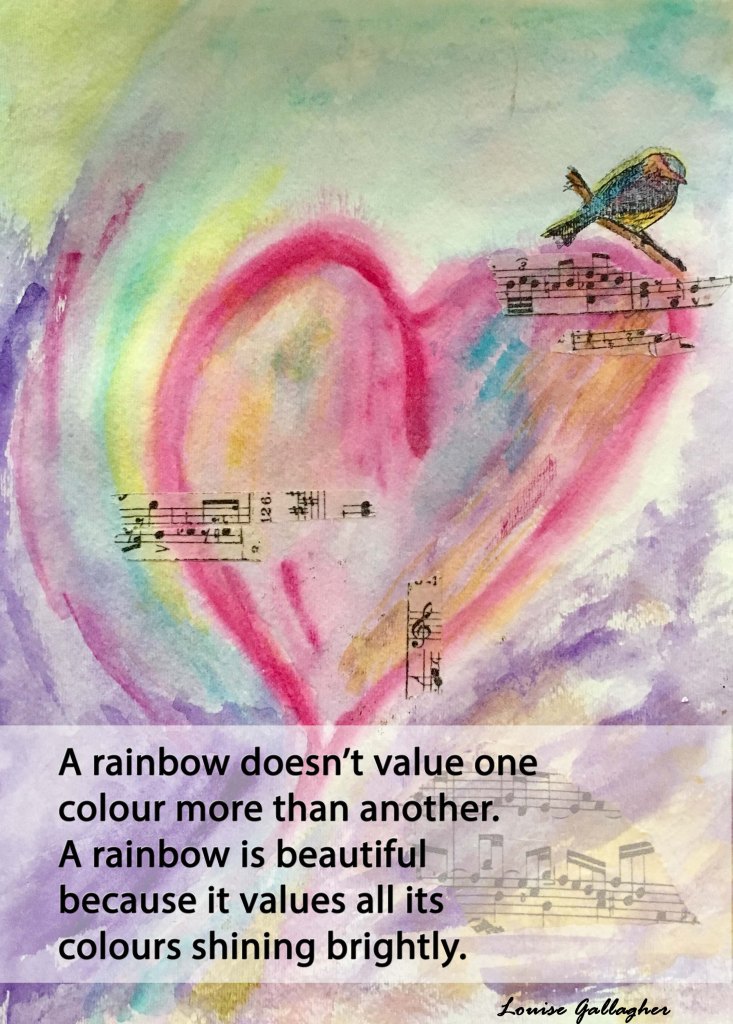
In the world of colour, white actually has no value. It is the reflection of light and gains value through the reflection of other colours. Like rainbows. Sunlight shines through water molecules in the air after a rain and is refracted so that we can see it dancing in a rainbow of colour arcing across the sky.

Without voices of colour speaking up about their experiences, informing those of us without colour about what it means to be devalued in this world because of the colour of your skin, we would not understand the totality of our whiteness in today’s world.

We have that chance. Right now. To listen. To hear. To understand. To learn. To grow and to see the world in all its beautiful colours.

We have the chance to change our glasses.

For real, lasting change to happen, we must stop seeing racism as ‘someone else’s issue’ and see it as ours too, because our whiteness blinds us to the truth about colour. In that discomforting place of recognizing our own culpability in creating the world in which we live, we have the opportunity to refract light differently.

And when we do that, we get to see the world is not black and white. It is a beautiful dance of colour creating rainbows everywhere. And in that light, the world is a much kinder, equal and just place for everyone to shine for all their worth.

Namaste

Acceptance in Every Peace of My Heart

Ahh. Acceptance. Of self. Beauty and the Beast. Yin and Yang. Light and Dark.

Sister Joan Chittister writes:

Self-knowledge gives us perspective, and self-esteem gives us confidence, but it’s self-acceptance that gives us peace of heart.

One of the most challenging things I have ever done is to accept myself as a mother who once was so lost she believed the only path to peace of heart was to desert her daughters.

It’s a long story.

The short version is, I got lost in an abusive relationship and lost myself. In that dark place, I held no mercy for me. I was beyond saving.

I believed the only way to save my daughters was to leave them. Because without me in their lives, I believed they would be free to live their lives without the pain and shame of me and all I’d done to hurt them.

Learning to love and accept myself as that mother was not easy. Especially when the question I asked myself everyday was, “What kind of mother would do that?”

And while the answer was wrapped up in the pain and trauma of being abused, I had to practice self-compassion and mercy every single day — for a long time, whether on some days I wanted to or not —  to get to a place where I could look at that woman who was, and is, me and say, “I forgive you. I love you.” I had to be willing to give up beating her up with my anger, pain, sorrow, shame and accept her brokenness with all my heart.

And then, I had to commit to walking in mercy every day to live with peace of heart and mind so that I could find the grace to create love and joy, peace and harmony in my world.

I had to stop using what happened as an excuse to not turn up in my life today. I had to quit telling myself I was a victim or even a survivor. I was a victor and I had to don my victor’s robe of glory over adversity, beauty over pain, love over fear, mercy over judgement.

I could not stand in the light if I was constantly turning off the lights of my own magnificence. Standing in my magnificence (and not judging it as tarnished, bruised, unworthy of being seen) was essential if I was to be a light and a safe haven for myself and others.

I had to, and still have to, practice radical mercy on my heart. Because magnificence does not come with a clean slate. It arrives wrapped up in everything I am, including all the wounds and scars, darkness and fears of me, myself and I.

And accepting who I am, all of me, is the path to peace of heart.

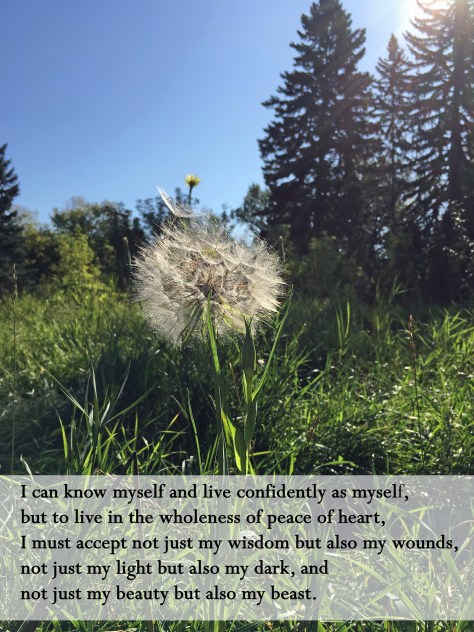
I can know myself and live confidently as myself, but to live in the wholeness of peace of heart, I must accept not just my wisdom but also my wounds, not just my light but also my dark, and not just my beauty but also my beast.

I invite you, just for today, to practice radical mercy on yourself. Stand in  front of the mirror, look deeply into your eyes and say out loud, “I forgive you. I love you. I accept all of you in my heart.”

And so it is.

Namaste.

Let compassion be my guide

It can be easy to forget some days that we are all on this journey of life, together.

That my plan may not align with yours.

That your ideas may be different than mine.

Regardless of our point of views, or our goals or aspirations, we are all on this journey of life, together. We all share this one planet, one earth. We all breathe this same air. Bathe in the same waters. Need the same things to sustain our lives.

It can be hard to remember sometimes that just because I disagree with you, it doesn’t give me the right to judge you. To make you bad or wrong. It just makes our opinions different.

My job is to stand true in my beliefs, and to hold that delicate space between us gently and lovingly clear of my desire to make my voice heard louder than yours.

Whatever you do, my responsibility is not to change you. It is to see you. To know you and acknowledge you as you are, not as I’d like you to be. And regardless of what you say, my voice does not matter more. Talking over you will not make me heard more. It just makes both our voices become louder.

We can disagree. We can hold differing positions and points of views.

When we do, how we share our differences is a reflection of where each of us stands and what each of us values.

How I treat you is a reflection of my values and of who I am.

How you act or speak or respond is a reflection of who you are.

I may not agree, but judging you doesn’t make me ‘more right’. It just makes me part of the problem.

Let me not be ‘the problem’ today. Let me be the path to compassion, love and peace.