Love? What does it really cost?

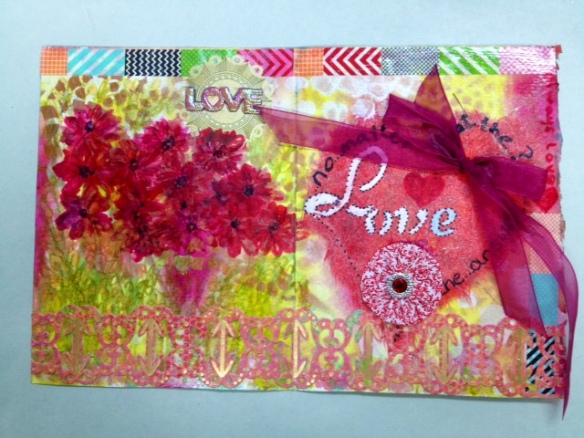
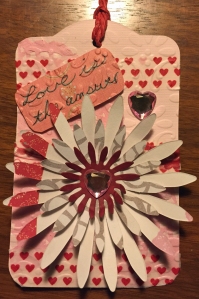
photo (43)Love. A many splendored thing. A many confusing mystery.

Love. We want it. Need it. Fight for it. Fight against it. We resist. We retreat. We hide from it.

Love. We don’t believe in it. We don’t understand it. We don’t feel it.

Love.

A verb? A noun? An adjective? An any ‘thing’?

Love is all around. It is in everything. It is always the answer.

When we surrender to Love, we give up naming it, blaming it, hating it.

When we give into Love, we give into the essence of our humanity, the core of our humanness.

Love is.

We are.

Love.

Love is ever-present, ever abiding and always in the air.

All we have to do to know love, to be love, to have and to give love is to stop resisting, stop justifying, stop fighting our universal need to know and believe in Love.

Yesterday, was the annual day of love. Hearts and flowers, mushy quotes and pithy sayings abounded all over the universe. I Love You’s rolled off tongues and strut their stuff across the screens of hand-held devices and computer monitors.

In our collective frenzy to declare our Love for everyone and everything, we force-fed message streams and twitter feeds with assertions of undying, never-ending, always enduring Love.

So what’s the big deal? Why do we go love crazy on one day of the year when Love is all around every day of the year?

Like Christians long ago confessing their sins to buy their assured seat in Heaven before traipsing off to the Crusades, perhaps we confess our love on this one day of the year to atone for our lack of loving actions throughout the year.

Colour me jaded, but Valentine’s Day feels like a bit of a hoax. In its hyped up, gimme-gimme cravings for attention, Valentine’s Day has become a retailer’s delight of super-sized proportions. Love doesn’t cost a dime, yet, encouraging the consumer to buy, buy, buy has overridden the true cost of giving and receiving Love.

Love is free.

On the wall at the far end of our bedroom, just below the ceiling, there is a wooden plaque with the words, “Always kiss me goodnight,” written on it.

Lying in bed, it is the last thing I read before turning out the light, and the first thing I read in the morning.

Its placement is intentional.

No matter the temperature of our relationship, that sign is a reminder to always give way to Love. To not go to sleep angry. To not awaken with yesterday’s disagreements clouding our hearts.

Love is the answer.

In anger. Fear. Confusion. Hatred. Sorrow. Love is the answer.

Because no matter what else you may be feeling, no matter what other emotion may be clogging your heart’s ability to pump freely, Love is always present.

And it doesn’t need you to dig into your pocketbook on one day of the year to remind someone you love of its presence.

Perhaps though, it is our human fear that makes us want to spend our way into protesting our love everywhere. Perhaps it is that because we do so many things that are not loving, that are not a reflection of the core of our humanness, we need this day to remind us that we can put down our arms of war to reach out with arms filled with nothing but love for one another.

In doing it one day of the year, perhaps we remind ourselves that it is possible to make peace not war. To live in community not separation. To choose Love not fear.

Perhaps, the purpose for Valentine’s Day is to remind us all to stop, take a breath and remember, Love is all around.

I hope so. Because given the retailer’s need for boosting up in our sagging economy, I’m sure they appreciated all the Love this year.

 

Can we end homelessness?

In January, 2008, I sat in a room with a few hundred other Calgarians, most of them involved in some way in the homeless-serving sector, and applauded the launch of Calgary’s 10 Year Plan to End Homelessness.

When asked, “Do you think we can do it?” my answer was  always, “It would be great if we could.” When pressed, I’d temper my enthusiasm with words of caution. “What do we mean when we say we will end it? Do we mean people will never pan handle again? Or fall on hard times with no place to go? Or not need emergency support?

If ending homelessness meant that, the answer was no.

But did I believe in the vision? Absolutely.

It is big and hairy and audacious, and it is vital to hold ourselves accountable to a vision like that if we are to make a difference, if we are to ensure people don’t get trapped in homelessness for years.

“Jack”* was in his late 40s the first time he stepped across the threshold of a shelter. He only stayed a few days before he sorted out the problem that lead him there. Before that, he’d done everything he could to avoid the shelter doors. He’d found a roommate to avoid Calgary’s high rents. When the room mate situation didn’t work out, he’d stayed with friends and when he ran out of friends, he spent a few nights sleeping in a park. He didn’t like that very much so eventually, believing himself to have run out of options, he landed at the shelter door.

The first time was hard. He was scared. Worried about what it meant to have fallen so far down he had no other recourse but to enter the shelter.

The second time, a couple of years later, was easier and by the third time he stayed at the shelter, he had filtered through enough of his fears and reframed the experience to mean, he wasn’t ‘a loser’, which is what he’d told himself the first time. He was simply using the resources available. And anyway, the folks at the shelter were nice and as long as he kept to himself, nobody bothered him. He was still determined to not stay there for long. He was still committed to getting out as soon as he could.

And then, the housing market went crazy. Afford his own place? Not going to happen.

What he thought would be just a few week’s stay became months. Months eased into years and suddenly, without his even noticing, Jack found himself permanently entrenched at the shelter.

“It became comfortable,” he told me once when I worked at the shelter. “Nine years go by pretty fast if you’re not watching.”

I ran into Jack not long ago. I was walking west. He was walking east. When he saw me he stopped to say hello and give me a hug. “I missed you when you left,” he told me.

We chatted for a few moments before I asked him where he was living now. “Are you still at the shelter?” I asked him.

“Nope,” he replied. “I got a place.” And he smiled and stood taller, straighter, prouder.

When Jack turned 65 and his old age benefits started to come in, he decided it was time to make a change. With the help of a senior’s housing agency he found subsidized housing he could afford. He’d been living on his own for a year when I ran into him on the street and was determined he was never going back.

“It used to be I’d work temp jobs, get some cash and blow it all on weekends,” he told me. “Even though I had the same amount of money then as I have now, I didn’t have a lot of hope I’d ever get out of that place ’cause I couldn’t see how I was going to afford it.”

For Jack, as for so many, Calgary’s high cost of living keeps them trapped in believing there is no alternative, there is no place for them to call home other than a shelter. As one man I know once said, “I’ve got a roof over my head and food on the table. I can’t complain about sharing my place with a few hundred other roommates. I can afford free.”

It wasn’t until Jack ‘aged out’ that a path to stability and independence appeared.

We can do better. We must.

Calgary’s Plan to End Homelessness is about ensuring people don’t get trapped in using shelter as a long term solution to their housing needs. It’s about ensuring Calgary has the system of care, the necessary affordable housing, and the right supports to ensure homelessness does not become a trap from which the only escape is to age out or die.

We will not be able to open the doors to home without a vision that says, “Yes. Together, we will end homelessness.”

Eight years ago I sat in a room filled with hope and possibility and a belief that together, we can make a difference.

A lot has changed since that day. We’ve learned a great deal. Acquired more information and data to base our decisions upon. We’ve filled in gaps, streamlined processes and gained a better understanding of what it means to be homeless, what it means to end it, and what it takes to do it.

One thing hasn’t changed. My belief that it is vital that each of us hold space for the vision of ending homelessness. Each of us believe in our capacity to make happen.

For Jack’s sake, and for thousands of others, we must.

***************

*Not his real name.


UEP. How to make a difference

United Way of Calgary and Area

Yesterday, the United Way of Calgary and Area announced the results of its 2015 Campaign.

Calgarians contributed $55,200 million to Calgary’s social services network. In spite of job losses, increased and on-going anxiety around job security, the continued collapse of oil prices pummelling the major industry of our city, Calgarians once again stepped up to show they care and to make a difference.

Last night, I presented at one of my favourite projects initiated by the United Way — Urban Exposure Project or UEP as everyone calls it.

I can’t remember if this is my 4th or 5th year of presenting to this group of ‘next generation’ Calgarians. I only remember how much I love being part of their desire to make a difference in our city and how grateful I am to be invited to be part of their endeavours.

The description for UEP on the United Way’s website reads:

The Urban Exposure Project (UEP) engages next generation Calgarians on social issues affecting our city and the impact of United Way through the lens of photography. Participants enhance their knowledge of social issues and photography, producing a final project to be shared with the community. UEP empowers young Calgarians to build leadership, awareness and community through their art.

The project runs from late January – April each year with weekly sessions focused on social issues, photography skills and the work of United Way and partner agencies in our city. UEP culminates with a gala-style event in May to showcase your work, stories and experiences with friends, family and community members.

The amazing and talented Jeremy Fokkens shares his photographic knowledge, tips and talents to inspire the photography skills of the group. My role in the project is to help the participants get comfortable with story-telling. To help shift their awareness from ‘fear’ — how on earth can I ask someone if I can take their photo? How do I find my story in the photo? How do I not mess up?… To a place of — Wow! What a great opportunity to connect, heart to heart, to other Calgarians and to learn more about our human connection and inspire others to learn more too.

The first time I presented at UEP there were maybe 15 – 18 participants. Last night, there were over 40 people crowded into the room — all of them coming from different walks of life, all of them eager to learn more about Calgary’s social services network.

I always begin my presentation with an invitation for participants to pair up and…. wait for it… “Draw the face of the person beside you. You have 1 minute. Start. Now!”

And the response is always the same.

Groans. Nervous laughter. Apologies for the lack of ability to create a masterpiece.

When the minute is up I ask, “How many of you immediately went to ‘I can’t do that!’ when I gave you the instructions?”

Inevitably, at least 50% of the group says yes and then, when I challenge everyone else, most of them sheepishly acknowledge they too felt an inner angst kick in the minute they found out what they had to do.

The point of the exercise beyond it being a great ice-breaker– we all have a natural push back when asked to do things we tell ourselves we can’t do. Few of us are immediately comfortable stepping outside our comfort zone. Few of us actually believe we can draw – or allow ourselves time to explore our creative abilities.

So what? I ask the group. Did you have fun? Did you laugh a lot and did you get a little more comfortable with the person beside you?

Last night, I had the privilege of working with a group of engaged, excited and inspiring people who are committed to learning and doing more to create a great city.

Yes, Calgary is facing tough times. Everyone in that room is nervous about their job security. Everyone is nervous about the uncertainty of the future. As one young woman I spoke with said, “I’ve never gone through this before.”

It’s okay.

Whether we’ve gone through a market downturn and downward slide of the economy once, or twice or more, it is always hard. Even without a crumbling economy, people experience hardship, tough times, uncertainty.

What’s important isn’t The Job or The Title or even the newness of label on our designer clothes.

What’s important is we turn up. We commit to making a difference and we give back.

Giving is Receiving.

Last night, as evidenced by the number of next generationers who were in the room to give back to community and the United Way, Calgary is in good hands.

Markets may tumble and stocks may fall, but our willingness to give back, to be there for one another, to support eachother will carry us through.

Thank you UEP, to everyone in that room last night, to the United Way of Calgary and Area, to the thousands of people working in hundreds of agencies across our city to support people in good and tough times.

You make a difference.

How to fall in love with yourself.

cardHow does one fall in love with oneself?

In my years of coaching, working with street teens, working in the homeless sector, learning what it means to live as ‘an artist’ of my own heart, running art programs, teaching story-telling and delving into the power of Love and writing about it, there is a common thread that runs through our psyches, no matter where we’ve been, what we’ve done, how we’ve gotten to where ever we are at.

Shame.

We are burdened with shame and gratitude depleted.

Brené Brown writes about shame. She studies it, researches it and expresses its debilitating effects with great clarity in her may books on the subject.

She writes:

“Shame works like the zoom lens on a camera. When we are feeling shame, the camera is zoomed in tight and all we see is our flawed selves, alone and struggling.”

“Shame, blame, disrespect, betrayal, and the withholding of affection damage the roots from which love grows. Love can only survive these injuries if they are acknowledged, healed and rare.”

“Perfectionism is a self-destructive and addictive belief system that fuels this primary thought: If I look perfect, and do everything perfectly, I can avoid or minimize the painful feelings of shame, judgment, and blame.”

“Faith is a place of mystery, where we find the courage to believe in what we cannot see and the strength to let go of our fear of uncertainty.”

Brené Brown, The Gifts of Imperfection: Let Go of Who You Think You’re Supposed to Be and Embrace Who You Are

We can be shame driven or heart full.

We can be shame full or heart driven.

Or,

We can be heart driven and heart full and in the fullness of living from our heart-centered wholeness, we can set ourselves free.

It’s all in where we put our attention. Whatever we put our attention on becomes stronger in our life.

When I focus on avoiding shame, my avoidance grows stronger giving shame little chance to flow free.

When I put my attention on how unworthy I am of love, how undeserving of grace or kindness or tender loving care, my story becomes all about how unworthy, undeserving I am. It also gives me an excuse not to change, not to face my fears and step through the threshold of my shame.

It is easier to hate myself when I’m constantly telling myself how much I hate myself, my life and the world around me. The story of why I have the right to feel this way, to tell myself this is true, is a powerful story. Staying connected to the story I’m telling myself, even when it hurts, is safer than letting it go.

Change your story. Change your life.

How do you fall in love with yourself?  Stop hating yourself.

Here’s an exercise.

  1. Go stand in front of a mirror and look into your eyes. (It’s okay. You can keep your clothes on. You’re looking into your eyes, not at your body – and it’s not about judging what you see. It’s about being open to looking in). Look deeply, yes deeply, into your eyes and repeat OUT LOUD 10x (slowly, breathing between each repetition) “I love you.” (repeat 10x) Remember — Keep your eyes open and look deeply within them, not at them.
  2. Breathe. Yes. Breathe. It’s okay. Telling yourself you love yourself is a good thing to do. It’s a place to start. Sure, you may feel silly, stupid, uncomfortable. You might even tell yourself ‘well, that’s a lie’. But, think about it. Is the statement “I love me” any different than “I hate me”?  You are your thoughts. If your thoughts are all about hating yourself, that will become what you believe to be the truth. So, start gently, lovingly, even if you’re afraid, by changing the message you tell yourself.
  3. Repeat many times, every day, until it comes as naturally as breathing. Eventually, dispense with the mirror. Just keep telling yourself, I Love You. I Love Me.

Think of the alternative. Do you want to tell yourself 10x in the mirror, “I hate you.”?  What if you chose instead to just love yourself, even within hating yourself?

Do you want to keep repeating out loud how small, useless, unworthy, undeserving you are?

Even if that feels like the truth, it’s not. It’s just your attention has been on hating yourself for so long, there’s been no room to allow the truth of Love to appear in your eyes.

And yes, I have most definitely simplified the process of falling in love with yourself. It is a journey, an adventure, a grand expedition to choose to fall in love with yourself, even when your mind is telling you ‘Well that’s dangerous. Don’t go there. You’ll get hurt. Let down. Betrayed. Destroyed….”

You have to begin somewhere. Why not here?

Loving yourself is not for sissies.

It’s for everyone. Each of us. All of us.

Loving yourself takes courage. Passion. Fortitude. Hope.

Loving yourself takes heart.

Namaste.


Self-love or self-hatred? Which will you choose?

A commenter writes, “Self-love is no simple task.”

It’s true. It is not always easy to love oneself. To be in love with oneself. To hold oneself in loving thoughts and tender mercies.

There was a time when loving myself was the last thing I wanted to do. Challenge is, I didn’t want to face the fact I was actively engaged in avoiding loving myself so I pretended I did love myself, well sort of, almost, some parts.

In my ‘I love myself but….’ I did a lot of things that hurt me. That hurt people I love.

I knew what it meant to love another — well sort of, at least as long as I didn’t have to face the fact I didn’t really love myself.

In my “I love you but not me” pretense, I could pretend everything was okay when actually, I was not living my truth. Not standing true to my beliefs. Yet, in fact, I wasn’t really lying — I didn’t want to admit I didn’t love myself so pretended I did, but because I didn’t, the things I did that hurt me, that put me in situations that were not self-loving or filled with dignity, self-respect, kindness — they were true to my feelings about myself.

Ahh, the webs we weave when we attempt to deceive ourselves about the truth of our human condition.


It is fascinating to me that for many of us, we think about not loving ourselves, but we hesitate to ask the next question. If I am not loving myself, what am I doing?

Am I hating myself? Am I doing things that express my self-loathing? Am I drowning my self-loathing beneath the false pretense of over-confidence? Lack of self-confidence. Humour. Anger. Acting out. Drugs. Alcohol. Am I playing down to my worst instincts to avoid having to acknowledge I am afraid to love myself. Afraid to see this flawed, fragile and frightened being is me — and I’m not loving myself enough to see that what I am doing is hurting me.

Is avoidance of self-love my game?

Long before I fell into the arms of a man who almost killed me with his abuse, I was in therapy. I wanted to understand why I did not love myself.

I knew it was true — that I didn’t love myself. What I didn’t know, what I didn’t see or what no one ever asked me was — Which hurts more? Loving yourself or hating yourself?


Recently, I did an EQ (Emotional Intelligence) In-Action Profile with my brilliant friend Ian Munro at Leading Essentially.

It was very telling and informative for me to see where my automatic default goes when I am under duress/stress.

I am ‘optimally fit’ in my Positive/Negative orientation, and ‘optimally fit’ in my balanced reliance on thoughts, wants and feelings.

In my ‘Self-Other Orientation’, well, according to the results it, ‘Needs a Work-Out’.

It’s all about trust. Boundaries and loving myself enough to set healthy ones.

Dang. Wouldn’t you know it.

In this quadrant the good news is, ‘I don’t let relationship ruptures fester or run on too long. The bad news is, I may find myself taking more responsibility than is actually mine to take.’

Taking excessive responsibility is the Achilles’ heel of those who are more self-oriented, the Profile tells me.

No kidding.

Starving children in Africa?

War in Afghanistan?

It’s either my fault or I can fix it. There is no in-between.

Just kidding. I know that’s not true, but somewhere deep within me is a wish, a desire to fix it. To bring peace to the world – all of it, not just the parts over which I have domain or impact. It is not succumbing to that place where I believe everything is all my fault, that is vital to my well-being. Of not giving into the feeling that if I could just grab a magic wand and sprinkle fairy dust over everyone so they could just ‘get along’ and quit making such a mess of relationships and our world, I will have done my job.

It’s all about boundaries.

About knowing what is mine and what is yours. What I am responsible for and what I’m not and then…

Yup. That self-love thing again — loving myself enough to give myself the grace of setting boundaries that honour me, and trusting others to be responsible for their journey along the way.

As I mentioned to a friend awhile ago, “I am getting so tired of people crossing the boundaries I refuse to set.”

Boundaries are great. But first, you gotta set some!

Here’s to setting healthy, loving and effective boundaries that get me to optimal fitness in my world.

What about you?

Feeling any need to love yourself a little more today? Go for it. There’s nothing to lose, because really, is self-love any more difficult than self-loathing?

*********************

For those of you interested in the EQ In-Action Profile, Ian is an amazing coach. Do check out his website. Leading Essentially

Thank you KW for your inspiring comment.

There’s no ‘getting over’ a Psyhcopath

A woman I have never met writes me an email to tell me how she has just seen the documentary that was created about the journey I took through hell with a man whose lies and deceit almost killed me. It still occasionally appears on Discovery Channel and OWN and I always know when it’s been on. Someone will write to tell me they saw it. That they too have a story like mine.

Often, they will write of their misadventure and ask me, “How did you heal? How did you get over that?”

They will also, as this woman has, thank me for having had the courage to tell the story. To share it. “I don’t feel so alone,” she writes. “I am not crazy.”

It is one of the reasons I did the documentary. So that people know they are not alone. Not crazy. That there is hope, and life, after an encounter with a psychopath, or as I used to call it in the early days of my healing, a P-encounter.

Sometimes, the woman will tell me she is still in the relationship, or trying to break it off. Sometimes, it is a mother writing for her daughter’s sake, or a sister, pleading for understanding. Asking me to help them make sense of what is happening. Why won’t she leave? How do I save her?, they ask.

You must cut off all contact with the “P”. You cannot save anyone as long as the “P” is calling the shots. You are not powerful enough to combat the poison he feeds you, or the person you want to help, with every breath he takes and every word he speaks.

We must first stop the poison from entering before we can heal its effects.

There is no sense in encounters of the “P” kind. They are designed to drive the victim and those around them crazy.

“P” encounters are never about Love. They are always about Abuse.

P-encounters rob you of joy. Of your sense of worth, your self-esteem, your belief in yourself. They destroy hope. They tear apart lives, rip apart families and decimate relationships.

The damage is terminal if you stay  in the relationship. Your heart will wither within your body. It will become capable of pumping only enough blood to keep you alive. But moments of joy. Moments of bliss, of seeing the sunshine and feeling the warmth on your face, of feeling alive and free, those will be transitory, fleeting, brief.

When in a relationship with a “P” you will always be connected to the umbilical cord of his lies and deceit feeding you the poison that is cutting off your blood flow, your free-thinking, your heart. He needs to keep you connected in order for him to stay alive. He will do anything to not let you go.

Fear, manipulation, terror, deceit. These are all tools of the trade for a “P”. They have spent their lives perfecting their art. They are subject matter experts in human manipulation. (and yes, women can be P’s too).

And we, their prey, whether a man, woman or child, are simply a means of keeping their art alive.

How did I heal?

By naming what happened for what it is. Abuse. By stopping all contact, even in my mind, with the ‘memories’ of a lost love. It was never real. It was only the creation of his desire to catch me in the web of his lies.

How did I heal?

By taking one step after another, every single day, and reminding myself as each step took me away from those dark and violent days, that I was not healing from a love story gone wrong. I was healing from abuse.

How did I get over it?

I didn’t.

It was not something to get over. I wasn’t trying to climb over a fence dividing ‘those days’ from these days now. I was healing from the loss of joy, the ripping apart of all my relationships, the destruction of my dreams, my heart, my belief in my worth, my belief in magic and wonder and awe.

To heal from the loss, I had to reclaim what I had lost. And I couldn’t do it by getting ‘over him’. I had to do it by letting go of the idea of loving him and believing he was my soul mate, my perfect lover, the man of my dreams, my Prince Charming.

I had to stop all thoughts of loving him and the lies I told myself about how I had lost a beautiful love so that I could see myself without the poison of his lies holding me enthralled in the make-believe he’d created when that relationship first began.

I had to become fierce and tenacious and willing to feel the pain of the loss of myself so that I could fall in love with me. All of me. Beauty and the Beast. The abused woman. The woman who deserted her children. Who let go of her life to take that journey to happily ever after and became lost on the road to hell.

I had to fall in love with me, the woman who is caring, kind, sometimes funny (Ask my daughters. They will tell you being funny is not one of my strengths 🙂 ) Who believes in angels and sees fairies dancing on sunlit water and hears the wind whispering stories of far off places in seed pods dancing on the branches of a tree in springtime.

Who believes we are powerful beyond our wildest imaginings because, she knows with all her heart, we are magnificent human beings capable of creating a world of wonder where harmony, joy, peace and Love abounds.

That is the woman I have fallen in love with. And that is how I ‘got over’ the P-encounter.

Namaste.


Don’t Look Back.


I used to spend a lot of time in the mountains, climbing and skiing and revelling in the views from mountain tops. My daughters’ father is an avid mountaineer. The best weekend for him was to spend it laden down with climbing ropes and axes, scrambling up scree slopes and carefully choosing your path up the side of a mountain to reach some far off summit you can’t see from the bottom, but know is there high above you, waiting for your ascent.

Climbers take their time. They are thoughtful, precise and prepared.

Before they ever head out, they have researched the route, mapped their ascent and at the same time, are prepared for the unexpected.

Anything can happen when climbing a mountain, no matter which direction you’re going. Up or down.

Once, while climbing Cathedral Mountain, we got lost in the woods leading to the beginning of the ascent route. We had to bushwhack through dense forest and being that I was at least a foot shorter than my two climbing companions, I did more rolling over deadfall than stepping. I did not look very dignified nor graceful.

Just below where the climb began I got bit in the calf by a spider. My leg swelled up to three times its size and there was no way I could proceed. I didn’t have a book (any excess weight is not welcome on a climb) so I spent the day sunning and resting on a huge boulder while the two men continued the climb.

It was an unexpected lesson in mindfulness. My mind wanted me to believe the approach of a grizzly bear was imminent. That I was in mortal danger sitting on that rock.

I spent the first couple of hours alone trying to swivel my head in every direction, until eventually I grew tired of being constantly on-guard against some unseen adversary. I had to get present. To become one with my environment. By the time my climbing companions returned, even though my leg was red hot and swollen, I felt grounded. Refreshed. Calm. I’d had a beautiful time being present with the world around me.

When climbing, no matter which way you’re going, looking back is not a good idea. Looking back means you’ve taken your focus off where you’re at. What’s happening in the here and now. When climbing, you must stay present to every step you take, because every step is important to your well-being. And to your climbing partner’s well-being too.

And while each step is filled with anticipation of reaching the summit drawing you ever higher, you can’t let your mind stray to the view at the top. You  must keep it on where you’re at, what you’re doing right now.

I never tired of the view from the top but I never particularly liked the climb. It scared me to be exposed. To be dependent upon a rope, another human being, a foothold on the side of a mountain-face that was supposed to hold, but dare I trust it?

I wasn’t all that keen on the descent either.

Coming down has its perils. You are tired, there is the natural let-down of having reached your goal, of having breathed the rarified air at the top and swooned at the sight of a feast of mountains spread out as far as the eye can see.

There’s not much time to linger on a mountain top. The sun is arcing towards the earth in the distance, storm clouds are building on the far horizon, ice falls, rock falls and other natural hazards litter the slopes below. Your body is fatiguing and now, having devoured the view, you must set your sights on the descent. The valley below is calling. The ‘real world’ awaits.


No matter whether climbing up, or down, or simply walking on the path to your ascent, looking back can be dangerous.

Like life, to reach your goal you must have confidence that each step will lead you to the next and the next. Knowing where you’re going keeps you stepping safely. It keeps you aware of pitfalls on your path, of hazards on your route of opportunities and possibilities for new and better paths to your destination.

Looking back will only keep you from seeing what lays on the path ahead.

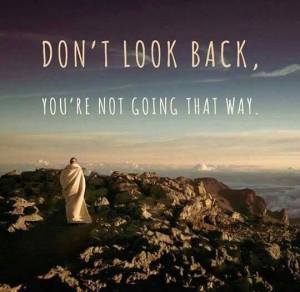
Don’t look back. You’re not going that way.

******************************************

With gratitude to Lou at Zen Flash for the title and inspiration for this post.

In the age of forgetting

say a little prayer copy

When I was a little girl, Sunday mornings were reserved for church. It was a ritual. We would get all dressed up in our Sunday best, pile into my dad’s car and arrive as one big family of 6 at the church with lots of time to spare. My dad didn’t like being late.

Inevitably, between home and entering the portals of the church, something in my apparel would have come askew. My mother would straighten my skirt. Tuck in my blouse and lick her finger to wipe away some spot of dirt that had managed to find its way to my cheek.

Inside, on the hard wooden pew, my sister and I would sit side by side, our feet not quite touching the floor, swinging our legs and subtly, and sometimes not so subtly, pushing and prodding at each other. My father would grumble about our behaviour and my mother would caution us to Shush.

They didn’t have Sunday School during Catholic mass so we would squirm and wiggle our way through the hour and half mass, kneeling and standing and bowing our heads in tandem with the rest of the congregation, repeating the well worn phrases of the mass, even when the words were in Latin.

Fifty years later, though I seldom attend mass now, I still know when to stand and when to kneel. When to bow my head and when to touch my breast three times with clenched fist and whisper Holy. Holy. Holy.

Cellular memory runs deep.

What is forgotten over the intervening decades is my connection to the holiness of everything. My connection to the greatness of nature. The oneness of life.

We live in an age of lost intimacy with the oneness that runs through life touching us all. Human. Animal. Plant.

We live in an age of acquiring information while forgetting to dig into the roots of our deep and abiding knowledge of life’s divine presence in each of us.

On those Sunday’s when I was a child, there was no question in my mind that God was not present in the church. I saw him in the bowed heads of the congregation. I felt him in the hushed silence, the flickering candles, the incense burning, the light streaming in through a stained glass window.

God. The Divine. Yaweh. Spirit. Whatever word you use to describe the sacred nature of life was there, in each of us as we stood together to listen to the priest, to hear the holy words, to share the wine and bread.  Just as he was there in countless other churches and services and temples and mosques around the globe where humankind gathered together to praise the holy nature of life on earth.

Places of worship bring us together. They remind us of our holy nature, our divine essence. Our Oneness. They connect us to the goodness in each of us, the wonder of our world, the sacredness of our time on earth.

It is outside the walls of worship, beyond the portal doors that I struggle to stay connected, to remember my essence, like your essence, is sacred by nature. That we are all one. All together on this one planet spinning through space held to the earth by the invisible strands of gravity’s grace and the miraculous nature of life.

Take time today to stop and breathe deeply and remember, You are Divine. Just the way you were born. It is your nature. It is all our nature. We are all the divine expression of amazing grace and light. Magnificent and perfect in all our human imperfections.


How did ED get here?

When my eldest daughter was about 6 years old she got a hamster. It had its own cage complete with spinning wheel and sawdust on the floor. It was sweet and cuddly and funny and she loved that critter with all her heart. When it died a few months after coming into our home, she was devastated.

“I will mourn for three days,” Alexis informed me. “And then I’ll be okay.”

I baked her a cake in honour of her grief and mourn she did. For three days she cried and lay on her bed curled up in a ball. We sat in a circle eating cookies and shared stories of her lost pet and Alexis drew pictures to commemorate her oh so short life.

After awhile, she decided it was time for another hamster.

This one was not at all like the first. It was mean and bit when held and didn’t at all like being cuddled. Putting your hand in his cage meant risking the loss of your fingers so I was the one relegated to cleaning the cage and caring for it.

I did not like this pet and when it died, nobody mourned its loss.

I decreed us a Rodent Free Household, and neither of the girls pushed back. At least, not in the rodent department. Four legged friends of the furry, wiggly, woofy kind were another matter.

Bella came to live with us after a visit to the Humane Society. She was big and black and furry and 1 years old and loved to run around the back yard chasing the girls or to curl up in their bed and cuddle. She was perfect.

Except for her predilection for chewing shoes. She didn’t just chew them. She ate them. Completely. But usually only one of each pair. I’d spend days searching for one of the girls’ missing shoes only to discover the only evidence of what happened to it in the backyard when I cleaned up the offerings Bella dropped there.

I couldn’t get mad at her. She was way too sweet.

For the first while of having Bella in our home, she would travel between my house and their father’s house in the next block whenever the girls went over to stay with him. I’d pack up a bag for them and a bag for Bella and off they would go.

Sometimes, they’d come home alone. Bella is staying with dad today mom, they’d tell me. He’s going hiking and thought he’d take her with him.

Sometimes became often until eventually, Bella took up formal residence at their father’s house. She’d still come to visit me, but I always knew where her heart was. And that was okay.

One day, while the girls were at their dad’s, Bella ran out onto the street and was hit by a car. He called me immediately and I raced over to take the girls while he took Bella to the vet emergency hospital.

When I arrived ten-year-old Alexis, ran into my arms crying her heart out while her sister promptly informed us that she was going to the hospital with Bella. She was not going to leave her alone.

Alexis and I went for ice cream sundaes and talked about life and accidents and what can happen while her sister walked into the emergency room and insisted on being present throughout the surgery to repair Bella’s back leg.

As a mother of a daughter with an eating disorder, I have struggled to not unwind history in search of that one moment where had I done this, not that, perhaps ED would not have raised its ugly head.

I know it is self-defeating, and fruitless, to find EDs origins in the past. I know that it is in the here and now that healing begins, yet still I wonder.

What if I hadn’t baked that hamster a cake?

What if I didn’t offer up ice cream sundaes to soothe her fear?

What if?

Ultimately, with ED as with all things, the answer lies in the present.

There is no one inciting incident that marks the beginning of EDs presence. His beginnings are a constellation of factors, some environmental, some emotional, some actions taken with well meaning intention, some without thought.

No matter his beginnings, there is only the truth that ends his presence in the here and now. Forgive and let the past lie where it belongs so we can surrender and fall into Love.


ED. Stop calling.

When her sister was in her late teens my youngest daughter and I would often talk about the possibility that her sister had an eating disorder.

“Do something mom,” my youngest daughter would insist.

I worried that if I ignored it she’d die. If I acknowledged it, she’d lie, and lying would only make her hate herself more which would exacerbate the problem.

So mostly, I did the best I could, which given the gravity of the situation, was never enough.

I’d obliquely refer to eating disorders, ask if she was okay, ask if she thought she needed professional help. I’d read online about EDs and while part of me believed it was possible, the other couldn’t believe it was true.

I was so accustomed to the violent swings of her emotions. I chalked it all up to ‘it’s just the way she rolls through life’.

The first time she threatened suicide she was five years old. I can’t remember the instigating situation but I’ll never forget watching this tiny, perfect human being standing at the top of the stairs looking down at me and informing me that she was sorry she’d picked us as her parents, she was going back to heaven.

“I’m sorry to hear that,” I told my precious child before asking. “How do you plan on getting there?”

She didn’t hesitate in her response. “I’m going to go to the kitchen and get a knife and stab myself to death.”

I stopped smiling. My heart stopped beating for just a second as I quietly suggested we sit down and talk about this.

It was one of the most heart-breaking surprises of being her mother. I never, ever anticipated having to talk my five year old daughter off a ledge. But I would do it, again and again over the ensuing years.

At 13, after her sister informed me one day as I drove her to dance that I couldn’t leave her alone with her sister anymore because every time they were alone Alexis threatened to kill herself, I put them both into counselling.

It seemed to have a positive impact for awhile but then, I fell into a pit of despair in a relationship that was killing me. I tried to juggle the darkness consuming me while I also worked to keep the darkness at bay in Alexis’ life too.

It was exhausting and terrifying.

Even though I know that part of my natural defense/response mechanism is to assume everything is my fault, that I need to fix it because I broke it, when I look back on those days now, I am in awe of the fact that I never once thought I needed help. I was so consumed by guilt and shame and self-flagellation, I couldn’t see the disease eating away at my life was part of the problem that was killing my daughter.

There are familial threads in eating disorders and depression.

My mother spent her life in a deep sea of grief. When we were children, the darkness would become so great, her despair so all consuming, she would stand in the kitchen and hold a knife to her breast and tell us she was going to stab herself to death.

I told myself I had to fix it. That I had to make my mother smile. That I had to lift the cloud of gloom that enshrouded her.

I wasn’t that powerful, but I thought I had to be. And so, I kept smiling and laughing and wanting to be like the sunshine while my mother fought the darkness and I fought with her to be less sad, less clinging, less scared of the world around her.

I was never big enough to take the knife out of my mother’s hands all those years ago, but I became a master at taking the knife out of Alexis’ hands until one day in her mid-twenties when I told her I couldn’t do it anymore.

I was exhausted and had run out of things to say.

That was the day I quit enabling her, quit propping her up and talking her out of every dark corner she’d disappeared into.

That was the day she saved her own life.

C.C. and I were visiting in Vancouver. Something had triggered her despair and in her anger, she informed me she didn’t want to live anymore. I asked her if she had a plan to take her own life and she informed me she was going to the emergency room and checking herself in.

“That sounds like a good plan” I replied and let her walk out the door.

It was just after midnight and I could not go running after her anymore. I had to trust the Universe. I had to believe that whatever happened next, I was not powerful enough to fix this. I had to accept, I love my daughter. It was time for her to learn to love herself.

On the other side of the door, at the end of the sidewalk, my daughter tells the story of sitting down on the curb and calling the Distress Centre. A kind, caring voice answered the line. In that stranger’s deep listening, Alexis let go of the rope she was hanging herself with and began the journey of learning to live without ED consuming her.

It has not been a straight line through recovery. It has not been a one step after the other. There have been many detours back to the darkness, many steps forward when I thought I could grab her out of ED’s arms.

My daughter has taught me a great deal about courage. She’s taught me alot about learning to trust, about being willing to let go of my belief I have to fix it, I have to hold it all together. I still struggle with letting it go. Still sometimes fall into the trap of believing I have the power to make my daughter love herself more than ED or the darkness consuming her.

Like Alexis, I am learning to reach out, to not hold myself in silence’s killing embrace.

I am grateful for a stranger who listened deeply to Alexis one night years ago. Because of her, I am learning to walk my path without fearing I won’t have the answers that will save Alexis’ life. Because of her, I know, there is someone on the end of the line who my daughter can reach out to when the darkness becomes too great. All she has to do is call.


Namaste.

++++++++++++++++++++++++++++++++++++++++++++++++

This is Eating Disorder Week. Please, if you are living with an ED, reach out, seek help. If you are living with a loved one with an ED, know, you are not alone. Distress Centre Crisis Line:  403.266.HELP (4357)  

I shall be writing more about ED from my perspective this week. It is healing and it is freeing because in writing it out, I find myself not alone with just my thoughts.

Alexis’ blog post today is HERE.