
Let us gather by the fire: #longestnightyyc


solstice-fire-copy

Let us gather by the fire
and cast away all fear
of darkness.

Let us gather by the light
to remember those lost
to the darkness.

Let us gather
in darkness and in light
those we remember.

Photo by Sandis Helvigs @ https://unsplash.com/collections/256462/fire

Winter solstice brings with it the promise of lengthening days and spring blossoms yet to bloom.

In the solstice, we are invited to breathe deeply. To dig deep into our own darkness to find the light of our humanity. In that light, we are invited to share our kindness, truth, beauty and Love.

Last night, almost 100 people gathered in the dark to share their kindness and truth and to remember those who have passed away in darkness that is homelessness.

This year, the event was held at Olympic Plaza, a light-filled space where skaters twirl on the ice and the twinkling lights glitter on a giant Christmas tree.

We gathered by the tree, almost 100 people strong, to read the names of those who have passed away. Behind us, laughter rang out as children slid across the ice and parents cautioned them to ‘take care’, ‘slow down’, ‘don’t fall’.

Homelessness is like that ice. Smooth and slick. It lures you in with its promise of an easy slide over the rough spots to ‘the other side’.  Believing the ice will hold, you step onto its glassy surface, hoping, wishing, praying it will hold you until you find a safe harbour far from the cold.

For some, that safe harbour becomes a shelter, a place designed to provide emergency supports to help you weather the harshness of the bone-chilling cold that consumed you long before you stepped upon the ice. Too often, that emergency space becomes a permanent refuge as you become trapped in the icy grip of having no place to call home.

The difference between those skaters who slid and twirled across the ice last night, and our solemn gathering of friends and family of those who lost their lives to homelessness was laid bare in the sparkling lights of a giant Christmas Tree.

That tree represents the promise of a new life, new beginnings, new possibilities about to come.

Trapped in homelessness, there is little promise of a better tomorrow. There is no cautioning call warning you to slow down, turn here, look there. In homelessness, there is only the steady downward slide towards a place you never imagined you’d find yourself, a way of life you never dreamt would become yours.

In homelessness, there is no warm fire to gather round with family and friends, toasting marshmallows and sharing stories of your time together playing on the ice. There is no steaming mug of hot cocoa complete with marshmallows waiting to warm you up.

In homelessness, there are only the dark, deep nights of winter calling you constantly further onto the ice until the safety of home becomes just a distant memory, a long forgotten dream.

In homelessness, becoming marooned on the ice is a real and constant danger.

Last night, we gathered to remember those who never found their way safely back to their homes. We read their names, shared stories of their lives, listened to the drum beating, the voices chanting and for a moment, there was no homelessness, no question about which side of the street you lived on — the dark or the light.

There was only us. Our common humanity. Our gathering people come to remember.

Thank you to the Client Action Committee of the Calgary Homeless Foundation for your vision and commitment to making sure no one is forgotten.

Thank you to Vibrant Communities Calgary for your generous contribution of hot chocolate, cookies, and bus tickets for those who needed them.

Thank you to the Aboriginal Friendship Centre, Syd and Brad in particular, for the meal beforehand, the drumming and the prayers.

And thank you to everyone who gathered together to remember those who lost their lives in homelessness. You will not be forgotten.

May we all find hope in the dark nights of winter. May we all find peace.


#LongestnightYYC

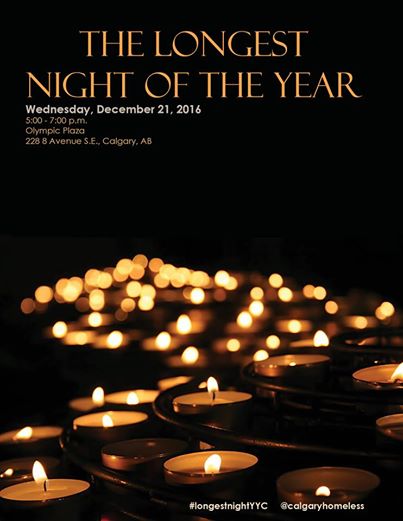
Today is Solstice. The Longest Night of the Year in the Northern Hemisphere.

After months of travelling deep into the darkness, today, the sun will rest low upon the horizon. There she will rest three days before slowly beginning the long journey back to summer Equinox. In her journey back into the light, she will breathe hope into the promise of spring bursting forth with new blossoms. She will breath possibility into the new buds bursting open. In her warm embrace she coax all beings out of hibernation.

She will breath. In and Out. In and Out. And we will rejoice in the sun’s welcoming rays.

For today, we remember.

We remember, the long journey here to this longest night. The long walk into the darkness and depths of winter.

This journey into the darkness of shadowed days where the sun moves back and forth in ever-shortening arcs giving night room to hold reign upon earth.  The darkness is not something we can avoid. Pass-over, under, or by. The darkness must be savoured, explored, journeyed into as we explore the essence of our creative spirits resting in winter’s embrace, breathing deeply into the knowing that soon, the cycle will continue, the earth will journey closer to the sun, and summer will once more hold us in its rays of light.

longest-nightFor today, re remember.
We remember, those for whom the journey here on earth ended in another season. We remember those whose hearts stopped beating on one final note and breath escaped their bodies to nourish life no more.

Today, we remember.

We remember, those who followed the sun’s journey and have now entered the eternal deep and left us here on earth without their smiles, their hopes, their presence. Who have left us here with only the memories of those we loved, cared for, dreamed with, and about. .

Today, we remember.

Tonight, if you are in Calgary, we are holding The Longest Night of the Year Memorial at Canada Olympic Park. Please join us in remember those whose long walks into the darkness never lead them home.


The Gift Project #storiesofhope

It is alive.

It is real.

It is ready for you.

baner-copyThe Gift Project has come into its own existence.  A little idea has become its own reality because of the generosity and creativity of Paul Long, Alexis Maledy, the amazing people at Corkscrew Media, Six Degrees Music Studios and Keys to Recovery.

Thirteen courageous and caring people shared their stories of recovery, of finding hope and home, after journeys through addiction.

These are powerful, compelling stories that touch deep and dig into the heart of our humanity, our shared human condition, our desire for connection, our need for belonging.

I hope you will join me in sharing these stories. In posting them on your social media pages. Pressing the LIKE button beneath each one.

And, as I build up The Gift Project’s social media presence, I hope you will follow along… and maybe even share one of your own stories of hope and encouragement in recovery.

Many blessings. Much gratitude.

http://www.thegiftproject.ca

HomeSpace: a home in our community for everyone.

Today is the release of the preliminary report of the Point-in-Time Count of Homelessness held October 19th in Albereta.

PIT Counts are interesting beasts. They provide a moment-in-time snapshot of homelessness in any given city. They are not the de facto scientific answer to who is homeless, how long they’ve been homeless, or what are the issues contributing to their state of being.

They are a moment in time of those counted on a given night.

Yet, often, media see the PIT results as the measure of a city’s success, or failure, to end homelessness.

The PIT number only tells part of the story. The part where we count who is on the streets or in shelter, incarcerated with no fixed address, or hospitalized with no fixed address on that night.

The more important data is how well a city is doing at housing those for whom home was a long ago place. How well those who are housed thrive in housing. How much is health, physical and mental well-being improving.

In Calgary, we are doing a stellar job of ensuring the system of care is strong, responsive and proactive. We have agencies who work together to share data, discuss housing plans, develop strategies to ensure the system of care is using its resources as impactfully as possible.

Challenge is, the economic climate, the lack of affordable housing especially for those with lower incomes, is limited in our city.

We need housing.

homespace-logoWhich is why I am so proud to work for an organization that had the courage to take the bold move of transferring its $60 million housing portfolio to an independent entity so that organization could focus on the development, building and management of housing for the h0meless-serving sector and vulnerable Calgarians.

On Friday afternoon I stood amidst friends, colleagues, agency partners, government officials and stakeholders as HomeSpace Society was officially launched.

It was exciting. Moving. Thrilling to see this dream that was seeded in the early 2000’s become a reality.

Some of my favourite people from the Foundation where I work have moved over to HomeSpace — and the enthusiasm, commitment and passionate excellence they carry with them is inspiring, and hopeful.

They know their job like no one else.

They know what it takes to move a project from concept, to land acquisition, to development approval and to final build.

They know what vulnerable people need for housing and to stay housed. And, they know how to work with the funded agencies who provide supports to tenants so that those for whom homelessness has been a long time reality can let go of the ‘homeless identity’ to claim their new way of being in the world, ‘at home’.

It took a lot of hard work, commitment, vision and patience for HomeSpace to become a reality.

Congratulations to everyone involved. From CHF management, board members, and team to the entire team at HomeSpace, and everyone who played a role. Job well done!

I’m excited about what the future will bring for vulnerable Calgarians, the homeless-serving sector, and our city.

This morning we will be talking about the people experiencing homelessness on one night in our city. And while we won’t be talking about those who are housed, it’s their story that must be told, because that the bigger picture of how Calgarians are making a difference, together!

Silly statements and other limiting words

I am talking with two of attendees at an event. They are both Indigenous Peoples. Both well-versed in sensitivities around Indigenous issues.  Both have been discriminated against. Branded as ‘other’. Felt the disdain of those who call themselves ‘white’.

I tell them about my awakening at an Indigenous training course I took a couple of weeks ago.

“I have never stopped to think about the richness and depth of Canadian culture as being grounded in Indigenous Peoples,” I tell them. “I have fallen for the discourse that our history as a nation began when white man arrived.”

It didn’t. It began thousands of years ago with a culture that is deeply connected to the land, the elements, nature and a desire to walk softly upon the earth.

“Discrimination and ‘other’ thinking is pervasive,” I say. “I participate in it without even recognizing I am participating in it.”

One of the men mentions the statement we make as a Foundation at the beginning of all our events acknowledging that we are standing on traditional Treaty 7 land.

“You know that calling it ‘Treaty 7’ land is a reference to colonization,” one of the individuals mentions. “For many of us, it is a reminder of all that has harmed us, not strengthened us.”

I am taken aback.

It is subtle this discrimination, this ‘other’ thinking.

Later, I am at a roundtable discussion on the National Housing Strategy the Federal Government is currently in the process of drafting.

Our host is a public figure. An elected official. Well-respected. Well liked. He has always been conscious and considerate in his approach to homelessness.

I am listening to the conversation. To my peers around the table talking about the content in the documents before us.

On a page referring to the themes to be covered by the Strategy is a list identifying those who need extra consideration due to the specialized needs of their demographic/human condition. ‘Homeless, seniors, youth, families, people with disabilities’. There is no mention of Indigenous Peoples.

Someone mentions the omission. The elected representative is surprised there is no mention. He comments that he doesn’t see how it could have gotten so far into development with such a glaring omission.

“Perhaps it’s like the language we use without thinking,” I say. And I ask him about a comment he had made earlier in the session. “You said, ‘We are not going to make silly statements like, we’re going to end homelessness. We know we’re not.”

How is that a silly statement, I ask. It is aspirational. Forward-thinking. But silly?

There is a pause and then they talk about how they were referring to the timeline. He tries to justify the statement until someone else around the table also speaks up in support of my question. “If the government plans on ensuring everyone has access to housing, won’t that mean we end homelessness?”

Another pause.

I stand corrected, the elected official says.

Language.

We get hung up in our words. Use them to divide and conquer. To separate and clarify.

We make words the ground upon which we stand, the positions we will not cede, the space we will not move from.

And in the process, our language becomes the battlefield upon which we stake our claim to be right. It becomes our battery of defenses against another so that we don’t have to give up our right to stand our ground.

It was a short week and a tough one. A week where words spoken awakened my consciousness to injustices caused by the language of Treaties that continue to define and marginalize an entire Nation. A week where language failed to inspire by its use of silly statements about what we can, or cannot do, amongst a group of people passionately committed to ending the very thing they called silly.

I believe passionately in our human capacity to create possibility from the seemingly impossible.

I believe we are all one humanity. One human race.

But the words I heard this week, and the ones omitted when they needed to be spoken, are cause for concern.

How can we stop discrimination? How can we end homelessness when the very words we use continue to mire people in the limited thinking of the past? How can we inspire one another to do better when the words we use build walls and tear down confidence in our ability to contribute our best?


Panhandling: to give or not to give.

He is walking towards me, along the island between the opposite lanes of traffic. He stops several cars in front of me, jumps off the cement onto the roadway, gets close to the window of the driver and starts to gesticulate wildly in the air, occasionally thumping his chest and the cardboard sign he holds against it.

A hand reaches out of the window, gives him something, I assume money.

He moves to the next car. Repeats.

Nothing happens.

He gesticulated more wildly until eventually throwing his hands up in the air, screaming something at the driver’s window and moving onto the next car in line.

He does this until he is beside my car. He starts to wave wildly. I smile and shake my head, ‘no’. On principle I do not give to panhandlers who walk on the road at stop lights. It is dangerous and it is against the law.

He flings his arms up into the air, angrily shaking his sign in front of him.

I do nothing.

He keeps shaking and yelling. I do not open my window.

I do want to cry. To tell him to stop it. To not abuse drivers in such a way. To not use a busy street as his opportunity to gather coin.

I also want to tell him to stop trying to shame me into giving him money. To make me feel guilty.

But I know that is not his ‘doing’. It is my feeling in response to his doings.

The light turns green, traffic begins to move and I drive on.

He remains on the median waiting for traffic to once again stop.

I think about this man as I drive. How I felt angry, frustrated, sad. How I wanted to cry.

Long ago, when I started working at a homeless shelter, I quit giving to panhandlers. I realized that our city offers many opportunities for people to get food, shelter, support. Giving on the street limits my opportunity to leverage my contributions on ending homelessness by giving to those doing the work.

And on a personal level, I want to feel good about my giving. I want to give because I feel it is the right thing to do. It is helping to end homelessness, not contributing to its presence on traffic islands and street corners.

And there’s the rub. We may end homelessness but we will not end people panhandling simply by ending homelessness.

Mental health issues, addictions aside, people panhandle like that man yesterday because it works. Out of the 10 cars he will probably approach every 3-5 minutes, if he gets just one person to give him $2, he will raise about $20 – $40 in an hour. Multiply that by three or four  hours a day, and he will have garnered a good return on his investment.

Challenge is, it’s dangerous. It does not support the bigger picture. And it’s against the law. Which means, when we give to someone who is breaking the law because of the location of their panhandling, we are contributing to law-breaking and albeit one could argue it is a small way, we are tearing apart the underpinnings of a just society.

I do not know the story of the man who was panhandling yesterday. Many of the panhandlers I know who do use traffic lights as their location of choice, are housed. They use panhandling in such a way to supplement their income and because it’s a habit.

I almost cried yesterday. Not because I didn’t give, but rather, because the man asking was so emotive in his asking, I questioned whether or not I was a ‘good person’ by not giving.

I know I am but in that moment in time, I almost felt coerced into colluding with someone’s belief that my giving would make all the difference in the world to them, or at least make them go away. I know it won’t.

Namaste.

When one man stands tall, we all rise up: ending homelessness.

It will be home to 30 individuals with long-term lived experience of homelessness.

Housing. Supports. Community. Possibility.

These things will be there too.

Yesterday, we celebrated the official opening of Stepping Stone Manor, a 30 unit permanent housing apartment building with supports for individuals exiting chronic homelessness in our city. Dignitaries, builders from the RESOLVE Campaign who are supporting the building of an additional 7 – 10 more such buildings in our city, agency partners, neighbours, all came out to be part of the celebration.

Those who spoke had great words to say. About how we need more affordable housing. How ending homelessness begins with housing first. How people experience homelessness because of societal issues, not because they choose it. How addictions, divorce, mental health issues, all these things contribute to someone becoming homeless — but only when we do not have the necessary richness in our social welfare system to provide access to the supports they need to live their lives with dignity. When we do not have enough richness in our communities to build or safeguard someone’s resilience so they can weather life’s ups and downs.

It was inspiring. Exciting. Affirming to hear the speakers. To see so many people come out to be part of the event.

And then, Michael spoke. And what was a ‘hey let’s celebrate what we’re doing to make a difference’ became, ‘let’s remember that we don’t do this ‘for’ people so we feel good, we are doing it with them so that in the possibilities created, we have a better chance of becoming a better society where everyone knows that they belong, where everyone is treated with dignity, respect, kindness, care.

Michael spent 20 years living on the streets.

He slept in the woods. Used and abused drugs and alcohol.

He felt the shame of being imprisoned for things he’d done. The way he had become, the way he so often felt and was treated as ‘less than human’.

Fifteen months ago, Michael was released from prison and the Calgary John Howard Society (CJHS) started supporting him in his transition away from the streets, away from reacting to his life through crime, to finding the path he is so firmly committed to walking. The path of a brave, honourable and caring man.

“Housing is everything,” he told the crowd of 60 or so guests. “It gave me a place to begin again.”

He talked about the support CJHS has given him through housing. How it helped him make the decision to enter rehab. To get clean and sober. To walk a different path than through substance abuse and crime.

And it helped him see clearly the difference he can make when walking this path.

“I could look at the last 20 years as wasted or I can look forward to the next 20 years as an opportunity to do better,” he said.

His decision is to see the future through eyes of possibility, hope, growth, strength.

Last week, in a conversation with Michael about speaking at the event, he told me he still struggles to release his shame.

“You don’t deserve to carry shame,” I told him. “You deserve to carry pride, courage, strength.”

Yesterday, I watched a man step out from behind his past to claim his right to stand tall, to stand proud, to stand for what he believes in.

The chance to ‘do right’ for himself, his community, his people. The right to let go of the past. The right to build a new life on the path of his choosing. The right to see himself through eyes of compassion, love and hope. The right to be the true human being he is, not the one he was labelled before he awoke to his capacity to make a difference by being the difference he wants to create for all his relations.

Yesterday, I witnessed a man stand tall. He shone bright and in his light he illuminated the path for all to see; Ending homelessness doesn’t happen because one man decides to get off the streets. It happens because we as a society collectively take action to create paths away from homelessness for everyone. Where we all recognize that one man is every man, woman and child who has not had the opportunity to find their way home, not because they didn’t want to, but because there was no path.

Yesterday, a brilliant human being courageously stood tall and spoke up. The path is clear. We must all work together to end homelessness. It is the right thing to do.

Namaste.


To end homelessness in the future, we must begin with the children today.

It is a startling fact. At any given time, approximately 1% of children in Alberta will be involved with foster care.

44% of adults experiencing homelessness report having had experience with foster care.

According to a 2009 report by the BC Representative for children and youth, youth in care are 17 times more likely to be hospitalized for mental health issues than the general public. By 21 years of age, 41 percent of children and youth in care will have contact with the criminal justice system, compared to only 6.6 percent of the general population in the same age group.

Put another way, involvement in the foster care system nurtures homelessness, mental health issues, criminal justice interactions and other risky behaviours in children just as we nurture resiliency, self-sufficiency, self-confidence in our children.

To be fair to the people providing foster care, it is not ‘them’ creating the issue. Many wonderful, well-meaning and competent caring people foster children in their homes.

It is more systemic. More foundational. We believe foster care works.

In that belief we overlook the impact lack of permanency has on the child. As reported in the Canadian Medical Association Journal, “Children who have a government as their parent, no matter how well-intentioned or necessary that arrangement is, are often damaged by it… They are damaged because multiple moves to living arrangements with multiple caregivers – no matter how loving the foster parents – do not promote stability, security and attachment, the building blocks every child and youth needs to succeed.”  (Trupin EW, Tarico VS, Low BP, et al. Children on child protective service case-loads: prevalence and nature of serious emotional disturbance. Child Abuse Negl 1993;17-345-55.)

To end homelessness in adults, we must stop fostering it in children.

This thought came top of mind this morning when a girlfriend sent me a link to one of the stories from the Calgary Drop-In & Rehab Centre’s project Shelter from the Storm. I am in awe of this project which was spearheaded by Michael Frisby two years ago. It is powerful, moving and soulful. I wanted to find the times for a concert, Verses vs Homelessness, that is happening this weekend and went to the DI’s website and on the homepage, the video they did of a child’s journey into adulthood, and homelessness, played automatically.

This is a powerful, and haunting, story.

One of the actors is a client of the DI. Has been for way too long. His journey into homelessness began in adulthood with the breakdown of his marriage, an unaddressed addiction and a prolonged journey through self-defeating behaviours that lead him into homelessness. The seeds of that journey were planted in childhood. They may never have sprouted if he had not experienced the breakdown of his marriage and the subsequent loss of his relationship with his child. He may not have known the challenges of homelessness if he hadn’t succumbed to an addiction that has haunted him for years. He once told me, “I hate myself so I drink and once sober, I remember why I hate myself and so, I drink again to forget”.

An emergency shelter should never become a longterm home for anyone. But too often it does. Not because the individual chooses it, but mostly because the other options seem too daunting, too scary, too impossible to even be considered. The man in the video has thought about housing. He’s thought about leaving. He’s thought about moving on. But always, the lure of the familiar calls him back. The community of understanding draws him in. And his fear of what will happen to him beyond the world he has come to know so well, traps him from stepping out.

We don’t know what it’s like to be homeless. We don’t know what happens to someone’s psyche when they lose everything and find themselves in the one place they never imagined they would end up.

We just don’t know.

In Shelter from the Storm, Michael and all the performers share the experience through song and verse and music and story.  They are giving us an insider’s view of the loss and pain and sorrow that is called homelessness.

These are important stories to hear. What’s even more important, is that we stop creating opportunities for these stories to become someone’s life. and that begins with taking care of the children.

To stop homelessness in the future, we need to stop doing the things that foster the growth of it in children today.

The Face of NIMBY is Not Pretty

“Who’s going to live here?”  It is one of the most frequently asked question when talking to communities about housing for formerly homeless individuals.

The challenge is, the answer is the thing that causes their fear to rise. Individuals with long-term experience of homelessness.

Not because formerly homeless individuals and families are scary, but rather, because often we carry misconceptions of what the state of homelessness is and who the people experiencing it are.

Homeless and criminal are not the same words; yet there are those who believe Homeless = Criminal.

People experiencing homelessness may have a criminal record. But then, it’s almost impossible to live in homelessness and not be ticketed for some infraction for which the majority of us would never be ticketed.

Jay-walking. Sitting on park benches. Open liquor in public spaces. Being intoxicated in public. Spitting on the sidewalk. Littering. Urinating in public. These things happen every day in our city, especially during Stampede, yet often they are overlooked by authorities because, well really? Are you going to ticket everyone? And anyway, it’s Stampede. It’s just what happens.

In homelessness, you do not have the luxury of a backyard or living room to pop open a beer and kick back. You do not have access to a washroom when you need it.

As to jay-walking and sitting on park benches and other things that people of all walks of life do everyday, they are less likely to be ticketed at the same rate as those who are visibly homeless. Add to that the fact that individuals in homelessness do not have the resources to pay fines and often do not turn up for court dates, it’s easy to see how a criminal record can easily follow.

The other factor that leads to individuals in homelessness having criminal records is that addictions are often a result of, or part of the homeless condition. And, even though homelessness accounts for less than 0.1% of the population, over 40% of those experiencing it self-report having an addiction (approximately 10% of the total population will report being impacted by an addiction in their lifetime).

Again, without the resources to a) support an addiction, or b) get help; individuals will turn to other means to get the substances they need to feed the beast of an addiction.

And that’s why housing with supports is so important.

Homelessness by its very nature is an unstable condition. With housing and supports, individuals begin to take stock of their lives from a place of stability. In that place, evidence clearly shows that self-care follows. Use of illegal substances, interactions with police and emergency response teams, incarcerations, all decrease.

For six years I worked at one of Canada’s largest homeless shelters. During that time I never once experienced a mob scene where a mass of individuals yelled and threatened staff, demanding they answer questions or give them assurances they will be safe on our streets, or not be ticketed for sitting on a bench, or as happened the other night, give them the names of the people who were coming in that day to serve meals or sort clothing or a host of other jobs regularly filled-in by volunteers.

Yet, last week, when my co-workers and I attended an open house to meet with community about a proposed housing development for 28 formerly homelessness citizens , we were met with an angry mob threatening us, demanding answers, yelling out and demanding to know, “Who is going to live here?”


They weren’t there to talk about the merits of our proposal. The aesthetics of the building. Its fit within the architectural landscape or compliance with zoning.

They were there to talk about ‘the people’.

When a for-profit developer proposes an apartment building, community does not demand to know the income, life-history including criminal background-check, race, gender, faith of those moving in. They do not demand to know what will they do in their spare time. Because they have no right to know these things. And to ask would be to risk being charged with infractions of the Human Rights Act.

Yet, because people have been marginalized, impoverished, homeless, and are often without a voice, people feel they have the right to ask questions and use names that demean the human condition of fellow citizens. They feel they have the right to act out in ways that are more threatening and offensive than anyone I have met on the streets or in a shelter who is experiencing homelessness.

This week, I have been sifting through emails from community members regarding our project.

I am stunned by the face of NIMBYism (not in my backyard) many of those who have written in portray. It is not pretty.

Yet, at the same time, I am optimistic. Their opposition is not based on the merits of the development. It is all about fear.

We can, I hope, abate fear by continued engagement that heightens our awareness of the need to  lower our voices against and raise our voices for taking action to get homelessness off the streets and out of backyards by making it possible for people to find themselves at home.


7 Steps to Let Art Happen

7 steps to let art happen copy

With less than 24 hours to go before the 7 cities Conference on Housing First and Homelessness started, one of our keynote presenters took ill. We met as the organizing committee and the decision was made that I would give the address at noon the next day. It was specific to a play that was to be performed, one which I had a deep understanding of. It was my eldest daughter’s play which she’d written as a 20-year-old volunteer in the art program I’d started at the shelter where I used to work.

I knew I was best suited to set the stage for the play, but I was a tad panicked. I still had the official conference powerpoint to prepare and the final tweaks to the EMCEE notes to finish off. Plus, I was meeting the team at the hotel to help set up that evening.

Panic, fear, anxiety were not my friends.

I had to let them go. I breathed.

And then I breathed some more.

I arrived at the hotel for the opening reception and afterwards asked the team if they were okay setting up without me. They had no problem. It was all my head dancing with fear (and a little bit of procrastination) that made me feel like I ‘needed’ to be there.

I came home and worked on my presentation and suddenly, where I did not know it was already germinating, a presentation appeared with 7 key points to highlight how it was that art happened in a place where survival was the name of the game, and art was not considered part of the survival path.

That was my first lesson on how to Let Art Happen — anywhere. Trust in the process.  

In letting go of fear and giving into trust, the ideas and words and underlying framework of the presentation appeared. Which is also what happened when I first set up the Possibilities Project at the shelter. I simply trusted in the process. Trusted it was the right thing to do with a donation that had been given to the shelter from a church – they wanted to support art in the shelter. I knew I could make that happen simply by trusting in my own creative and artistic abilities.

The second step that became clear was Persistence is vital. I started writing the story of a man who kept refusing to come up to the studio space until one day, after weeks of asking, he simply said, “Now’s the time.” He became one of the cornerstones of the project’s success.

Find value in all things was a challenge the day I discovered much of the art stored in the large multi-purpose room had inadvertently been thrown into a dumpster on the loading dock. We salvaged much of it — and I used that event to leverage the value of having a dedicated art studio for the project.

Watching how the artists were delighted for each other when they sold a piece at the art shows was a true lesson in how to Be Grateful for all things. It didn’t matter if they sold a piece for $5 or if another sold 10 pieces to their one. They were all grateful for the opportunity to share their work.

From a man holding a paint brush for the first time in 20 years breaking into tears and committing himself to another path, to a woman selling her first piece and deciding to connect with supports to find a way out of homelessness, Always believe in miracles was vital to the success of the project.

We do not know what will happen when we Plant seeds of possibility. We can be confident something will. Seeds of possibility are closely linked to miracles — you need the seeds planted to grow into those beautiful miracles of life dancing all around.

Every life is a work of art. It’s important that we each Be the artist in our own lives. Artists honour their talent. They trust it and respect it. They value its presence and treat it with love and compassion and do not give up in believing in themselves, even on their darkest days. Artists let their creative expression out. Always. When we become like the artist, miracles happen, possibility explodes wide open and life expands into limitless opportunity to be ourselves, in every kind of weather, no matter where we are. All because, we Let Art Happen.

Let Art Happen.

  1. Trust in the process
  2. Persistence is vital
  3. Find value in all things
  4. Be grateful for all things
  5. Always believe in miracles
  6. Plant seeds of possibility
  7. Be the artist in your own life.


PS. The play was amazing. More about that in another post!