Give the Gift of Life | 52 Acts of Grace | Week 8

acts of grace week 8 copy

For the past few months I have been part of the organizing team for a conference that was held Wednesday, Thursday, Friday here in Calgary. The 7 cities Conference on Housing First and Homelessness attracted over 410 delegates, 85 presenters and people from across Canada.

When we were planning for the event, we wanted to create a space where knowledge could be shared, ideas sparked and successes recognized, as well as a place to learn from mistakes so we could all do better. We also wanted to create a space where we celebrated the amazing people who are at the front lines and in the back offices planning, organizing and mapping out strategies to end homelessness.

We decided to create a Photo Booth with a Hero Wall — a space where delegates could dress up, act silly, and take photos of their ‘inner hero’. People were also invited to complete two statements on a piece of coloured paper — Ending homelessness means… and  Excellence already turns up in my work… and to hold their answers up while they were having their photo taken in the photo booth.

The second question came from a conversation I had prior to the conference with one of our Friday keynote speakers, Michelle Cederberg. When I explained the Hero Wall she quickly identified ways to tie it in with her talk — and even came to the Thursday noon keynote session to ensure she aligned her talk with the theme of the conference and the audience. Her insightful and high-energy talk on energizing for excellence inspired everyone with simple and practical ways to take care of themselves. She offered helpful tips on feeding and tapping into our personal pool of internal energy so that we can direct our outward attention, in a healthy way, at the important work of ending homelessness. (I highly recommend Michelle as a keynote speaker)

Ending homelessness is hard work.

Having fun is good self-care.

When we were in the planning stages for the conference there was some concern the Photo Booth would be a dud. Nobody would dress-up. People would think it was silly.

We needn’t have worried.

The Photo Booth was a huge hit!

It showed very clearly that — we all want/need to ‘let our sillies out’, as Week 7’s Act of Grace suggested.

Taking ourselves too seriously can wield a death blow to creativity, energy, enthusiasm and compassion.

Cutting loose, letting your hair down, letting it all hang out — they are antidotes to the weary that can overshadow our work and lives when we get stuck trying to push through each day pulling our energy out of an empty well.

Did you ‘let your sillies out’ last week? How did it go?


The Mob.

I am searching for the “face of the divine” in the strangers circling me. I am searching to see them as more than the mob they have coalesced into. I am searching for the essence of our humanity, for the same kind of different we each share. And I am blind.

Fear does that.

It blinds me to seeing, as St. Benedict counselled, ‘the face of the divine’ in every stranger at the door.

My fear is not-ill placed.

I am at an open house for an apartment building the Foundation I work for is considering building. Some community members have already been clear they do not want this 28 unit apartment building for formerly homeless individuals in their community.

The challenge is, we are not there to talk about the people who will be housed. As I told one man, each person we house has the same right to live in community as you and I do.

But the people who have come to this open house do not want to talk about the merits of the development. Does it comply with zoning? Can we decrease the density? Can we change the facade?

They are there to tell us they do not want ‘those people’, or as one man called them the week before, ‘this litter’ in their community.

And my heart is heavy.

But I am not afraid. I believe in the power of our human capacity to connect, to ‘see’ beyond the labels and into the heart of what is the right thing to do.

And then suddenly, fear awakens.

Where the room is filled with small circles of people standing by the renderings we have on display of what the building will look like, talking to my co-workers at the various stations, it suddenly becomes a full blown mob.

All it takes is one woman yelling into the centre of the room “Gather round people. We gotta talk. I’m not liking what I’m hearing.”

And the crowd circles around her. Their murmuring becomes a roar. They turn to face me and start chanting in response to a man’s calling out, “Do we want them here?”

“No! No! No!” And as a mob they raise one arm into the air, fists clenched and keep shouting and glaring at me and pumping their fists into the air.

They are between me and the exit. My back is up against the wall.

“What’s it going to take for you to hear us Louise? We Don’t Want You Here?” the woman who incited the mob yells out.

I take a breath.

“We hear you,” I tell her. A co-worker has come to stand beside me. I turn to her. “What should we do?” she asks. “I think we need to pack up and leave,” I reply.

I turn back to the crowd. “We hear you and so we are going to pack up our display and leave.”

Their anger rises. “No! No! No!” they scream as one voice.

The woman calls out again. “Tell us what we have to do to get you to hear us! We don’t want you!”

I breathe again. Fear grows with each breath as the mob circles closer around me.

“We hear you. We are leaving so you can meet and talk about your next steps.”

The woman screams. “No! Tell us what to do.”

I keep breathing, willing the tears, the shaking in my body to not rise up and take over. “We cannot tell you what to do. Good night and thank you for coming.”

And my co-worker and I turn our backs on the crowd and begin to pack up our information.

With no foci, the mob energy deflates. Someone turns on the lights at the far side of the room and the crowd moves as a wave to take seats where a microphone was already set up for a town hall meeting.

A woman approaches as I am pulling the panels of the display pieces together. “I really came here tonight to learn more about the project,” she tells me.

“I appreciate that,” I reply. “What would you like to know?”

And we talk for ten minutes about the project as the mob settles into chairs on the other side of the room and begin to discuss how to block our bringing those people into their community.

“Why can’t you tell us who will live here?” she asks.

“We have,” I reply. “They are individuals with a history of long term homelessness who need housing and supports in order to end their homelessness. We cannot be more specific than that.”

And therein lies the challenge.

The community wants certainty. They want names of those will live there, histories. To give them what they want would violate the human rights of those we serve. The people we serve deserve better than that.

It is not the ‘who’ the community really wants to know. They want to know the crime that already scares them will end. They want to know their future is secure.

We can tell them our experience in our over 20 buildings in the city does not show increased crime around our buildings. We can show them the evidence from crime data and maps, findings of property values.

They cannot hear us because ultimately, it is not about the merits of the development nor the evidence in other communities. It is about their fear of the world around them today and their fear of what their world will look like in the future.

And I cannot change their fear.

I faced a mob the other night. I was scared. I felt unsafe. Upset. Exposed.

I am writing about it because I am still shaken, still struggling to see ‘the divine’ in the ugly face of the mob. Yet I know, it is the path to finding our humanity beyond our fear of one another.

And so I continue to seek the divine in every face and in that journey, my fear abates.
 

We are all doing our best.

It is an interesting thought waiting for me this morning in my email. From TUT: A Note from the Universe.  “…no matter what has happened, you did the very best you could.  And so did those who may have let you down.”

Other than those of personality disordered behaviours of the negative kind (and yes, there are some of those in this great big beautiful world), the vast majority of the +7.4 billion human beings on this planet are trying to do their best. Every day. Day in. Day out.

Like you and me, they experience moments of joy, sadness, sorrow. They have felt the loss of love, belonging, connection.

Like you and me, they have searched for meaning. They have wondered, why am I here? Is this all there is? What’s my purpose? Or even, What’s the point?

Like you and me, they have struggled to understand why some people do the things they do that hurt them. Why it feels some days like they are alone.

And, like you and me, they have done things they are not proud of. Done things that hurt others. Let others down. Upset apple carts and tipped over hopes and dreams.

Like you and me, they were not consciously working at letting anyone down, tripping someone up or fighting them off. They are, like you and me, just doing their best to get along, keep going, keep moving forward. They are all striving to give what they can, however they can, where ever they are on their journey so that they can feel like they got something in return for their investment in life.

Framed that way, it’s easier to accept that sometimes, we misstep. Sometimes, we don’t get it ‘right’. Sometimes, we just aren’t playing at our highest — but we are doing the best we can in that moment.

The other night I attended a community association meeting in an area where the homeless foundation I work for is looking to purchase property and build a small apartment building for individuals with lived experience of homelessness (less than 30 units). The board of this association is mixed 50/50 on their support of our project. Like many communities we talk to, those not in support feel that the community has enough low income developments, that they are at a tipping point with the point of no return towards decline too close for comfort given the socio/economic mix of the community.

At the meeting, two community members in close proximity to the property we are considering purchasing came to present their views of the development. “Nobody wants you, not even the businesses in the area,” they said. And one by one they listed off businesses and after each name said, “They don’t want you.” “They don’t want you.” “They don’t want you.”

Clinging to their position of ‘you don’t belong here’, it was challenging to provide these individuals with any facts.

Our evidence, and research from across North America, show that a development of this size does not negatively impact community with higher crime rates and lower property values. In fact, the evidence shows that a low-income project of this size has little to no impact on a community. Crime stays at historical levels, though it can drop given the increased attention to safety the not-for-profit brings to the community, and property values continue to follow prevailing market trends.

Beyond the facts of this kind of development however, is the fact that these individuals weren’t there to do their worst for their community. They were there to do what they believed was best.

It is easy in emotionally charged situations to sit in judgement of what another is doing, especially if what they are doing does not align with what you see as the preferred outcome.

I have been to many of these kinds of meetings. Always, on both sides of the conversation, people sit with their deep beliefs over what makes community work. And both sides work hard to get the other side to shift their perspective to see it through their point of view. Both sides want to defend their positions. Both sides want to protect their right to build better community — the best way they see to do it.

I believe in the vision and mission of creating better community through ending homelessness.

I also believe that within individual communities, people want to create better through ending those things which disturb their peace of mind and disrupt the vibrancy and health of the community they know. They are doing their best to protect what they know and have today so that they can have some reassurance the future of their community does not slip over the tipping point into such disorder they too will no longer feel like they belong there either.

Having spent the past 10 years working in the homeless-serving sector, I believe we cannot end homelessness by telling people ‘you don’t belong in our community’, or conversely, “we belong in your community”. We can end it by recognizing that we are all doing our best — and sometimes, our best means finding common ground through shifting our position from fearing what we don’t know to seeing the human cost of keeping homelessness on our streets.

We all belong in community. We all have the right to find our way home, even when the way we get there might be different than yours or mine.

Namaste.


No matter what side of the street you’re on, everyone belongs in community.

“I don’t give to panhandlers,” she tells me. “I just walk right by.”

I am listening intently. She is there to find out more about affordable housing for formerly homeless citizens and I am there to hear her views.

“Nobody listens to what I have to say,” she tells me. “So why should I bother to share my thoughts?”

“Your voice matters,” I tell her. “And if you don’t share it, we won’t hear it.”

She looks at me with suspicion. Yeah. Right, her quizzical look seems to say.

She goes on to tell me about last summer when she went downtown for a Stampede Breakfast and afterwards, as she walked towards Rope Square, a big outdoor performance space that pops up during Stampede in the City Centre, she walked past a man who asked her if she could spare some change so he could buy a cup of coffee.

“You know they’ve got free pancakes and sausages a couple of blocks away,” she told him. “Why don’t you go get in line?”

The man apparently laughed at her suggestion he go line up and replied. “I’m not going to line up for breakfast!”

She was shocked. “Imagine him not being willing to go and line up for food yet he’s willing to beg for money,” she told me indignantly.

“Was he visibly homeless?” I asked.

“Oh yes,” she replied. “He was quite dirty and kind of smelly too.”

“I wonder if his reluctance to line up had more to do with his experience of how people on the street treat him,” I commented. “Perhaps he’s been abused so often by passers-by he doesn’t want to risk what people will say to him if he stands in line.”

“Oh my,” she replied. “I hadn’t looked at it that way. I wonder if he was more afraid than lazy.”  She paused and seemed to get lost in her thoughts for a few moments before adding, “It’s horrible what we do to each other isn’t it?”

Yes it is, I replied.

Last night I attended a community Open House to talk about a new affordable housing project the Foundation I work for is looking to build. My job was to answer questions, to listen, to encourage people to fill out the comment forms as they left the room.

It was also to hold space for each person in attendance to give voice to their feedback, their concerns, their opinions. Without judgement. Without pushing back into their opinions. Without trying to change their minds but rather, to create common ground in which every voice was heard.

A group of women I approached to ask if I could answer their questions told me they had none. They hated the idea and didn’t want to talk about it.

Another man told me I was lying, no matter what I said in response to his questions, he wanted to hold fast to his belief he was right.

Fear is a powerful emotion. It can block our vision, shut down our capacity to hear, close off our minds.

As I said to one man, “We all fear change. This is a community that is experiencing great change on every level. Fear is a natural response.”

“I’m afraid these people will come here and destroy everything,” he replied.

“Is everything the way you like it now?” I asked.

His response was fast and vehement. “Oh no! This community is a mess. It’s not like it used to be.”

His ‘used to be’ was over 50 years ago when he and his bride moved into the house they still live in today. “There were kids everywhere,” he said. “We knew everyone on our street. Today, I barely know my next door neighbour.”

It is hard to accept change when what we are yearning for is a past that no longer exists. It is hard to see the future when all we see is the loss of what we once had that gave us a sense of belonging in our community.

For the people who took the time to share their views last night, whether they were for or against the project, there was a common thread throughout the conversation. ‘Our community has changed.’

As I stood and watched the people milling about, the small groups gathering, some of them eyeing those of us from the Foundation with suspicion, angrily talking amongst themselves, while others smiled and talked about the possibilities of the project, I was reminded of Ghandi’s quote, “Be the change you want to see in the world.”

For those who came out to speak against the project, they are being the change they want to see in the world. They are working hard to protect what they have so that they can continue to feel like they belong in their community.

For those who were in favour of the project, they too are intent on creating the change they want to see in the world.

They are all part of community. That powerful place of connection and belonging, no matter what side of the street they walk.

Namaste.


To get out of the basement, you gotta get to higher ground.

Years ago, I met a man named Collin who wanted nothing more than to be a role model for his sons and the youth in his community on a Reserve in Saskatchewan.

He told me this while taking a course on self-esteem I was teaching at the homeless shelter where I used to work.

“I don’t get it, Louise,” he said as we were discussing the concept of ‘balcony people’ versus ‘basement dwellers’. “I’ve been sober for 3 months and all my friends here want me to do is go drink with them. Why can’t they be happy for me? Why do they want me to get drunk again?”

Collin had spent many, many years in a drunken stupor. He’d left his wife and sons behind and followed the path that almost killed him until one day he realized he couldn’t do it anymore.

“I didn’t want to be that drunken Indian people saw lying on the sidewalk. But I didn’t know how to get up,” he said. And then in Rehab for yet another time, light slipped through the cracks of his despair. He realized he couldn’t show his sons, as well as the youth on the Reserve from where he came, what it meant to walk the path of honour and pride unless he got sober.

It was his dream. To return to his Reserve and teach his sons, and all the youth, what it meant to walk with your head held high, proud of your heritage, proud of your People.

Collin found his balcony and he wasn’t coming off of it.

The challenge was, he still had a lot of people around him who were scared of looking up. Scared of reaching up from the gutter where they drifted through every day, their senses dulled by drugs and alcohol.

“What if you’re already doing what you dreamt of right where you are?” I asked Collin.

“What do you mean?” he replied. The lines around his deep black eyes crinkled up, deep furrows appeared in his brow. He shoved the tip of the white cowboy hat he always wore back from his forehead.

“What if your getting sober shows them that it is possible. That no matter how often they tell themselves they can’t do it, the path of sobriety is open for them too.”

“Then why don’t they just get on with it?” he asked. He smiled when he said it. He knew the answer. “Because it’s not that simple. Right? I was one of the basement dwellers too.”

He sat quietly for a few moments before sharing the rest of his thoughts. “If I’m in the basement living in the dark, it’s hard to see there’s a path leading towards the light, not just deeper into the dark.”

And that’s when the truth of his position hit him. “I couldn’t see in the basement because I was surrounded by people who were just as scared and lost as me. And they’re no different. They can’t see the beauty of the view I see from up on the balcony because they’re down there living in the dark. I can’t go back to the basement, but I can keep standing on my balcony showing them what’s possible.”

Climbing out of the basement is not an easy task. We want to cling to the darkness, hold onto the familiar, stick with what we know. And if it includes using drugs and alcohol to keep us numbed in that place, it can be even scarier to step up.

The only way out is to let go of what’s holding us down.

Staying out of the familiarity of the basement can be even harder when we are surrounded by those we knew ‘back there’. In their fear of what is ‘out here’ they want us to come back and help them feel safe in the dark.


Collin never got to show his sons what it meant to live a proud man. He died of a heart attack three months after our conversation.

But he did get to show those around him who feared the path out of the basement that it was okay to step into the light. He never gave up on his sobriety in those final months. He never let go of standing on his balcony and telling others about the beauty of the view he saw from up above.

I like to think he died with a proud heart. That even as it beat the final drum note of his life, he was standing tall, standing proud on his balcony surveying the wide expanse of the universe around him knowing that in walking the path out of the darkness, he was showing his People how not to be afraid of the light.


Can we end homelessness?

In January, 2008, I sat in a room with a few hundred other Calgarians, most of them involved in some way in the homeless-serving sector, and applauded the launch of Calgary’s 10 Year Plan to End Homelessness.

When asked, “Do you think we can do it?” my answer was  always, “It would be great if we could.” When pressed, I’d temper my enthusiasm with words of caution. “What do we mean when we say we will end it? Do we mean people will never pan handle again? Or fall on hard times with no place to go? Or not need emergency support?

If ending homelessness meant that, the answer was no.

But did I believe in the vision? Absolutely.

It is big and hairy and audacious, and it is vital to hold ourselves accountable to a vision like that if we are to make a difference, if we are to ensure people don’t get trapped in homelessness for years.

“Jack”* was in his late 40s the first time he stepped across the threshold of a shelter. He only stayed a few days before he sorted out the problem that lead him there. Before that, he’d done everything he could to avoid the shelter doors. He’d found a roommate to avoid Calgary’s high rents. When the room mate situation didn’t work out, he’d stayed with friends and when he ran out of friends, he spent a few nights sleeping in a park. He didn’t like that very much so eventually, believing himself to have run out of options, he landed at the shelter door.

The first time was hard. He was scared. Worried about what it meant to have fallen so far down he had no other recourse but to enter the shelter.

The second time, a couple of years later, was easier and by the third time he stayed at the shelter, he had filtered through enough of his fears and reframed the experience to mean, he wasn’t ‘a loser’, which is what he’d told himself the first time. He was simply using the resources available. And anyway, the folks at the shelter were nice and as long as he kept to himself, nobody bothered him. He was still determined to not stay there for long. He was still committed to getting out as soon as he could.

And then, the housing market went crazy. Afford his own place? Not going to happen.

What he thought would be just a few week’s stay became months. Months eased into years and suddenly, without his even noticing, Jack found himself permanently entrenched at the shelter.

“It became comfortable,” he told me once when I worked at the shelter. “Nine years go by pretty fast if you’re not watching.”

I ran into Jack not long ago. I was walking west. He was walking east. When he saw me he stopped to say hello and give me a hug. “I missed you when you left,” he told me.

We chatted for a few moments before I asked him where he was living now. “Are you still at the shelter?” I asked him.

“Nope,” he replied. “I got a place.” And he smiled and stood taller, straighter, prouder.

When Jack turned 65 and his old age benefits started to come in, he decided it was time to make a change. With the help of a senior’s housing agency he found subsidized housing he could afford. He’d been living on his own for a year when I ran into him on the street and was determined he was never going back.

“It used to be I’d work temp jobs, get some cash and blow it all on weekends,” he told me. “Even though I had the same amount of money then as I have now, I didn’t have a lot of hope I’d ever get out of that place ’cause I couldn’t see how I was going to afford it.”

For Jack, as for so many, Calgary’s high cost of living keeps them trapped in believing there is no alternative, there is no place for them to call home other than a shelter. As one man I know once said, “I’ve got a roof over my head and food on the table. I can’t complain about sharing my place with a few hundred other roommates. I can afford free.”

It wasn’t until Jack ‘aged out’ that a path to stability and independence appeared.

We can do better. We must.

Calgary’s Plan to End Homelessness is about ensuring people don’t get trapped in using shelter as a long term solution to their housing needs. It’s about ensuring Calgary has the system of care, the necessary affordable housing, and the right supports to ensure homelessness does not become a trap from which the only escape is to age out or die.

We will not be able to open the doors to home without a vision that says, “Yes. Together, we will end homelessness.”

Eight years ago I sat in a room filled with hope and possibility and a belief that together, we can make a difference.

A lot has changed since that day. We’ve learned a great deal. Acquired more information and data to base our decisions upon. We’ve filled in gaps, streamlined processes and gained a better understanding of what it means to be homeless, what it means to end it, and what it takes to do it.

One thing hasn’t changed. My belief that it is vital that each of us hold space for the vision of ending homelessness. Each of us believe in our capacity to make happen.

For Jack’s sake, and for thousands of others, we must.

***************

*Not his real name.


The story in our hands.

Hands. To hold. To carry. To touch. To feel.

Hands. They tell a story, our story, our past. They bridge the space between us, they reach within, they stretch beyond.

Hands.

Yesterday, I met a woman whose hands told the story of her life on the streets. Hard. Calloused. Strong. Her hands held mine in their vice-like grip as she poured out her grief, her sorrow, her frustration, her anger.

Her hands pushed the hair back from her face, they sliced the air as she told the story of fighting for every breath she takes. Of fighting for a space to call her own, of reaching for one small piece of comfort, ease, truth, acceptance.

And in her story-telling, she held out her hands towards me and showed me her cracked palms and insisted, You couldn’t imagine what it’s like. You just couldn’t imagine.

What I hear is your life is hard, very hard, I said to her.

And she bowed her head as tears flowed from her eyes. And then, with a shrug, she straightened up, angrily wiped away her tears with one hand and replied, It’s the life I’ve got. I gotta deal with it.

A few years ago, I sat at the bedside of a man from the shelter where I worked as he transitioned from this life to whatever lay beyond. I held his calloused hand in mine and felt the story of his life unravel in my palms.

I knew him well. He was one of the first people to come to the art program I’d started at the shelter. James had a love of photography and used whatever money he earned shovelling snow, working temp or picking bottles to purchase a camera, computer, software and other photography related tools that would help him improve his art.

It’s my retirement program, he’d laugh.

Retirement never came.

He’d been homeless for years and though alcohol had been a driving force in the tearing apart of his former life, he no longer drank. He mostly just kept to himself, did his work, took his photos and offered them for sale at our various art shows.

He was gifted. And passionate. His hands held his camera steady, guiding his eyes to the story beyond the picture he was taking.

And they never failed. They always found the beauty in the mundane, the unique angle in the light, the poignant story in a window.

His were steady hands. Hard-working. Strong.

As the cancer that gripped his body began to eat away at his life, his hands grew softer. Quiet. Until the final night when I sat with him in a room at a hospice just outside the city and heard his final indrawn breath and felt the last touch of warmth leave his body. For a moment, his hands lay still in mine until I had no choice but to let go. His hands were cold and I could not warm them.

Yesterday, a woman gripped my hands and I was reminded of James’ hands in mine on that cold December night when life let go of a man who had fought so long to hold his grip on it.

Her hands were warm and fierce and strong as she gripped mine. She did not need me to warm them. She just needed me to hold on, for a moment, while she told her story.

Sometimes, that is all we can do. Hold one another in communion, sharing our stories, guiding our hearts to listen deeply to what the other says. And when the time is right, to let go so we can each continue on our journey, strengthened by our brief encounter, knowing we are not alone.

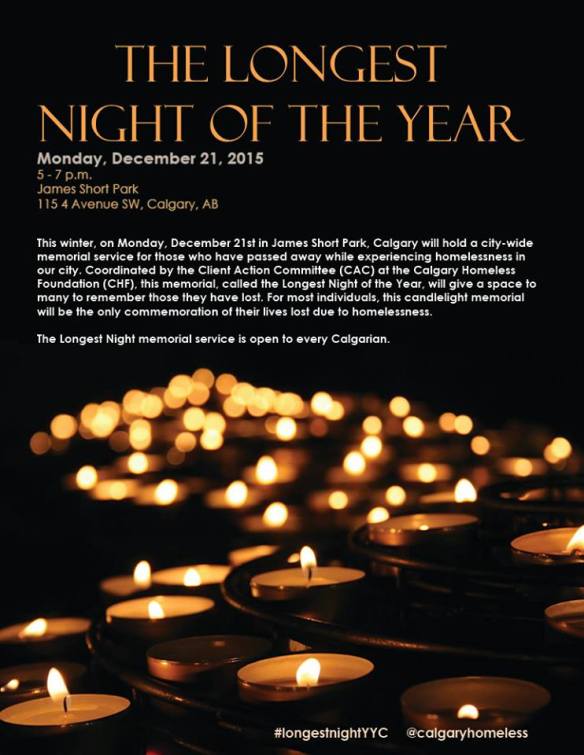
The Longest Night of the Year. We remember.

We gathered in the early evening darkness, the city a constant hum of traffic on the streets surrounding us. We gathered and we held our tiny flickering candle lights and listened to the sounds and stood in the silence. Remembering.

We remembered.

People who have walked the streets, stood on corners and asked for change and slept in alleyways and city parks or a mat on the floor in a shelter.

We remembered.

The laughter and the tears. The good times and the bad.

We remembered.

The friendship. The camaraderie. The stories told and those not shared.

We remembered.

Moments we shared. Moments we knew about. And the stories we never knew of where they’d been before. Of where they’d come from before this thing called ‘homeless’ hit.

And as we remembered, as we carried the light in the darkness, the city moved around us, a sibilant, hissing stream of traffic carrying people to and fro the places they needed to be, wanted to go, had to get to.

And we stood surrounded by tall buildings looming in the dark, their windows lit, lights glistening. And our voices called out the names of those we’d lost. Our voices spoke their names into the night and for a moment, their names lit up the darkness and in the stillness between each breath, hearts beat in time, candles glowed and we were one.

Last night, we held the first Longest Night of the Year, a memorial service for those who have passed away in homelessness. About 50 people gathered in a downtown city park to stand together and speak the names of those they knew who had passed away and to write them on a large framed poster.

And one woman came to the mic and spoke of her brother who she’d lost to the streets. They had lived together on the streets. She spoke of gang wars and drugs and fighting and hurting people and lashing out at those who passed by who never saw her, who didn’t know her name but who still chose to call her names and mock her and her brother for their baggy clothes and angry ways. She didn’t care, back then when her brother was alive. She only cared about blocking out the pain, numbing the fear, burying her past. And then, her brother died a violent death.

We must stop the violence, she said. Stop the violence.

And she’s right. We, all of us, must. Stop the violence.

It was a night of remembering and a night of promising to do better. To do more to ensure we do not lose more of us to the dark. We do not lose our way completely.

And we stood together so that we do not forget those who have left who once walked our streets. So we do not forget they once lived amongst us. That they once laughed and joked and told stories and shared a cigarette, a last meal, a last smile.

And I wondered, what if we saw them/this differently?

What if we, the privileged ones, the ones with homes and jobs and places to go, stopped our busy just to see those who walk amongst us with no fixed address as other than ‘homeless’?

What if, we do not see them as ‘other than’ but as all of us?

What if we took time to remember, this is our world, one planet, one earth. One home. For all of us. And we are each responsible for one another. We are all one.

Namaste.

To read more about the Longest Night of the Year:

http://www.metronews.ca/news/calgary/2015/12/21/marking-a-solemn-solstice-in-calgary.html

http://calgary.ctvnews.ca/video?clipId=774895


Remembering those who never made it home.

longest night


There are a thousand roads leading into homelessness, but only two leading out of it. One leads home. The other leads to the grave.

On Monday, December 21 we will gather as a community to remember those whose road out of homelessness ended with their last breath.

We will remember. And together we will say, “You are not forgotten.”

It is hard in this place called, ‘homeless’ to remember that there are those who miss you, remember you, want to know where you are. It is hard to remember where you are, let alone who you are, when every street you turn down becomes a dead end leading you nowhere but back to where you came from, and that’s the road that lead you here, to this place called homeless.

It is the dichotomy of the place and state of homelessness. You have to lose everything you’ve got to get there yet, it takes everything you’ve got to get out of it.

For some, getting out of it is only achieved when their heart stops beating and breath no longer passes over their lips.

For some, the only road out is the road they so desperately tried to avoid with every breath they took to stay alive.

And then they are gone and there is no marker, no ceremony, no memorial to say, “I was here. I existed. I made a difference.”

A walk through the unmarked graves in Queen’s Park Cemetery in Calgary tells the story. The city provides land to bury those of no fixed address, but there is no money to mark the names on a headstone. When the grave is dug, a city worker places  cardboard tag affixed to a little metal stick with the deceased’s name scribbled on it with a black sharpie in the ground to mark the location of each burial plot.

If you’re lucky, the stick will still be standing up and the tag will still be affixed.

But mostly, the sticks have fallen over, the tags have gone blowin’ in the wind and all the flowers, if there were any, are gone.

It’s hard for those who want to remember to come and visit. Just as so often happened in life, they do not know where to find their loved ones in a field of unmarked graves.

This Monday, we will stand together and remember. Please come and stand with us. Come and remember and listen to each name called out, each candle lit.

And in our remembering, let us say together, “You are not forgotten.”

Namaste.


What if homeless didn’t equal criminal?

The story is not new. An employer discovers the guy he hired a few months ago lives at a homeless shelter. He’s been doing great work but now the employer is scared and the employee must go.

When I worked at a homeless shelter we would ask clients if we could film them to include in different advertisements and videos we created to tell the stories of the shelter. Several times a year I would get a request from someone asking me to please pull the clip from our latest video or advertisement where their face appeared. Their explanation inevitably went something like this,

“I’ve got a job now. I’ve moved on and I don’t want anyone to know I was there.”

or

“I’m looking for work and I don’t want a potential employer to google my name and find me connected to that place.”

or

I’m grateful for everything you’ve done for me, but people don’t trust homeless people and I’ll never get a job if they find out where I live.”

At the Foundation where I now work, we present annual awards to those who have demonstrated excellence in the homeless serving sector. As part of their recognition we include a booklet that lists the names of the nominators and award recipients as well as a brief story about the recipient from the nominators.

Last year, we changed our policy from including full names of nominators to just first name and last initial after one woman phoned me in a panic. “I googled my name and found the article I wrote about (name of person she nominated) and why I believed she deserved the award. I’ve been shortlisted for a job and I can’t risk the company finding out about my past.”

We pulled the booklet off the website, (it was from an awards ceremony five years ago) but could not promise the woman that Google would not have stored it in a cache somewhere. It was the best we could do.

And our best was not good enough.

Not because the employer ‘found out’. I’m thinking they didn’t because the woman did not contact me again.

Our best was not good enough because that woman, and so many others, live in fear that people will find out they were homeless. That they live or lived at a homeless shelter. That they used services designed for people experiencing homelessness. That they are somehow, in the views of many in our society, not good enough, broken, lacking and even, because they are homeless, criminals.

Most of us don’t spend our days worrying too much about the judgements of others. We’re not really impacted by the person behind or in front of us at the checkout. We know we won’t see that stranger in the elevator again so don’t really pay much attention to them.

We live in our bubble of ‘normal’ and move through our days without giving much thought to what others are thinking of us.

For someone experiencing homelessness, judgements come fast and furious.

They are heard from strangers walking by who hurl words at panhandlers that pierce like daggers to the heart.

From kids driving by in a car who think it is funny to hurl eggs at the woman pushing the shopping cart, or the man picking up empty pop cans from the street.

They are visibly homeless and thus, somehow do not deserve our respect or that we behave as decent, caring human beings.

For that man who lost his job because of his address, there is not much we can do. Discrimination of this sort is not illegal, and, even though we created a Homeless Charter of Rights, they are an idea, a beautiful wish for all mankind. They are not enshrined in our legislation.

And so, he will move on. He will chalk it up to another strike against himself, another let down, another put down that is just the way it is.

It doesn’t have to be. It can be different.

If we change. If we decide not to see people experiencing homelessness through eyes of condemnation and fear. If we decide not to equate poverty with lack of ambition, smarts or ability. Vulnerability as weakness. Homelessness as criminal.

If we change the way we see those whose lives have lead them into homelessness not as victims of their own doing, but rather as fallout from a social system that does not have the resources, affordable housing and supports people need to make their way in life, perhaps we will change our minds about who ‘the homeless’ really are. Perhaps we’ll see, ‘they’ are not us versus them. They are you and me, all of us.  Together.