Magic Happens When We Stop Shrinking

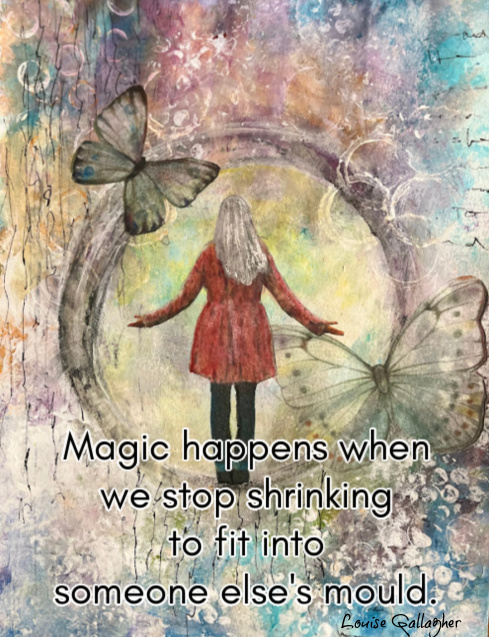
I saw an image on Instagram this morning that really resonated with me. A beautiful butterfly with the caption: “Magic happens when you stop shrinking to fit spaces you’ve outgrown.”

It’s how I look at aging. I’ve outgrown my 50s, 60s, and now, I’m growing and expanding into my 70s, devouring every delicious bite of being this age of empowered living.

Somewhere in my 30s, I realized I was being sold a load of horse-manure by the cosmetic industry. “Anti-aging.” “Anti-vaginal odor.” “Anti-anything” some clever marketer thought women should address in order to stay, reclaim, or feel young again.

It was as if they were whispering (though it often felt like shouting), “Being your age is okay, but looking, smelling, and feeling it? No way! That just means you’re old.”

Well, guess what? I’m in my 70s now. And I have not stopped aging. Shocking, isn’t it? What I have done is stop buying into the anti-aging narrative. There is nothing in it for me to be afraid of aging. Heck, I’ve been doing it every single day of my life. I’m an aging expert. And in my vast repertoire of experience, I’ve learned a thing or two about the anti-aging movement.

  1. Anti-aging is anti-women being themselves. It’s a relentless campaign to convince us that our natural state is a problem to be solved.
  2. Anti-aging is a confidence racket. It’s constructed to make us feel bad about how we look, act, dress, talk, and even smell. The goal isn’t to make us beautiful; it’s to make us insecure.
  3. Anti-aging is a multi-billion dollar industry. I can’t fight the industry, but I can fight back by not buying their horse-manure. My wallet is my weapon.

What about you? Are you done shrinking? Are you ready to claim your right to be your age—with all the grace, sass, and dignity you’ve earned?

Let’s start a revolution. A quiet, powerful, and deeply personal revolution.

Your Call to Action:

Stop playing their game. Look in the mirror today and say, “This is me. This is my magic. Aren’t I magnificent!”

What is one small, rebellious act you’re doing to embrace your age? Maybe it’s ditching the painful heels for a pair of shoes that love your feet. Maybe it’s not hiding the grey or wearing a bold new lipstick that makes you feel powerful or finding your power in opting out of make-up entirely á la Suzanne Sommers. Maybe it’s simply refusing to feel ashamed of a new wrinkle and choosing instead to see each one as a celebration of your life story.

Please do share your story in the comments below. Let’s celebrate our earned wisdom, our hard-won freedom, and the deliciousness of being exactly where we are. Because magic doesn’t happen when we shrink; it happens when we expand.

How to Journey to Stillness

Tuesday morning, Sun shine. Fluffy white clouds tinged with grey and blue shroud Vancouver Island in the distance. Sea a gently undulating blanket, always in motion. Trees stand tall, branches still, their filigree network of needles pricking the untouchable sky.

In meditation this morning, the invitation was to ‘let your mind dissolve into the clouds’. I struggled with it. Struggled to find the stillness and spaciousness of nothingness. To imagine my mind as dissolvable.

I am attached to my mind and its constant yammerings and yawings. It’s incessant litany of thoughts and ideas tumbling around inside my head telling me, ‘that’s a good idea’. ‘what on earth were you thinking?, ‘you need to do more’, ‘you’re not enough’… and all that jazz.

Stilling the chatter has been a lifelong journey for me. Meditation is my gateway to the stillness, and calm, of letting my mind dissolve into the clouds.

Some mornings, my mind feels busier than others. When I began meditating, I started small. Even 1 minute of sitting in the silence is better than none.

Whether you’re a beginner, or a seasoned meditator, here are four ideas on how you can begin to meditate or to enrich your existing practice:

1. Start Small:

  • Silencing the mind completely is a lofty goal, especially for beginners. If you’re just beginning, start with just a few minutes of dedicated stillness each day, gradually increasing the duration as you become more comfortable. If like me, you go in and out of your practice, sometimes leaving it for days on end, always begin again and do not judge yourself harshly!

2. Focus on the Breath:

  • The breath is an anchor to the present moment. Especially as you begin to practice, pay close attention to each breath. In. Out. In. Out. As you progress, focus the sensation of each inhale and exhale, noticing the rise and fall of your chest or belly. When the mind wanders, gently guide it back to the breath. In. Out. In. Out.
  • Remember not to judge your progress, or the stillness of your mind. Stay, ‘open minded’. Curious. Calm.
  • Tip: To support your practice, try this counting exercise: inhale for a count of 4, hold for 4, exhale for 4.

3. Engage the Senses:

  • Connect with your senses. Take a mindful walk in nature, noticing the sights, sounds, smells, and textures around you. Or, sit quietly and savour a cup of tea or coffee, paying attention to the warmth of the mug, the aroma, and the taste.
  • Exercise: When connecting with your senses, close your eyes and ask yourself: “What do I hear? What do Ifeel against your skin? What do I smell?” Don’t seek the words to describe what your experiencing. Feel it. Don’t name it.

4. Embrace a Creative Outlet:

  • Engaging in creative activities can quiet the mental chatter and induce a state of flow. There are countless individual ways of experiencing this – painting, writing, dancing, playing music, gardening, or anything that allows you to express yourself and get lost in the process.
  • As a mixed media artist and as a writer, getting lost in the process of creation has taught me to ‘trust in the process’ . Time disappears, the world around me fades as I become immersed in the pure joy and wonder of allowing my intuition and creative essence to express itself fearlessly.

5. Acceptance and Non-Judgment:

  • It’s crucial to approach stillness with a gentle, non-judgmental attitude. When thoughts arise (and they will!), acknowledge them without judgment and gently redirect your attention back to your chosen anchor (breath, senses, etc.).
  • Remember: Meditation is a practice, not a performance. There’s no “right” way to find stillness just as there is no wrong way to begin again.

What about you? What do you do to stop the chatter and open the portal to your heart?

How Safe is Your Voice?

A Conversation Across Generations and Lived Experiences

The pursuit of being ‘heard’ and giving voice to our stories is a lifelong journey. From our first cries as infants to the wisdom we share in our later years, our voices evolve and adapt to the world around us. Sometimes, they are strong and powerful. Sometimes, soft and tentative. But how often do we consider the safety of our voices, especially when it comes to hearing and listening to the diverse perspectives that different generations and lived experiences bring to the table?

Ageism and the Erasure of Lived Experience

Ageism, the discrimination or prejudice based on age, can lead to the erasure of invaluable lived experience. This is particularly true for older adults who have navigated decades of challenges and triumphs, accumulating a wealth of knowledge that is often overlooked or dismissed. Just as the lived experiences of marginalized groups who have frequently been silenced or disregarded, such as those who have experienced homelessness, are essential at the table, so too are those of older adults.

The Power of Lived Experience

Lived experience voices bring a unique and irreplaceable perspective to the table. They offer firsthand insights into the realities of aging and ageism, the challenges of navigating social systems, and the complexities of diverse life journeys. When we include these voices in conversations about policy, programs, and systems of care, we create solutions that are more effective, equitable, and responsive to the needs of all individuals.

Older Adults: Experts in Their Own Right

Older adults are not merely recipients of care; they are experts in their own right. Their lived experiences have equipped them with a deep understanding of what works and what doesn’t, what is needed and what is missing. By valuing and amplifying their voices, we can tap into this wealth of knowledge and co-create solutions that truly serve the needs of aging populations today while creating pathways for future generations to age without fearing being silenced and ignored.

Creating a Brave, Safe Space for All Voices

To foster a culture that is purposefully brave and safe for all voices, we must actively combat ageism and other forms of discrimination that silence lived experience. This means:

  • Centering Lived Experience: Actively seeking out and prioritizing the perspectives of those who have lived through the issues we are addressing.
  • Listening with Humility: Approaching lived experience voices with respect, recognizing that their insights are invaluable and often hard-won. And, due to the insidious and pervasic nature of ageism, have been silenced and struggle to be heard.
  • Co-Creating Solutions: Involving individuals with lived experience in the design and implementation of programs and policies, ensuring that their voices are heard and their needs are met for their benefit, not the systems.
  • Building Bridges: Fostering dialogue and collaboration between different generations and lived experiences, recognizing that we are stronger together.

Radical Bold Aging: Amplifying Lived Experience

Radical Bold Aging, which champions the empowerment and agency of older adults, aligns perfectly with the goal of centering lived experience. By recognizing older adults as experts in our own lives, we are empowered to advocate for our needs, challenge ageist stereotypes (both our own and society’s), and actively participate in shaping the world around us.

The Challenge and the Reward

Creating brave, safe spaces for all voices, including those with lived experience, is an ongoing commitment. It requires us to confront our own biases, actively seek out diverse perspectives, and challenge systems that perpetuate exclusion. But the rewards are immeasurable. When we embrace the power of lived experience, we build a stronger, more compassionate, and more equitable society for all.

So, the question remains: How safe is your voice?

Let’s make safety the foundation of our conversations, across generations and lived experiences, and build a world where everyone’s voice can truly be heard, valued, and respected.