How Safe is Your Voice?

A Conversation Across Generations and Lived Experiences

The pursuit of being ‘heard’ and giving voice to our stories is a lifelong journey. From our first cries as infants to the wisdom we share in our later years, our voices evolve and adapt to the world around us. Sometimes, they are strong and powerful. Sometimes, soft and tentative. But how often do we consider the safety of our voices, especially when it comes to hearing and listening to the diverse perspectives that different generations and lived experiences bring to the table?

Ageism and the Erasure of Lived Experience

Ageism, the discrimination or prejudice based on age, can lead to the erasure of invaluable lived experience. This is particularly true for older adults who have navigated decades of challenges and triumphs, accumulating a wealth of knowledge that is often overlooked or dismissed. Just as the lived experiences of marginalized groups who have frequently been silenced or disregarded, such as those who have experienced homelessness, are essential at the table, so too are those of older adults.

The Power of Lived Experience

Lived experience voices bring a unique and irreplaceable perspective to the table. They offer firsthand insights into the realities of aging and ageism, the challenges of navigating social systems, and the complexities of diverse life journeys. When we include these voices in conversations about policy, programs, and systems of care, we create solutions that are more effective, equitable, and responsive to the needs of all individuals.

Older Adults: Experts in Their Own Right

Older adults are not merely recipients of care; they are experts in their own right. Their lived experiences have equipped them with a deep understanding of what works and what doesn’t, what is needed and what is missing. By valuing and amplifying their voices, we can tap into this wealth of knowledge and co-create solutions that truly serve the needs of aging populations today while creating pathways for future generations to age without fearing being silenced and ignored.

Creating a Brave, Safe Space for All Voices

To foster a culture that is purposefully brave and safe for all voices, we must actively combat ageism and other forms of discrimination that silence lived experience. This means:

  • Centering Lived Experience: Actively seeking out and prioritizing the perspectives of those who have lived through the issues we are addressing.
  • Listening with Humility: Approaching lived experience voices with respect, recognizing that their insights are invaluable and often hard-won. And, due to the insidious and pervasic nature of ageism, have been silenced and struggle to be heard.
  • Co-Creating Solutions: Involving individuals with lived experience in the design and implementation of programs and policies, ensuring that their voices are heard and their needs are met for their benefit, not the systems.
  • Building Bridges: Fostering dialogue and collaboration between different generations and lived experiences, recognizing that we are stronger together.

Radical Bold Aging: Amplifying Lived Experience

Radical Bold Aging, which champions the empowerment and agency of older adults, aligns perfectly with the goal of centering lived experience. By recognizing older adults as experts in our own lives, we are empowered to advocate for our needs, challenge ageist stereotypes (both our own and society’s), and actively participate in shaping the world around us.

The Challenge and the Reward

Creating brave, safe spaces for all voices, including those with lived experience, is an ongoing commitment. It requires us to confront our own biases, actively seek out diverse perspectives, and challenge systems that perpetuate exclusion. But the rewards are immeasurable. When we embrace the power of lived experience, we build a stronger, more compassionate, and more equitable society for all.

So, the question remains: How safe is your voice?

Let’s make safety the foundation of our conversations, across generations and lived experiences, and build a world where everyone’s voice can truly be heard, valued, and respected.

Blame Game: Aging Brain or Modern Life? What’s Behind Your Shrinking Attention Span

In one study, the average person’s focus lasted a mere 8 seconds before switching – shorter than a goldfish! More recent findings put us at 47 seconds, a far cry from the 2.5 minutes measured just twenty years ago.

What’s really going on with my aging brain?

In the digital whirlwind of our world today, it’s easy to fear that our brains are showing the wear and tear of modern life. But by reclaiming our focus, we can counter those fears and age with grace and intention. Because, let’s face it. It’s not all about our aging brains. Along with the accessibility of digital information, when you throw in the stress of a pandemic, it’s no wonder our attention spans are feeling the strain. We’re constantly bombarded with news updates, TikTok trends, and notifications galore. This constant stream of notifications and content are training our brains to crave novelty and quick hits of information. Our brains are practically being rewired to jump from one thing to the next, always seeking the next quick hit of dopamine. It’s like we’re training ourselves to have the attention span of that goldfish!

But there’s hope. As we age, many of us yearn for a slower pace, for the ability to savour moments and be present. Strengthening our attention span is a vital step in that direction.

Five Simple Practices to Reclaim Your Focus

  1. Embrace Mindfulness: Daily mindfulness practice, like meditation or journaling (with pen and paper!), can train your brain to stay in the present moment.
  2. Spend Time in Nature: Leave your phone behind and immerse yourself in the natural world. Simply observing the sights and sounds can be incredibly calming and restorative.
  3. Ditch the Devices (Sometimes): Yes, it can be scary to disconnect, but the rewards are worth it. Challenge yourself to leave your phone at home for a few hours and rediscover the joys of real-world experiences.
  4. Engage in Long-Form Activities: Read a whole book, listen to a long-form podcast, write a letter – activities that require sustained focus can rewire your brain for deeper engagement.
  5. Practice Self-Compassion: Don’t beat yourself up if your mind wanders. Building new habits takes time and effort. Be patient with yourself, celebrate small victories, and keep at it.

Aging with Grace and Focus

As we age, the fear of mental decline is not uncommon, but it doesn’t have to be our reality. By actively nurturing our attention span, as well as our overall well-being through exercise, diet and lifelong learning, we can counter those fears and live each day with intention and clarity.

What are you doing to keep your mind sharp and engaged? Share your tips in the comments below!

Untangling the Threads: Breaking Free from Negative Self-Talk

Have you ever paused to count the negative thoughts that flit through your mind each day? You know the ones: “I can’t…” “What’s wrong with me?” “I just don’t get it.” “Nobody likes me.”

Our minds are a whirlwind of activity, generating an estimated 60,000-80,000 thoughts daily. The unsettling part? Roughly 80% of those thoughts are negative. Yes, even if you consider yourself a positive thinker, a subconscious stream of negativity likely runs beneath the surface.

But here’s the good news: Awareness is the first step towards freedom. By identifying these negative thought patterns, we empower ourselves to make a conscious choice to disempower them.

Moving from unaware to aware to actively choosing a different path is a transformative journey. It requires self-discovery, vulnerability, and a fierce desire to break through the barriers that hold us back. It’s about moving from “playing small” to living our dreams in vibrant, technicolor glory.

3 Simple Steps to Untangle the Threads:

  1. Identify: Start by noticing your negative thoughts. Write them down when they arise. Look for patterns – What triggers them? What themes emerge? Common culprits include “all-or-nothing” thinking, catastrophizing, and disqualifying the positive.
  2. Reframe: Challenge those negative thoughts. Are they really true? What evidence do you have to support them? Can you think of alternative, more positive interpretations? For example, instead of “I’m a failure,” try “I’m learning and growing through this experience.”
  3. Step Away: Don’t engage in a battle with your thoughts. When negativity arises, acknowledge it, reframe it if possible, and then let it drift away. Try visualizing yourself stepping away from those thoughts or imagine them floating away like leaves on a stream.

Remember, this is a process. Be patient and kind to yourself. Each time you catch a negative thought, you’re strengthening your ability to choose a more positive path.

Are you ready to untangle the threads of your inner critic and embrace a brighter, more empowered mindset?

Join me for my free online Masterclass, RADIANT BOLD AGING, 3 Transformative Practices to Ignite Passion & Joy in Your Life Everyday. June 7, 10am (MT). To Register: RADIANT BOLD AGING

From Giving to Living: Balancing Self-Care with Caring for Others

Throughout our lives, especially as women, we often prioritize caring for others over ourselves. Whether as mothers, partners, friends, or colleagues, we frequently extend compassion and care outward, sometimes leaving very little for ourselves.

As we age, this pattern can persist if we do not consciously assess our own self-care practices. Proper self-care is crucial for living fully and passionately. It not only enhances our ability to care for others but also protects us from accumulating resentment and bitterness. Constantly prioritizing others can lead to an empty well of empathy and compassion.

Many factors contribute to neglecting self-care, including childhood conditioning, societal expectations, and a lack of self-belief. Without examination, these habits can lead to perpetual feelings of fatigue, burnout, and emptiness.

That’s why I’ve created the ‘Self-Care Check-In,’ a simple yet powerful tool to assess your self-care habits.

Why Reflective Journaling? Reflective journaling makes our thoughts and feelings tangible, allowing us to address often overlooked needs, desires, and well-being. This exercise encourages you to pause and ask whether you treat yourself with the same kindness and love you offer others.

In reflective journaling, there’s no judgment—only curiosity and empathetic acceptance. It opens a space for awareness, helping you explore possibilities for more loving self-care practices.

Self-Care Isn’t Just Pampering It’s about recognizing our worth and making ourselves a priority. By responding to specific questions through journaling, we can gauge our current self-care practices and identify steps to integrate better self-care into our daily routines.

Remember, the way we treat ourselves sets the stage for how we interact with the world, especially as we embrace the bold and brilliant years of our lives.

Let’s Get Started:

  1. Open your journal to a new page and title it ‘Self-Care Check-In.’
  2. At the top right-hand corner of the page, write a large A+. You’ve already started practicing positive self-care by showing up on the page—that deserves an A+.
  3. Below are four questions to help you assess your self-care. Please answer spontaneously, without overthinking.
    • Physical Self-Care: “What is one physical activity I did for myself today? (e.g., stretching, walking)”
    • Emotional Self-Care: “What is one thing I did today to make myself feel loved or supported?”
    • Mental Self-Care: “What is one thing I did today that brought me peace or rest?”
    • Gratitude: “What is one thing I am grateful for about myself today?”

After answering these questions, reflect on which area was most challenging and consider what steps you can take to improve self-care in that area.

For me, emotional self-care requires daily conscious effort. What about you?

I’d love to read your thoughts and experiences. Please share them in the comments below.

______________________________

We explore Self-Care and what holds us back from extending it to ourselves in my 8 week program, The ReWrite Journey.

I’ll be starting a new cohort Monday, May 13th at 5:30pm MT.

Gift yourself time to explore the art of ageless living with The ReWrite Journey.

Learn more HERE

Discovery Seminars: Are you willing to explore your possibilities?

Imagine spending five days diving deep into the core of your being, challenging the thoughts and habits that hold you back from joy, growth, happiness, love and so much more.

This past week, coaching at the Discovery Seminars, I did all of that and more. From the lightbulb moments of self-forgiveness to the awakening of personal power and the unfolding of miracles, the journey was full of inspiring moments and transformation.

It all begins for trainees at noon on Wednesday. People walk in with a full spectrum of emotions: reluctance, desperation, hesitation, excitement, and even anger. Some are unsure why they are there or what they are seeking, or have come simply to please their boss or get a loved one of their back. Others are holding onto a last thread of hope they will find a reason to take another next step.

As the days unfold, so dp the stories shared. There are so many moments that stand out for me: someone who walked in skeptical about what was in the room for them realizing their worth. Another finding the courage to release shame by sharing something they’ve never told anyone. Another choosing to forgive themselves; breaking through a barrier that had once seemed insurmountable. These acts of courage and vulnerability became a continuous thread of turning points, transforming the seminar room into a sanctuary of empathy, understanding and loving kindness.

Through guided discussions, reflective exercises, and shared experiences, we delved into the habits and thoughts that trigger unhealthy responses. The process wasn’t just about identifying these triggers but learning how to confront and reshape them.

And then, the fifth day happened. Everything changed. It wasn’t just one event but a culmination of moments, insights, and revelations that led to this transformation. Participants who had walked in carrying the weight of their pasts were now looking forward with determination, their faces and hearts alight with hope. Others found a friend to lean on. Others a shared experience to grow through. Others a glimmer of possibility to take in and nurture its flame.

For me, one of the most beautiful momments is always watching the trainees say goodbye. When a group of strangers gathered on Wednesday, they held themselves separate. Now, in their goodbyes, it’ss clear that the bonds formed were unique and profound. They weren’t just leaving with new friends; they were leaving with a new perspective on life. The power of hope was palpable, urging everyone to not let the lessons fade but to actively apply them in their pursuit of a life free from past regrets and pains.

I spent five days in the Discovery Seminars room last week. I am changed. I am inspired.. I am grateful.

So, here’s my challenge to you:  Are you willing to reflect on the habits and thoughts that may be holding you back? What if… you decided to confront the habits and thoughts that are keeping you playing small in a supportive, transformative environment like Discovery Seminars? What if… you decided living at a 6 isn’t enough — and to find your 8 or 9 or 10, you choose to explore something new? What if… you decided you’re worth fighting for?

Fact is, on Wednesday at noon, few people walk into the Discovery Seminars room eager to dive into the essence of what drives them to do the things they do that keep them falling down, beating themselves up, or playing small.

And yet, on Sunday, people always walk out grateful they did.

How to rewrite your stars.

In the quiet of each morning, I am greeted by the unwritten story of the day ahead—a narrative waiting to be crafted with intention and purpose. In these moments, I am reminded of the ReWrite Journey course I have the honour of guiding—a course designed to delve into the art of storytelling, our storytelling.

Every Monday evening, in the sanctuary of our virtual circle, seven women, a collective of seekers and storytellers, explore the contours of our Origin Stories. It is here that we acknowledge our agency, summon our strength, celebrate our courage, and distill the wisdom from life’s intricate journey. This is the groundwork of the course, The ReWrite Journey I’ve created, a journey of reflection and empowerment.

Every choice we make—every word, every action—becomes a sentence, a paragraph, a chapter in the ongoing story of our lives. As we begin to chart our paths forward, we set markers—goals and dreams that beckon us with the promise of fulfillment and transformation.

In the ReWrite Journey course, we don’t just look back; we also cast our gaze forward, rewriting our trajectory with markers that serve as beacons towards a future we dare to design. What kind of story do we aspire to live out? What are the empowered choices we will make to propel us towards our envisioned horizon?

As we write and create, we ask… What if, instead of drifting on the currents of habit, we took the helm with hyper-conscious awareness, navigating our existence with the recognition that we are here, now, fully capable of scripting the grand narrative of our lives? What if today, we chose to live out the greatest story ever told, our own, with every choice a stroke of the author’s pen?

What if?

________________

Gratitude is the foundation of so much joy in my life. I am deeply grateful for the seven women who have joined me in this, the inaugral session of The ReWrite Journey: Your Past, Reimagined. Your Future, Reclaimed. The ReWrite Journey is a transformative eight-week odyssey that weaves the wisdom of the past into the tapestry of a future rich with possibility.

The ReWrite Journey offers a sanctuary for women of all walks of life who seek to embrace the vibrant threads of their experience and weave them into a future tapestry, vibrant with the hues of their wildest dreams and richest aspirations.

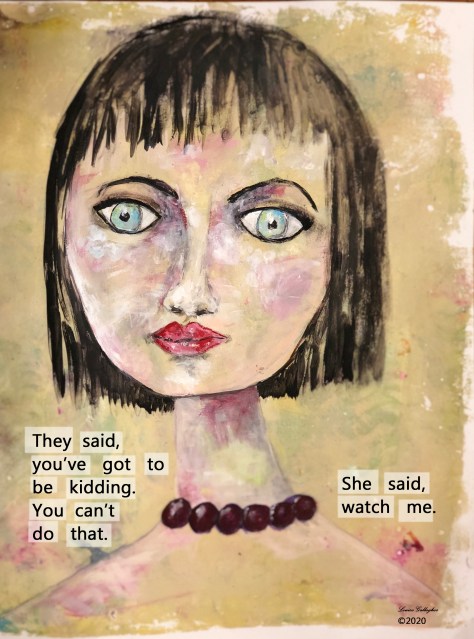
Watch me! #BellLetsTalk


No. 54 #ShePersisted Series
Mixed media on canvas paper
11 x 14″
©2020

It has been a while since I created a painting for the #ShePersisted series I began in March 2017.  Yesterday, I pulled out a background I’d created on the weekend, drew a circle and began to throw down paint.

I didn’t know what I was going to paint. I didn’t have a destination or image to reference. I was going with the flow and letting whatever appeared to be what was visible on the canvas.

She appeared.

She was challenging. Faces always are for me.  They take practice. Skill. An understanding of light and its play with the shadows. A willingness to mess up and dig in.

They’re best painted with a reference photo.

I had none. Somewhere, early in the process, I made a commitment to myself to paint from within me, to use my inner memory/knowing of the face as my reference.

It’s a wonderful challenge. There’s that scared, uncertain place within me where I worry I don’t know enough, I need something solid to guide me. There’s that voice of doubt that takes great joy in whispering, “You can’t do it.”

And then, there’s the vibrant, alive place within me that doesn’t like can’t and don’t and shouldn’t. That voice likes to leap into the fray, calling upon my courage and self-belief to rise up and call out joyfully, “Watch me.”

I painted a woman’s face yesterday.

I didn’t think I could.

And then I did.

I love the magic that happens when I let go of working hard to control the process and instead let myself be the process.

I love the mystery that opens up to wonder when I accept it’s not about ‘doing it perfect’. It’s not about creating something that is a reflection of something else. It’s all about allowing what is calling itself to be expressed from within to become visible on the canvas before me.

This morning, as I look at her, that little voice of doubt and uncertainty, the one who likes to find criticism in so many things, it wants to tell me all the things I could have done differently. I could still change.

I’m not listening. Not heeding that voice. It is the voice of the past. The voice of millennia of women being told they can’t, they musn’t, they shouldn’t, they don’t dare.

I dare.

Yesterday, I painted a face.

Her origins are a mystery. Her story is not.

She is every woman before me who was told she couldn’t.

She is every woman who was shut down, put in her place, pushed into dark alleys and corners, hidden from the light, hidden from the truth of her power, her beauty, her strength, her courage.

She is every woman who was told she had no power, no voice, no right.

She is every woman who was held captive to the lie she had to be perfect. That she would never be enough. The voice that still whispers from the dark roots of the past, “You can’t do that.”

They said, “You can’t do that.”

The wise woman within rose up and shouted to the winds and the seas, the stars and moon, to heaven and earth, “Watch me!”

________________________________________________

Today is “Bell Let’s Talk Day“.

Speaking up about mental health is important. Taking action is vital. Erasing stigma. Changing minds. Providing supports and help for those whose mental health is preventing them from living joyful and productive lives is imperative for everyone.

Changing the story of how we view mental health changes how we treat each other, how we build strong and healthy relationships and how we create a better world.

For women, our mental health is tethered to a past where we had no voice, no rights, no power. A past where we lived under the shadow of men and the laws and societal mores that were designed to create a ‘just and fair’ society and that ultimately were tools to keep us in our place.

There is no place in the shadows for freedom, self-efficacy, self-determination, equality, self-hood.

Cutting the ties that bind is an important act, not of rebellion but of freedom.

May we all be free to speak up. May we all know we have the power to take positive action to be actively engaged in creating a world where everyone has a place to belong, no matter the state of their gender, race, sexual orientation, faith, beliefs and economic, mental or physical state of being.

The Darkness and The Light

When I was a little girl I remember my mother being very sad. My father was away a lot and she was far from her motherland.

Her first language was French. She was used to heat and sun, to servants taking care of everything, to living a carefree life surrounded by family, the sounds and smells of India where she was born and raised and the Catholic faith that had filled her life with meaning.

And there she was, no family to support her, raising four children mostly on her own, ill prepared for the loneliness and coldness of a Canadian winter and the harshness of the landscape. All she had to cling to was her faith, and in that she felt God had foresaken her to this foreign land so far from home. She was lost.

My mother seldom yelled or screamed. One of her favourite sayings was, “If you can’t say it in a whisper, don’t say it at all.”  She did cry. A lot. Sometimes, when she was really desperate, she’d hold a knife to her breast and threaten to kill herself.

I remember as a five-year-old standing in front of her, confused, terrified, not understanding what was happening. I learned to smile through her pain. To never show I was afraid. To never acknowledge my fear. Somehow, the knife was always put back in the kitchen drawer and life would go on. I still struggle to let go of smiling when I’m in pain.

My mother’s mental health overshadowed all our lives. We became accustomed to her mood swings, her habit of crying while making supper and ironing my father’s shirts, her seemingly irrational fears and her constant caution to ‘be careful’.

As a teen, I began to resent my mother’s tears, her constant sadness, and what I deemed her unending criticism of me and my life. I could never do things right enough for my mother. I was always causing trouble she would tell me before asking, “Why can’t you be like the others?”

My mother’s journey through life has been constantly overshadowed by her mental health. She is 97 now. She finally got help in her 80s. That’s a long time to live in the darkness before finding the peace of heart and mind she’s always sought.

I no longer resent my mother and even though she’d often ask why I hated her so, I never hated her. I just never understood her. And the truth is, I always loved her. She gave me the gift of my life, and many other gifts too.

Because of her mental health, I learned to differentiate between ‘the person’ and the behaviour.  The person is ‘the person’. I can love the person. I do not have to love their behaviour. Behaviour can change. As an adult, I had to change mine so that I could let go of my anger and find peace in my relationship with my mother.

Albeit awkwardly at times and sometimes not soon enough or steadfast enough, my relationship with my mother taught me that I needed to set boundaries. In my 60s now, I still struggle with this one, but I’m getting better.

I learned that seeking help is important. I first started seeing a therapist in my 20s. I had to. I thought I was ‘the crazy one’. I thought my mother’s sadness and tears were all about me. And while I no longer have my therapist on speed dial, I know when the darkness clouds my thoughts, it’s time to call to get some light.

I learned my behaviour, who I am, is all about me. I am the only person I can work on and I am deserving of my loving care and attention.

I learned that I can’t change what is happening in another person’s mind. I didn’t create it. I can’t cure it.

I learned that I’ve got to take care of my mental health first.. I can’t do the work for another, but when my mind is clear, I am not at risk of climbing into the darkness with them and can hold the light steady as they find heir way out of the darkness into life.

And I learned it is not helpful nor healthy to defend against what someone is saying or doing when they are lost in the darkness. Loving them is and I can choose to always keep loving them, though sometimes I must do it from a distance to keep myself safe from the darkness.

All these things I learned from my mother and her journey.

The darkness is real. So is the light. The light is more powerful than darkness because when you stand in the light, you can see where you’ve been, where you are and where you’re going.

In the darkness, all you can see is that there is no light.

__________________________________________________________

According to the Canadian Association for Suicide Prevention, today in Canada 10 people will end their lives by suicide; up to 200 others will attempt so.

For each death by suicide, between 7 and 10 survivors are profoundly affected. Today in Canada, suicide will leave up to 100 people in a state of bereavement. Latest research shows there were 3,926 suicides in the year 2016 in this country. In 2015, over 3,396,000 Canadians aged 12 and over had suicidal thoughts.

Tuesday, September 10th was World Suicide Prevention Day. Let’s all stand in the light together.


Not having an answer to homelessness isn’t good enough

She is walking towards me deep in conversation with another woman. She is animated. Expressive. Her whole body engaged in her conversation. It is a warm October afternoon but she is dressed for colder weather. Toque. Mitts. Big heavy winter jacket. Blue with a fake fur collar. Khaki pants tucked into the tops of laced up black walking boots, the kind you’d picture if someone said, “your mother wears army boots,” in an attempt to dis you.

As we pass she looks at me. I smile. She stops. Calls out. “Hi! How are you? Haven’t seen you in awhile.” She darts between two passers-by and comes to a full stop in front of me. “Where do I know you from?” Before I can answer she blurts out her response. “The Women’s Centre! That’s where.”

I start to correct her. I’m not sure I know her but perhaps it was the shelter where I used to work, but her words keep rattling out towards me like a woodpecker digging into bark. “You still there? I sure hope so. You stood out. You always do. It’s why I noticed you on the street.”

Again I attempt to correct her, to tell her I don’t think we’ve met and then I let it go. Sometimes, people just want to be heard.

She tells me about her husband. ‘The abusive bastard’. They put him in the ground three years ago. That’s how she says it. Put him in the ground. I wasn’t there. No f*cking way, and her expletive is loud enough it startles someone walking by. They skirt our little tableau where we stand at the corner of the avenue where the C-train rumbles by.

She tells me the story of how he kept her locked up on 149 acres. Sixteen years I suffered, she says. How she’s lost a son to suicide. Hung himself. Why would he do that? she asks.

I hope she doesn’t expect an answer from me. I don’t have one.

She’s lost another to cancer and the third, well, the good for nothing, and again she inserts a loud expletive, is in jail. Just like his father. She says. And she shakes her head making her salt and pepper curls bob up and down. “How come I couldn’t do nothing good in the world?” she asks. “Tell me that? How come?”

I am grateful she keeps on talking without waiting for an answer. I don’t have one.

She shares more of her story. Dates. Places. Names. They are written on her memory, streaming out in a continuous tide of re-telling. She animates her conversation. Bounces from one spot to another in front of me. One moment up close, almost whispering in my ear, the next stepping far back. “You stay there,” she says. And I wonder, does she mean me or is the statement part of her story.

She talks about the Catholic school she attended as a child. The abuse. The nuns. The priests. She points to two tall brick buildings down the avenue from where we stand. “Big as those,” she says. “I had to walk in and tell them I was there to demand an apology for my sister. She was one pound when she was born. You could hold her in the palm of your hand.” And she cups one hand holding it out towards me like a child begging for alms. “She was that little. I had to protect her. I had to get her away from them.”

She breathes and I look into her eyes and say, “It sounds like life was very hard for you.”

“You don’t f*cking know the half of it,” she sputters and continues on with her story. Jumping from her sister to one of her other 10 siblings. “Only 8 of us survived the first years of our lives,” she says. “There just wasn’t enough to go around.”

“I seen my sister just before she died,” she says. And she moves in real close to my right ear and whispers. “I walked up to her bed, she was so sick, so close to dying, and I said, ‘Terry’, real soft like. She knew it was me. Tears rolled down her cheeks. She knew it was me.”

“I’m sorry,” I say. It is all I can think of to offer her in way of comfort.

“Nah. She’s better off dead.” And she continues on re-telling stories of her life. A 1963 GrandAm she once owned. A shotgun that belonged to her husband that he used to threaten her with until she gave it, along with his other 20 guns, to the police.

“He told them he was a collector. Insisted they give them back. I got away though. Took the bus to Edmonton. I’m a registered LPN. I’m not stupid you know. They tell me I’m bipolar. F*cking baztards. What do they know? I’m 74. Of course I have moods.”

Another C-train rolls by and I know I have to go. Ellie the wonder pooch is waiting for me at home. She’ll be anxious for her dinner.

“Hey! I’m glad I saw you,” she says. “You listen good but you gotta speak up good too. For others. Will you do that for me? Speak up? Get us some justice? I got a place now but ya’ know, there’s so many who don’t. Will you make sure they get a chance?”

“I’ll do my best,” I tell her.

And we part and move in our separate directions and I carry her story with me. I wonder how she got so lost. How life could have been so difficult and still she clings to it, fights for it, and others.

And I wonder, what is the best for someone who’s needs are so complex, whose mental health is so fragile that they would reach out to a relative stranger and tell them their story standing on a street corner? How can my best do anything to offset the demands of a life lived on the edges?

And I know, Not having an answer to homelessness and abuse and lack of support for mental health issues isn’t good enough anymore. We can’t keep pushing the problem along, sweeping it into shelters or someone else’s backyard. We’ve got to speak up, give voice, stand up for those who have been beaten down so far they no longer have the strength to do it alone. We gotta do it together. All of us.


Two people standing heart to heart

He is sitting on a bench outside of the offices of an organization that works with people with mental health issues.  I am walking past to a meeting further down the avenue.

He sees me. Stares. Gives me a little smile.

I smile back.

He says, “Hi! How are you?”

I stop in front of him, give him my attention. “I’m great. How are you? I haven’t seen you in a long time.”

He pauses before replaying. As if trying to remember, or place me, or see if he actually knows me. He remembers.  “At least two years,” he says. “I can’t remember your name. I’m sorry.”

“It’s okay. I forget yours too. I’m Louise.”

“Oh right. I remember. I’m Jack.”  (not his real name)

“Nice to see you Jack. It has been awhile. How are you doing?”

He shrugs his shoulders, takes a puff on the cigarette he’s been holding in one hand. He’s tall and gangly. Mid-forties. He sits with his body entangled, one leg over the other, the foot bouncing in constant motion. His body doesn’t move as much as it vibrates in a constant hum of nervous energy flowing.

“You still work there?”

I know him from the shelter where I used to work. I tell him I’ve been gone for almost two years.

He laughs. “Me too. And I’ll never go back. I’m on a life bar. Stupid really. I couldn’t control myself. Someone got fed up with me. Now I’m gone.”

“That’s too bad,” I say.

“No it’s not,” he replies. “I’ve got my own place now. It’s hard. But I’m managing. I got support and I don’t want to go back. But it’s hard.”

“How is it hard?” I ask him.

His body stills for a moment and his eyes focus on me intently.

“I remember. You were always interested in what was really going on. You cared.”

I’m not sure what to say. I sit down beside him and ask again. “How is it hard?”

“The living day-to-day,” he says. “The remembering to do what I gotta do. I come here,” and he waves his cigarette at the building behind us, “because they get me. They help.”

“I’m glad they’re here for you.” I tell him.

“It’s been nice chatting with you,” he says.

He is dismissing me. “It’s been nice chatting with you too. Can I give you a hug?” I ask as I stand up.

He looks surprised. Nervous. Scared.

“Really?”

“Well, I’d like to but only if you want one,” I tell him.

He laughs. “People don’t hug me,” he says. “I scare them.”

I smile. “Would you like a hug?”

His leg that is crossed over the other bounces up and down and then stops. He unwinds his body and stands up. Leans over to put his arms around my shoulders. Lightly, like a willow tree folding over so its branches can kiss the earth. It is a quick hug. A squeeze. His arms are gone as quickly as they touch my shoulders.

“I liked that. Thanks. I gotta go now.” And he carefully butts out his cigarette, tucking the saved bit into the palm of his hand. He waves one hand and returns into the building behind us.

I continue on my way to my meeting, smiling as I walk.

A chance encounter. A brief moment of conversation. A smile. A hug. Two people standing heart to heart. A human connection.

I like that. I carry it with me throughout my day.