 I cut corners last night.
I know. I know. Bad idea. If one believes the idiom, cutting corners leads to disaster, or at least a poor result.
I hadn’t intended to do it. I thought I could get away without cutting corners, but, after cutting one corner, it quickly became evident, cutting corners was necessary.
Which got me thinking about idioms and taking things at face value.
Cutting corners began appearing in print in the 1850s. It was originally used in reference to navigation with other uses in reference to riders following hounds and the ‘lure’ in the hunt versus taking shortcuts. Mark Twain used it in reference to a gondola in 1869 but there are many references to it even before that. (Source)
I have never questioned the wisdom of the advice to not cut corners. On the surface, not cutting corners is a good thing. It keeps me on the path well-known, the route most travelled.
But what about taking risks? Exploring new paths? Testing uncharted waters?
Sometimes, you have to cut corners to discover a new way.
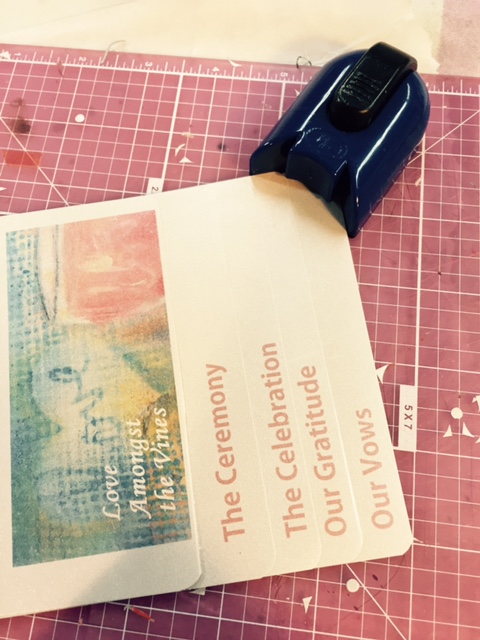
Like the corners I was cutting last night. They were on the programs I am creating for our wedding. Originally, I thought I could get away with leaving the corners straight. After testing one with cut corners versus straight, it was apparent that the cut corners give the programs a more finished look.
Except, I’d already completed 16 programs. When I’d started making them I’d considered cutting the corners but decided they were okay left straight. And they were, but…
I don’t want just ‘ok’. I want polished.
Not cutting them in the first place created more work in the long run. I had to carefully do each page individually, after I’d put the programs together.
16 x 5 pages each program x 4 corners each page = 320 corners versus (16 x 5 pages cut as one) x 4 corners = 64
Had I begun with cutting corners in the beginning, I could have cut in bulk, saving myself considerable time without impacting the look of the final product. Fortunately, I’m only 1/3 of the way finished the programs. I’ll definitely cut the corners in bulk going forward!
Which brings me back to not testing things I believe to be true only to discover the truth I thought was true, may not be so.
I didn’t start painting until I was in my mid-forties.
I’d always told myself, I am a writer. I have no artistic abilities. When I began painting on a whim one day with my eldest daughter I discovered the ‘truth’ I’d believed all of my life until then wasn’t true. Never having really tested my belief though, I couldn’t know its limitations. That day when I set out to paint with Alexis, my intention was to spend time with her doing something she loved. In the process, I discovered not only did I have talent, I love painting too.
Now, I could have gone through the rest of my life and been quite content with where I was at. But imagine…
Because I love painting, two years ago I built a studio in our basement so I could have my own creative space in our home. That space has been a gift. In that space the muse stirs me to places I can’t imagine until I set myself free to explore new ideas, fresh takes on the tried and true and even, to cut corners.
.

 Dare Boldly