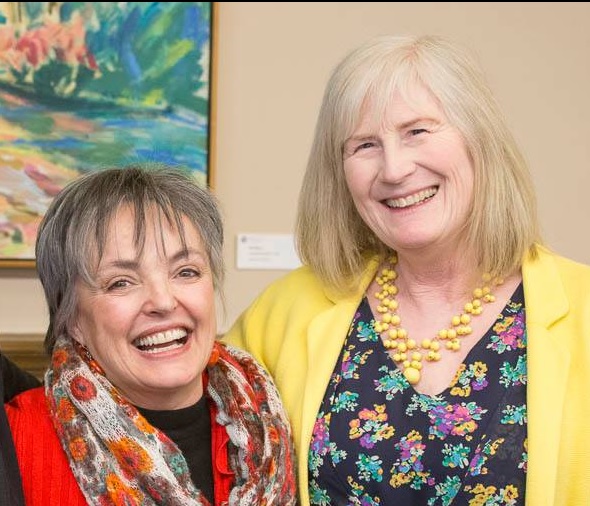
Wendy: A Silent Hero Remembered

It’s been 10 days since I received the news that my dear friend Wendy had left us. A decade of days, each carrying the weight of grief, sadness, and a bewildering sense of loss.

Guy de Maupassant once penned in his novel, Bel Ami, “The only certainty is death.”

It is the inevitabilty of every tree, flower, animal and human journey — the arc of life bends towards its own end. But what fills the arc with brilliance is everything we do between our first breath and our last. It’s the friendships we forge, the laughter we share, the tears we wipe away, and the love we generously sprinkle over the lives of others.

Why then has Wendy’s abrupt departure from this world left me so disoriented?

The word ‘unexpected’ echoes through my mind.

I had plans with Wendy, plans that involved many more days of laughter, stories, a glass or two of wine, and a charcuterie board artfully assembled. I was expecting to see her again.

Last Tuesday, HomeSpace, the not-for-profit organization she dedicated her considerable energy to, hosted a celebration to honour her life’s work. A crowd of colleagues, past co-workers, and her loving family gathered to celebrate a woman who was the silent engine behind so much good. Wendy was a woman who made the world a better place simply by doing—by organizing, by guiding, by supporting, and by empowering others to be their best selves.

Wendy never sought applause or public acknowledgment. She thrived behind the scenes, diligently ensuring others could stand in the spotlight.

If Wendy could hear the heartfelt stories and tributes shared in her honour that day, I imagine she’d dismiss the praise with her usual modesty. She would retreat to the kitchen, fussing over an extra cheese plate or refilling wine glasses, patiently waiting for the collective adultation to move on. Then, she would return to the crowd, quietly making her rounds to ensure that everyone was taken care of.

Don’t get me wrong, Wendy wasn’t a saint adorned in rose-colored glasses. She had her flaws and complexities like each of us, but it was precisely those nuanced layers that made her so incredibly human, so deeply cherished.She was a woman of many opinions—on governments and leaders, healthcare, and even the inefficiency of city traffic. We’d often muse (and chuckle) about how the world would be a more compassionate place if we were in charge. Yet, she never uttered a word that could hurt a friend, tarnish a colleague, or dim the atmosphere of a gathering.

And when we’d finished with complaining about the state of the world, we’d resume our conversations about the transformative power of art, the pressing issue of homelessness, and the secret to a perfect lemon pie as if these topics formed the very air we breathed.

Wendy was a woman of action, and during the pandemic, she transformed into a ‘mask-making wizard.’ At the memorial, some of her countless masks adorned a wall, framed by photographs capturing her life. Every face in those photos had at some point been touched by Wendy’s kindness, likely having received a mask or some other gift from her.

She gave until her heart could give no more.

Now, her heart has given its last beat; her breath its final exhale. Wendy is gone, but she leaves behind footprints deeply embedded in our hearts—imprints we never expected would be set in such quicksand.

What remains are the memories I will cradle in my heart, wrapped in a quilt of tender loving care.

Wendy’s absence has reminded me of the fragility of life, urging me to cherish each shared laugh, every shared story, all the shared moments that dance in the space between birth and the inevitability that Maupassant wrote of.

And so, while the world feels a bit dimmer without her, Wendy’s light continues to shimmer in the countless lives she has touched—mine most certainly included.

The SnowGlobe of Your Mind

Picture your memories as snowflakes dancing gracefully inside a snow globe. Within this crystalline sphere of your mind, memories shift and evolve, reflecting the dance of time.

When life delivers an unforgettable moment, new memories, like freshly formed snowflakes, gracefully descend. Some settle prominently, clear and within reach, while others are layered beneath the most recent moments.

The newly formed memories shimmer at the surface, vibrant and easily relived. Yet, with the passage of time, some memories nestle deeper into the canvas of your past, becoming more elusive.

Every so often, a gentle reminder—a fragrance, a melody, a cherished object—stirs the snow globe of your mind, reviving memories once buried, making them seem as fresh as yesterday.

But the dance of memories is intricate. Not all remain pristine. Some blend, others fragment, mirroring how memories can morph, skew, or fade. The internal landscape of your snow globe continuously reshapes, embodying the fluidity and fragility of your recollections.

Over the weekend, a dear friend of mine danced into the sunset. The moments we shared are vibrant in my mind’s eye. Years of camaraderie at work blossomed into a cherished friendship that weathered life’s seasons. Together, we savored laughter and tears, and shared a passion for life’s simple pleasures—good food, wine, and the joy of companionship.

She was a beacon during stormy nights and a steadfast supporter in countless endeavors. Her commitment to community causes was unparalleled, always standing tall when others faltered.

Today, the snow globe of my mind swirls with memories of her. Tears, held back since the devastating news, pool in my eyes, not yet ready to spill over into reality.

Absorbing the weight of her absence requires time—a pause to comprehend the void left by her departure and the realization that our shared moments are now finite.

In sharing this somber news with former colleagues, we all agreed: in her memory, we must forge the one thing she crafted so effortlessly—community.

We must take time to cherish shared moments, to truly connect beyond mere plans.

Life is a journey where memories incessantly gather, shaping each of our distinct snow globes filled with experiences with individuals who grace our path. By crafting new memories, new snowflakes, we enrich our life’s tapestry. As we treasure past memories and savor each distinct snowflake, the entire globe becomes more luminous.

Ultimately, it’s the strength of our community that defines us and makes our world richer. A world where, the love we leave behind becomes our lasting legacy.

Namaste

Bubbles and Reflections: My Mother’s Voice

I’m soaking in the bath when my mother’s voice drifts into my consciousness. “Wake up! Wake up!”

It envelops my mind, as delicate and fragrant as smoke wafting from a pot of Jasmine tea.

Hold on. That voice—it isn’t emanating from within me, is it? After all, she’s in spirit now. It feels as if her words have clung to every possible molecule, ferrying her message to my consciousness.

Could I be… possessed?

I don’t even have to articulate the thought. She’s already heard it.

“The ones we love may depart this world,” she murmurs, “but their voices linger, etched into our subconscious. And for the record, you’re not possessed. You’ve merely inherited the gift of deep listening.”

“Oh,” is all I manage. What else can I say? This is sooo beyond my thinking mind.

“Wake up, Louise,” she urges.

“I’m awake,” I mutter, though it’s not convincing given it’s the ungodly hour of 6 a.m.

“Not physically,” she corrects. “I’m referring to the sole of your soul’s core. Truly awaken.”

Her clever play on words surprises me. In life, English wasn’t her first language, and witty remarks were not her style.

But I’m digressing. A frequent occurrence when my mother decides to pop in during my baths. I always add extra bubbles for privacy, though she’s often reminded me she can see straight through them—and me.

“I don’t need to see through you anymore, Louise.” Again, she’s ahead of me, anticipating every thought.

Can’t I just have one peaceful soak?

“I’m not merely dropping by, Louise. My spirit has journeyed into the Great Mystery, and now I’ve become the maternal voice deep within you. The nurturing presence you’ve always longed for. The mother I couldn’t be back then.”

“Oh.”

“But I’m not here to complicate things,” she reassures. “Yes, I caught that ‘about time’ thought. But I’ve returned for a different reason.”

I play my part, inquiring, “Why?”

“To prevent you from drifting aimlessly, mistaking mere existence for a fulfilled life.”

Her depth overwhelms me, rendering me silent.

“Your silence is of no consequence, Louise. I perceive even the words you withhold.”

Ugh. As if a rogue thought critter wasn’t enough, now I have my mother tramping through my subconscious?

I could really use a breather.

“You don’t need a break, Louise.” I brace myself for a parental cliché, but she catches me off guard.

“You need a psychic hug.”

Intrigued, I venture, “What’s a psychic hug?”

“It’s a surrendering. Letting go of the constant quest for answers and finding solace in the questions.”

“You’ve been reading Rilke?” I joke, half-serious. Has she been stomping through my bookshelves?

Her laughter is delicate, like chimes. “I haven’t. I just understand what you’ve yet to embrace. I sense your desires, dreams, even those you’ve yet to acknowledge. I’m here to guide you in navigating the unknown.”

“But what if I’m not ready for that?”

“I know you are.”

And just like that, she fades. Leaving me amidst bubbles and reflections.

The end?

Or perhaps, just the beginning?

Scorched

C.C. and I set out late one afternoon for the west coast. We didn’t know what the drive would be like. Fires burned throughout the interior. The news was grim. Had we left the next day, we’d have been forced to take a long detour as the Highway closed due to one of the fires swooping down from the mountain side, jumping the highway and cutting off access.

We couldn’t see the numerous fires burning all around but the air was heavy with the smell and feel of smoke. The sky ominous. Apocalyptic.

We made it through to the coast and spent ten wonderful days with family in Vancouver and on Gabriola Island. C.C. was happy to spend the week on Gabriola with my sister and her husband — gracious hosts they share their beautiful home on the mountainside overlooking the ocean with open arms, hearts and kitchen. Despite having broken a kneecap two months ago, my sister never fails to cook up delectable and copious amounts of vegan fare.

In Vancouver, I savoured time with my daughter and her family, my grandchildren filling my heart to overflowing with joy and laughter.

On Monday, the highway once again open for passage, we drove back beneath smoke-filled skies while fires continued to burn out of control, though not as pressing up against cities, villages and homes as before.

When we reached the area where the fire had jumped the highway, it was grim.

Burnt out trees. Downed powerlines. Shells of cars littered driveways where once a garage stood in front of a home that was now vanished.

The devastation was both surreal and terrifying.

I stand in awe of the courage shown by firefighters and those families who frantically safeguarded their dearest belongings, escorting their children and pets to safety.

A friend relayed a harrowing account: ash and smoke blanketed the sky for days. They were away when the winds changed, steering the fire towards their home. News of their community’s fate was scarce, leading to an agonizing night of uncertainty. Miraculously, the fire forked around their property, sparing them and their neighbors. But not everyone was as fortunate. On their side of the lake, 170 properties were either damaged or devoured by the flames, with another 139 in West Kelowna also lost.

And still, the fires persist.

Driving through the fire’s path, witnessing its unyielding march to the lake, was both a humbling and heart-wrenching experience. The scale of the devastation was overwhelming.

But in the midst of this tragedy, I find solace. No lives were lost. I’m grateful for the brave souls who confront such perils head-on, ensuring others find safety. And I’m relieved that our friends have a home to return to.

Namaste.

Scorched
By Louise Gallagher

Red hot
forest
earth
scorched black
grasses seared
grimy soot scattered
beneath billowing clouds
pregnant
with smoky vapors
wafting
on the wind
like ghostly messengers
telegraphing 
Mother Nature’s losses
to distant horizons.

Far above, soaring
swoops
of blue-sky sail
effortlessly to infinity.

In every ending 
a beginning
opens the door
to new tomorrows.

Is Your Personal Baggage Allowance Exceeded?

At the beginning of his book, “The Power of Regret: How Looking Backward Moves Us Forward,” author Daniel Pink shares a quote from American essayist and novelist, James Baldwin:

“Though we would like to live without regrets, and sometimes proudly insist that we have none, this is not really possible, if only because we are mortal.” – JAMES BALDWIN, 1967

When I worked at an adult emergency homeless shelter, I had the privilege of sitting with numerous individuals as they traveled the final steps on their life journey. Every one of them expressed the desire to leave this world unburdened by regret. Mostly, their regrets stemmed not from the homelessness they’d experienced, but the broken relationships with the ones they loved.

In some cases, as the end neared, they reconciled with lost family members. In others, the lost ones wanted nothing to do with their wayward family member. I have often wondered if the lost ones regret their decision.

When my mother took her last breath three years ago, I felt regret’s sting upon my psyche. There were so many things left unsaid, wounds unhealed, forgiveness neither asked for nor given.

I had to do something with those regrets. Surprisingly, it was my deceased mother who helped me most.

For about six months after she died, a vision of her visited me regularly (I know that sounds airy-fairy, but it’s the only way I can explain what happened). My mother didn’t appear as the quiet, reserved, compliant woman I knew but as the spirited Holly Golightly, Audrey Hepburn’s iconic character from “Breakfast at Tiffany’s.” Other than dark hair and eyes, about the only other trait they shared was a certain inability to identify with other people’s feelings.

In life, my mother insisted she could do no wrong, and insisted she didn’t. As her youngest daughter, I insisted she could and did. And that was the chasm that lay between us.

It was my therapist who gave me the key to healing that relationship in the afterlife. “Some relationships,” she said, “can’t be healed until the other person is gone.”

And then, my mother was gone.

And then, she appeared one day while I lay in the bath and told me she was sorry for not being a better mother. For not being able to see me in life through the lens of love, not regret.

She also told me I didn’t have to keep adding bubbles to my bathwater in the hopes she wouldn’t see my naked body. “I’m spirit,” she told me. “I can see right through you.”

As in life, I ignored her and kept pouring in the bubbles.

According to Pink, regret is not only healthy and universal; it is a valuable self-development tool. It can spur us on to learn from the past, grow in the present, and lighten the load of what we carry into the future.

Harnessed wisely, regret can help us do and create better on our life journey.

For me, my regrets around my relationship with my mother stemmed from my desire for having ‘the perfect mother.’

Being a mother, I realize there is no such thing.

Yet still, I wanted my mother to see and know me, not as that ‘bratty’ child I used to be, but as the wise, compassionate woman I strive to be today.

Over the course of the months she came to visit me from the afterlife, I realized my greatest regret was that I was neither very wise nor compassionate in my interactions with her.

To quote Dan Pink:

“Regret makes us human
Regret makes us better”

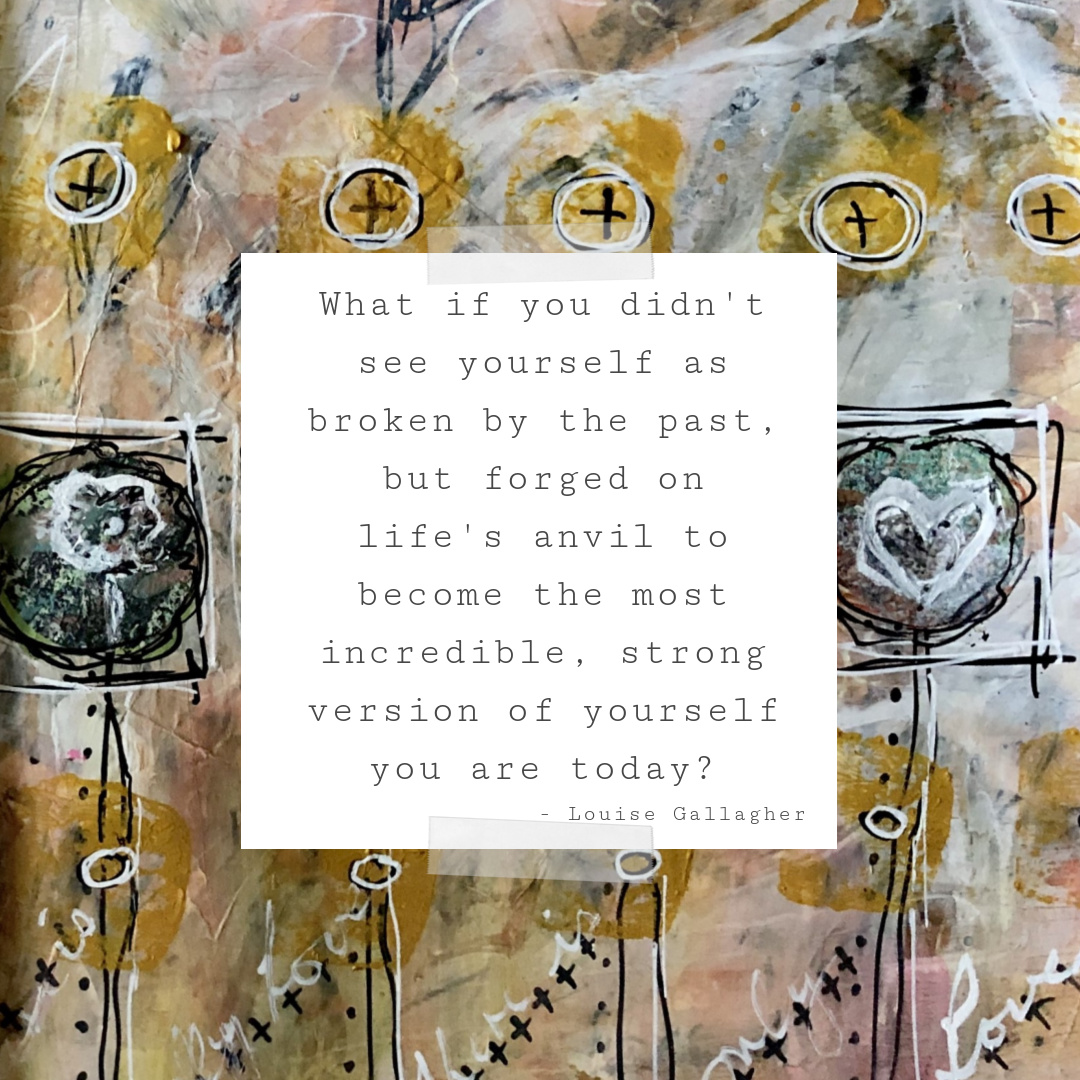
To let go of my regret and ultimately to grow as a human being, I had to choose to undo and reframe my regret so that I could forgive myself and let go of any remaining vestiges of regret I held about my mother. Fuelled by the grace of forgiveness, I am able to make wiser, more loving decisions today.

Every moral’s journey of life is marked by choices, paths taken, and roads left unexplored. Regret is an integral part of this journey, a bitter-sweet reminder of our humanity. However, it doesn’t have to weigh us down. My experience with my mother taught me that regrets can be reframed and even embraced to foster growth, healing, and compassion. Whether it’s a relationship with a parent, friend, or anyone else, we have the power to transform our regrets into wisdom. By doing so, we create space for forgiveness and love, not just for others, but for ourselves.

In the end, perhaps that’s the greatest lesson regret offers: a chance to become better, more compassionate human beings.

Change: Are you willing?

This morning, in the quiet of meditation, a profound question surfaced. “Aside from what Mother Nature creates, everything else on this planet Earth that we call our home has been built by humankind. If we don’t like what we’ve created, what are we willing to do to change it?”

We live in a world that is largely our own creation – a complex tapestry woven from the threads of human ingenuity, creativity, and ambition. It’s in our nature to be creators. From the simplest of tools used by our ancestors to the sophisticated technologies of more recent decades, we have always found ways to shape the world around us, molding it to better serve our needs, desires and aspirations.

Yet, our creations aren’t always perfect. We’ve built towering cities that touch the sky, but at the cost of pristine forests and ecosystems. We’ve developed incredible technologies that connect us instantaneously, yet we often feel more isolated than ever. We’ve striven for efficiency and convenience, only to find ourselves bound by the chains of consumerism, a consumerism that too often gives rise to a deep-seated dissatisfaction with what we have, and what we have not.

Which brings me back to the question that arose in my meditation. “What are we willing to do when we don’t like what we’ve built?”

It’s not an easy thought. There are parts of me that are willing to let go of things, ways of doing and being that don’t serve the world. But, let’s be honest here, there are also parts that don’t want to let go of the things that make my life easier. The things I really like. Like electricity, driving my car, flying places, new clothes, a well-stocked fridge, a mindset of discarding things I don’t need only to replace them by ‘newer, better, bigger’..

This morning as I gaze out at a perfect blue sky day, I wonder, “What am I truly willing to change?”

In August, C.C. and I will be driving to the west coast to visit family and friends. Taking gifts for my grandchildren fills my heart with joy. Yet, they already have a wealth of toys, books, clothes, THINGS. Am I willing to forgo my consumerism to simpy be present within the joy of our connection?

Am I willing to change for the better of the planet?

Given the state of the world today, do I have a choice not to?

Embracing the idea of change can feel unsettling, but it’s crucial for our planet today, and for my peace of mind.

In this world of floods, raging wildfires, war, hunger and starvation, isn’t it time to challenge the status quo and push our boundaries? Isn’t it time we all advocate for sustainable practices to conserve our environment, promote genuine human connection over virtual interactions, or resist the incessant pull of mindless consumerism?

If not now, when?

Individually, there is a lot we can each do. And if we each start doing similar things, we have a chance to create collective action that does make a difference. Because, the kind of changes Planet Earth needs us to make do not occur in isolation. It’s going to take a collaborative effort, requiring us to bridge our differences, pool our resources, and unify our goals. It may demand sacrifices and require us to forgo certain comforts, but if the end goal is a world that is sustainable, a world that aligns more closely with our true desires for life on earth, then the effort is surely worth it.

Which brings me back to the question that arose from my meditation: What are we willing to do to change the world we’ve built if we don’t like it?

It is not just a passing thought. It’s an urgent call to action. If we can learn anything from our past, it’s that we are the architects of our own reality. We have the power to dismantle the structures we’ve built and create something far better in its stead.

Our willingness to change is the first step towards a more harmonious and sustainable future.

Are you willing?

Namaste

Boundaries: The Difference Between Yours and Mine

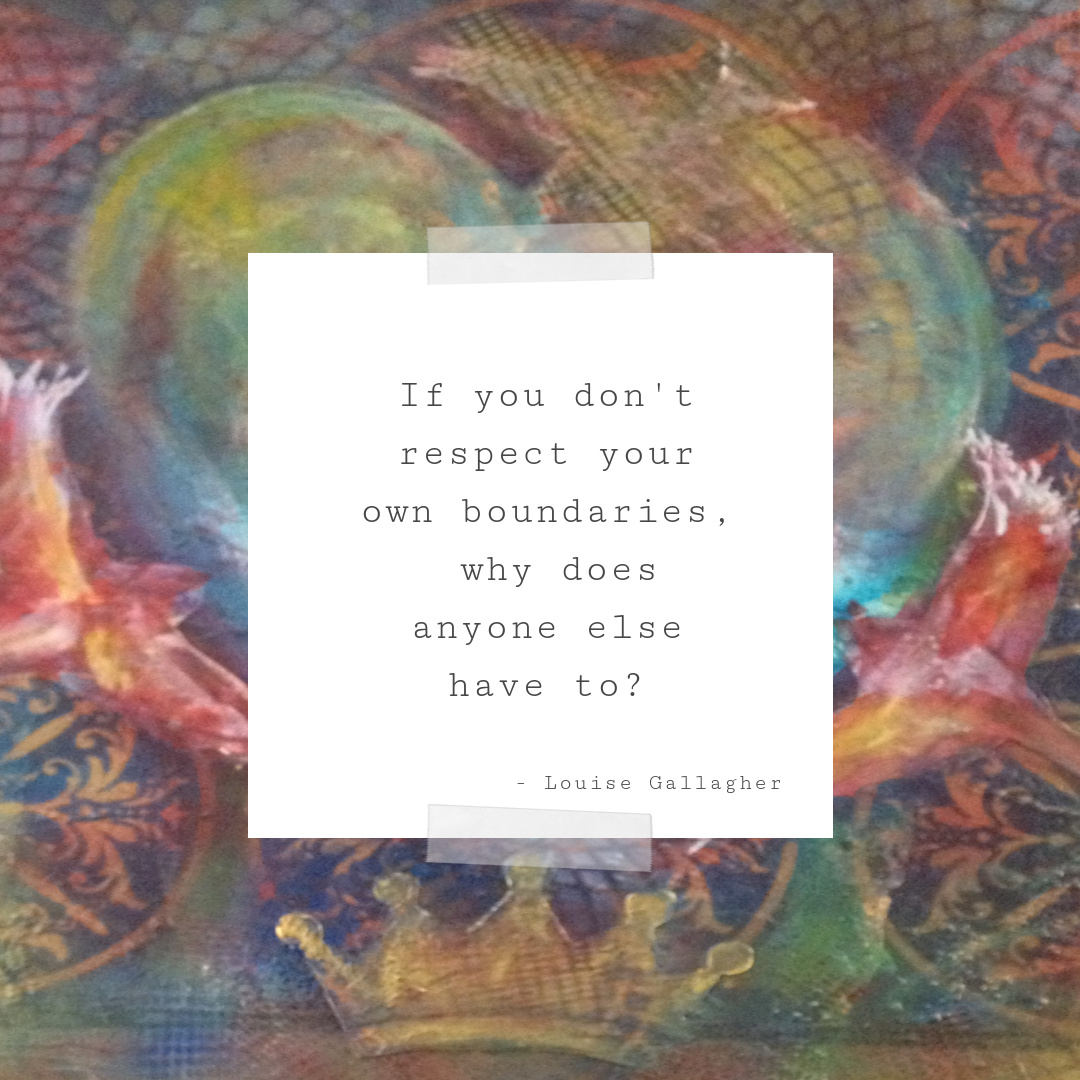
Boundaries – a line that marks the limit of an area, a concept we grasp as physical demarcation between one space and another. But when it comes to our emotional landscape, these lines become blurred, complex, and often invisible. Yet they are equally, if not more, significant for our wellbeing.

The absence of boundaries is like trying to hold water in your hands without a container – you lose yourself in an unstructured space, susceptible to the whims and influences of others. You become a canvas upon which others paint whatever they want, with little consideration for your emotional integrity.

This realization dawned on me many years ago when I found myself telling someone, “I’m getting tired of you crossing the boundaries I refuse to set.” The stark truth of my words hit me hard. It begged the question – Are my boudnaries like that proverbial tree falling in the forest with no one around to hear it fall? If I don’t set boundaries, is anyone crossing them?

Sometimes, we find ourselves blaming others for overstepping our boundaries, when in fact, it’s our responsibility to set and honor them. Like a lighthouse in the fog, our boundaries guide us to safe harbors, away from the rocky shores of emotional distress.

The challenge is, you’ve got to know your boundaries to set them. For me, because mine weren’t clear, it was really hard when I first began this work to get clear on what I wanted, allowed and didn’t allow in my life. It required scrupulous self-reflection and difficult conversations. But it was crucial to my emotional health and in ensuring that my relationships are respectful and reciprocal.

And the bottomline is, I’m worth it. I’m worth doing the work of knowing myself deeply and honouring my own needs. So are you.

The question is, how do we define our boundaries? What makes a boundary healthy? They aren’t lines drawn in anger or fear. They’re created from self-understanding and respect for our own needs and limits. Healthy boundaries involve clear communication of our expectations and the consequences if these lines are crossed. They are firm yet flexible, allowing for growth and change.

Acknowledging our feelings, needs, and values is the first step in establishing our boundaries. These can be as simple as setting aside personal time for relaxation or as complex as articulating our expectations in a romantic relationship.

And here’s the thing. Setting boundaries is only half the journey. Upholding them requires strength, courage, and consistency. We need to understand that it’s okay to say no, that it’s acceptable to prioritize our needs, and that standing up for ourselves is not selfish but self-preserving.

Remember, each time we compromise our boundaries, we’re not just bending rules – we’re subtly telling ourselves that our needs, our wellbeing, aren’t important.

Embracing boundaries as a fundamental part of who we are is a lifelong journey. The first step is understanding that boundaries aren’t limitations, but definitions. They define who we are, what we need, and how we want to be treated. They’re not walls, but markers of respect – both for ourselves and others.

In the end, we cannot control how others behave. We can control how we respond. Respecting our own boundaries, calmly, firmly holding them in place with tender heart and hands, eases tension while creating joyful, loving spaces that honours and celebrates the differences between us. In those differences lies a sea of limitless possibilities for life to blossom in all its living colours.

Oh! And to the individual to whom I said, “I’m tired of you crossing the boundaries I refuse to set”… Thank you for laughing with me at the realization of how ludicrous my utterance was. I’m grateful for your compassionate care as I walked into experiencing my truth coming to light.

A Father’s Legacy

I have always had a deep love for reading. As a child, I was envious of my, next to me in age, older sister who had the privilege of going to school before me. Determined to catch up, I would insist that she teach me to read while she did her homework each night at our kitchen table.

There was something magical about learning how letters formed words that held meaning and joy in making sense out of sentences woven together with those meaningful words.

Many evenings, when my father was home, he would pull out the dictionary and challenge us with the definition of unfamiliar words. As I grew older, my siblings and I would gather with our father around that same kitchen table to play Scrabble, a game that further deepened my love affair with words.

A while ago, after my mother’s passing, I stumbled upon a big tin box of papers she had carefully preserved over the years. Among them, I discovered one of my father’s small black notebooks where he had diligently recorded our Scrabble scores. There, in his scrawling handwriting, I found evidence of my passionate connection with words. My father, who never believed in letting me (or anyone else for that matter) win, inevitably emerged as the victor in every game. However, scattered throughout the notebook, I discovered occasional victories of my own, moments when I had managed to best him.

My father is the root of my love for words and writing. A man of few words himself, he used writing to express the emotions his heart did not know how to speak.

When I moved from Europe to Canada in my early twenties, my father’s letters were the lifeine that connected me to ‘home’. Over the years, he began to shift from letter-writing to recording casette tapes where both he and my mother would chat together as if I was at the table with them. Inevitably, they also shared menus and recipes.

My father’s love of all things culinary is the root of my love of cooking.

Someone mentioned to me the other day that I don’t often write or speak about my relationship with my father.

They’re right.

Challenge is, I didn’t have an answer to the next part of their question, “Why is that?”.

I wasn’t close to my father. I don’t think anyone could be. Some of our lack of closeness may be because for many years, I held my father on a pedestal and it’s hard to be close to anyone when you can only view them from afar. It could also be because the walls around his heart were so high and impenetrable, breaking through (and believe me, I tried a lot) left me feeling like Sisyphus rolling his giant boulder up the hill again and again, never to reach the top.

But here’s the thing, not having an answer doesn’t excuse me from my responsibility to explore that relationship to understand its role in forming who and how I am in this world today.

My father was a complex man. Undoubtedly, our relationship influenced many of my choices in partners. While I always seemed drawn to those who were emotionally distant and strong-willed, they also needed to possess intelligence, generosity, quick-wittedness, and a love for reading. And if they happened to enjoy playing Scrabble and spending time in the kitchen, it was an added bonus!

Our parents play an integral role in who we become and how we see the world and our role in it.

My father taught me to not be afraid to rock the boat. That accepting ‘status quo’ was just another way of settling. He taught me the value of a human being is not because of their skin colour, faith, pedigree or wealth, it’s because they’re the same kind of different as us. He taught me to be welcoming to everyone at the dinner table, and to make room for those who have no other table to sit at.

During our countless walks along the Rhine River on peaceful Sunday mornings, he instilled in me an appreciation for all creatures, both great and small. He helped me see the wonder and awe in nature’s grand displays of bold colors as well as its quiet, leafy beauty. He encouraged me to listen to the melodies of birdsong and discover the rhythm of my own heart amidst the gentle thrum, thrum, thrum of barges gliding along the river.

He taught me the art of baking bread, exploring recipes and new ideas, and the value of curiosity in seeking answers to the countless questions that arise within my mind.

And he taught me how to love life, fiercely.

I was 42 years old when my father died of a massive heart-attack almost almost 28 years ago. It’s time I got to know him better now.

___________________________________

PS. If you are interesting in exploring your relationships with those who played a role in making you who you are today and want support in taking that journey in a safe, loving and courageous space, Discovery Seminars has room at their table for you.

Embracing Imperfection

We live in a beautifully imperfect world. A world full of mystery, wonder and awe-inspiring moments, including, dark and forboding times.

What if, it all belongs?

What if it is our constant struggle to be perfect and to create perfection all around us that causes strife, our lack of connection and belonging in this world?

It’s a not so subtle force, this desire to be perfect and to make the world around us perfect. Its constant yammering to do better, be better, make better of ourselves and everything we create, achieve, buy and do in the world leaves us feeling dissatisfied and sometimes defeated by ourselves. Its constant wailing pounds away at our peace of mind disrupting our ability to be together in peace in the world.

In its strident calling out for justice, in its insistence that ‘this’ or ‘that’ do not belong in the world, in its labelling of human suffering and misdeeds as ‘wrong’, in its endless battling against one foe versus another, it denies the inescapable truth — Imperfections, sorrows, and struggles are threads woven into the tapestry of our shared human journey.

As long as we do not accept each other and our shared journey, the everything we perceive as imperfect will remain as thorns that prick away at the tapestry of our human journey causing knots of discord everywhere.

It is in our acceptance of imperfections that freedom waits. Acceptance should not be mistaken for resignation or passivity. It does not imply giving up on striving for change, justice, and truth. Instead, acceptance allows us to relinquish the habit of railing against perceived injustices and embrace the imperfect nature of our existence. By understanding that imperfections are an integral part of being human, we foster a sense of belonging and unity in our ability to work together in our shared imperfections.

For me, my quest for perfection often leaves me exhausted. In my journey, I’ve gathered together a tool-kit full of ways to quieten my need for perfection–meditation, exercise, dance, creative endeavours, being in nature. Yet still, there are times I refuse to do the things I know calm and heal me. Still, my quest for perfection raises its persistent voice whenever I fall into the belief that I am separate from the world around me or that the world around me is separate from me by our differences..

The desire for perfection keeps us separate from one another,. Those whom we deem ‘different’, the things we deem unwanted, become the barriers to the things we want most as human beings — a sense of belonging, that we fit in, that we are loved and needed on this journey. In that separation, we arm ourselves against our fears of the other, and lose our belief in our power to affect postiive change, together.

Love is perfect and when I when I choose to stand, strong of back, soft of heart, and lay down my arms full of discord and open them instead to Love, I find myself in a more peaceful, loving world.

When I choose to focus on changing the things I can with loving-kindness, my ripple becomes part of our collective power to change the world for everyone.

Our world is full of imperfectios amidst its perfect beauty. When we let go of criticizing, compaining and condemning the things we do not understand, or judge too harshly, we pave the way for perfect Love, together.

What about you?  Are you holding onto your perfect armor, hoping it will protect you from life’s imperfections? Are you holding yourself separate from all the world’s perfectly imperfect beauty?

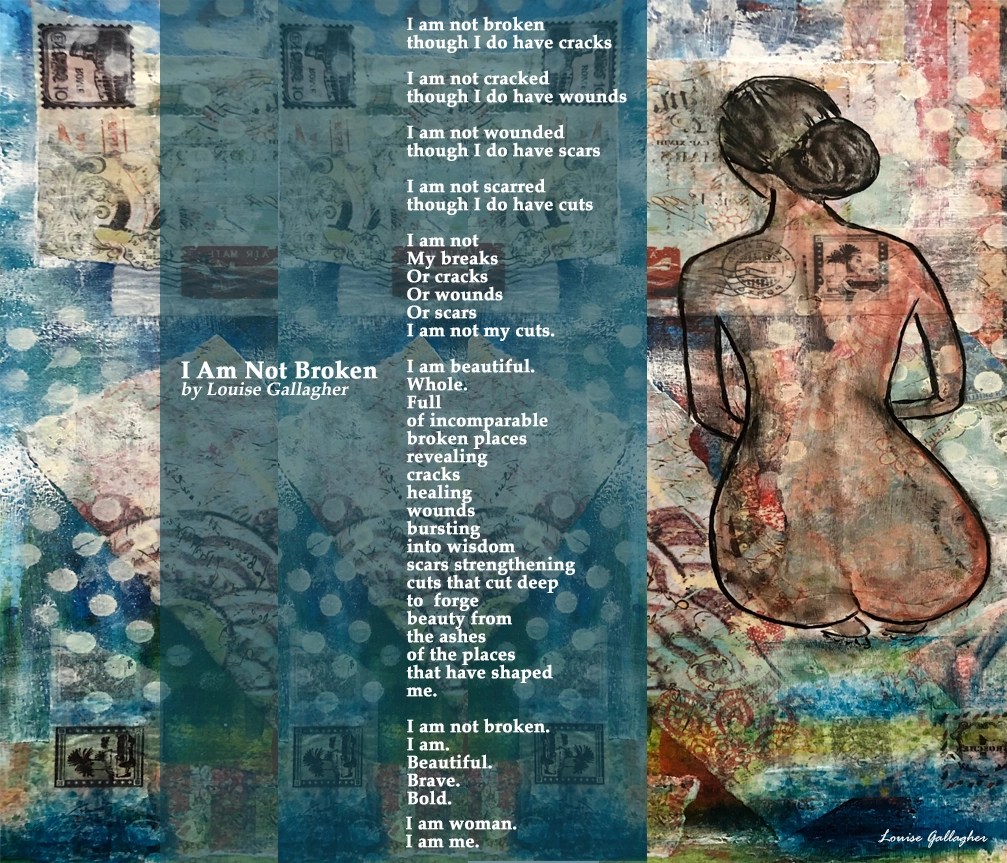
I am not broken (a poem)

I wrote this poem some time ago and am sharing it spoke to me again this morning as I was looking at all that has happened in the election we’ve just endured here in Alberta — the outcome of which wa not to my best liking– but, as I said to my beloved, “The people have spoken. At least this time, she was elected by a majority of Albertans, not just a select few.”

And I am reminded of the words of Rev. Gary Pattison who said, the Sunday after Trump was elected as President of our neighbours to the south, “We must stand, strong of back, soft of front.”

We must listen to understand. Hear without judgement and Be tolderant and Create common ground where ever we go.

Our system isn’t broken — but when we let divisiveness separate us, we create broken spaces.

.

I AM NOT BROKEN
by Louise Gallagher

I am not broken
though I do have cracks

I am not cracked
though I do have wounds

I am not wounded
though I do have scars

I am not scarred
though I do have cuts

I am not
my breaks
or cracks
or wounds
or scars
I am not my cuts.

I am beautiful.
Whole.
Full 
of incomparable
broken places 
revealing
cracks 
healing
wounds 
bursting 
into wisdom 
scars strengthening
cuts that cut deep
to forge 
beauty from
the ashes
of the places
that have shaped 
me.

I am not broken.
I am.
Beautiful.
Brave.
Bold.

I am woman.
I am me.