#LongestnightYYC

Today is Solstice. The Longest Night of the Year in the Northern Hemisphere.

After months of travelling deep into the darkness, today, the sun will rest low upon the horizon. There she will rest three days before slowly beginning the long journey back to summer Equinox. In her journey back into the light, she will breathe hope into the promise of spring bursting forth with new blossoms. She will breath possibility into the new buds bursting open. In her warm embrace she coax all beings out of hibernation.

She will breath. In and Out. In and Out. And we will rejoice in the sun’s welcoming rays.

For today, we remember.

We remember, the long journey here to this longest night. The long walk into the darkness and depths of winter.

This journey into the darkness of shadowed days where the sun moves back and forth in ever-shortening arcs giving night room to hold reign upon earth.  The darkness is not something we can avoid. Pass-over, under, or by. The darkness must be savoured, explored, journeyed into as we explore the essence of our creative spirits resting in winter’s embrace, breathing deeply into the knowing that soon, the cycle will continue, the earth will journey closer to the sun, and summer will once more hold us in its rays of light.

longest-nightFor today, re remember.
We remember, those for whom the journey here on earth ended in another season. We remember those whose hearts stopped beating on one final note and breath escaped their bodies to nourish life no more.

Today, we remember.

We remember, those who followed the sun’s journey and have now entered the eternal deep and left us here on earth without their smiles, their hopes, their presence. Who have left us here with only the memories of those we loved, cared for, dreamed with, and about. .

Today, we remember.

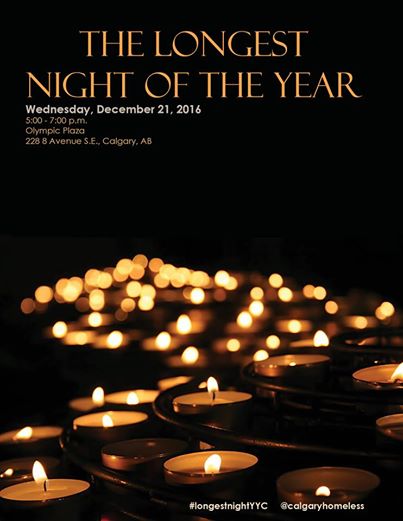
Tonight, if you are in Calgary, we are holding The Longest Night of the Year Memorial at Canada Olympic Park. Please join us in remember those whose long walks into the darkness never lead them home.


A Tree for Christmas #storiesofhope

She hadn’t had a Christmas tree in four years. Not because she didn’t want one. She never gave up wanting one. She didn’t have one because for four years she didn’t have a home to put one up in.

And now, she does. Now, she has a place of her own.  She has a tree.

It’s not a large tree, but in her one bedroom apartment, it fits perfectly. “I love the smell,” she says as she ties another silver ball onto a branch. She breathes deeply. “Oh wow! This is so exciting.”

I am sitting in a chair watching her, chatting, attaching hooks to each ball in preparation of its placement on the tree. Joelle had agreed to have her photo taken for the brochure as a way to give back to the agency that has, as she describes it, ‘saved my life’.

I knew Joelle* when she was staying at the shelter where I used to work. A tiny birdlike woman, chronic health conditions, addiction,  a messy divorce, life missteps left her without a home, or the ability to work. In her weakened state, she became one of those who ‘fall through the cracks’ and end up on the doorstep of shelters across the country. Struggling with life, poor health, poverty, addiction, they run out of resources to keep a roof over their head and find themselves knocking on a shelter door.

If they’re really lucky, and there’s a focus in their community on affordable housing for those living on the margins they will get a place to call home, just as Joelle did.

On this day, just before Christmas several years ago when I still worked at an emergency shelter, I watched Joelle carefully place decorations on the tree and was moved and touched and reminded of the delicacy of this thread called the human condition. A thread made up of tiny moments that link us to the wonder, and sometimes sorrow, of being human, of being part of humankind, alone, yet not alone. Together, yet separate.

Joelle’s tree was a gift. A gift from a woman she met during the summer while in hospital for six weeks receiving chemotherapy. The woman, Sarah, was in the next bed. For six weeks the two women from very separate and different walks of life connected. They talked and shared and when Joelle got out of hospital, Sarah took it upon herself to create a welcome home for Joelle in her new apartment.

And that’s where the magic kept unfolding.

Being released from hospital into homelessness is one of the tragedies in our social fabric. For Joelle, being released back to the shelter was a given. Until through Calgary’s Plan to End Homelessness and the housing the shelter provided, Joelle was housed.

She was provided the basics, furniture, dishes, but the place still lacked that feminine touch, that sense of — ‘Joelle’. And then Sarah,  stepped in and ‘prettied up’ the place. She held a house-warming for Joelle, inviting her lady friends to come and create a place of comfort and beauty for this woman she’d met while lying in a hospital bed, recovering from her own serious medical condition.

I sat and watched and chatted with Joelle and I knew it was there. In that room with us. It was palpable.

The spirit of Christmas.

The best of our human condition dancing in the twinkling lights of a Christmas tree that was a gift from a stranger who has become a friend and who continues to take the time to ensure this woman for whom life has not been easy, finds a less stressful, more beautiful path.

“What does having your own place this Christmas mean to you?” I ask Joelle as she tosses tinsel and reminisces about Christmases past.

“It means I get to spend it with my daughter. We get to be a family.”


And there it was, all over again. The meaning of Christmas shining in the light of one woman’s eyes filled with wonder as she decorated a tree and dreamt of spending time with the ones she loves. And in the wonder of the moment I was reminded  once again that Christmas is not in the baubles and glitter, the gifts or the Christmas cards strung along a mantle. It’s right here. Right where we are. It’s a place to belong. To be welcomed. To be together. A place where family meets and connects to what makes magic happen — our human condition shining in Love.

It is Christmas. No matter where we are, no matter how far from home we have strayed, may we all come home to the heart of sharing peace, love and joy at this special time of year.

For stories of Christmas and recovery and having a home, please visit The Gift Project.

baner-copy

This article has been revised from its original version posted in 2010.  I have changed the names of the individuals involved.

Listen to this!

Awhile ago, my team and I at the Foundation where I work, developed a short video about ending homelessness.

Our purpose was very clear — we wanted to inspire people, motivate them and engage them to think about homelessness not as the story of an individual who has made ‘bad’ choices, but as a societal issue that we have the capacity and power to change — when we work together.

When I was meeting with the production company to discuss talent for the video, as in– who should be ‘the voice’, I suggested a young man I’d met at a concert produced by the Calgary Drop-In & Rehab Centre.

Jordan Williams is a talented, compassionate and passionate young musician. He infuses everything he does with the stories and experiences he’s gathered as a young Aboriginal man who has faced homelessness, discrimination and other hard times and allowed the circumstances of his life to forge  him into a kinder, more caring and thoughtful human being.


Jordan Williams shared his voice with us so we could create a video that awoke people to the possibility that they can play a role in ending homelessness.

Thank you Jordan for your heartfelt and enthusiastic commitment to making this project into a reality.

Thanks also to the crew at Foundry Communications for guiding this project into reality. To Paul Long for writing an awesome script and to the team at Six Degrees Music & Production for the awesome sound work — and for creating a space for everyone to feel right at home in the studio!

Want to play a part in ending homelessness?  Here are some ideas on how to get involved.

Volunteer. Emergency shelters are always looking for people to serve meals, sort donations, help clean. Check out Propellus (Volunteer Calgary)– or a similar organization in your area, to find out ways to volunteer, or, contact an agency directly.

Donate. Canada Helps is a great site to find charitable organizations in your area to help you match your passions to your giving.

Create — it’s easy to create/host an event that will raise funds for an organization. At the Calgary Homeless Foundation we have the Dinner Party — invite a group of friends for dinner and make a difference. We provide an entire toolkit on how to get the dinner on the table while inspiring your friends to dig into good companionship, conversation, great food and the art of making a difference.

Be a Social Media magnet — like the FB page of an agency you’re committed to helping. Share their posts on your social media so your network can connect with their network and… make magic (aka change) happen.

Heed the call–visit the Calgary Homeless Foundation FB page, watch the short video Homelessness Doesn’t Stand a Chance, click on Like, and SHARE! (you’ll have to scroll down three or four posts to find the video — it’s pinned so will always be near the top)

There’s a whole lot of gratitude and thankfulness coming your way!

Thank you!


HomeSpace: a home in our community for everyone.

Today is the release of the preliminary report of the Point-in-Time Count of Homelessness held October 19th in Albereta.

PIT Counts are interesting beasts. They provide a moment-in-time snapshot of homelessness in any given city. They are not the de facto scientific answer to who is homeless, how long they’ve been homeless, or what are the issues contributing to their state of being.

They are a moment in time of those counted on a given night.

Yet, often, media see the PIT results as the measure of a city’s success, or failure, to end homelessness.

The PIT number only tells part of the story. The part where we count who is on the streets or in shelter, incarcerated with no fixed address, or hospitalized with no fixed address on that night.

The more important data is how well a city is doing at housing those for whom home was a long ago place. How well those who are housed thrive in housing. How much is health, physical and mental well-being improving.

In Calgary, we are doing a stellar job of ensuring the system of care is strong, responsive and proactive. We have agencies who work together to share data, discuss housing plans, develop strategies to ensure the system of care is using its resources as impactfully as possible.

Challenge is, the economic climate, the lack of affordable housing especially for those with lower incomes, is limited in our city.

We need housing.

homespace-logoWhich is why I am so proud to work for an organization that had the courage to take the bold move of transferring its $60 million housing portfolio to an independent entity so that organization could focus on the development, building and management of housing for the h0meless-serving sector and vulnerable Calgarians.

On Friday afternoon I stood amidst friends, colleagues, agency partners, government officials and stakeholders as HomeSpace Society was officially launched.

It was exciting. Moving. Thrilling to see this dream that was seeded in the early 2000’s become a reality.

Some of my favourite people from the Foundation where I work have moved over to HomeSpace — and the enthusiasm, commitment and passionate excellence they carry with them is inspiring, and hopeful.

They know their job like no one else.

They know what it takes to move a project from concept, to land acquisition, to development approval and to final build.

They know what vulnerable people need for housing and to stay housed. And, they know how to work with the funded agencies who provide supports to tenants so that those for whom homelessness has been a long time reality can let go of the ‘homeless identity’ to claim their new way of being in the world, ‘at home’.

It took a lot of hard work, commitment, vision and patience for HomeSpace to become a reality.

Congratulations to everyone involved. From CHF management, board members, and team to the entire team at HomeSpace, and everyone who played a role. Job well done!

I’m excited about what the future will bring for vulnerable Calgarians, the homeless-serving sector, and our city.

This morning we will be talking about the people experiencing homelessness on one night in our city. And while we won’t be talking about those who are housed, it’s their story that must be told, because that the bigger picture of how Calgarians are making a difference, together!

Drowning in the raging torrents of homelessness.

We are waiting for a street light to turn green when my daughter says, “Oh dear, I hope that man is okay.”

A truck is blocking my view of the man she is referring to. When it passes I see the man. He is lying in the doorway of a building on the other side of the street. Half-in. Half-out. His legs on the stair above him. His head resting on the sidewalk.

We cross the road, pass two business men deep in conversation and approach the man where he lies just behind them.

“Sir? Sir? Are you okay,” my daughter asks him.

His legs are twisted where they lay on the step above him. He spills out onto the sidewalk like a slinky running down the stairs.

He opens his eyes. Befuddled. Confused. The braid of his long grey streaked black hair lays at a right angle to his head. His clothes are tattered and worn. His boots are untied.

“What happened?” he asks.

We’re not sure but we tell him it looks like he has fallen on the street.

“How can we help?” my daughter asks.

“Help me sit up. Please.” he says.

Both my daughter and I think we should call 911. What if he hurt himself when he fell.

No. No. He insists. I just need to sit up.

“We need to make sure you can move before we help you sit up,” I tell him. “Can you show us that you can move your legs?”

He wiggles his feet. I sense a bit of a mischievous smile as he does it. There is something engaging in his nature, even as he lays on the ground at our feet.

Alexis and I help him sit up.

“How can we help?” we ask again.

“If you have some spare change I can go get a cup of tea,” he says.

“I’d rather you not move just yet,” I tell him. He seems disoriented. Weak and oh so vulnerable. “I’ll go get you some tea.”

And I cross back over the street to the fast food deli on the corner while Alexis stays and chats with him.

His name is Frank she tells me when I return with tea and cookies. I tell him my name. He thanks us profusely.

The two business men on the corner finish their conversation and move off. We stay and sit with Frank and chat for a little longer. We give him money for fried chicken and chips from the ‘joint’ just up the street. His favourite he says. He promises me he will not use the money for more booze. I tell him I trust him. He smiles, and there’s that glimmer of endearing mischief again. He tells me I have no choice.

Alexis and I leave him sitting there with his tea and cookies. We discover the building just down the street is a Drop-In Centre. We go in and let the woman at the desk know about Frank’s condition, his fall and our fear he may have hit his head harder than he imagined.

She goes out to help him and after stopping at the deli on the corner further down the block for a bowl of soup, we see that Frank is no longer sitting in the doorway where we’d left him.

We hope the worker has taken him into the Drop-In Centre to keep an eye on him.

We have done what we can.

As we continue our walk towards downtown, Alexis tells me that Frank has told her he is 70 years old. I drink a lot, he said. What else do I have to do with my life?

His words sit heavily in my heart.

The latest Vancouver Point-in-Time Count of Homelessness found 1,847 people experiencing homelessness. 539 of those people are unsheltered.

It is everywhere in this city. Homelessness.

There are people ensconced in sleeping bags lying at the corners of almost every busy intersection in the downtown core. There are youth. Men. Women. Dogs too.

They sit, their cardboard signs telling the same story. Asking for the same thing. Hungry. Grateful for any help.

The cost of living in this beautiful city by the ocean is spiralling upward and upward. And people are falling faster and faster through the cracks. It feels like a heavy and daunting task — to end homelessness. To make sure everyone has a home.

Alexis and I met a man named Frank. His body lay sprawled across the street. We could not end the homelessness that has swept him up in its mighty torrent. We do not have that kind of super human strength just as he does not have the super human strength he needs to pull himself out of the waging waters.

As a society, we must find our collective strength to make the choices needed to stop the flow of humanity falling into the raging waters of homelessness.

We must find ways to build bridges so people can find their way safely to the other side before being dragged under homelessness’ turbulent depths.


Silly statements and other limiting words

I am talking with two of attendees at an event. They are both Indigenous Peoples. Both well-versed in sensitivities around Indigenous issues.  Both have been discriminated against. Branded as ‘other’. Felt the disdain of those who call themselves ‘white’.

I tell them about my awakening at an Indigenous training course I took a couple of weeks ago.

“I have never stopped to think about the richness and depth of Canadian culture as being grounded in Indigenous Peoples,” I tell them. “I have fallen for the discourse that our history as a nation began when white man arrived.”

It didn’t. It began thousands of years ago with a culture that is deeply connected to the land, the elements, nature and a desire to walk softly upon the earth.

“Discrimination and ‘other’ thinking is pervasive,” I say. “I participate in it without even recognizing I am participating in it.”

One of the men mentions the statement we make as a Foundation at the beginning of all our events acknowledging that we are standing on traditional Treaty 7 land.

“You know that calling it ‘Treaty 7’ land is a reference to colonization,” one of the individuals mentions. “For many of us, it is a reminder of all that has harmed us, not strengthened us.”

I am taken aback.

It is subtle this discrimination, this ‘other’ thinking.

Later, I am at a roundtable discussion on the National Housing Strategy the Federal Government is currently in the process of drafting.

Our host is a public figure. An elected official. Well-respected. Well liked. He has always been conscious and considerate in his approach to homelessness.

I am listening to the conversation. To my peers around the table talking about the content in the documents before us.

On a page referring to the themes to be covered by the Strategy is a list identifying those who need extra consideration due to the specialized needs of their demographic/human condition. ‘Homeless, seniors, youth, families, people with disabilities’. There is no mention of Indigenous Peoples.

Someone mentions the omission. The elected representative is surprised there is no mention. He comments that he doesn’t see how it could have gotten so far into development with such a glaring omission.

“Perhaps it’s like the language we use without thinking,” I say. And I ask him about a comment he had made earlier in the session. “You said, ‘We are not going to make silly statements like, we’re going to end homelessness. We know we’re not.”

How is that a silly statement, I ask. It is aspirational. Forward-thinking. But silly?

There is a pause and then they talk about how they were referring to the timeline. He tries to justify the statement until someone else around the table also speaks up in support of my question. “If the government plans on ensuring everyone has access to housing, won’t that mean we end homelessness?”

Another pause.

I stand corrected, the elected official says.

Language.

We get hung up in our words. Use them to divide and conquer. To separate and clarify.

We make words the ground upon which we stand, the positions we will not cede, the space we will not move from.

And in the process, our language becomes the battlefield upon which we stake our claim to be right. It becomes our battery of defenses against another so that we don’t have to give up our right to stand our ground.

It was a short week and a tough one. A week where words spoken awakened my consciousness to injustices caused by the language of Treaties that continue to define and marginalize an entire Nation. A week where language failed to inspire by its use of silly statements about what we can, or cannot do, amongst a group of people passionately committed to ending the very thing they called silly.

I believe passionately in our human capacity to create possibility from the seemingly impossible.

I believe we are all one humanity. One human race.

But the words I heard this week, and the ones omitted when they needed to be spoken, are cause for concern.

How can we stop discrimination? How can we end homelessness when the very words we use continue to mire people in the limited thinking of the past? How can we inspire one another to do better when the words we use build walls and tear down confidence in our ability to contribute our best?


Growing Tolerance @CalgaryKeys to Recovery

keys logoHe is quiet spoken. Humble. 

He is a landlord who works closely with Keys to Recovery, a not-for-profit agency that provides supportive housing for formerly homeless Calgarians who are exiting rehab and treatment with no fixed address.

He talks about his understanding when first he began working with Keys.

How he became aware of his lack of tolerance, understanding, compassion.

And why tolerance is so important to create a better city for everyone.

He is dynamic. Humble.

He is the former Chief of Police of Calgary, or as the MC, the brilliant and compassionate Jonathan Love, Mr. @JLoveNotes describes him, Our Forever Chief.

He too mentions tolerance. Talks about when he first became a cop in 1975 how little he, or anyone, knew or understood about homelessness, addictions, abuse, family violence. How so seldom there were any answers, or any compassion, to provide those on whom they called to provide support.

How tolerance as a society is so vital to creating a just society. A city where everyone has a place to call home.

He is calm. Humble.

He talks about his life before homelessness. His successes. The company he built. The family he held dear.

He talks about the impact of his addiction. The trauma of homelessness, of being lost and intolerant of any offers of help.

And he talks about going to treatment. Twice. How the first time, coming out and only have the street to greet him, he couldn’t tolerate the shame and trauma. He fell back. Hard.

And then he talks about getting straight, going back to treatment and finding a home with Keys.

They’ve given me my grandkids, he says.

Once upon a time, we were a city that did not tolerate the presence of people with mental health, addictions, physical disabilities well.

We are learning.

The value of tolerance. Compassion. Empathy. Caring about one another, no matter where we are on the street.

We are learning to celebrate the work of being there to support those who fall, and to celebrate those who do the work of being there to help them find their feet again.

Last night, Keys to Recovery , along with many supporters, staff and board members, celebrated our growing tolerance for one another, our growing capacity to look compassionately and act with kindness and consideration with those who have lost their way.

We are learning to tolerate the spaces between what we believe is ‘the right way’ to live and ‘the real things’ that happen to people along the way.

We are learning to be more compassionate, caring and considerate of one another. And in that space, we are learning to celebrate baby steps and giant leaps forward as we create a world where all of us can live our own unique human potential, without fearing the intolerance of others.

It is a good thing.

Namaste.

Panhandling: to give or not to give.

He is walking towards me, along the island between the opposite lanes of traffic. He stops several cars in front of me, jumps off the cement onto the roadway, gets close to the window of the driver and starts to gesticulate wildly in the air, occasionally thumping his chest and the cardboard sign he holds against it.

A hand reaches out of the window, gives him something, I assume money.

He moves to the next car. Repeats.

Nothing happens.

He gesticulated more wildly until eventually throwing his hands up in the air, screaming something at the driver’s window and moving onto the next car in line.

He does this until he is beside my car. He starts to wave wildly. I smile and shake my head, ‘no’. On principle I do not give to panhandlers who walk on the road at stop lights. It is dangerous and it is against the law.

He flings his arms up into the air, angrily shaking his sign in front of him.

I do nothing.

He keeps shaking and yelling. I do not open my window.

I do want to cry. To tell him to stop it. To not abuse drivers in such a way. To not use a busy street as his opportunity to gather coin.

I also want to tell him to stop trying to shame me into giving him money. To make me feel guilty.

But I know that is not his ‘doing’. It is my feeling in response to his doings.

The light turns green, traffic begins to move and I drive on.

He remains on the median waiting for traffic to once again stop.

I think about this man as I drive. How I felt angry, frustrated, sad. How I wanted to cry.

Long ago, when I started working at a homeless shelter, I quit giving to panhandlers. I realized that our city offers many opportunities for people to get food, shelter, support. Giving on the street limits my opportunity to leverage my contributions on ending homelessness by giving to those doing the work.

And on a personal level, I want to feel good about my giving. I want to give because I feel it is the right thing to do. It is helping to end homelessness, not contributing to its presence on traffic islands and street corners.

And there’s the rub. We may end homelessness but we will not end people panhandling simply by ending homelessness.

Mental health issues, addictions aside, people panhandle like that man yesterday because it works. Out of the 10 cars he will probably approach every 3-5 minutes, if he gets just one person to give him $2, he will raise about $20 – $40 in an hour. Multiply that by three or four  hours a day, and he will have garnered a good return on his investment.

Challenge is, it’s dangerous. It does not support the bigger picture. And it’s against the law. Which means, when we give to someone who is breaking the law because of the location of their panhandling, we are contributing to law-breaking and albeit one could argue it is a small way, we are tearing apart the underpinnings of a just society.

I do not know the story of the man who was panhandling yesterday. Many of the panhandlers I know who do use traffic lights as their location of choice, are housed. They use panhandling in such a way to supplement their income and because it’s a habit.

I almost cried yesterday. Not because I didn’t give, but rather, because the man asking was so emotive in his asking, I questioned whether or not I was a ‘good person’ by not giving.

I know I am but in that moment in time, I almost felt coerced into colluding with someone’s belief that my giving would make all the difference in the world to them, or at least make them go away. I know it won’t.

Namaste.

I am All My Relations

The beauty of ceremony is that it does not judge any of us.

I hear these words as I sit in a room with co-workers participating in an all day Indigenous Peoples workshop. As I told one of the facilitators, Brad, “I want to learn to be non-judgemental even when I know I’m being judgemental.”

So do I, he responded.

It is a lifelong journey.

Cultural awakening is about reconnecting to ceremony. To ‘old ways’ that sustained a people before ‘contact’, before cultural genocide, before Residential School and cultural trauma, before the tearing away of cultural identity and the societal intention to ‘take the Indian out of the child’.

We are all victims of colonialization, says Sid, the other facilitator. We must all heal together.

I spent most of my school years in France and Germany. One of the most common responses when I told people I was from Canada was, “Ah, You are American.”

No, I’d emphatically deny. Canadian.

What does that mean? people would ask, and I would struggle to tell them who I was.

And then today, as I listened to Brad and Syd,  as I thought about what they were sharing about the 7 Sacred Teachings and the Medicine Wheel and Grandfather’s Teachings and Tipi Teachings and The Seven Sacred Rights, it struck me that for generations we have tried to erase aboriginal ways when really, what we need to do is embrace them, assimilate us into them, not the other way around.

To be Canadian, to truly understand my Canadian roots, I must step into Aboriginal culture. I must walk with All My Relations to become part of the history of this land, Turtle Island, as it was known before ‘contact’.

I have had the arrogant and somewhat myopic view that ‘my Canada’ is built on history since white man came to this country.

My Canada began before ‘contact’. My Canada began before the Indian Act. Before Treaties and reservations. Before the tearing away of aboriginal culture to make way for a ‘new way’ of being present on this land.

My Canada is deeper than my roots. It is broader than my vision of the past.

My Canada is an ancient story steeped in the teachings of Creator, Spirit World, Grandmothers and Grandfathers, and so much more.

My Canada is the story of the past where we walked this land honouring nature, plant, animal, minerals. Where we honoured our service to nationhood, family, all our relations and our own responsibility to be accountable for our individual journey, our thoughts, beliefs, actions and attitudes.

In the Tipi Teachings it says that ‘we are all connected by relationships and depend on each other.’

Tipi Teachings teach us that we can change our destiny and make positive changes in our life when we wake up every day and decide to have a happy day, because only we know what is best for us.

In our relatedness, what is best for us, must be good for another.

I spent a day in an Indigenous teachings workshop and came away understanding what it means to be Canadian.

I am blessed.

I am grateful.

I am All My Relations.

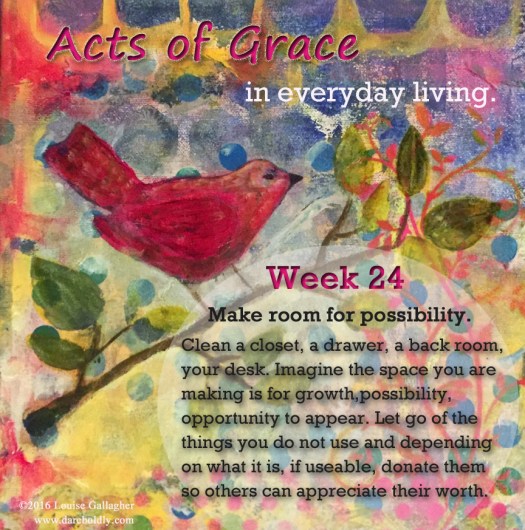
Make room for possibility | 52 Acts of Grace | Week 24

acts of grace week 24 copy

I was part of a Garage Sale this weekend. Myself and 3 other women joined forces to create an opportunity for others to find value in the things we no longer needed or wanted.

Day 1 was fun (long and tiring and I did completely forget about a dinner engagement C.C. and I had that evening which was not a good thing!) We got rained on for a bit but by afternoon, the sun broke through the clouds and we promised those who dropped by to visit that we had lots of free things to give away, especially laughter.

Day 2 was cold, cloudy and while it was great to chat and laugh with my lady friends, standing there waiting and hoping for people to drop by was not as much enjoyable as the day before — NOTE TO SELF:  when doing a garage sale, do it one day only.

One of my co-conspirators and I had some of our art for sale. As I told one person who commented they liked the inclusion of art in our event, “I had no choice. My studio walls are full as are pretty well all the walls in our house.”

Sometimes, the lack of space is a good inspiration for clearing out. And, as I only decided to be in the sale on Wednesday, I didn’t have a lot of time to think about what I would, or would not be willing to let go of. I just had to decide and do it.

And in that decision, opportunity for creating space for possibility appeared.

As I walked around the house, pulling out things that were tucked away in closets or taking things off shelves that only served as dust magnets, I felt the rush of letting go wash over me. I am decluttering, clearing out things, I told myself, because I want to simplify my life, create order and calm by having less and doing more with what I have. It feels good.

What also felt good was at the end of the sale yesterday afternoon,loading up my car with all the things I hadn’t sold and taking them down to a local shelter. Dishes, candles, towels, kitchen gadgets, books and knick-knacks, all went to the Calgary Drop-In & Rehab Centre. Along with providing emergency services and shelter for people experiencing homelessness, they operate a furniture and household distribution centre for those exiting homelessness. When an individual or family have housing, they can go to the warehouse, pick out everything they need for their new home… for free.

It’s a win/win.

I didn’t have to bring the unsold items home.

Someone else won’t have to pay to furnish their home.

I like the balance in that equation.