4:00 am. My mind drifts into wakefulness, still shaking off a disturbing dream.
In it, I am walking a path across a field. A snake appears on the trail. Mouth spilling letters like jelly beans, he spies me and slithers away. The scattered letters dance a frenzied jig, then fall in scattered sequence into a question I desperately try not want read: “Where did you go?”
Angry, I rush forward to kick their accusatory presence away, but a woman appears on the trail. Her smile, as enigmatic as a Mona Lisa, is her only response. She holds out her hands, and the letters leap up to form a radiant diamond necklace around her neck.
What the feck?
This dream crystallizes the biggest challenge of my life as a full-time caregiver: To not lose myself in the midst of caring for another. Somewhere in the daily angst and confusion of watching the man I love lose ground to this almost year-long pneumonia that has complicated his COPD even further, I have lost ground against anger, regret, and fear. My disgruntled state of mind has disrupted everything, compromising the very kindness and compassion I strive to live by.
The internal critic hisses the question: Where did I go?
Today’s poem for Month 2: Day 9 of Dear Me, I Love You, my mission to write a love poem a day for a year is the answer. I’m finding myself again, right where I belong, anchored in these words reminding me to Choose Love. Always.
The Sage’s Silence
by Louise Gallagher

With the whine of a petulant child,
the critic within asks,
“Where did you go?”

The Sage holds her silence in grace,
her Mona Lisa smile
her only response.

She knows I am right here
anchored in the Now
which cannot be anywhere else
but where Love is
when I lean into her tender voice
urging me
with every breath
to Choose Love. Always.
Month 2 of my year-long ALove Poem a Day project begins!
Yesterday, while walking the shore, I got stuck on that famous Hollywood line from Love Story: “I love you means never having to say you’re sorry.”
It’s a beautiful romantic myth. It’s also not true.
This week’s post is a deep dive into why that cliché is so dangerous, and why saying “I’m sorry” is actually one of the strongest commitments you can make in love.
A decade ago, I spent a year writing a daily love poem to my husband. That practice taught me the immense, sustaining power of love, even in the darkest times. Now, it’s time to turn that unwavering devotion inward.
At the beginning of September, recognizing that I was feeling stressed and overwhelmed , mostly as the role of care-giver continues to challenge my self-perceptions and my courage to be present within all that is present, I decided to write a love poem.
That one poem inspired this series, Dear Me, I Love You. The commitment is to write a love poem to myself every single day for one year. This compilation represents the first month of that journey, a deep dive into the sometimes difficult, always necessary work of radical self-acceptance.
The creation of these poems became its own lesson in vulnerability and trust. The daily ritual demands a choice: to choose surrender over certainty, acceptance over criticism, and grace over judgment. Within these pages, you will witness a transformation—a journey from seeking external validation to standing firm in the truth that your worth is non-negotiable. It is a chronicle of learning that the love you seek is the love you are already made of, revealed one heartfelt poem at a time.
I invite you to follow along on my Substack– each poem has an intro that explores the inspiration for the poem as well as the philosophical elements underpinning it.
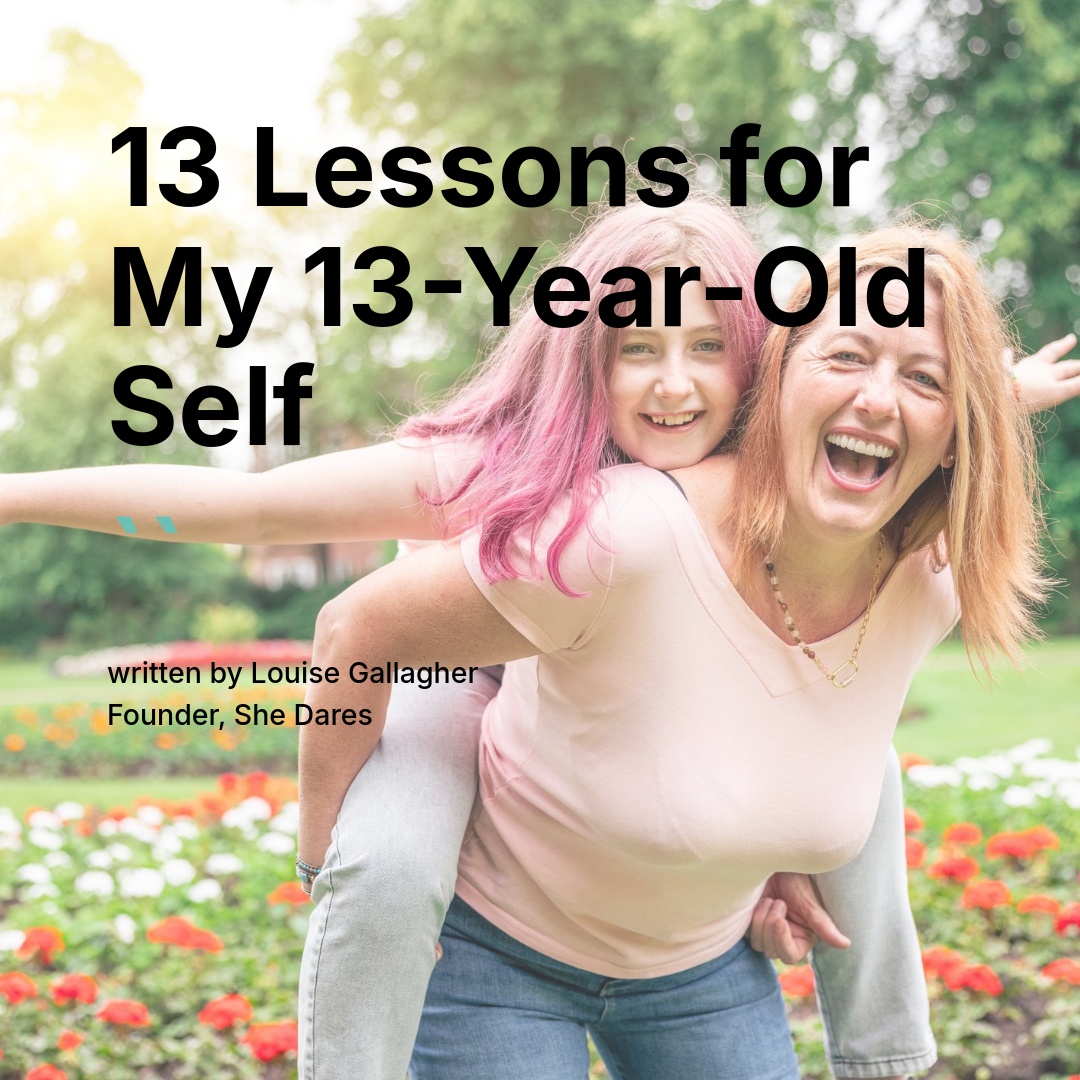
What would you tell your younger self? That’s the question that inspired my new mini-booklet, 13 Lessons for My 13-Year-Old Self. It’s a short, powerful guide filled with life lessons on love, living, and finding your way.
I originally wrote the list 11 years ago with 10 messages when my beautiful friend Joyce Wycoff asked me if I would contribute to a book she was creating for her niece’s 13th birthday. Joyce republished it recently to celebrate the same niece’s 24th birthday.
I’m so grateful she shared her post with me. As she always does, she inspired me to ‘create better’.
If you would like to read the 13 lessons, you can download a complementary copy of the booklet HERE for a limited time.
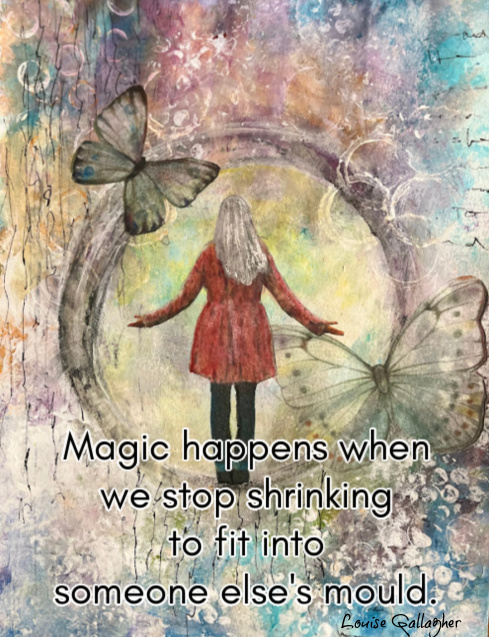
I saw an image on Instagram this morning that really resonated with me. A beautiful butterfly with the caption: “Magic happens when you stop shrinking to fit spaces you’ve outgrown.”
It’s how I look at aging. I’ve outgrown my 50s, 60s, and now, I’m growing and expanding into my 70s, devouring every delicious bite of being this age of empowered living.
Somewhere in my 30s, I realized I was being sold a load of horse-manure by the cosmetic industry. “Anti-aging.” “Anti-vaginal odor.” “Anti-anything” some clever marketer thought women should address in order to stay, reclaim, or feel young again.
It was as if they were whispering (though it often felt like shouting), “Being your age is okay, but looking, smelling, and feeling it? No way! That just means you’re old.”
Well, guess what? I’m in my 70s now. And I have not stopped aging. Shocking, isn’t it? What I have done is stop buying into the anti-aging narrative. There is nothing in it for me to be afraid of aging. Heck, I’ve been doing it every single day of my life. I’m an aging expert. And in my vast repertoire of experience, I’ve learned a thing or two about the anti-aging movement.
Anti-aging is anti-women being themselves. It’s a relentless campaign to convince us that our natural state is a problem to be solved.
Anti-aging is a confidence racket. It’s constructed to make us feel bad about how we look, act, dress, talk, and even smell. The goal isn’t to make us beautiful; it’s to make us insecure.
Anti-aging is a multi-billion dollar industry. I can’t fight the industry, but I can fight back by not buying their horse-manure. My wallet is my weapon.
What about you? Are you done shrinking? Are you ready to claim your right to be your age—with all the grace, sass, and dignity you’ve earned?
Let’s start a revolution. A quiet, powerful, and deeply personal revolution.
Your Call to Action:
Stop playing their game. Look in the mirror today and say, “This is me. This is my magic. Aren’t I magnificent!”
What is one small, rebellious act you’re doing to embrace your age? Maybe it’s ditching the painful heels for a pair of shoes that love your feet. Maybe it’s not hiding the grey or wearing a bold new lipstick that makes you feel powerful or finding your power in opting out of make-up entirely á la Suzanne Sommers. Maybe it’s simply refusing to feel ashamed of a new wrinkle and choosing instead to see each one as a celebration of your life story.
Please do share your story in the comments below. Let’s celebrate our earned wisdom, our hard-won freedom, and the deliciousness of being exactly where we are. Because magic doesn’t happen when we shrink; it happens when we expand.
Why the fear of not having a purpose is holding you back—and how to find freedom in every single act.
We talk a lot about purpose. We talk about finding it, earning it, and living it. But in our obsession with finding a purpose, we often trap ourselves in a constant state of anxiety and comparison. We get stuck in an unhealthy emotional morass, believing others have a grander purpose than we do—or that we have non at all. This leads to a cascade of negative beliefs: I’m not good enough. I don’t make a difference. I’ll never measure up. I don’t matter.
The fear of not having a purpose often propels us into dead-end streets and chaos corners. It compels us to keep searching, to never let our guard down, and to stand vigilant for some grand purpose to float by so we can claim it. We tell ourselves, “I’ll finally matter when I find my purpose!”
What if you don’t have to search for purpose? What if all you need to do is live on purpose?
The Heavy Load of Finding Your Purpose
Countless books have been written about finding your purpose. We often see purpose as “what we do in the service of others,” as if it’s a monumental job description we must earn. Yet, what we do in service is simply a reflection of how we live our lives every day, in alignment with our values, principles, and beliefs.
The other night, while having dinner with my two daughters, we went around the table and shared a unique quality we admired in one another. When it was my turn, both of my daughters said, “You have a unique ability to meet people where they’re at and see the good in them.”
My heart felt so light. Since retiring and moving to a quiet Gulf Island, I’ve struggled with the question, “How do I live my purpose when I’m not ‘out there’ in the world, making a difference?” Hearing my daughters’ words, I realized I am making a difference just by showing up in my world every day with an open and loving heart and mind. By being fully present, I am both living my purpose and living on purpose.
There’s great relief in that acceptance. A feeling of spaciousness and possibility. I’ve accepted that my purpose doesn’t have to be some grandiose idea of healing the sick or solving world poverty. It’s simply to live my best, in every moment of every day, so my ripple is one of love, joy, and harmony. In this act, I gift myself peace of mind, body, and heart. And from that space, living on purpose feels easy, and the world around me feels calm and accepting.
The Lightness of Living on Purpose
One of the biggest differences between having a purpose and living on purpose is that having a purpose is passive, while living on purpose is active.
A purpose can be a goal—a destination to reach. Goals are important, but when they’re the singular focus and not rooted in our values, we can lose sight of our impact on the world. Hyper-focused on attainment, we can believe our goal is all that matters – and everyone else better get out of our way.
Living on purpose, however, demands our full engagement with life. It’s an intentional practice that requires our attention. It’s the realization that everything we do, say, create, and think has a ripple effect.
If you want your ripple to be an invitation to others, you must be conscious of the waves you make.
Living on purpose is not about the things you acquire or the goals you achieve; it’s about how you live your life. Living on purpose illuminates the world all around you. And in that brilliance, your light becomes a beacon of hope for others.
Practical Steps for Living on Purpose
It’s easy to live on purpose when you know the values, principles, and beliefs that guide your every action, word, and thought. Clarity of what matters most will automatically underpin everything you do, creating space for you to live intuitively and intentionally.
Here are three simple, actionable steps to start living your purpose right now:
Clarify Your Values: Your purpose is built on your values. Take some time to identify what matters most to you—things like honesty, compassion, creativity, or courage. Ask yourself, “What do I stand for?” Then, write down a list of five or six values that resonate deeply with you. Ask yourself, “How do I live this? For example: The cashier at the grocery store misses charging you for an item. Do you let them know? If honesty is one of your core values, letting them know is never in doubt.
Knowing your values provides a personal compass for your actions.
Conscious Action: Connect your values to your actions. For example, if a driver cuts you off, you can choose to respond with your value of compassion instead of anger. A simple, “Bless them. Forgive me. Forgive them. Bless me,” can restore your equilibrium far faster than endlessly muttering under your breath. (And yes, ‘forgive me’ is important because if you’re human, you probably had a not-so-nice thought or two about them when they cut you off.) This reinforces the idea that every act becomes an expression of your purpose.
When we live on purpose, our values take centre stage.
Embrace the Ripple Effect: Recognize that every action has a ripple. One word shouted in anger can create shockwaves of unease. One word spoken in kindness can resonate like a single harp string pulled in a room full of harps creating a ripple of harmony.By consistently acting from a place of integrity, your positive influence naturally expands. Focusing on conscious living is far more sustainable and fulfilling than constantly searching for a monumental purpose.
To make a difference, live true to your values, principles and beliefs.
Is there a step that feels most accessible to you today? Please share your thoughts and inspire others to live on purpose.
Unearthing Creativity: A Journey Back to Morning Pages
Why do I write? Often, it’s a delightful blend of self-inspiration and cosmic detective work: nudging myself into new ventures, finding my footing in this wonderfully chaotic world, unearthing meaning in the mundane (or the magnificent), and generally figuring out why I am the way I am and what truly lights my fire today.
Lately, my quest has been to forge a morning routine template, a sort of daily superpower, to supercharge my creative process. As one does when seeking wisdom (or procrastination, depending on the day or moment…), I recently dove into the digital archives, specifically searching Facebook for “Morning Pages” groups. Lo and behold, a blog post I penned two and a half years ago popped up.
Reading it was… a punch to the gut. I’d written it during the harrowing time my eldest sister was in ICU, fighting for her life. A fight she ultimately lost. And with her, I lost my big sister, my confidante, my support system, my champion, my cheerleader, my friend.
As I reread those paragraphs, my mind went numb, tears pricked. Grief, it turns out, is a spectacularly messy business. It adheres to no timeline, no polite schedule. It’s less a well-behaved houseguest and more a rogue wave, crashing in when you least expect it. A name, a scent, or in my case, a few written words, can fling open the gates to a memory awash in all the feelings and emotions it contains.
I miss my big sister. I always will.
I’m learning to embrace that “always will,” so that when grief still washes over me, I can simply stop and feel the missing. It’s a quiet acknowledgment that the profound love we shared never truly died; it simply changed course when the river of life, carrying us both, split.
Next week, I’ll be sharing a crash course in How to Set a Morning Routine – your personal blueprint for creative consistency. Watch for the announcement!
I watch a windsurfer skimming the water, waves slipping underneath the board, body taut, legs primed, arms grasping the bar. A picture of tenacity, grit, and commitment. Commitment to every wave. To every nuance of the water, riding each roll of the surf like a bronco buster on a bull. Anticipating. Adjusting. Moving with each unpredictable buffet of the wind and eruption of the sea.
Like life, we travel through each day, holding on to what’s dear to us, to what’s important. Anticipating. Adjusting. Moving. Sometimes, we miss a step and fall. We have one or two choices: get back up and carry on, or stay down and let the waves carry us further out into the chaos of not taking charge of our own journey.
Sometimes we simply need the right tool. Or the inner wisdom to know we are strong enough to carry on, even when we feel we have no energy left.
Just as the windsurfer learns from every dip and dive, we too can grow stronger through life’s inevitable challenges. It’s in those moments of choosing to rise that our true power is revealed, often found by tapping into our inner wisdom or discovering the right support. What if we all embraced that spirit, understanding that sometimes the most profound growth happens right after a fall?
What helps you get back up when life knocks you down? Is it a particular tool, a mindset shift, or relying on your inner strength? Share your strategies and support others in our community who might be feeling adrift. Join the conversation below!
Fear lives in my belly. It’s that grumbly, rumbly, churning feeling of disquiet that eats away at my peace of mind when I give into it.
Love lives in my entire being. It’s that warm, soothing, tranquil feeling of quiet joy bubbling up to embrace my peace of mind when I give into it.
Which one will I choose? It’s up to me. Just as I can’t ‘try’ to be fearless, I can’t try to ‘be fearful.’ I am or I’m not.
Yoda said it best: “Do or do not. There is no try.”
Which will you choose today? To take the path to the dark side, or to keep walking the path into the light? Will you allow your fearful thoughts to drag you down, or will you allow loving kindness to lift you up and draw you out of the darkness and hold you in the light? It is your choice.
Some time ago, during a presentation, I experienced a moment where fear washed over me with such velocity I was left speechless. I’d made a mistake in how I presented something to a group of about 100 people, and when my co-presenter offered some feedback, my critter mind went into hyper-active defensive mode. I heard their words as a scathing critique, condemning me as stupid and unprofessional.
Here’s the thing: that is not what my co-presenter said. All they really did was provide constructive feedback on how to do it better next time. In my fear of making mistakes, of looking foolish in front of the group, of being shamed for not doing it right, my fear twisted their feedback completely out of context. In that moment, my fear rose up and heard condemnation. It drove me away from courage and truth into the darkness of self-criticism.
I’d like to tell you I recovered right there on the spot. Truth is, as soon as I could, I ‘gracefully’ (ok. I rushed out of the room without making eye contact with anyone) left the room, desperately trying not to draw attention to myself and went to the washroom. In a stall, alone and crying, I had a little pity party and then pulled myself together. When the session resumed, I stood in front of the group and continued.
The Breakthrough Moment: Fear as a Catalyst for Clarity
Yet, here’s the thing about those moments. This particular one was a breakthrough. The initial wave of fear, the self-condemnation that followed my co-presenter’s kind words, felt utterly disorienting. But that very intensity, that visceral jolt of discomfort, became the catalyst I didn’t know I needed. It forced me to ask: Why did I react this way? What was truly going on inside me? All night long, I worried over and thought through the events of that evening, trying to discern why my reaction to such a simple moment had been so visceral, so immediate, so intense. The discomfort of that fear was no longer paralyzing; it was probing. It pushed me to look beyond the surface interaction and into the depths of my own internal landscape.
The next morning, I awoke, tired yet incredibly clear on what that moment of feeling shame at the front of the room represented. And in my enlightenment, the sun broke through the darkness and light illuminated my path in all its brilliant clarity. The fear, in its uncomfortable intensity, had served its purpose: it had shone a spotlight on a hidden truth.
Since I was a small child, I had held a belief within me that was not true. I didn’t even know the belief was there until such an insignificant moment erupted into a deep dive into truth. The ‘belief that is a lie’ rose to the top and screamed in my face, and, I swear, felt like it was ripping my heart out. This painful confrontation, however, was precisely what was needed. The fear had not been the enemy; it had been the messenger, pointing me toward a limiting pattern I needed and was ready to shed.
The specific details of the ‘belief that is a lie’ are not what matters most today. What matters is, I stepped into it and today, I am celebrating. I am dancing. I am shouting for joy. Throughout my life, this ‘belief that is a lie’ had caused me a lot of pain, confusion, and harm. On some deep subconscious level, I had always been aware of its presence, lurking in the darkness, disturbing my status quo and jeopardizing my capacity to feel and know pure joy.
Now that I see it. Now that I know it. Now that I can face it, I can deal with it. I am grateful. The very fear that initially threatened to derail me ultimately became the powerful force that propelled me towards greater self-awareness and healing.
I cannot heal or change what I do not acknowledge. I acknowledge that the ‘belief that is a lie’ does not serve me well. It does not bring me the ‘more’ of what I want in my life.
Today, I choose to step boldly, confidently, and joyfully onto the path of light, love, and well-being, understanding that sometimes, the greatest growth begins with the uncomfortable truth that fear reveals.
Which path do you choose today?
As a Thank You for being here, I have created a mini-guide on transforming fear into a motivating force for good.
Just click below to download your complementary copy of ‘When Fear Becomes Your Guide’
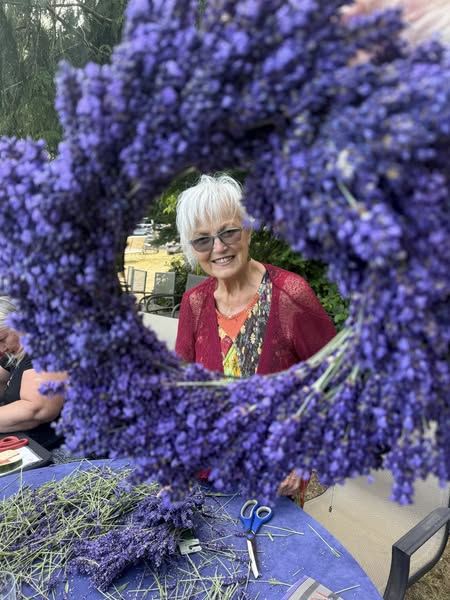
Surrounded by the exquisite scent of 700 Lavender plants in bloom and serenaded by wind chimes and birdsong, my sister, Anne and I, along with 4 other women and the amazing Dar Yuill spun lavender into beautiful wreaths.It was a delightful afternoon of creating, chatting and celebrating our human connections and community.
And… I decided, just for fun, to write a song for the day and ask AI (I know, I’ve crossed over to the ‘dark’ side – but it’s really cool!) to put my song to music. And this is what I got! (Lyrics are mine)
And these are the complete song lyrics:
In Lavender Fields
by Louise Gallagher

In lavender fields where the sun sets wide,
Gentle breezes whisper tales of old.
Memories float like clouds in the sky,
Soft petals dance under the sun's gold light.

Oh, lavender fields, how you bring me peace,
With every breath, my heart finds release.
In your charms, I find the quiet ease,
Of simple days when life was full of rest.

Through the rows of purple, I create a wreath,
Feeling the warm sun caress my cheeks.
Each strand weaves a memory, each scent a tone,
Nature's melody, sweet and sweet.

In lavender fields, I let go and rest,
Where worries fade and calm takes hold.
In your gentle beauty, I find my best,
A peaceful journey, soul and fold.



 Dare Boldly