Fear of Looking Imperfect

One of the things that inevitably comes to the forefront for me in art-making, is my fear of looking imperfect. Of looking like an imposter, or that I haven’t got it all together.

Over the past few weeks, as I’ve gotten ready for the Vale’s Greenhouse Cultivation of Art Show and Sale, I have come up against my fear again and again.

Yesterday, after what I deemed another miserable attempt to create something worthy of being part of my offerings at the show, I told my beloved, “I figured something out in the studio today.”

“What’s that?” he asked from where he sat on the sofa watching a hockey game on his laptop.

“The thing I hate about art shows is that I get all caught up in the outcome and lose my joy of creating simply for the sake of creating.”

“Oh.” he replied. “Is that why you’ve been on edge these past few days?”

I was on edge? Hmmm…

“Probably. I love being immersed in the creative nature of art-making, but what I’ve noticed, as I’ve gotten ready for the art show, is I’m not allowing the creative process to just happen. I’m making art instead of making space for art to happen.”

I paused for a moment as C.C. sat quietly watching me, waiting for me to find my way through my angst. “I hate art shows. Don’t even know why I go in. I don’t create to sell. I create to have fun. And I’m not having much fun right now.”

Ahhhh….. that little five year old loves to get into it when she feels like I’m fleeing the scene of my artistic potential.

It isn’t that she’s trying to create havoc or run amuck with my self-confidence. Rather, it’s that she feels my fear. Unfortunately, when I am running with fear as my companion, she gets scared. Scared means she can’t go play with abandon amongst the wildflowers. She can’t paint the moon all the colours of the rainbow because I am standing outside the sacred garden of my creative nature.
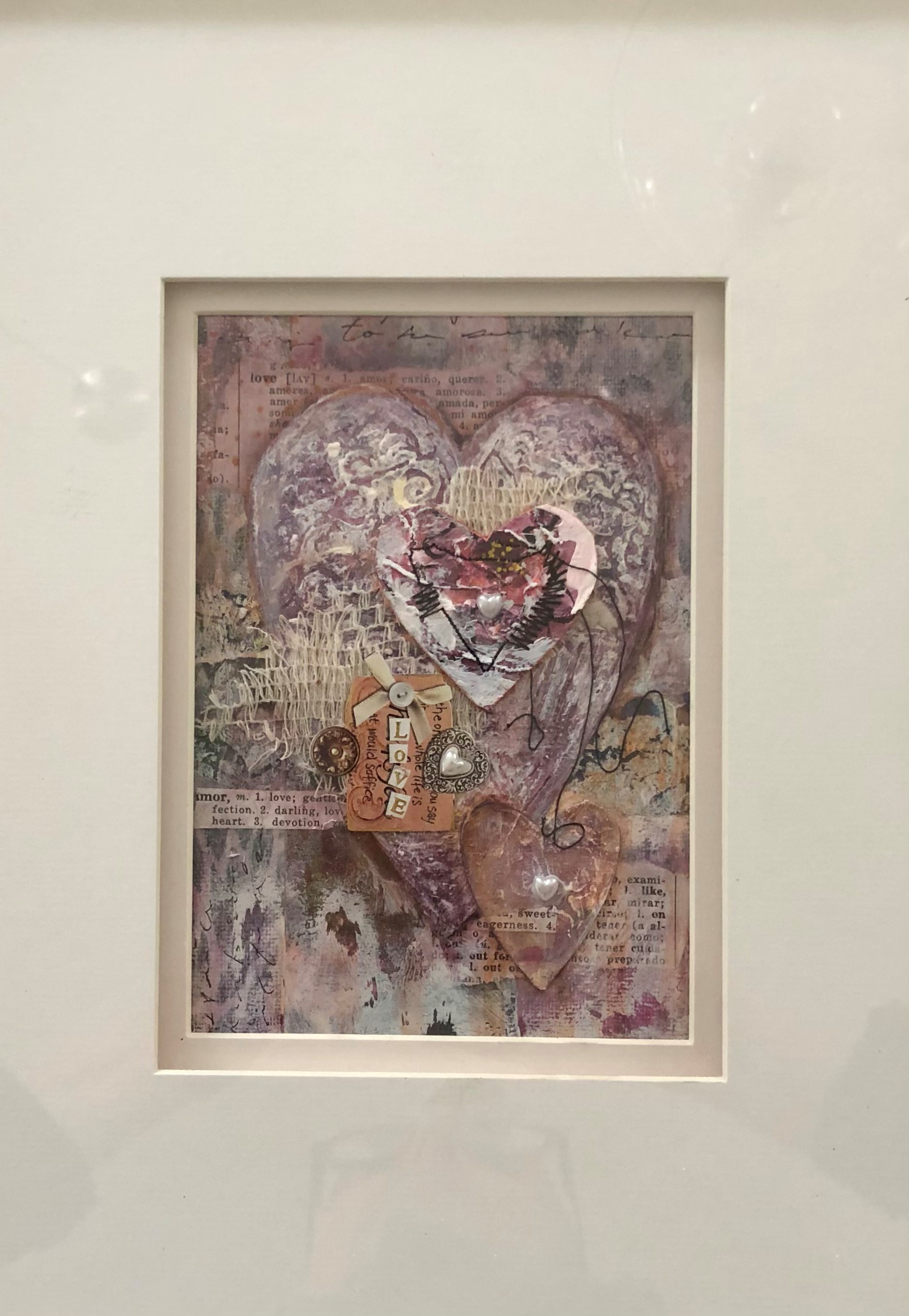
When I’m running with fear of my creative expression and talents, my peace of mind is a fast river of muddy waters swollen by spring run-off. .

This morning, I woke up, took Beaumont the Sheepadoodle for his early morning walk. At one point, I stood at the railing of the John Hextall pedestrian bridge which joins the western edges of the city to the downtown. I stood on the Hextall and watched the waters of the Bow River flowing deep and fast beneath it.

As I stand and watch the waters and Beau sniffs the grasses growing in the planters that line the center of the bridge, I am reminded of a poem by Apollinaire Guillaume. I was first introduced to Apollinaire in my teens. His work still resonates deeply. The poem, The Mirabeau, begins with the line, “Under the Mirabeau flows the Seine.”

And I am transported back to that child of five who danced and laughed and spun about when she was a little girl and we lived in France. Life was full of possibilities. She had such dreams, such flights of fancy and wonder and awe. There was nothing she couldn’t do and she planned on doing it all.

And I hear her whispering deep within me. “Let me go back to where I am free to run amidst the wildflowers and paint the moon all the colours of the rainbow. Let me go back so you can run free of fear standing here on the Hextall above the Bow.

And when I return home I take a flight of fancy and write an homage to Appollinaire.

An Homage to Appollinaire
by Louise Gallagher

Under the Hextall flows the Bow
muddy waters churning
the mountains are running 
free
of winter’s excess
the lakes are flowing 
clear
of mother nature’s blanket
frozen
against their beauty

I stand on the bridge
and cast my doubts
into the fast-flowing waters
free
of fear that the waters
will never run clear again
that the lakes
will never thaw
that I will never
be free
of fear

I cast my doubts
beyond the thrall
of my confusion
and breathe
the morning’s cool fresh
kisses
falling
upon my face
where I stand 
musing
on the Hextall
above the Bow.

And I return to my studio.

I need not fear my imperfections. I only need to embrace them so that I am free to celebrate my creative expressions in all their many colours, all their multi-dimensions and all their unique expressions.

In that frame of mind, I let go of expectations and outcome and throw myself with abandon into the deep running waters of my creative expressions flowing free.

Namaste
And No One Listens

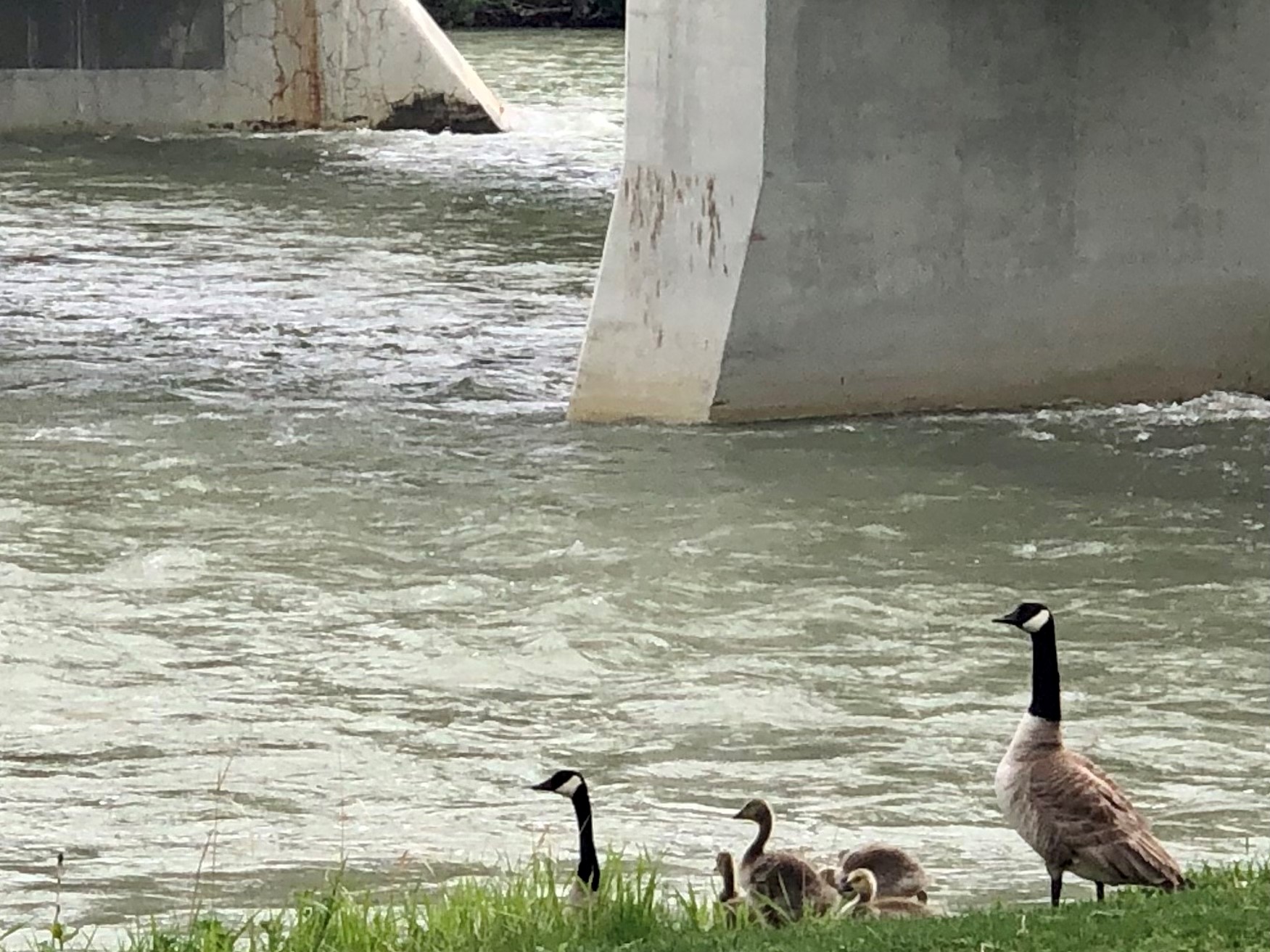
I watch a flock of geese huddling around their children at the edge of the river. Four adults. Many goslings.

The river flows fast. Swollen with spring run-off from the mountains and the rains of the past few days.

It is not safe for the babies. The adults keep them on shore.

And I am reminded, as so many things do these days, of the remains of 215 children found beneath the lands of a former residential school sanctioned by the Canadian government and operated for decades by the Catholic Church on the Tk’emlúps te Secwépemc First Nation.

Those goslings do not need to be taken away from their parents, or even kept away from the river. The parents are seeing to their safety. It is their nature.

And as I walk slowly home along the swollen river, its roar drowning out the traffic travelling across the bridge above, as I listen to the birds chirping in the trees and the geese hissing as Beaumont the Sheepadoodle and I pass by, I think of the women who would come to the homeless shelter where I worked, their eyes swollen, their bodies battered as they struggled to find a way back to who they were… before.

Before… the settlers and his assertions their ways were better came…

Before…. their schools and assimilation and attempts to ‘kill the Indian in the child’…

Before… the church and its doctrine arrived…

Before… the government took away…

...their lands, their way of life, their history, their traditions, their culture, their language, their homes…. Their children.

In a tweet on May 27th, Prime Minister Trudeau called it, “a painful reminder of that dark and shameful chapter of our country’s history.”

In the House of Commons on June 3rd, Nunavut member of Parliament Mumilaaq Qaqqaq stated. “Colonization is not a dark chapter in Canadian history. It is a book that the federal institution continues to write,”

“Foster care,” she said, “is the new residential school system.”

Is is also a gateway to homelessness for far too many.

According to Without a Home: The National Youth Homelessness Survey, 20% of the homeless population in Canada is comprised of youth between the ages of 13-24. In a given year, there are at least 35,000-40,000 youth experiencing homelessness. Of that number, over 30% are Indigenous. Research also highlights that over 40 percent of youth experiencing homelessness in Canada have been involved with child welfare services, including foster care and group homes. Over 52% of children involved with child welfare services are Indigenous.

In her comments in the House of Commons, Qaqqaq also said, “We are tired of living in someone else’s story and refuse to continue to have it written for us.”

She’s right. This book we’ve been writing… It’s not a story I want to keep reading. Keep hearing. Keep living.

It’s time we stop writing it so that Indigenous peoples can write their own book.

____________________

I wrote the poem below for all the women who were never heard when they called out for their missing children and were never heard.

And No One Listens
by Louise Gallagher

She cries out for help
	Again and again
	Where are my children
	Where have they gone

No one listens
No one hears

She walks the trails where once they gathered berries. Together
She trudges through the fields where once they played. Together
	
She keeps searching. Searching. 
	Calling. Calling. 

Their names become a symphony of anguish 
Their memory an unending refrain of pain
Their missing a cut too deep to be washed away by her tears
she searches for a way to drown them beneath the burden of the grief
that flows as deep as the river upon which she once paddled with her children. Together.

She talks to the priest who has promised her soul salvation
She talks to the man the government has sent to help her and her people
assimilate into the ways of the settlers, ways that are foreign to her
ways that do not ease her suffering.

Their words do not bring her salvation
Their words do not ease her pain
	It is God’s will
	It is His way
	It is the law
	It is our way.

And she keeps calling out for her children
She keeps calling out for help
until one day she too is lost
Lost
To God’s will
and His Way 
to our way
the way that has taken her children
the way
that has catapulted her life
into an unending liturgy of sorrow, pain and suffering

She cannot escape
the missing of her children
of her way
her People’s way
the way of the land
and falls

She lies on the sidewalk now
of a city she does not know
in a way that has erased all memory
of who she was
before
before they took her children.

She is broken 
apart
separated
from her people
the ways of her ancestors
her children, missing
her voice, lost

She no longer calls out through the pain she cannot heal
the stories she cannot tell
the memories she can no longer remember.

She no longer cries out her children’s names
She no longer calls out for help

And no one listens.
No one hears.

It Is Their Ways That Will Heal Us.

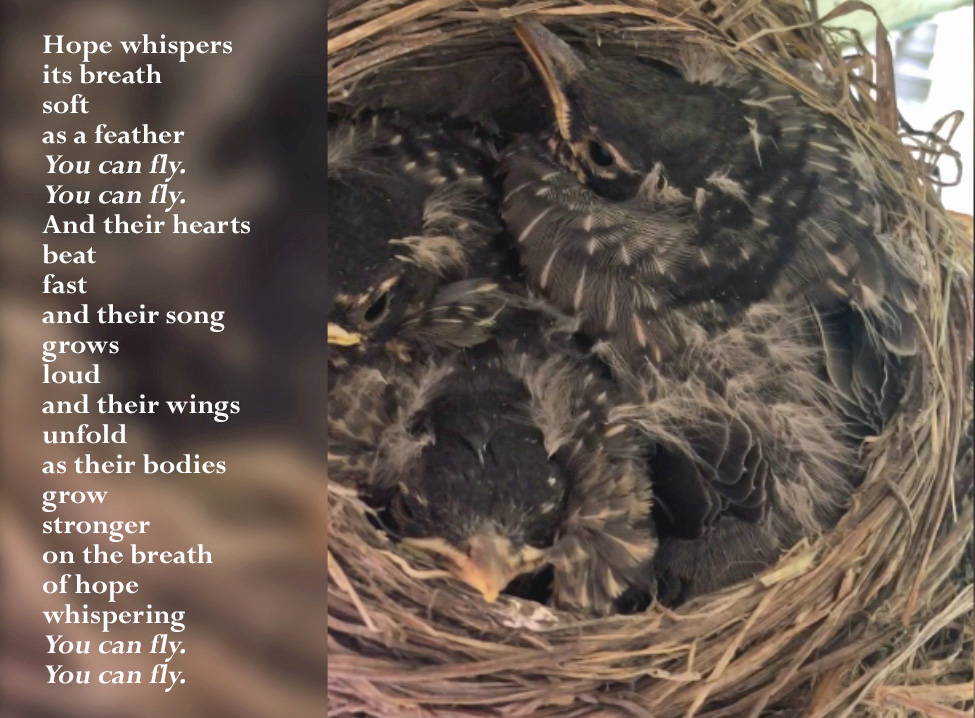
They are getting ready, these tiny bodies of winged possibility that have only known the nest their mother built since first she laid them in its safety and sat for days and days on end upon their shells until they were born.

I have watched them over the past three weeks grow from tiny, featherless newborns into feathered beauty with wings unfolding with every breath they take.

I have watched the mother and father robin carefully tending to their young. Bringing food. Sustenance. Warmth.

The father doesn’t linger long. But he is never far away.

Over these first weeks of life, the mother has moved from sitting in the nest for hours on end, to sitting on its edge for brief spurts of time, trusting in nature to take its course and give her babies the gift of flight.

Her babies are growing stronger. Soon it will be time.

And I sit and watch and marvel at the power of nature. To create life. Sustain life. Set it free.

And I think of the mothers whose children were taken from them so young. Who never had the chance to nurture and sustain their offspring. Who never had the gift of seeing them take flight.

And I think of how, in their pain, they wandered through their days searching for their missing children until they could no longer stand the pain.

And how, like a bird with a broken wing, they had to tend to their own wounds. Heal, as best they could, the gaping holes that could never be filled. How, they yearned again for those days when their children ran and played and sang songs and told stories and gathered around the table and shared a meal and bickered amongst themselves knowing, that no matter what, their lives were woven together with strands of love threaded through a way of life that could never be erased.

Until it was.

Until a force greater than their mother’s arms could hold back and their father’s breath could push away, swept in and tore the ties that bind apart, ripping out the hearts of the weavers who had built the nest they called their home.

And how, over generations and generations of unravelling the ties that bind, there was nothing left of the threads of all their ancestors weaving the vibrant stories that had sustained them, nurtured them, carried them through their lives. Nothing left of the songs that sang them awake and the stories that lulled them to sleep. Nothing left of the way of life threaded through their history, for their history was gone. Rewritten. Erased. Assimilated.

Until one day, there was a murmuring. It wasn’t loud, but it was steady. Like a heartbeat. And in its steady thrum, thrum, it whispered a song of hope, rising up, Up across the land calling their ancestors and all their relations to rise with it.

And in its beat, a memory flickered through the darkness, and then another and another. Memories full of the way it was when the rivers ran deep teeming with fish and the buffalo roamed the prairies as far as the eye could see. Memories of the forest paths beckoning with healing ferns and moss and flora. Memories of when the drums beat loud and the fires burned bright. Memories of the stories the elders told that guided the young in the ways of their people as their mothers wove baskets in the light of the fire and their fathers hunted for the foods that would sustain them. Memories of their ancient ways. Ways that nurtured and sustained and honoured all of life.

It began as just a murmuring, a gentle breath of hope. It is growing. Louder.

And their wings are growing. Stronger.

And the way is growing. Clearer.

And their hearts are beating. Faster.

And the drums are pounding. Fiercer.

Soon. Soon. It will be time.

Time to erase the erasing of their ways that could never be erased because theirs are the way of nature and nature can never be erased. It flows always. In the rivers. In the seas. In the air we breathe. In the light of the sun and the cast of the moon. It flows deep within the earth that has always nurtured and sustained life on this planet we call our home. This planet that is growing weary of our ways that is killing off its creatures, poisoning its waters, clogging up its air.

This earth is calling them to awaken to their ways.

It is time. Time for the stories to be told. For the light to return. Time for the threads of yesterday to be woven back into the tapestry of life that was their way. And is their way.

It is their ways that will sustain and nurture us.

It is their ways that will heal the wounds.

It is their ways that will heal the truth.

It is their ways that will heal the earth and all of nature.

If is time for us to step aside and let their ways lead us all back into nature’s balance.

My Credo – a reshare

On June 11th, last year, I posted My Credo – It was created in the wake of George Floyd’s murder, of the thousands upon thousands who were marching and calling for change.

I am sharing it and what I wrote about it again as when I re-read it this morning, I had this deep sense of knowing — yes… this is true for me. This is what I want to create in this world.

For me, My Credo speaks to what I stand for, and against. It acts a guidepost against which I can measure every action, word and thought. And, it provides me with a safe and courageous container within which to grow and evolve so that I can give my all to creating better in this world.

Years ago, when I began my healing journey after being freed from an abusive relationship, I created a credo for how I wanted to live my life. It included statements like, “I shall turn up for me in all my wounded brokenness and love myself completely”.

It also included a statement on how I wanted to treat the past — as a bludgeon to beat myself up with or as the vehicle that brought me to this moment right now where I was free to heal and fall in love with myself and all my world and celebrate life for all I’m worth.

I chose to treat it as the vehicle that brought me to this moment right now. The past had served its purpose. It was time for me to let go of its pain and find a more loving, caring and roadworthy vehicle within which to continue my journey.

We cannot change the past. We can learn from it and grow deeper in our understanding of its impact on our lives today. And, we can use it as corroboration for what we need to do today to ensure tomorrow is not a repeat of a past we do not want to live again and again.

There is so much good in this world. So much beauty, possibility, hope, joy… And there is grief and sorrow, pain and suffering, violence and abuse.

It is all present. And always, no matter what is present, Love is always there.

To live by this credo, fearlessly letting all of my human condition be present, I must accept all is present. Light and dark. Fear and hope. Anger and sorrow. Suffering and joy. And I must love it all, fearlessly. Joyfully. Completely.

I am not powerful enough to change all the darkness in the world. I am powerful enough to determine how bright I want my light to shine. And I am powerful enough to shine as brightly as I can so that others can see in the dark and stand with me in the light.

Today, I am choosing to shine full on. Bright beams blasting.

I am stepping onto this road armed with My Credo. Yesterday, the decision to step onto the road to ask a man with a brick if he was ok, was what I had to do. The tenets of my credo were guiding me.

To be of service in creating change so that Indigenous people, all people, who live on this land now called Canada, are treated with dignity and respect, I must live by my credo. It is my map to creating a future where my grandchildren will know, the world into which they are born is not a place in which only they and others like them enjoy its’ privileges. It is a place where all the world enjoys the same privileges. Where all people have equal rights and are inspired to live freely and shine bright.

Namaste

____________________________________________

Do you have a personal Credo?

If you’d like to write one, here are some questions you can ask yourself to get started.

A man. A brick. A morning encounter.

It is 6:30am and Beaumont the Sheepadoodle and I are just on our way from our early morning walk. I turn the corner from the main avenue onto the street that leads to the cul de sac where we live when I see a man at the intersection further ahead, the one that leads into our little community along the river.

He crosses the street towards Beau and I, sees us, stops, stretches as if casually releasing a kink in his back and then turns left and slowly begins to walk along the avenue leading away from our cul de sac. He goes a few feet. Stops and begins to twist and turn his body as if stretching during a jog.

I am curious about his presence. He doesn’t look like a jogger. He looks dishevelled. Possibly under the influence. Suspicious.

I keep walking, turn into our cul de sac. The neighbour who lives at the corner, opens his front door. He is holding his cell phone in one hand as he calls out to me. “Get in here,” he says. And he waves his hand quickly, desperately trying to get my attention.

I stop and look at him. He waves again and repeats. “Get in here. Quickly.”

Beaumont and I walk into his house. His dog, a beautiful big brown lab, is locked behind a door. Barking.

Beau looks a bit bemused by it all. He sniffs and pulls towards the door from where he can hear the barking.

My neighbour says, “There’s a guy with a brick in his hand. I’m on the phone with police. I woke up to him pounding on my windows.”

Oh.

“The guy in the beige t-shirt and baggy sweatpants?” I ask.

And my neighbour keeps talking to the police while watching out his front window for the man.

“He walked away down the avenue,” I tell him. “Going east.”

He relays the information to the police.

Just then, the man in the beige t-shirt and baggy pants comes back into view, walking back towards our cul de sac.

“There’s nothing in his hands,” I tell my neighbour.

I watch him. His walk is unsteady. He steps into the middle of the intersection, bends down and scoops up the brick he’d been carrying before. He must have dropped it when he saw me walking up the street with Beau.

The man stands in the middle of the intersection. Undecided. He starts to walk further into the entrance to our cul de sac.

I go back outside. Beau goes with me.

“Excuse me,” I call out to the man. “Are you okay?”

He stops, looks at me where I stand on my neighbours front porch. He is standing in the middle of the road, about 30ft away.

“Are you?” he asks somewhat belligerently.

“I am,” I reply. “But I’m concerned about you. Are you okay?

He looks at me again. Kind of shrugs, shakes his shoulders. He starts to back away into the intersection.

“You might want to put the brick down,” I call out. “It scares people when they see someone walking around with a brick in their hand.”

He turns his back and begins to walk back along the avenue, away from me, brick in hand.

Because of construction on the main road, there is only parking on one side of the street along which he walks. I watch him toss the brick onto the street, away from the parked cars on the other side.

He turns to look back at me and gives me the not so nice high five finger before walking unsteadily away. I realize he’s probably not drunk. He is suffering from a condition that affects his ability to walk steadily.

I thank my neighbour for looking out for my safety and Beau and I walk home carrying the image of that man and his brick.

Was the brick to break in or to help him feel safe?

By his body language when I asked if he was okay, he was not accustomed to someone being concerned for his welfare.

He also didn’t like people watching him, suspiciously.

He was angry.

Belligerent.

Trying really hard to be scary.

More than anything he looked lost. Broken. Beaten down.

And my heart feels heavy.

See, that man with the brick. He was Indigenous. His black hair was tied in a pony tail that ran down his back all the way to his waist.

And yes, walking around a quiet neighbourhood with a brick in your hand, pounding on windows is not a good, nor legal, thing to do.

But, when I called out to him and asked if he was okay, he answered. When I suggested he put down the brick because it scared people, he did.

I don’t believe he was a bad man doing bad things. He was a desperate human being doing desperate things to ease his pain.

It doesn’t make what he was doing right. Pounding on windows is not a good thing to do. Nor is carrying a brick in your hand.

What is a good thing, however, is to see him through the lens of a human being, a man carrying a brick and a long history of pain and suffering that has brought him to this place where he walks around carrying a brick.

It doesn’t change that what he was doing was wrong. It does make me feel less afraid and more compassionate about his plight.

And so, I say a prayer for that man. I pray for him relief and comfort from the burdens he carries. And, I pray for him a safer, kinder road forward.

And I pray for me, and all my neighbours, the same.

_____________________________

There is an addendum to this story.

When I returned from the garden centre later this morning, the man with the brick was standing at the entrance to our cul de sac with another man and the woman who does her 15,000 steps every day walking the hill.

He had frightened her earlier by throwing the brick close to her feet and had come back in the hopes of finding his bike, which got lost sometime last night, and…
to apologize.

I stopped to speak with the trio where they stood at our entrance and he asked me, “Did you see me?” Did you see my bike?”

I talked with you, I told him and went on to tell him of our exchange.

“I am so sorry for scaring you,” he said. “I could have hurt you.”

I don’t believe you would have, I told him. I don’t believe that is your heart.

He also wanted to apologize to my neighbour at the corner but he was out, so I promised to relay his message.

“I don’t remember much,” he said. “I was so drunk. I must have passed out in the woods along the river and when I came to, my bike was gone and I was all messed up.”

And then he said, “If you ever see me drunk walking around here, promise you’ll tell me to go home.”

And I replied, “I will.”

It took great courage for him to come back and apologize. Great courage and heart.

More Than Just a Lost Boy

In school, I vaguely, and I mean vaguely, remember learning about Sir John A Macdonald. Sir Wilfred Laurier, Langevin and the other ‘Founding Fathers of Confederation’ as well as the Davin Report, the full name of which was, Report on Industrial Schools for Indians and Half-Breeds. (Source)

I vaguely, and I mean vaguely, remember learning about how the Davin Report set the path for the assimilation of children into the Euro-centric culture of Canada’s founding fathers. It proposed a cooperative approach between the Canadian government and the church to implement the “aggressive assimilation” pursued by President of the United StatesUlysses S. Grant.[29][28]:1.

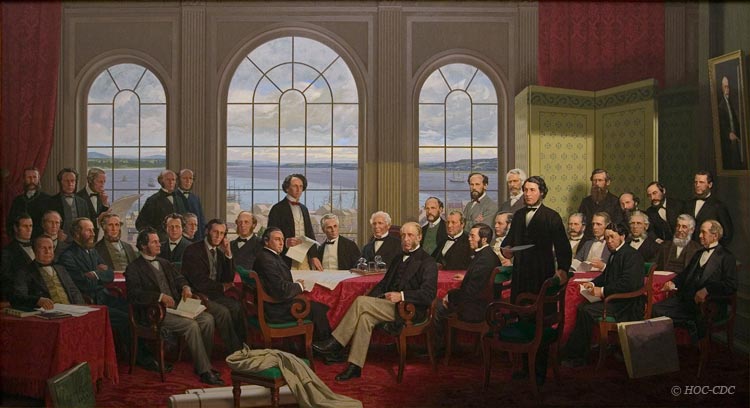
I remember vaguely, and I mean vaguely, photographs of the painting above. it is a recreation of an original painting by Richard Harris that hung in the Parliament Buildings in Ottawa from 1884 to 1916 when it was destroyed in a fire that also destroyed the original Parliament Buildings. In 1964, Confederation Life, an insurance company, commissioned artist, Rex Wood, to recreate the original painting to be presented in honour of Canada’s Centennial. In the recreated version, three figures, who had not been considered Founding Fathers in 1883 when the original painting was commissioned, were added on the right.

I remember vaguely, and I mean vaguely, having to re-enact in some elementary school class, the negotiations, the haggling, the political maneuverings needed to get signatures on the bottom line of The British North American Act, Canada’s constitution.

I know, and I mean know, I did not ask, where are the Chiefs in this painting? Where are the First Nations people who were the first to inhabit these lands? Why were they not signatories? Why aren’t they in the painting?

I also know, and I mean know, whatever I learned about ‘assimilation’ it was framed in the language of the founding fathers, because I know, and I mean know, I never thought to ask…

What about the children? What about the residential schools?

What about the attempted annihilation of those who walked these lands, who hunted and planted, who gathered and raised families and had their own system of governance, who built canoes and lodges, who knew the medicinal values of all the plants and could heal broken limbs and festering sores with their knowledge rooted in the forests and lakes, the mountains and rivers of this land and who had lived here for centuries long before white man arrived?

I know this because I know that I was never taught about the residential school system when I was in school. I was never taught to question the purpose, value and impact of assimilation.

I could not question what I did not know.

My education into the harm done by the residential school system began in the 1990s when I began working on a project with a group of street-engaged teens. We were writing a play together. Its purpose: to build a bridge from street life to main street. To give those who did not know, an opportunity to learn more about something they did not understand – -street life.

Several of the teens involved in this project were Indigenous. Like the other young people involved they were thoughtful. Articulate. Passionate about the project and committed to using it as a vehicle to reach other teens to let them know, street life is not the solution. It is a road to more pain and suffering.

I was involved with this project for three years. In the second play we wrote there was a young man involved, I’ll call him Chris, who had run away from a reserve in Saskatchewan.

I credit Chris with awakening me to the horrors of the residential school system and its lasting impact on Indigenous peoples.

Both his parents, his aunties and uncles, they all attended the schools. They had never been lovingly parented. Deeply wounded, they did not know how to parent their own children.

Chris wasn’t angry with his parents. He was angry with ‘the white man’. With authority. With a system that denied him dignity, respect, justice and freedom.

And still, for all his anger and pain, Chris kept turning up for our group every single Wednesday afternoon. He didn’t have a home, but he did have a place to belong in our small group of fledgling writers and actors.

The play itself was a cooperative endeavour. Everyone involved offered their words and ideas and as a group, we chose which ‘story-line’ to pursue in the overarching piece.

Chris was an inspired rapper. His words penetrating. His emotions ran deep.

Everyone agreed, Chris’ story was a pivotal piece of the play and he was hyped to be giving voice to his people’s story.

And then, a few days before the play was to be mounted, I received a call from Chris.

He was in tears.

I’ve been arrested, he told me. I won’t be out before the play.

I struggled to find a way to get Chris permission to still be able to be part of the play. But the system was greater than me.

I don’t know what happened to Chris after that as once the prison doors closed, I lost touch with him.

What I do know, and I mean know, is that Chris made a difference in my life. He opened the door to the dark underbelly of our history. His wasn’t just ‘a story of a boy lost to the streets’. It was the story of an entire people whom, despite the centuries of abuse they’d endured, had never lost their will to fight. To survive. To live.

I don’t know where Chris is now, but I believe, and I mean believe deeply, that wherever he is, Chris is waking people up to the fact, ‘not knowing’ is not good enough.

We must educate ourselves. We must start asking questions. Demanding action. Creating change. Now.

What are you willing to do?

I feel like I have been holding my breath for the past week. I feel like the burden of these days have settled on my spirit, bringing me little peace of mind, little gentleness of body.

Mind and body are all one.

Our human condition is all one.

We are all one people sharing this one planet walking this one earth, together.

We are One.

Peel back my skin, my blood runs red. My bones are white.

Peel back your skin, your blood runs red. Your bones are white.

Peel back the layers of my story, your story, we were all born of a mother’s womb. Different yet the same.

Our lives entered this world through a force of nature that sometimes feels too mystical, too ephemerally magical to comprehend.

Yet here we are. Walking this one earth. Sharing the same air. The same waters. Lands. Breath.

A friend commented on my FB page this morning that “There is always light after darkness.”

She’s right. The earth turns. The sun rises. Darkness rests. The earth turns. Sun rises….

If we keep our eyes closed, we will never see the light. To see the light, we must step into the darkness with our eyes and heart and minds wide open to its shadows, its hidden mysteries, its beauty.

The lights shines brightest in the darkness. So does truth.

In an email exchange with a friend this morning I commented on how to heal, Indigenous peoples have had to be able to speak the truth of what happened to them.

In my own life, speaking truth has helped me heal from childhood abuse, initmate partner abuse, and from my own misdeeds on this journey called, ‘my life’.

Speaking truth heals.

So does facing it.

And the truth is, non-Indigenous Canadians have struggled to hear the truth and to face our shared history of racism and cultural genocide of Indigenous peoples because… it hurts.

It hurts to think that our forefathers acted with such cruel and callous intent towards those who walked these lands long before the first boatload of settlers arrived.

It hurts to know that, while the motivation behind Residential Schools at the time may have been considered ‘best practices of the day’, (even writing that phrase I am aghast to think it was possible knowing what we know today, but at the time, it is possible it was so) they did little to stop the abuses they uncovered, at the time and during the century and a half of their existence, and continue to take little concrete action to address the truth of the inequities of The Indian Act today which continues to limit the rights and lives of Indigenous peoples.

And it hurts to think this land, this country of which so many of us are proud, believe is a fair and just nation, is not, has never been such, and continues to be not a fair, just and equitable nation for Indigenous, First Nations, Metis, Inuit and many people of colour.

It hurts.

Truth does that sometimes. It hurts.

But when I write it out. When I state unequivocally, we are not a fair, just and equitable nation for all, there is hope. In the face of the truth, I do not have to waste my time defending against it.

In acknowledging it, I open the door to the question… “What am I willing to do about it?” What am I willing to do to dismantle the lies I’ve told, the mistruths we all told to keep the status quo in place, no longer continue to exist? No longer continue to keep those who have been harmed by our inability to bear witness to the truth, can breathe fresh air, drink clean water, live fearlessly on this land that has been their land since long before we arrived.

What am I willing to do about it?

I will speak the truth. I will not hide behind platitudes of “We’re doing our best”. “It takes time to right a ship this large.” “It’s complicated.” “Change doesn’t happen over night.” etcetera. etcetera. etcetera.

It is in our denial, in our shying away from truth, in our dismissal of facts, our refusal to hear the pain and trauma, our habit of casting blame on the victims, to wash away the struggles of many with words like, ‘it’s time to get over it’, or, ‘‘those people. they’ll never change. they’re just dirty, rotten….’, it is in our inability to listen, and hear and be present with the truth, that we become that which we do not want to be, ‘an unfair, unjust and inequitable country.’ A country where the privileges bestowed the majority, simply because of the colour of our skin, give us an inequitable right and access to fresh drinking water, education, safe housing, health care, financial well-being, freedom of speech, justice and so much more.

The light shines brightest in the darkness.

It’s time we cast light on the truth so that we can stand in the darkness of our past, and find our way into a future where all children, all people, no matter the colour of our skin, our faith, our age, our education, our history, the depth of our bank account, or our ‘connections’, have the possibility of living a future free of racism, discrimination and abuse.

A future where our Canada is a just, fair and equitable nation for its people.

Namaste.

_______________________________

The anger comes in waves — this morning’s news shared on CBC that our Federal Government “says it’s not liable for cultural damage caused by Kamloops residential school: court documents”

I use the ‘our’ intentionally. This is our government. We cannot, must not, let them get away with denying the truth.

Link to CBC article.

Prayers Are Not Enough

I sit at my desk this morning, listening to the Robins calling to each other, the sweet twittering of their babies in the nest tucked in the beams beneath our deck a melodious accompaniment to this gorgeous day.

The leaves of the trees shimmer and dance against the peacock blue of the sky above. The yellow wings of a Finch flitter through the greenery. They are passing through on their migratory route north. Their song adding a sweetness to the morning symphony.

And I listen and watch and let the beauty sink in and still my heart is heavy. My spirit uneasy.

I am grateful the media continue to report on the discovery of the remains of 215 children discovered under the soil of the former Kamloops Residential School.

I am grateful the story has not been brushed over, buried like so much of the truth of what happened in those dark days of our history.

And I feel sad. Confused. Angry.

Where is the Catholic Church?

Where is the Pope’s voice of care, concern and above all, admission and accountability?

The Bishops are offering up prayers.

Prayers are not enough.

_______________________________

In 2009, the Truth and Reconciliation Commission requested funding of $1.5 million from the Federal Government to assist them in searching for what they knew to be true. There were many bodies of children buried beneath the soils of the network of approximately 140 Residential Schools that were in operation, run by churches of many denominations, across Canada from the 1880s until the final school closed in 1996.

Their request was denied.

In 2018, despite the urging of Prime Minister Trudeau along with survivors and families of the children, Pope Francis refused to provide an apology for the wrong-doings of the Catholic Church.

Today, the Pontiff remains silent on the discovery of 215 children’s bodies buried in unmarked graves on the site of a school run by his Church.

The Government of Canada has not yet offered to fund further investigations using the same technology to help find the bodies of lost children on the sites of other Residential Schools.

Let us not let their silence be a reflection of the truth. Let us raise our voices. Let us demand action.

____________________________________

Where Is The Church?

Two-hundred and fifteen
bodies 
two-hundred and fifteen
children’s lives
lost
to a system 
that did not
care
for the innocents
and treated their souls
as fodder for their own redemption.

Two hundred-and fifteen
children’s lives
buried
while they stood by
and watched
silent
as priests and nuns
Bishops and Cardinals
hid
the evidence
of their disgrace
beneath the soil
of the lands
that once belonged
to the people
whose souls
they professed to be saving.

Two hundred and fifteen
buried
while the Church remains
silent
unrepentant
uncaring.

Where are you?
Your prayers
are empty
when your voices
remain silent
to the truth
of your transgressions.

Where are your coffers
open
to support the hands
digging
for truth
for the bodies
who must be found
to bring comfort
solace
closure
to the families
who suffered so much
at your hands
holding high the cross
with which you hammered
your faith
into their bodies and minds 
to erase their culture
their traditions
their spirits
out.

Where is this church
that promised to love
all God’s children
standing
in the truth
of all that they did
to harm
these innocents?

Oh God,
how can your people
find comfort
how can they find their missing children
when your emissaries on earth
stand silent
in the soil
bleeding
dark 
with the blood
of all that was done
in your name
to steal the lives
and futures
of your children?

Is your Church missing too?
Is its faith lost
beneath the dark soils
of its past
that cannot be erased
and must never be forgotten.

Flags are Lowered. We Must Raise Our Voices.

Brandon, Manitoba Residential School — where 50 unmarked graves of students were found in 2018

When the boy became a man, he carried with him his past. Troubled. Painful. A heavy burden he could not put down even though it did not sit comfortably on his back.

As time moved on, and the burden grew heavier, he searched for ways to soothe the memories that would not lay quietly in the past.

He drank. He gambled. He took illegal drugs.

And still the memories haunted him.

He was a little boy. The day was sunny. The skies clear. A truck arrives. There are children sitting on the benches lining its flatbread. Some are crying. Some are laughing. Some are silent.

There is a man in a uniform. He clenches a piece of paper in a tight fist and reaches out with the other to grab his hand. His mother pulls him back. She is crying.

He’s never seen her cry. Never heard her yell.

The man in the uniform is stronger. Louder. By now, the boy is crying too.

His tears and his mother’s anguished cries cannot change the course of history.

He is bundled up into the back of the truck, thrust between two older boys as the truck pulls away from the only home he’d ever known.

When I meet the boy who is now the man, he is a client at the homeless shelter where I worked.

He is in his 50s. A big man. Good looking with dark, laughing eyes, high cheekbones, a barrel chest. Strong looking. He wears a white cowboy hat. His legs are bowed from years of riding a horse.

“I had a ranch,” he tells me. “Me and my boys worked the land.”

The memories worked him harder until he could no longer carry their burden and fell beneath the weight of the bottle that never left his side.

“I want them back,” he says. “Not the memories. My boys.”

He tells his story in front of a class of 11 other men living at the shelter. They are all taking a course to gain their certificates to work on industrial jobsites and in the oil patch. Part of the month long course includes a segment on self-awareness which I volunteer to teach once a week.

One of the questions I ask in the course is for each person to name someone they admire. They can be a historical or fictional person. Someone they know. Someone they’ve read about in the news. A friend. A family member.

The boy who became the man answers, “My grandfather.”

What is it about your grandfather you admire most? I ask.

“He was a proud man. A good example. He had a loud laugh that rose up from his belly and made it giggle like a bowl full of jello.”

It is when he says the word, ‘jello’, that I see the flicker of memory cross his face. It is as fleeting as a streak of sunlight in a heavily clouded sky.

His mother fed him jello when he had his tonsils out as a boy. Before the man in the uniform came and tore him away from her arms.

There was no jello at the Residential School. No laughter. No bellyful of anything but hunger and fear.

He is working hard to be a better man, this boy who is now the man. He is working hard to build a path back to his boys.

“I want to be a man they can be proud of,” he says. And then he adds, proudly. “I’ve been sober three months.”

It is not easy claiming and holding on to sobriety in a homeless shelter. Chaos. Despair. Depression. Addiction. Overdoses. Suicide. They are everywhere. They permeate the air like mist from a waterfall, clouding minds and dampening spirits.

He was determined to beat the odds. To find his way back home. To reunite with his boys. His mother had died while he was still at the school. “Her heart was broken. She lost all six of her kids to that place. I was the last to go. She never saw any of us again.”

He wanted to be sober so he could see his boys again before he died. He never got the chance.

Three months after the course ended, he was felled by a heart attack and his life was gone.

And still, these many years later, I remember him. The boy who became a man who lost his way beneath the weight of the shame of a past he could never forget. It was not his shame. It belonged to those who gave a boy memories he should never have had to carry.

He never made it back to his boys.. But in those final months of his life, he was the kind of man he always wanted to be. A man his sons would be proud of.

_______________________________

I share this story today in honour of all the boys who became men and all the girls who became women and carried with them the scars of Residential School.

I share it to honour the mothers and fathers who lost their children, never to see them again.

And I share it to remind us all that our silence, inaction, denial, blindness… they are all contributors to the trauma and racism, the denial of rights, the dismantling of culture and family structures experienced by Indigenous peoples.

We do not need Indigenous peoples to tell us again and again what happened. We must stop retraumatizing the victims by expecting them to teach us what ‘went wrong’.

We know what went wrong. We did.

We must now set things right by telling our government and leaders to do the right things. We must demand changes to government legislation, policy and practices so the unalienable rights of Indigenous peoples to self-government, according to their own laws and traditions, are recognized and implemented.

Flags are lowered. We must raise our voices. Now.

Did They Search For The Children?

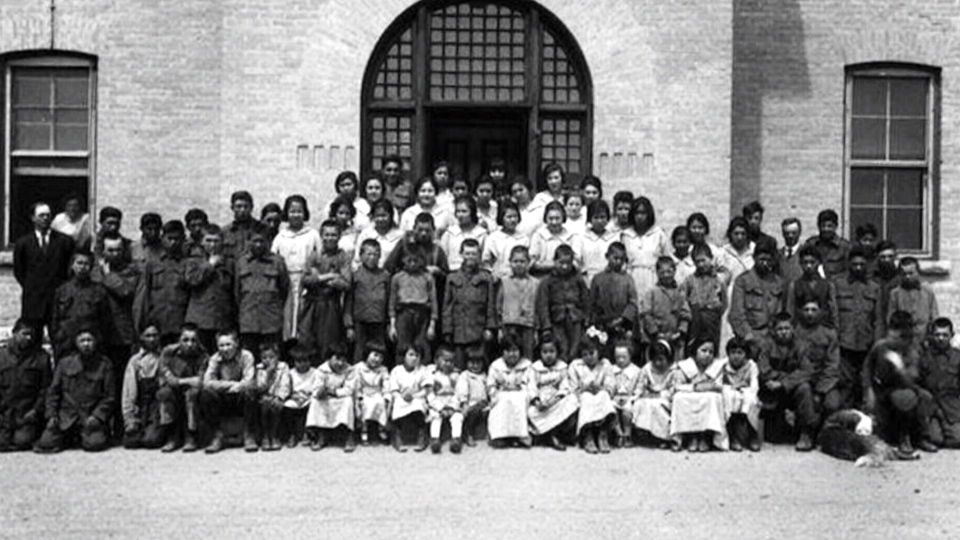
A 1931 photo of the Kamloops Indian Residential School. PHOTO BY NATIONAL CENTRE FOR TRUTH AND RECONCILIATION

I am haunted. Haunted by the image of a mother desperately trying to find her child.

I am burdened. Burdened by the stories buried beneath generations of denial.

I am bewildered. Bewildered by the truth that we are not standing up as a nation, standing with the Indigenous community, decrying these acts of genocide and demanding we start listening, deeply, to the stories so that we stop repeating history, again and again and again.

And I am saddened. Saddened by so much loss. So much abuse. So much.

____________

I awoke this morning with a question on my mind. “Did they search for the children?”

Because I know, if it had been one of my children who had gone missing, run away, taken, the police, the community, my family and friends would have banded together and never stopped looking until she was found.

And sadly, I know, that didn’t happen. Sadly, I know, no one listened when the mother of one of the 215 undocumented deaths cried out, “Help me. My child is missing!” Sadly, I know this is true.

Calgary Herald Article, May 21, 2021 – Why so many children died at Indian Residential Schools

______________________

Did They Search For The Children?
by Louise Gallagher

When they discovered
they were gone,
when they realized
their bed was empty
did they search
for the children?

Did they send out a call
for volunteers
to come
band together
with the police and school administrators
and community members
and the parents whose tears 
could not stop falling
as they searched 
desperately
the long tall grasses
that surrounded the school
in a frantic attempt
to find their child
gone missing in the night.

Did they search
or did they already know
it was too late
the child was gone
forever
buried
beneath the black
earth covering
their tiny, fragile body
still
forever more.

And when the mother came
knocking, knocking, knocking
at the door
her body awash in a river of pain
did they bring her inside
and wrap their arms around her
and tell her how
how this had happened
what had gone wrong
how sorry and ashamed and horrified
they were that her child
was lost
and that they too
would never stop
searching 
for answers
never stop searching 
for her child
forever more.

Or did they slam the door
on her dirty Indian face
leaving her to wander
inconsolably
in the rain and the sleet and the snow
under a hot burning sun 
along the long dusty road
leading away from the last known place
where she had seen her child
enter
that dark day
the police and the Indian Agent
had come
to steal her child away.

Did they slam the door in her face?
Did they turn their backs on the mother
and whisper amongst themselves
how they would never tell
anyone
what had happened
to the child.

These questions
these remains
these stories
of two hundred and fifteen children
found
buried
deep
beneath the black soil
surrounding a school
where children were taken
from their loving families
so the ‘Indian’ could be beaten out of them,
these questions
these remains
these stories
they haunt me.

And I imagine a mother
grasping for her child
as the police tear the wee one out of her arms
and I see Auschwitz and Buchenwald
but I do not see
my Canada

Oh my Canada
we have lived with these stories
burning
deep
buried beneath
the dark soils
of this land
eating away at our nationhood
and still 
we do little.

And I imagine it happening to me
while my daughters were young
or my daughter’s children 
and the children of her friends
right now
being forcibly taken
so the Canadian can be beaten out of them
and I wonder
would we ever recover?
Would we ever 
get 
over 
it
as so many suggest
those who lost their children
and their culture
and their language
and their land
must do
now?

And I wonder
can we ever recover
from our past?
Can we ever wash away
our shame
when we know now,
as they knew then,
we cannot bring
these children back.
They are gone
forever.