I Can’t Believe…. Believe it. It Happened.

Some time ago, I met a woman who was struggling to end a relationship that was causing her emotional harm. “I can’t leave him,” she said. “He needs me.”

How does he need you? I asked.

She paused. “How?” She seemed surprised by the question. Flummoxed. Her eyes shifted to the left, the right, up, down. She fluttered her hands in the air around her face. “I don’t know… he just does.”

And what do you need? I probed.

She sighed. Shrugged her shoulders. “I don’t know… for him to love me like he did when we first met?”

What else do you need? I asked again.

She held her breath as she thought about the question. “I…. I need him to change.”

On a scale of 1 to 10, 10 being ‘he absolutely will’, how likely is that to happen? I asked.

She smiled sadly. “Zero”.

And is that what you want for the rest of your life and for your children? To be with a man who cannot change the things he’s doing that hurt you and, also them?

Recently, I met that woman again. Once she faced the truth that to create change in her life she had to change what she was doing, she left him. It wasn’t easy, she said, but she did it with the support of caring people in her life.

Once out of the darkness, she went back to school. Got a certificate in HR and was working hard to create a life of stability, joy and love for herself and her two children.

“I can’t believe I stayed with that creep for so long,” she said after telling me all the amazing things that were happening in her life.

Believe it. You did. I said. But, in believing it, don’t compare it by measuring the length of time. You stayed as long as you stayed, It was neither long nor short. It is simply the length of time you stayed. A moment in your life. Not your whole life.

That woman reminded me of me.

When I first got out of a relationship from hell, ‘couldn’t believe’ was one of the phrases I had to eradicate from my vocabulary.

Saying, “I couldn’t believe” was the gateway to the disbelief of something that had happened that I had participated in. It disempowered me. To build my resiliency, I had to acknowledge it, learn from it, grow through that learning and triumph over it, not ignore it or my role in it.

Saying, I can’t believe’ blocked all access to healing and resiliency.

For that woman, resiliency didn’t help her survive that relationship. Her inherent desire to LIVE did that. Where resiliency became her constant companion was in doing the things she needed to do to build her life after the abuse. With each step into living free of abuse, her resiliency strengthened her resolve to keep creating her own happiness, her own dreams, her own path.

We all come upon sticky moments in our lives, sometimes many sticky moments. Some big. Some small. Some short. Some long. Size and time are not the issue. Believing it happened is.

When we stop saying, “I can’t believe….” we open the door to possibility. We allow our resiliency to step in and strengthen our ability and resolve to grow, prosper, thrive and triumph over adversity.

In that resolve, we grow stronger.

Namaste.

Resilience is built into our nature.

Episode 26 – Dare Boldly: No matter your age

When I worked in an adult homeless shelter, people always commented on how it must be a very depressing place to work.

I always replied, “It’s one of the most inspiring places I’ve ever worked.”

Every day I experienced a thousand people awakening in the morning to take another step. Their lives may have been in disarray, they may have lost everything and carried only the heaviness and indignity of the label, ‘homeless’, but they kept going.

That was inspiring.

I learned a lot about resilience at the homeless shelter. I saw it every day. From the young 18-year-old who was determined to finish his high school education to the 60-year-old woman who met her 20-something daughter, whom she hadn’t seen in several years, on the elevator one day. In that one meeting the mother made the decision to get help with her mental health issues so she could move out of the shelter and be a mother that could guide her daughter away from street life.

Resilience was everywhere at the shelter.

I remember Colin. An indigenous man who had left his family and community behind when the load of his past became too much to bear. When we met, Colin had been on the streets for many years and hadn’t seen his adult sons since they were school-aged children. “I want to be a man they’d be proud of,” he told me in the self-esteem-building class I was teaching.

In an environment where being sober was the anomaly, Colin was very proud of his three-month-old sobriety. Determined to see his sons again, he kept taking steps in the right direction.

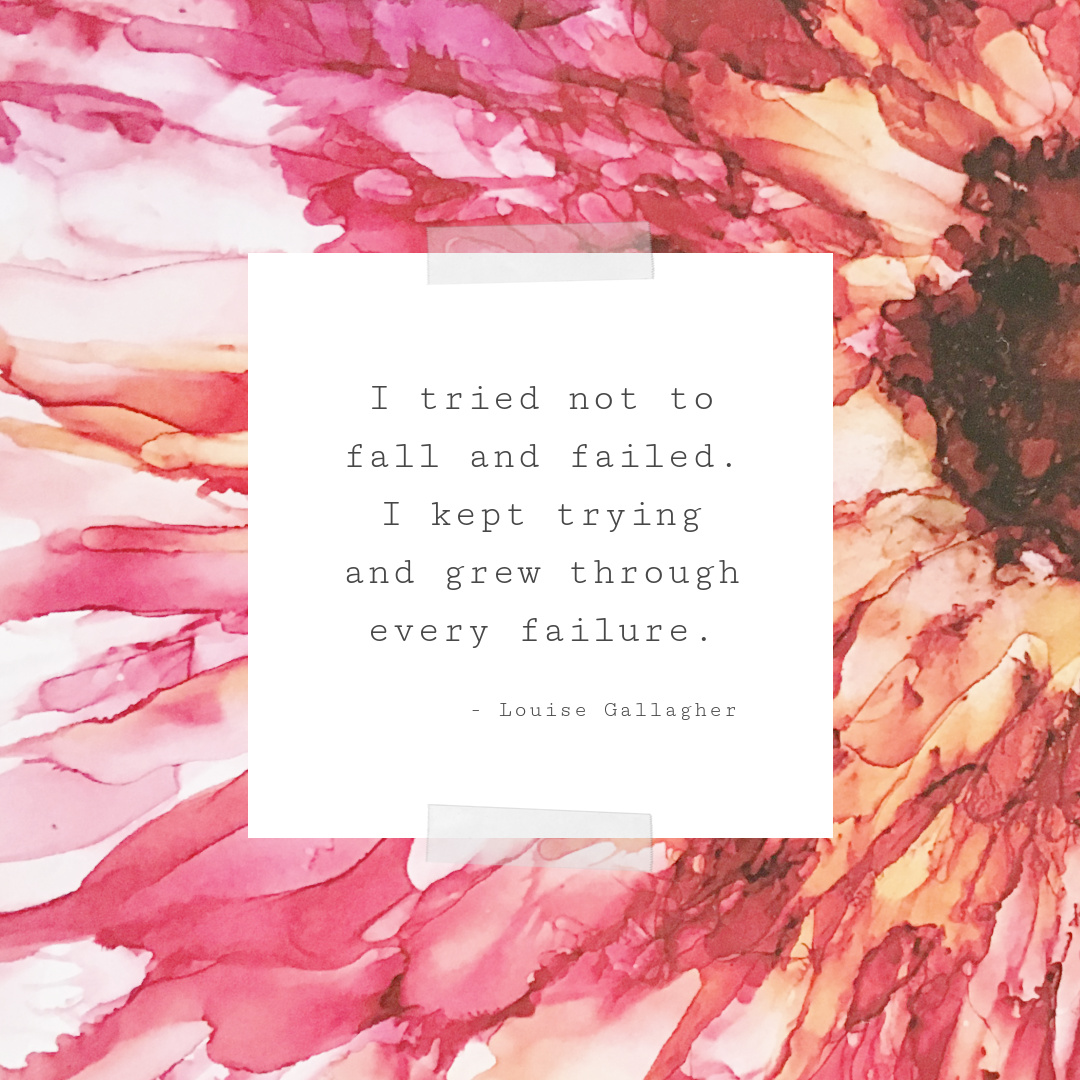
I was in awe of Colin’s commitment and resilience. Life kept knocking him down and he kept standing back up and moving forward.

Six months after we met, a massive heart attack took away any chance Colin had of meeting his sons again. And though he lost that final battle, he died exactly as the kind of man he told me wanted to be, “A proud man.”

Colin, and so many others I met at the shelter, displayed the characteristics of resilience every day. Courage. Strength. A willingness to face life’s challenges without giving up, and a deep awareness that to take a different path they had to change the things that brought them to the shelter door.

Resilience can come in many forms. There’s physical resilience, mental resilience, emotional resilience, and social resilience.

At the shelter, resilience came wrapped up in a community that held each other up and gave what they could to one another, no matter how little they had. And, it came in the hope and belief tomorrow would be a better day as long as they made it through today, together.

Colin never got to that tomorrow where he met his sons and heard them say, “We’re proud of you, dad”. But, in getting up again and again and continuing to fight for his sobriety, he taught many others the value of holding true to yourself and your dreams.

It is a lesson that continues to inspire me today.

Episode 26 – Resilience week – Dare Boldly: No matter your age

Take the “What’s the Big Deal about Aging?” questionnaire!

I’m really interested in a) writing and talking about aging, and I’m really interested in your feedback so if you don’t mind taking a few moments, I’d love to get your feedback – it’s my very first survey so I’m learning as I go! (in other words, it’s not the best designed survey but it’s my first! 🙂 )

Click HERE for survey (max 5 minutes to respond)

How to be grateful for it all

After five years of enduring a relationship that almost killed me, freedom tastes so sweet. In the aftermath of being freed from that living hell, when anyone asked me, “How are you?” my first response was, “I’m alive!”

Being alive, after feeling like I was the living dead, and believing (and hoping) the reality of death was waiting just beyond my next breath, being able to say, “I’m alive” and mean it was pure joy.

Sitting here, almost 20 years away from that moment of release, it’s hard to remember how lost and alone, terrified and depressed I was.

What I can and do still feel, is the elation I felt, and still feel, with being alive.

And, while I haven’t quite mastered the art of being grateful for the things he did that brought me to the point of trying to unhook gravity’s hold on my body so I could simply fall into the ocean and be washed out to sea forever, I am grateful for the realization I carry with me today. A realization that came from having walked that path of abuse and self-annihilation so long ago. Life is a precious gift. It asks only that we fall in love with ourselves and all of life moment by precious moment.

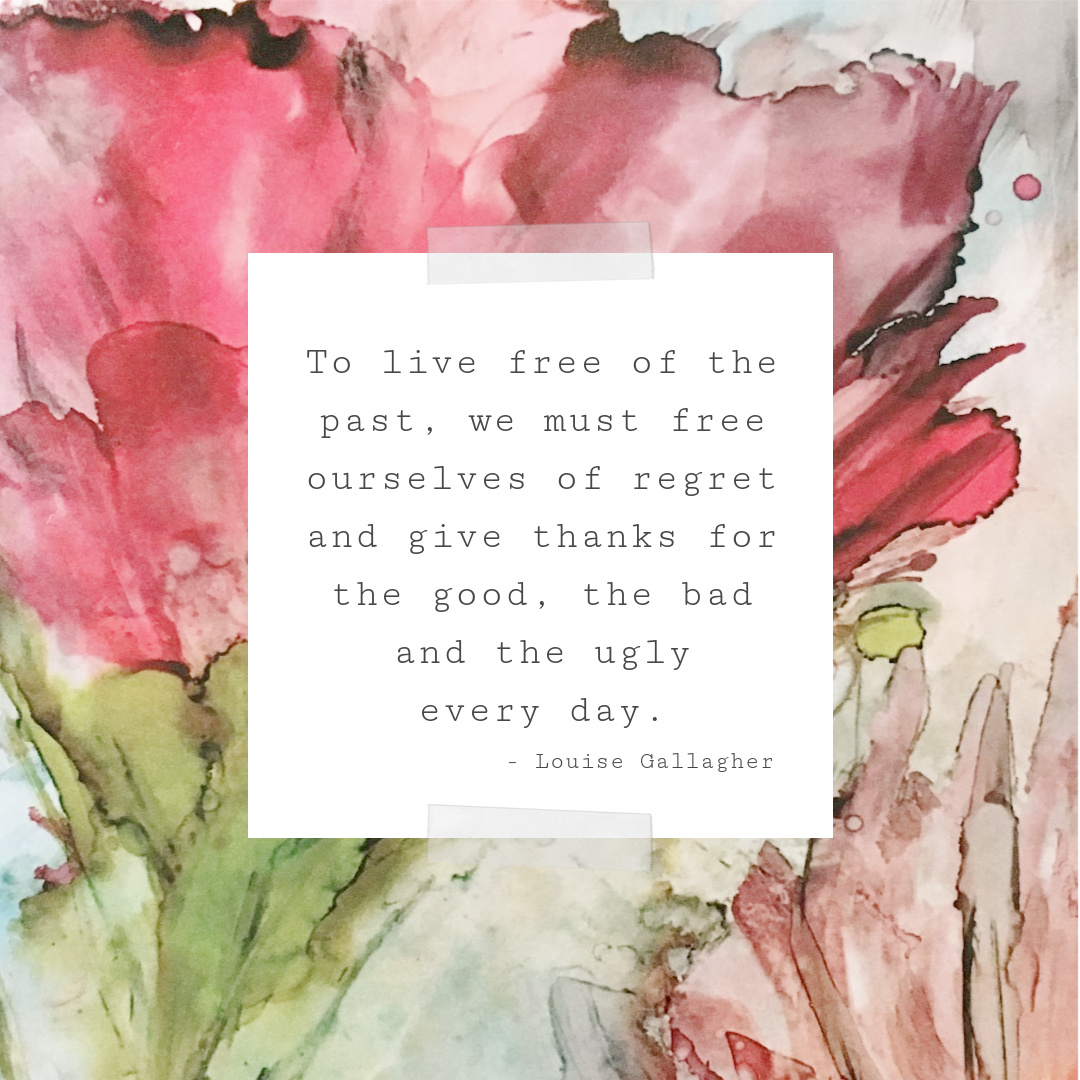
There is not one moment of the past that I can change. Regretting that relationship and all the pain and harm it caused those I love is a journey of futility.

In living my realization that life is precious, I fall in love with the woman I was then, and the woman I am today and every day when I hold firmly to my belief in the precious nature of life and celebrate every breath as an act of freedom.

And in that realization, I embrace the deep knowing that I don’t need to be nor become grateful for the things he did. To live in freedom, I only need to live with a grateful heart full of love for this beautiful, fulfilling, love-filled life I live today.

My gratitude I know today is not based on what he did back then. It’s founded in knowing that what he did is nothing compared to what I do, every day, when I embrace everything in my life, the good, the bad, and the ugly, with arms, heart, and all my being wide open in gratitude and love.

Long ago, I fell into the trap of believing someone else held the answers to my life and could give me a shortcut to happiness. I am grateful that through that journey, I have learned the truth.

I am 100% accountable for my own happiness. In claiming my responsibility for my life, all of it, I set myself free of regretting things I did and that happened in the past as I say, “Thank you” for the good, the bad and the ugly. IT is all a beautiful gift opening up to the gift of becoming, me.”

And in that gift, I lean, with anticipation and joy, into all life has to teach me on how to live without regret so I can experience the wonder, beauty, and awe of all the world unfolding in its mystery and magic all around me.

Namaste.

Age Matters. So does Gratitude!

I love rituals.. Ritual activates my gratitude muscles.

This morning, while lying in the bath (one of my favourite morning rituals) I was reflecting on gratitude, and how I have gotten out of the habit of writing my gratitude list every day.

I smiled and shook my head in loving consternation at my humanness – it can be so easy to forget to do the things I know are healthy, healing and nurturing.

As I looked around to see if I’d remembered to put my journal on the little stool beside my bathtub, (and realized I hadn’t) I decided the time to act was now.

No pen. No papaer. Easy peasy. I always have my phone on the counter beside the tub — it controls my music.

Why not download a gratitude app?

Over the weekend I’d been researching gratitude and come across several apps during my search. One that looked interesting and got good reviews is, Gratitude.

Being a ‘when I have an idea I like to get to it!’ kind of gal, I picked up my phone (careful not to drop it in the sudsy water) and checked out the App Store.

Sure enough, Gratitude is the first app to appear in the long list. I did a quick peruse of other apps and decided I’d give it a try.

And so, while I soaked in the warm soothing waters of the bath, I created my first Gratitude List on my phone. In the process, I smiled. And laughed at myself. I mean really Louise – I’m grateful for morning poops? Well that’s not very sophisticated now is it? I let it stand. Some mornings, I am just that – grateful.

The app also has a section for building a vision board.

I checked it out.

And that’s where I came up against the big, bad, ugly, feelings of symbolic annihilation.

The Vision Board section allows you to post photos for different areas of your life that reflect what you are seeking to manifest.

Problem is, of the many, many, many photos for each section — Family, Friends, Health, Travel… etc….. there are relatively few, and I mean few, photos that I can relate to.

As an example, in the ‘success’ section I found a handful of photos out of many, many, many, that depicted an older adult — and they were all the same 3 different men, all in business attire, all white. (add some racial disparity to the mix too!)

I wasn’t deterred – the app does allow you to pull photos from your own phone — and I have lots of those I can include.

But what struck me was how subtle ageism can be – even when the app builders were trying to build an app that would allow people to strengthen their gratitude muscles, they (I’m hoping unintentionally) practiced symbolic annihilation (one of the challenges THIRD ACTion Film Festival is combatting through its amazing line-up of films and events – full disclosure, I sit on their board)..

See, ageism is subtle. I probably would not have noticed it if I hadn’t been scrolling through their photos before realizing I could add my own! It wasn’t until I realized I’d been scrolling and scrolling before finding one or two that fit my ‘mindspace’ that I realized what the issue was.

I’d say –Hey! Anyone want to build an app just for older people? but… that would actually defeat the purpose of this journey into how to age with grace and be grateful for it all.

Because a separate app, just for baby boomers for example, would actually be saying, we’re special and separate from all of you. And we want to keep ourselves that way ’cause you don’t understand!

At least I think that’s what it would say — please share your thoughts! I’d love to know what it says to you.

In the meantime, I’m adding this one to my list of gratitudes this morning – I am grateful for this app that will send me reminders to practice gratitude, and that reminds me, to not think of myself as invisible and powerless. To not sit back and allow synbolic annihilation to erase my presence because I tell myself, there’s nothing I can do, it’s just the way it is. I must use my voice, my words, my actions to stay relevant, present and above all, true to myself, doing the things I believe will create better in this world for all.

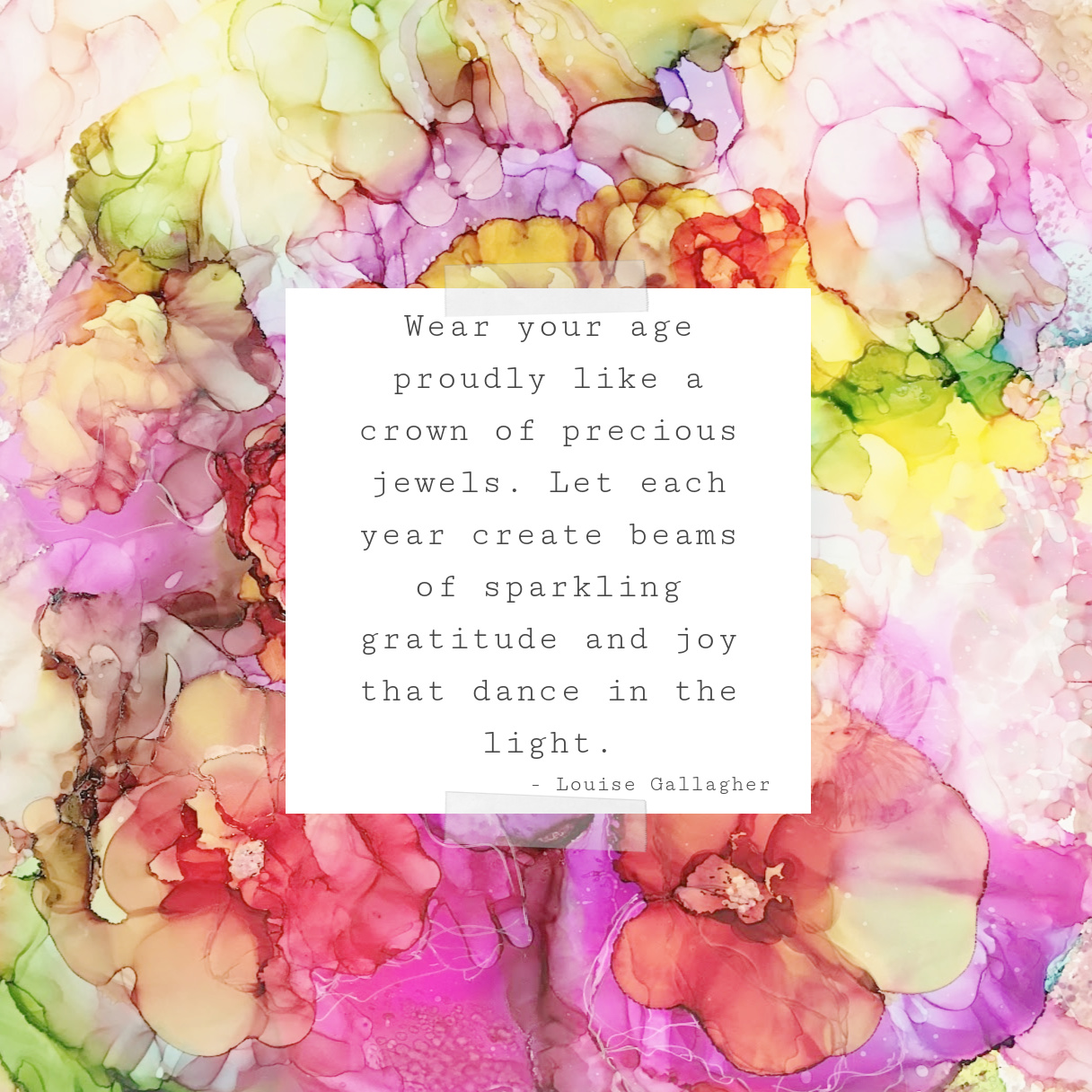
In other words, I gotta wear my age like a crown of precious jewels! Shining bright for all the world to see… Age matters! So does Gratitude!

Sparkle. Sparkle. Sparkle!

Namaste.

PS – I’m off to my physio appt this morning. If you’d like to listen to the video, please do come back later and I’ll have posted it!

Infantilizing older adults is not ok.

I have a confession.

It took me about 5 tries filming the video for today before I even came close to feeling comfortable with it.

Unconscious Bias. It’s a tough subject matter to delve into.

And today’s personal reflection is one that has quietly been stirring my thoughts for many years.

It’s about my mother and something that happened in the Assisted Living housing where she lived from her late 80s into her 90s.

Now conversations about my mother are often complicated and complex. This one is particularly challenging for me as I’m struggling to make sense of what I’m thinking, feeling and want to say.

It starts with an implicit bias where we ‘infantilize’ older adults with both the things we expect them to conform to and the words we use to describe them.

In this case, it was a Christmas concert in which my mother played in the Bell Choir.

I was always inspired by her desire to participate and do things creative. In this case, I was inspired by her bell ringing.

What disturbed me then, and still confuses me today is the manner in which the organizers of the concert insisted the performers come on stage.

They dressed all the choir members with reindeer ears, little mittens and then made them prance like reindeer as they came onto stage.

Now, if that had been one of my daughter’s grade 1 classes, I’d have been oohing and cooing about how sweet and cute they all were.

But these were older adults. People who had spent a lifetime maturing into themselves, building histories and stories, families and lives that mattered to them.

It felt disrespectful to treat them like children and then use words that I’d have used for my children to describe their presence.

And that’s where unconscious/implicit bias rears its sinister head.

See, it was really cute and sweet but, was it fair or honouring of the individuals’ on that stage?

Now, to be clear, this isn’t about saying it’s not okay to put on reindeer ears and prance around. If that’s your jam, go for it!

But, in the organizer’s insistence that everyone in the choir dress-up and act like reindeer, they took away the individual choir member’s agency and undermined their dignity through the inherent infantilization of their age.

And I compounded the issue by further infantilizing their performance with the words used to describe everyone, including our expressions of surprise that the performers could learn to play bells in the first place.

I’d love to hear your thoughts. I’m still working through mine — all these years later it still bothers me how the words I used to describe my mother’s participation had little to do with her talent and proficiency at bell ringing and more to do with how cute and sweet she looked in her reindeer ears as she pranced onto stage.

Until I started seeing it all through the lens of implicit bias, I hadn’t quite been able to grasp what had concerned me about that performance (and others I witnessed at the assisted living centre too).

Thanks for reading and being part of the conversation.

Namaste

Episode 8: When we infantilize older adults, we undermine their agency and dignity

.