In the River of Time

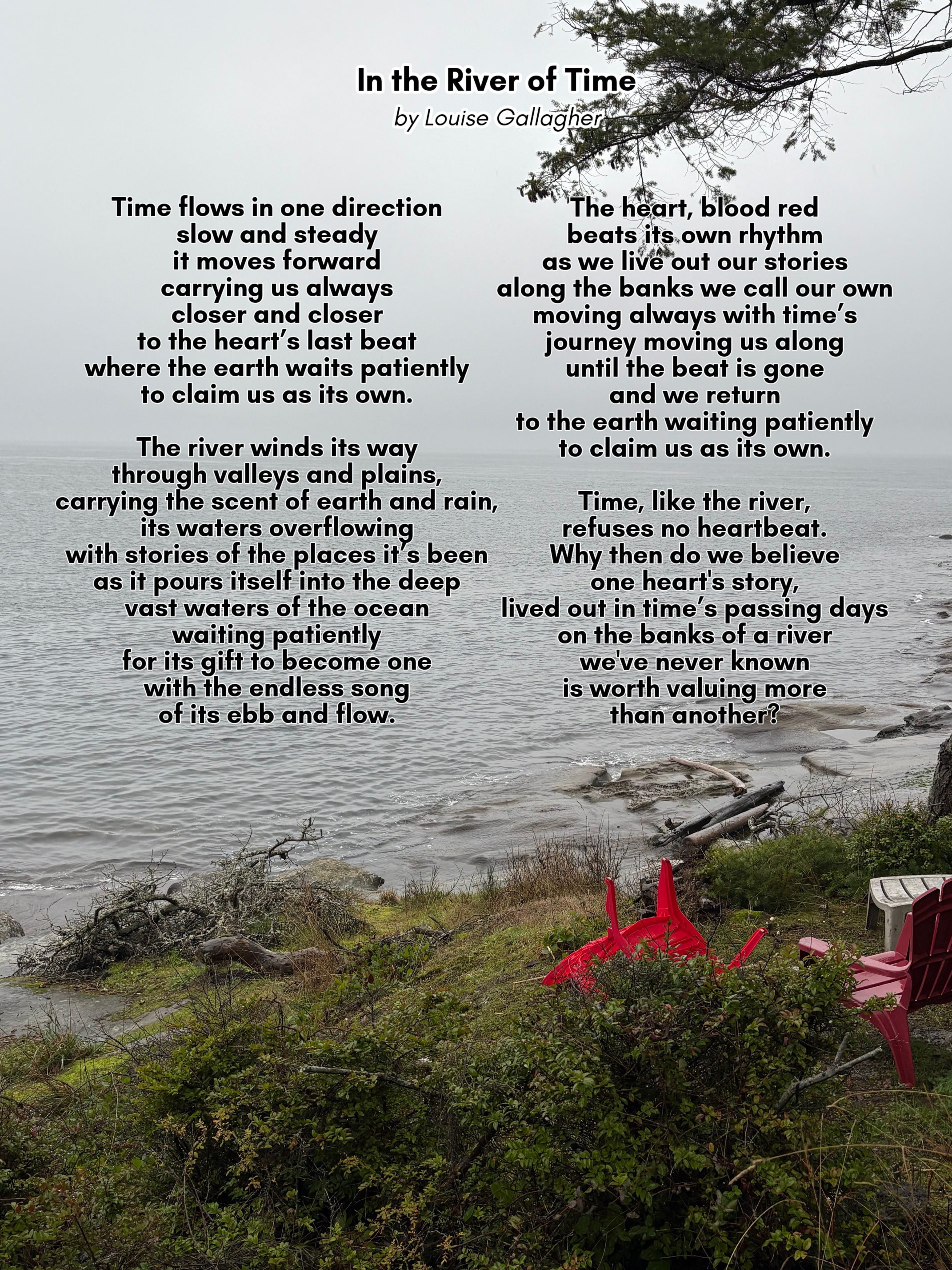
In the River of Time
by Louise Gallagher

Time flows in one direction
slow and steady
it moves forward
carrying us always
closer and closer
to the heart’s last beat
where the earth waits patiently
to claim us as its own.

The river winds its way through valleys and plains,
carrying the scent of earth and rain,
its waters overflowing
with stories of the places it’s been
as it pours itself into the deep
vast waters of the ocean
waiting patiently
for its gift to become one
with the endless song
of its ebb and flow.

The heart, blood red
beats its own rhythm
as we live out our stories
along the banks we call our own
moving always with time’s
journey moving us along
until the beat is gone
and we return
to the earth waiting patiently
to claim us as its own.

Time, like the river,
refuses no heartbeat.
Why then do we believe
one heart's story,
lived out in time’s passing days
on the banks of a river
we've never known
is worth valuing more
than another?

How Safe is Your Voice?

A Conversation Across Generations and Lived Experiences

The pursuit of being ‘heard’ and giving voice to our stories is a lifelong journey. From our first cries as infants to the wisdom we share in our later years, our voices evolve and adapt to the world around us. Sometimes, they are strong and powerful. Sometimes, soft and tentative. But how often do we consider the safety of our voices, especially when it comes to hearing and listening to the diverse perspectives that different generations and lived experiences bring to the table?

Ageism and the Erasure of Lived Experience

Ageism, the discrimination or prejudice based on age, can lead to the erasure of invaluable lived experience. This is particularly true for older adults who have navigated decades of challenges and triumphs, accumulating a wealth of knowledge that is often overlooked or dismissed. Just as the lived experiences of marginalized groups who have frequently been silenced or disregarded, such as those who have experienced homelessness, are essential at the table, so too are those of older adults.

The Power of Lived Experience

Lived experience voices bring a unique and irreplaceable perspective to the table. They offer firsthand insights into the realities of aging and ageism, the challenges of navigating social systems, and the complexities of diverse life journeys. When we include these voices in conversations about policy, programs, and systems of care, we create solutions that are more effective, equitable, and responsive to the needs of all individuals.

Older Adults: Experts in Their Own Right

Older adults are not merely recipients of care; they are experts in their own right. Their lived experiences have equipped them with a deep understanding of what works and what doesn’t, what is needed and what is missing. By valuing and amplifying their voices, we can tap into this wealth of knowledge and co-create solutions that truly serve the needs of aging populations today while creating pathways for future generations to age without fearing being silenced and ignored.

Creating a Brave, Safe Space for All Voices

To foster a culture that is purposefully brave and safe for all voices, we must actively combat ageism and other forms of discrimination that silence lived experience. This means:

  • Centering Lived Experience: Actively seeking out and prioritizing the perspectives of those who have lived through the issues we are addressing.
  • Listening with Humility: Approaching lived experience voices with respect, recognizing that their insights are invaluable and often hard-won. And, due to the insidious and pervasic nature of ageism, have been silenced and struggle to be heard.
  • Co-Creating Solutions: Involving individuals with lived experience in the design and implementation of programs and policies, ensuring that their voices are heard and their needs are met for their benefit, not the systems.
  • Building Bridges: Fostering dialogue and collaboration between different generations and lived experiences, recognizing that we are stronger together.

Radical Bold Aging: Amplifying Lived Experience

Radical Bold Aging, which champions the empowerment and agency of older adults, aligns perfectly with the goal of centering lived experience. By recognizing older adults as experts in our own lives, we are empowered to advocate for our needs, challenge ageist stereotypes (both our own and society’s), and actively participate in shaping the world around us.

The Challenge and the Reward

Creating brave, safe spaces for all voices, including those with lived experience, is an ongoing commitment. It requires us to confront our own biases, actively seek out diverse perspectives, and challenge systems that perpetuate exclusion. But the rewards are immeasurable. When we embrace the power of lived experience, we build a stronger, more compassionate, and more equitable society for all.

So, the question remains: How safe is your voice?

Let’s make safety the foundation of our conversations, across generations and lived experiences, and build a world where everyone’s voice can truly be heard, valued, and respected.

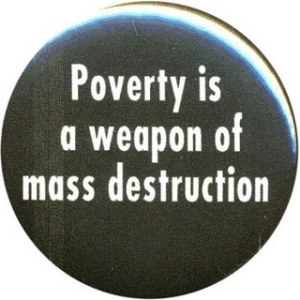
Can education end poverty, homelessness and discrimination?

I am at a dinner party. The people around the table are all successful by society’s norms. They have achieved status, good jobs, make contributions to their organizations, families, communities, society.

One of the guests states they know how to resolve the problem for Canada’s Indigenous people. “Give them goals,” they say with conviction, “and hold them to the outcomes.”

The other guests murmur in agreement. Yes. Yes. It’s what’s needed. They need to stop whining and start doing more to be productive members of society. Sure, we messed up, someone mentions, we treated them unfairly, but that’s in the past. It’s time to move on.

I chime in and ask if anyone around the table has read the Truth and Reconciliation Report. There’s a lot of head shaking, No.

So, we can sit here with answers when no one has read a report that provides clear directions on how to move forward in addressing the inequities and injustices that have created the trauma and crisis today.

Good point, someone says. But they still need to be held accountable to goals. They need to progress.

And who are we to say what that looks like I ask, when we don’t understand the people, culture, history and our role in creating the issues today?

I ask one man, the CEO of a large multi-national corporation how he would respond if a consultant, hired to help fix a problem in the organization, walked in and said, I know the answers. Here’s what you have to do. Yet, the consultant had not even looked at the organization’s balance sheet, annual report, strategic plan or interviewed leadership, etc.

The man laughed and replied, “I’d throw him out.”

Yet, it’s okay to act like that consultant about a situation you have not spent any time understanding.

There was a long silence and the conversation changed to another topic.


Yesterday, a reader commented on my post that education is vital. “… the answer is education. It lifts people, it lifts families, it lifts communities. And, while it is lifting people out of chronic cyclical poverty and its attendant problems, it lifts spirit, self-esteem/pride and empowers more accomplishment.”

I agree.

But it’s not just those experiencing homelessness, or poverty, or other social injustices who need education. It is all of us.

Recently, a man told me of his experience looking for a place to live. He arranged for a viewing of an apartment and when he got there, it was mysteriously, suddenly, unavailable.

You can’t tell the colour of my skin on the phone, he told me. But I could see his [the landlord’s] revulsion by the look on his face when he opened the door.

The man is Blackfoot.

It happens all the time, he told me. Sometimes, people don’t even bother to pretend. They just say, “I don’t rent to Indians.”

It doesn’t just happen to indigenous people, but to immigrants too.

Someone sees the colour of their skin, and doors close in their face.

Education is needed.

For everyone.

Discrimination hurts all of us. It fosters resentment, disillusionment, despair; entitlement, injustice, disrespect.

It creates Us and Them communities where the ‘have’s’ deny the ‘have not’s’ access to the resources and supports they need to be able to live without feeling the burden of poverty pressing them down.

It is not up to those who are being discriminated against to prove to the rest of us that they are equal, worthy or deserving. It’s up to each of us to let go of our thinking that someone else is not equal, worthy or deserving of our consideration, fair treatment, justice, dignity.

When we tear down the barriers we have erected to keep ‘them’ out of where we live, work, play and create communities, we create a world where tolerance, understanding, justice, and consideration for all has room to flow in all directions.

And that requires a willingness to learn — about the impact of our thinking we have all the answers for those we judge to be less than, other than, outside of our human experience.

We need to educate ourselves on the injustices we create because of our privileged thinking and belief that ‘they’ are the one’s who need to educate themselves to do better.

We are a planet of diverse cultures, faith, traditions, ways of being on this earth.

What we share in common is our human condition. And that is all we need to be equal to one another.

The rest… it comes with educating ourselves about the beauty in our differences, and learning to become compassionate in our view of how those differences make us each unique and richer in the experience of sharing our world in ways that create better, not just for the few, but for everyone.

Namaste.
 

To create change I must be the change.

Gary Paterson is the first openly gay person to be named the Moderator of a major Christian-based church, in the world.

The times they are a changing.

Chris Ball is from Calgary. A tourist in a city on the south-west coast of the United States. On the eve of the US election, while walking back to his hotel, he is attacked by three assailants, pummelled and kicked and beaten badly.

The times they are a changing; sometimes they seem to stand still.

On Sunday evening my eldest daughter and I attended the Jazz Vespers at St. Andrews-Wellsley United Church in Vancouver. Throughout the hour-long event, Rev. Gary Paterson intersperses the music with eloquent, educated and thought-provoking commentary on how to create change: We must name what concerns us. Be forgiving. Be grateful. We must create from the intention of creating better, for everyone. “Jesus Christ loves Donald Trump,” he says. “I’m glad he does because I’m not there. Yet.”

Not there. Yet.

Which suggests, the intention is to get there. To get to that place where the actions of a person are not the measure of how I love. How I love is the measure of my response and way of being in the world – may my response always be one that listens, hears and acknowledges the position of another from a place of integrity, dignity and compassion.

Miles Davis said, “I’m always thinking about creating. My future starts when I wake up in the morning and see the light. Then I’m grateful. To keep creating you have to be about change.”

What is the change you want to create in the world?

Chris Ball, the Calgary film-maker beaten on election night in Santa Monica is quoted in a Calgary MetroNews article as saying, “I’m in pretty good spirits. That’s just how I have to handle it. I’m alive and well and still very gay,” he laughed.”

The article states:

In retrospect, Ball doesn’t think it was really a political issue – it was a hate issue, fuelled by the charged atmosphere of the election night, with a group of drunk people who used Trump’s rhetoric as an excuse to get in a fight. He feels it could very well have been a Clinton supporter, or just someone else with a homophobic attitude on any other night – it’s an ongoing issue.

Chris Ball nor Gary Paterson can change the fact they are gay men. They can change their attitudes towards hate. And that’s what they’ve done.

We all can as Gary Paterson stated in his homily, “Stand with strong backs and soft fronts.”

We can all soften our hearts and love one another through eyes that see into and recognize and honour the human condition we each carry with us.

To create the change I want to see in the world, I must not hate those with differing views from me. I must not look at them through eyes of distrust, disbelief or disgust.

I must see them through eyes that honour their humanity. I must listen to them with a heart that is open to understanding their point of view. It may be different than mine but it is as right for them as mine is for me.

And, I must listen to their thoughts with the intent to not constantly override their words with mine. I must create space for their words to be as true as mine. It is on that common ground that we find space to hear, honour and know one another.

I must, as Ghandi so passionately exhorted, ‘Be the change I want to see in the world.”

In 2012, the United Church of Canada appointed a gay person as its Moderator.

I welcome the day when it is not the fact that he is a gay person or a woman or a First Nations person or person of colour that makes their appointment or accomplishments newsworthy.

I welcome the day when we have changed our minds enough on what it means to be human beings that the colour of our skin, our gender orientation or native bearing are not what we talk about. What we do. What we say. How we behave and accept one another as equal in all ways is how we greet and know and treat one another.

And for that change to happen, I must be the change I want to see and experience and create in the world.

Namaste.

What colour is your prejudice?

I am waiting for the C-train to arrive when a woman and a young child walk past me. She is pulling on the child’s arm, trying to hurry him up. He is running/hopping to keep up while also looking up at a bird sitting on the lamppost above. “Why didn’t he fly south, mommy?” I hear him ask.

I smile and watch them walking and my mind leaps into judgement without a second thought. “How nice to see an aboriginal mother and her child looking so normal,” I catch myself thinking prejudicially.

It is there, just beneath my skin, those thoughts that keep me mired in us and them thinking. That separate me from you because the colour of your skin, your heritage, your belief, is different than mine, or what I have been conditioned to think of as ‘the norm’.

I feel it when a woman in a burka floats down the street. I admire the grace of her garb but thoughtlessly judge the choices she makes to cover herself up in public.

I catch it when I see a police officer trying to pull an obviously inebriated and homeless man into a sitting position from where he lies on the sidewalk. Can he not be more gentle? More compassionate?

It is there as I judge passers-by for giving the man on the ground scathing looks of disgust.

It is present as I ride the C-train and another passenger is talking loudly on their cellphone. Where are their manners?

It is everywhere.

Judgement. Discrimination. Prejudice. Fear.

You are different than me. You behave other than how I do. You worship at a different pew. You talk in another tongue. You were born in a foreign -to me- land. You see the world through different eyes.

Why can’t you be more like me?

The better question is, Why am I always judging? Because it’s always there, my judging. Measuring. Gauging. Your words and looks and actions against mine.

Is it that I fear you will take from me what I hold dear? My position of self-righteousness? My place of privilege for having been here first? My belief that you would rather be like me than you?

Is it that I do not want to let go of what I have for fear you will have more than me? That you will be better than me?

Is it a habit?

Why don’t I just stop judging so you can be you and I can be me?

In that place of neither of us judging one another, we can meet somewhere in the middle, on the common ground of our shared humanity knowing, it is our judgements that are keeping us apart, not our differences.

I caught myself in judgement.

To create the world I want to live in, I must stop my judgements from creating a world of us and them to see the light in each of us shining as brightly as it can, where ever we are at. And in our lights shining, we connect on the common ground of our humanity knowing, we are one human race, one planet, one world.

What about you?