Make Time for the Sacred: The Technology Battle is Over (and I Won)

There’s only one way to spell ‘frustration,’ but I’ve invented a thousand ways to express it.

For the past week, As I’ve been creating my Make Time for the Sacred Winter Solstice Reflections. I’ve been fighting an epic, soul-crushing war against my laptop.

FRUSTRATION doesn’t cover it. That word is too polite. I was operating on a level of digital rage that involved a primal urge to launch my computer into the Pacific Ocean, or at least see what happened if I put the whole thing in the microwave.

(And yes, I know, it’s not the laptop’s fault. User error is a pandemic whenever I dive into new software. We are all just primates trying to manage a universe of wires.)

But here’s the brutal truth about perseverance: It works.

I was determined to get this course online before Advent started. I missed that deadline by four days and approximately 70 hours of lost sleep, but I PERSEVERED. The kinks are gone, the demons are exorcised, and the tech finally listens.

My course is officially ready.

The Invitation (Where You Come In)

Humans are fascinating creatures: we create complex tools, and then we struggle to use them. This Solstice reflection is a necessary pause from that struggle.

The Make Time for the Sacred Reflections is a beautiful, FREE way to prepare your heart for the return of the light.

Here is exactly what you get when you sign up:

  • Four Weekly Reflections: Delivered right to your inbox, running from now until the Epiphany on January 6th.
  • Flexible Access: Each week includes both a written option (to read and journal) and an audio option (for listening on the go).
  • A Sacred Pause: A simple, guided way to reconnect and reflect during the most chaotic season of the year.
  • And Bonus content — 4 questions to deepen your experience to prompt journalling should you choose.
  • A weekly meditation posted every Friday for your to savour over the weekend and into the following week.

This free gift ends January 6th. Release the procrastination. Get your pause now.

Lessons from the Surfer When Life Knocks You Down: The Art of Getting Back Up (Windsurfer Style)

I watch a windsurfer skimming the water, waves slipping underneath the board, body taut, legs primed, arms grasping the bar. A picture of tenacity, grit, and commitment. Commitment to every wave. To every nuance of the water, riding each roll of the surf like a bronco buster on a bull. Anticipating. Adjusting. Moving with each unpredictable buffet of the wind and eruption of the sea.

Like life, we travel through each day, holding on to what’s dear to us, to what’s important. Anticipating. Adjusting. Moving. Sometimes, we miss a step and fall. We have one or two choices: get back up and carry on, or stay down and let the waves carry us further out into the chaos of not taking charge of our own journey.

Sometimes we simply need the right tool. Or the inner wisdom to know we are strong enough to carry on, even when we feel we have no energy left.

Just as the windsurfer learns from every dip and dive, we too can grow stronger through life’s inevitable challenges. It’s in those moments of choosing to rise that our true power is revealed, often found by tapping into our inner wisdom or discovering the right support. What if we all embraced that spirit, understanding that sometimes the most profound growth happens right after a fall?

What helps you get back up when life knocks you down? Is it a particular tool, a mindset shift, or relying on your inner strength? Share your strategies and support others in our community who might be feeling adrift. Join the conversation below!

How to Journey to Stillness

Tuesday morning, Sun shine. Fluffy white clouds tinged with grey and blue shroud Vancouver Island in the distance. Sea a gently undulating blanket, always in motion. Trees stand tall, branches still, their filigree network of needles pricking the untouchable sky.

In meditation this morning, the invitation was to ‘let your mind dissolve into the clouds’. I struggled with it. Struggled to find the stillness and spaciousness of nothingness. To imagine my mind as dissolvable.

I am attached to my mind and its constant yammerings and yawings. It’s incessant litany of thoughts and ideas tumbling around inside my head telling me, ‘that’s a good idea’. ‘what on earth were you thinking?, ‘you need to do more’, ‘you’re not enough’… and all that jazz.

Stilling the chatter has been a lifelong journey for me. Meditation is my gateway to the stillness, and calm, of letting my mind dissolve into the clouds.

Some mornings, my mind feels busier than others. When I began meditating, I started small. Even 1 minute of sitting in the silence is better than none.

Whether you’re a beginner, or a seasoned meditator, here are four ideas on how you can begin to meditate or to enrich your existing practice:

1. Start Small:

  • Silencing the mind completely is a lofty goal, especially for beginners. If you’re just beginning, start with just a few minutes of dedicated stillness each day, gradually increasing the duration as you become more comfortable. If like me, you go in and out of your practice, sometimes leaving it for days on end, always begin again and do not judge yourself harshly!

2. Focus on the Breath:

  • The breath is an anchor to the present moment. Especially as you begin to practice, pay close attention to each breath. In. Out. In. Out. As you progress, focus the sensation of each inhale and exhale, noticing the rise and fall of your chest or belly. When the mind wanders, gently guide it back to the breath. In. Out. In. Out.
  • Remember not to judge your progress, or the stillness of your mind. Stay, ‘open minded’. Curious. Calm.
  • Tip: To support your practice, try this counting exercise: inhale for a count of 4, hold for 4, exhale for 4.

3. Engage the Senses:

  • Connect with your senses. Take a mindful walk in nature, noticing the sights, sounds, smells, and textures around you. Or, sit quietly and savour a cup of tea or coffee, paying attention to the warmth of the mug, the aroma, and the taste.
  • Exercise: When connecting with your senses, close your eyes and ask yourself: “What do I hear? What do Ifeel against your skin? What do I smell?” Don’t seek the words to describe what your experiencing. Feel it. Don’t name it.

4. Embrace a Creative Outlet:

  • Engaging in creative activities can quiet the mental chatter and induce a state of flow. There are countless individual ways of experiencing this – painting, writing, dancing, playing music, gardening, or anything that allows you to express yourself and get lost in the process.
  • As a mixed media artist and as a writer, getting lost in the process of creation has taught me to ‘trust in the process’ . Time disappears, the world around me fades as I become immersed in the pure joy and wonder of allowing my intuition and creative essence to express itself fearlessly.

5. Acceptance and Non-Judgment:

  • It’s crucial to approach stillness with a gentle, non-judgmental attitude. When thoughts arise (and they will!), acknowledge them without judgment and gently redirect your attention back to your chosen anchor (breath, senses, etc.).
  • Remember: Meditation is a practice, not a performance. There’s no “right” way to find stillness just as there is no wrong way to begin again.

What about you? What do you do to stop the chatter and open the portal to your heart?

My Struggle with Self-Care (and How I’m Finding My Way Back)

Six days into the new year and it already feels like a rocky start. I’ve slipped on all levels of my commitment to self-care and fostering calm. It’s as if the moment the calendar flipped to January 1st, some invisible switch was thrown, and the pressure to be better, do better, achieve more, kicked the critter chatter in my mind into high gear as my inner wise woman slipped into reverse.

Yesterday, I succumbed to the siren song of junk food. The rain was coming down in sheets as I drove back from Victoria, the early morning ferry (6:20 am – ouch!) catching up with me. Each mile felt longer, each raindrop a tiny hammer against the windshield. By the time I reached Duncan, the golden arches of self-indulgence were glowing like a beacon of comfort, and the gremlin on my shoulder was whispering promises of salty, greasy satisfaction. Resistance crumbled.

And it’s not just the diet. 10,000 steps? More like 10,000 excuses. Between ferrying C.C. to Seattle and navigating the labyrinth of Canadian customs and residency paperwork, my Fitbit has been gathering dust. The book? Those 1000 words a day are mocking me from the blank page.

I find myself making excuses, defending my actions as if I’m in front of a judge. Why this need to justify? Is it the fear of being judged, of not living up to some impossible standard of “New Year, New Me”? Or is it something deeper, a fear of failing myself, of not being disciplined enough, strong enough to stick to my resolutions?

Perhaps the real struggle isn’t with the self-care itself, but with the expectations I’ve piled upon myself. Maybe calm isn’t something to be achieved, but a state of being, a way of approaching life that I need to rediscover. Maybe it’s time to take off these judgmental glasses and see the world, and myself, with a little more kindness.

Maybe, rather than loading myself up with expectations and then giving my inner critic free rein to criticize my perceived “lack” of progress, commitment, or achievement—obscuring my gratitude like a dark cloud hiding the sun—maybe I need to step fully into gratitude. Maybe I need to choose to celebrate the beauty, wonder, and awe that already exist in my world.

Perhaps counting moments that take my breath away, instead of milestones that constantly raise the bar higher, will help me focus on taking one step at a time towards my goals. And maybe, just maybe, all I need to keep my steps moving gently and calmly forward is to carry gratitude in my heart—gratitude for the journey, for the present moment, and for the abundance that surrounds me.

What about you? What would it look like to silence your inner critic and embrace the gift of this moment?

What Gets Better with Age?

The title of this post is today’s daily question asked by the auto-prompter on WordPress. Good question.

As a child, I believed life improved with age. While that’s largely true, some things, like the scar under my chin from trying to reload a BeBe gun while resting my chin on it, don’t get better—they get richer in stories. Life, it turns out, is a blend of growth and weathering, where some edges soften and others gain character.

Of course, some of that growth can become evident on our bodies. Grey hair, wrinkles, sagging skin, widening hips and fuller bellies tell their own stories of time’s passage. Inside me, however, are the invisible signs of how deep my roots grow and how wise my years have become.

These inner changes aren’t always visible in the mirror, but they are etched into my soul. I’ve come to realize that some of life’s most precious treasures don’t tarnish with time. In fact, they often appreciate in value, much like a beloved antique passed down through generations.

Take, for instance, the understanding I have of myself. It’s no longer a fleeting reflection in a pond, but a deep dive into the ocean of my being. I know what makes my heart sing, what triggers my anxieties, and what fuels my passions. These insights, earned through years of self-reflection and lived experience, (not to mention a whole lot of therapy, personal growth courses and a whole library of self-help books) are like pearls gathered from the depths.

Every mountain scaled, every stumble along the path, has etched itself into the tapestry of my being. Whether a soaring triumph or a humbling tumble, each step of my journey has woven threads of wisdom and resilience into my life’s fabric. As I unearth the hidden treasures within each experience, I find myself lighter, shedding the burdens that once weighed me down, and richer in the boundless currency of joy, gratitude, and love.

My relationships have undergone a similar transformation, with some fading like old photographs and others deepening and strengthening like weathered oak trees. I’ve learned to cherish the connections that nourish my soul and to gracefully let go of those that no longer bring me joy. This discernment, born of time and wisdom, is a gift I wouldn’t trade for youthful naivety.

Even my perception of the world has shifted. The black-and-white landscapes of my youth have given way to a kaleidoscope of colors, textures, and perspectives. I’ve come to appreciate the complexity of human nature, the interconnectedness of all things, and the delicate balance between joy and sorrow. This nuanced understanding is like a mosaic, pieced together from countless shards of experience, with each experience contributing to the masterpiece that is becoming, wth every passing day, the story of my life — a life full of Joy. Gratitude. and Love.

What about you? What do you think grows better with age?

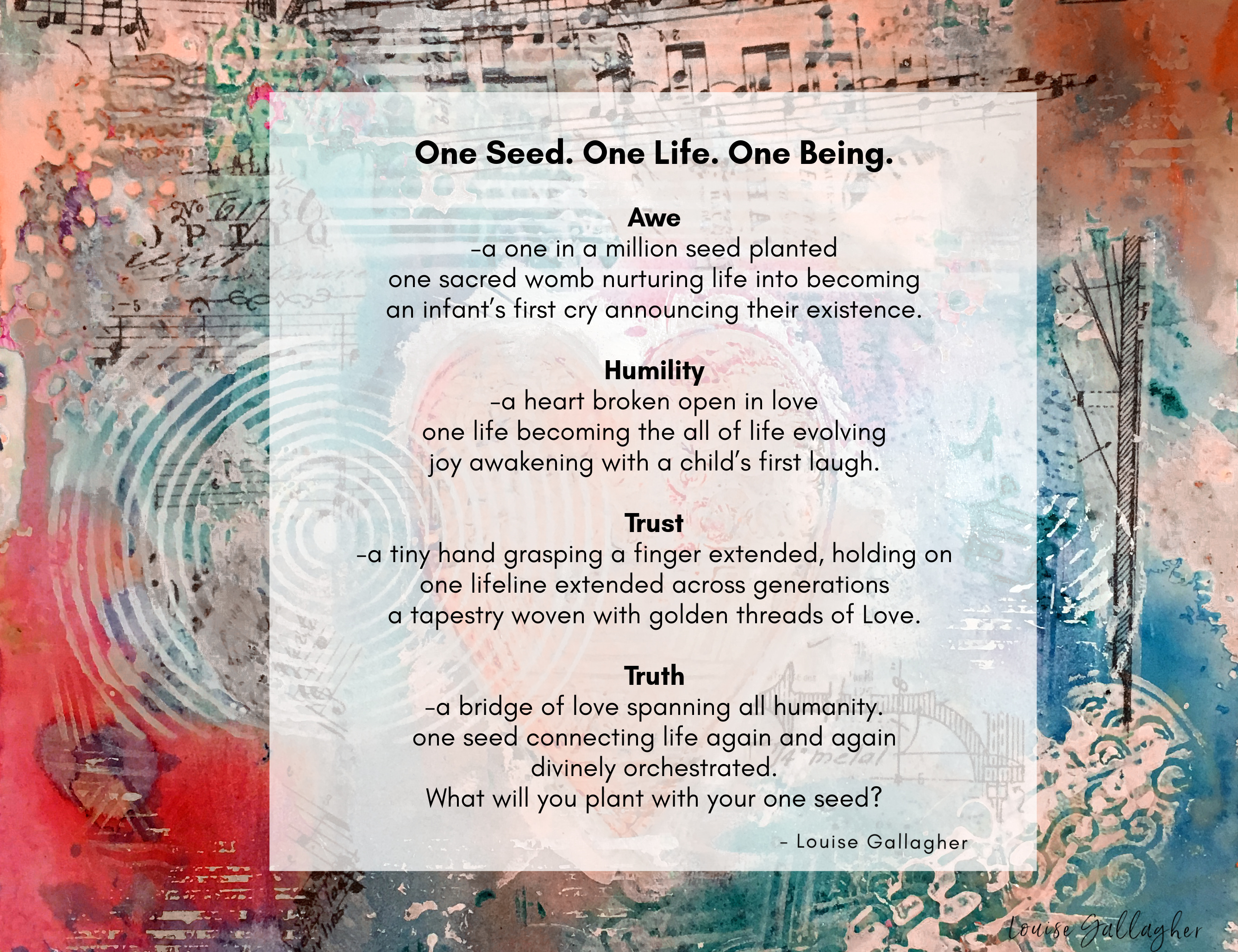
One Seed. One Life. One Being.

One Seed. One Life. One Being.
by Louise Gallagher

Awe
-a one in a million seed planted
one sacred womb nurturing life into becoming
an infant’s first cry announcing their existence.

Humility
-a heart broken open in love
one life becoming the all of life evolving
joy awakening with a child’s first laugh.

Trust
-a tiny hand grasping a finger extended, holding on
one lifeline extended across generations
a tapestry woven with golden threads of Love.

Truth
-a bridge of love spanning all humanity.
one seed connecting life again and again
divinely orchestrated.

What will you plant with your one seed?

Awakening before the sun, a tendril of a dream drifts through my mind. I lay in bed sensing the wonder and awe of life. It’s ineffable beauty. Luminiscent presence.

Images of my daughters. First cries. First laughs. First steps. So many first leading to lifetimes of joy, love, laughter and possibility.

I lay in bed and felt the poignancy and fleeting nature of life envelop me.

And gratitude awakened.

And Love consumed me.

And the muse whispered, “Write of awe.”

This poem began with 4:00am stirrings of awe and wonder.

I have learned it’s best not to ignore the early morning whispered flutterings of the muse. She is persistent in her flowing nature and does not condone well my resistance to her urgings.

Knowing well the ephemeral nature of her visits, I arise, pad barefoot to my desk and begin to scribble in my journal.

Morning has broken.

I may just go back to bed for a nap.

Blame Game: Aging Brain or Modern Life? What’s Behind Your Shrinking Attention Span

In one study, the average person’s focus lasted a mere 8 seconds before switching – shorter than a goldfish! More recent findings put us at 47 seconds, a far cry from the 2.5 minutes measured just twenty years ago.

What’s really going on with my aging brain?

In the digital whirlwind of our world today, it’s easy to fear that our brains are showing the wear and tear of modern life. But by reclaiming our focus, we can counter those fears and age with grace and intention. Because, let’s face it. It’s not all about our aging brains. Along with the accessibility of digital information, when you throw in the stress of a pandemic, it’s no wonder our attention spans are feeling the strain. We’re constantly bombarded with news updates, TikTok trends, and notifications galore. This constant stream of notifications and content are training our brains to crave novelty and quick hits of information. Our brains are practically being rewired to jump from one thing to the next, always seeking the next quick hit of dopamine. It’s like we’re training ourselves to have the attention span of that goldfish!

But there’s hope. As we age, many of us yearn for a slower pace, for the ability to savour moments and be present. Strengthening our attention span is a vital step in that direction.

Five Simple Practices to Reclaim Your Focus

  1. Embrace Mindfulness: Daily mindfulness practice, like meditation or journaling (with pen and paper!), can train your brain to stay in the present moment.
  2. Spend Time in Nature: Leave your phone behind and immerse yourself in the natural world. Simply observing the sights and sounds can be incredibly calming and restorative.
  3. Ditch the Devices (Sometimes): Yes, it can be scary to disconnect, but the rewards are worth it. Challenge yourself to leave your phone at home for a few hours and rediscover the joys of real-world experiences.
  4. Engage in Long-Form Activities: Read a whole book, listen to a long-form podcast, write a letter – activities that require sustained focus can rewire your brain for deeper engagement.
  5. Practice Self-Compassion: Don’t beat yourself up if your mind wanders. Building new habits takes time and effort. Be patient with yourself, celebrate small victories, and keep at it.

Aging with Grace and Focus

As we age, the fear of mental decline is not uncommon, but it doesn’t have to be our reality. By actively nurturing our attention span, as well as our overall well-being through exercise, diet and lifelong learning, we can counter those fears and live each day with intention and clarity.

What are you doing to keep your mind sharp and engaged? Share your tips in the comments below!

The Awakening List

Have you heard of “Gratitude Lists”? Research confirms that focusing on gratitude increases happiness and joy. I write mine before falling asleep, believing I’ll carry gratitude into my dreams.

Recently, I found a letter my mother wrote to my sisters and me. It was her “good-bye” letter, expressing gratitude and apologizing for any harm she’d caused. “These will be my last words of love you read,” she wrote. “It is time for me to go.” She took her last breath 14 years later.

Life was hard for my mother. As she told me in a visit from the afterlife, “The burdens I carried were too heavy. I never felt free to be myself.” As a child, and beyond, I believed my job was to ‘take the knife out of my mother’s hand.” To be, the good girl, she wanted me to be. Subsequenly, I subconsciously believied I had to conform to others’ will to be liked. Yet, deep within, I knew this was a recipe for a life unlived. Through therapy, courses, journalling, meditation and a host of other self-empowerment supports, I embraced my own agency to live my life on my terms. Yet still, that image of my mother holding a knife to her breast persisted, as did my ping-pong efforts to ‘fit in to be liked’ and to ‘stand out on my own terms’.

Shortly after finding that letter, a dream awoke me to the true power of my freedom. I have long understood that I was never strong enough to take the knife out of my mother’s hand. What my dream awakened was the truth — I am powerful enough to take the metaphorical knife out of mine.

And that brings me to my “Awakening List.” Each morning, I expand my Gratitude List into five Awakenings. For example, this morning i wrote:

  • I awaken to the melody of songbirds. Life is sweet.
  • I awaken to seven hours of uninterrupted sleep. Life is full of lovely surprises.
  • I awaken to my breath filling my lungs. Each breath is a gift of Life and Love.
  • I awaken knowing my dreams have the power to unfold as I step into my own power. I am powerful beyond my wildest imaginings.
  • I awaken to this day with anticipation, excitement, and gratitude. My heart is a joyful place.

This practice opens my mind, heart, and body to the morning’s wonder and beauty, beginning my day with positivity. And, it reminds me of my capacity to be the Shero in my own life.

Do you have a special practice to open each day with wonder and beauty? Please share in the comments below. Let’s ripple out our inspiration to touch the lives of others!

From Giving to Living: Balancing Self-Care with Caring for Others

Throughout our lives, especially as women, we often prioritize caring for others over ourselves. Whether as mothers, partners, friends, or colleagues, we frequently extend compassion and care outward, sometimes leaving very little for ourselves.

As we age, this pattern can persist if we do not consciously assess our own self-care practices. Proper self-care is crucial for living fully and passionately. It not only enhances our ability to care for others but also protects us from accumulating resentment and bitterness. Constantly prioritizing others can lead to an empty well of empathy and compassion.

Many factors contribute to neglecting self-care, including childhood conditioning, societal expectations, and a lack of self-belief. Without examination, these habits can lead to perpetual feelings of fatigue, burnout, and emptiness.

That’s why I’ve created the ‘Self-Care Check-In,’ a simple yet powerful tool to assess your self-care habits.

Why Reflective Journaling? Reflective journaling makes our thoughts and feelings tangible, allowing us to address often overlooked needs, desires, and well-being. This exercise encourages you to pause and ask whether you treat yourself with the same kindness and love you offer others.

In reflective journaling, there’s no judgment—only curiosity and empathetic acceptance. It opens a space for awareness, helping you explore possibilities for more loving self-care practices.

Self-Care Isn’t Just Pampering It’s about recognizing our worth and making ourselves a priority. By responding to specific questions through journaling, we can gauge our current self-care practices and identify steps to integrate better self-care into our daily routines.

Remember, the way we treat ourselves sets the stage for how we interact with the world, especially as we embrace the bold and brilliant years of our lives.

Let’s Get Started:

  1. Open your journal to a new page and title it ‘Self-Care Check-In.’
  2. At the top right-hand corner of the page, write a large A+. You’ve already started practicing positive self-care by showing up on the page—that deserves an A+.
  3. Below are four questions to help you assess your self-care. Please answer spontaneously, without overthinking.
    • Physical Self-Care: “What is one physical activity I did for myself today? (e.g., stretching, walking)”
    • Emotional Self-Care: “What is one thing I did today to make myself feel loved or supported?”
    • Mental Self-Care: “What is one thing I did today that brought me peace or rest?”
    • Gratitude: “What is one thing I am grateful for about myself today?”

After answering these questions, reflect on which area was most challenging and consider what steps you can take to improve self-care in that area.

For me, emotional self-care requires daily conscious effort. What about you?

I’d love to read your thoughts and experiences. Please share them in the comments below.

______________________________

We explore Self-Care and what holds us back from extending it to ourselves in my 8 week program, The ReWrite Journey.

I’ll be starting a new cohort Monday, May 13th at 5:30pm MT.

Gift yourself time to explore the art of ageless living with The ReWrite Journey.

Learn more HERE

Discovery Seminars: Are you willing to explore your possibilities?

Imagine spending five days diving deep into the core of your being, challenging the thoughts and habits that hold you back from joy, growth, happiness, love and so much more.

This past week, coaching at the Discovery Seminars, I did all of that and more. From the lightbulb moments of self-forgiveness to the awakening of personal power and the unfolding of miracles, the journey was full of inspiring moments and transformation.

It all begins for trainees at noon on Wednesday. People walk in with a full spectrum of emotions: reluctance, desperation, hesitation, excitement, and even anger. Some are unsure why they are there or what they are seeking, or have come simply to please their boss or get a loved one of their back. Others are holding onto a last thread of hope they will find a reason to take another next step.

As the days unfold, so dp the stories shared. There are so many moments that stand out for me: someone who walked in skeptical about what was in the room for them realizing their worth. Another finding the courage to release shame by sharing something they’ve never told anyone. Another choosing to forgive themselves; breaking through a barrier that had once seemed insurmountable. These acts of courage and vulnerability became a continuous thread of turning points, transforming the seminar room into a sanctuary of empathy, understanding and loving kindness.

Through guided discussions, reflective exercises, and shared experiences, we delved into the habits and thoughts that trigger unhealthy responses. The process wasn’t just about identifying these triggers but learning how to confront and reshape them.

And then, the fifth day happened. Everything changed. It wasn’t just one event but a culmination of moments, insights, and revelations that led to this transformation. Participants who had walked in carrying the weight of their pasts were now looking forward with determination, their faces and hearts alight with hope. Others found a friend to lean on. Others a shared experience to grow through. Others a glimmer of possibility to take in and nurture its flame.

For me, one of the most beautiful momments is always watching the trainees say goodbye. When a group of strangers gathered on Wednesday, they held themselves separate. Now, in their goodbyes, it’ss clear that the bonds formed were unique and profound. They weren’t just leaving with new friends; they were leaving with a new perspective on life. The power of hope was palpable, urging everyone to not let the lessons fade but to actively apply them in their pursuit of a life free from past regrets and pains.

I spent five days in the Discovery Seminars room last week. I am changed. I am inspired.. I am grateful.

So, here’s my challenge to you:  Are you willing to reflect on the habits and thoughts that may be holding you back? What if… you decided to confront the habits and thoughts that are keeping you playing small in a supportive, transformative environment like Discovery Seminars? What if… you decided living at a 6 isn’t enough — and to find your 8 or 9 or 10, you choose to explore something new? What if… you decided you’re worth fighting for?

Fact is, on Wednesday at noon, few people walk into the Discovery Seminars room eager to dive into the essence of what drives them to do the things they do that keep them falling down, beating themselves up, or playing small.

And yet, on Sunday, people always walk out grateful they did.