Always breathe into Love.

It was early in the evening of Dec 7, 2009 when I made the decision to drive 45 minutes south of the city to sit with a man whose life was quickly ebbing from his body.

He was a client at the homeless shelter where I used to work. He’d been taken to hospice earlier in the day and wasn’t expected to survive the night.

I’d called the hospice when I got home to check on him, to see if any frontline staff were by his side. I was concerned about my going to be with him. I wasn’t a frontline worker. Wasn’t trained to sit at a dying man’s bedside. I didn’t want to overstep my bounds. Didn’t want to put myself in a position where others might think I didn’t belong.

I decided all of that was ego talk.

A man was dying. He had touched my heart in many ways over the 3 years I’d known him. I did not want him to pass over the threshold to the “5th stage” alone.

And so I went.

James A. Bannerman took his last breath at 12:45 am on December 8th, 2009. I sat and held his hand as he took one last breath in and then no more. His body stilled, his heart quietened and in that intake of breath, his life on this earth ended.

I had wondered earlier in the day yesterday why I was feeling ‘different’, at unease, restless.

And then I was reminded of James.

I’d gone to a meeting to clarify a situation in which I’d been involved in a decision to not be part of a secondary piece to the memorial service being planned for December 21, The Longest Night of the Year. It was a good idea but, without more time and resources being available to do the needed planning to ensure the proposed addition to the event went off well, we could not as an organization support the idea at this time.

I’d made the decision on behalf of the organization in a phone call with someone from another agency who wanted to talk through their concerns with me. That conversation impacted  someone else in a way I had not intended, did not foresee.

They are passionate about this event. They had contributed greatly to its coming into being last year and wanted to make it bigger, better. Their ideas are good. Their commitment inspiring. They were disappointed and expressed their disappointment the only way they knew how.

It was a good reminder. To be compassionate. To be open to fierce conversation. To be thoughtful in all things. Kind in every way.


And I am grateful.

In their words I was reminded of James. Reminded of that sacred moment of sitting in the quiet of a cold winter’s night, holding the hand of a fellow human being as he took his final breath on his journey home to ‘the beyond’ of this life here on earth.

In that memory lives the essence of my belief in our humanity.

There is no us and them. You versus me. We different than thee.

There is only us.

There is only this human journey we all share.

We may come from different sides of the street. We may have experienced different parts of the experience called homelessness, and a host of other human conditions. But in the end, as we take our final breath, as the life force leaves our body, there is only one thing we leave behind, one thing that carries us over the threshold of whatever lies beyond this life on earth.

And that is Love.

I had a moment yesterday where my desire to defend against overrode my need to breathe into being present, compassionate, thoughtful, kind.

Thank you James for teaching me many years ago to put aside my fears, my ego, my desire to be comfortable so that I would remember always to breathe into Love.


Namaste.


.

If you wrote your own eulogy, what would you say?

A page will turn on the calendar tomorrow and the number in my age will turn one year more.

For as long as I can remember, my birthday has been my time to celebrate.

And I’m not shy about it.

I love birthdays.

A birthday reminds us all to celebrate our own lives. To acknowledge the gifts we’ve received, and the gifts we bring to the world.

Long ago, I took a course where one of the exercises was to write an eulogy for yourself.

I struggled with it.

What did I want people to say about me at my funeral?

As I’ve become my older self, the closeness of an eulogy becomes more clear. So does its purpose.

When in that course, I recall focussing on the things I’d done in the world. My accomplishments. My deeds. As I was taking the course in my early 40s and I expected to live well into my 80s, there were lots of things I thought I’d have done by the time I died.

Some of the things I’d imagined I never even began. Like getting a Ph.D. Hasn’t happened. Yet.

Like being a NYT’s best-selling author. Hasn’t happened. Yet.

Writing my eulogy today is much easier. Whether or not I’ve done all those things yet, it’s up to me to decide how important they are to me. And choose my next steps accordingly. Whatever I choose to do, it’s not about ‘the what’. It’s about who and how I am in the world today.

It’s about how I treat people. How I make them feel. Who I am in good and not so good times.

I want people to remember me as Caring. Passionate. Compassionate. Creative. Kind. I want them to feel a warm fissure of joy when they think of me. To feel like they mattered to me. That I celebrated their human magnificence, their beauty, their heart.

“As we mature, we must engage with what our own mortality means for us, knowing that we one day enter what I call the Great Unknowing. The season of winter helps us to practice for this.”
.— Christine Valters Paintner, PhD

In this deep winter chill that has settled on our city, I step with loving heart and open mind into the limitless awe of the Great Unknowing. In our intricate dance of life and death, I expose my fears and tears, my joys and laughter. In that liminal space where light shines endless into the deepness of the mystery of the dark, I become the woman I have always been. In that space, my eulogy is not a monument to my life, it is a living reflection of the woman I am today when I live my life in the fires of creativity, fearlessly expressing the best of me so that instead of fearing the worst of me being exposed, I rest in peace every day, knowing that whatever happens next, I have nothing to fear.

**************************************************

There are all sorts of resources on google to help you write your own eulogy — no matter your age. In fact, writing your eulogy in every decade is a powerful exercise. It can serve as a wake-up call, a reminder of time passing, a poke to ‘get at ‘er’. It’s not about beating yourself up — it’s about reflecting on how you want to live your life, what you want to fill your precious time with, and how you celebrate the best of you, everyday.

Some of the questions asked to ignite thinking around your eulogy are,

“How do you want people to remember you?” Not ‘what for’. ‘How.’

“How do you want people to feel about you when they are celebrating your life after the ceremony?”


An interesting article I found through Google with the search term “writing your own eulogy” is here.

Waking up is easy. Awakening is a lifelong journey.

Yesterday, Balroop commented in response to the post about the photo of my mother, “we tend to remember certain moments more vividly and then keep them in our heart. I am glad you looked at this picture. That is how perceptions change.”

Integral Theory teaches that to truly understand something, we must view it from four main quadrants, or realities, made up from our understanding of the Singular, Plural, Interior and Exterior quadrants.

In that photo of my mother, from my singular perspective of, ‘this is my mother’, I have my understanding of our relationship and where I fit in that dynamic. From the Plural, there is ‘our relationship’ and my understanding of it. On an Interior level, there are my feelings, memories, emotions, thoughts and ideas about my mother and our relationship. And the exterior brings in my perspective of seeing that relationship, and that photo, from the outside looking in.

Which all goes to say, as Balroop suggests, perceptions change when we change our position of how we look at something.

I see this a great deal in the homeless-serving sector where I work.

People join our team, coming from an organization outside the sector. People enter this work believing in the possibility of making a difference. Wanting to ‘do good’. Wanting to make their contribution to society count. They carry with them thoughts and ideas, understandings and perceptions of homelessness.

One of the most common forms people use for addressing someone experiencing homelessness, especially if they come into the sector from another field of work, is to use the phrase, The Homeless.

To shift from calling a group, The Homeless, to using the phrase,’ individuals experiencing homelessness’, requires being able to see ‘the label’ as just that. A label.

It is not the person. It is not the group of individuals sharing the common condition of homelessness.

To be able to let go of ‘the label’ requires being able to stand in each quadrant and ask, “Where do I stand in this thought? What preconceived ideas, notions, thoughts, feelings do I bring with me?”

And then, to go through the exercise from the position of the other two main pronouns. “We.” “It.”

For example,

  • “Where do ‘we’ stand in this thought. What preconceived ideas, notions, thoughts, feelings do I carry from the ‘we’? The perspective of my learned understandings through societal messages? How does ‘group think’ inform my thinking of it this way?” (societal consciousness, morals, values)
  • Where does ‘it’ (the label ‘the homeless’) stand in this thought. What preconceived ideas, notions, thoughts, feelings have I/We instilled into the label that inform my thinking of people experiencing homelessness this way?” (societal consciousness, morals, values)

I am not an Integral Theory master. I do love the science behind it and how it challenges me to not see in black and white or one-dimension but to pull myself out of direct line of sight thinking to seeing the many facets, and dimensions of situations.

In looking at my mother’s photo, I am reminded of the power of memory to hold my thinking in place and limit my being present in my life today. And in the power of that awareness, to expand and deepen my understanding of the limitations of what I am holding onto and its affect on my life today.

Waking up is easy. Awakening to our own power to create lives of meaning, substance, value… that’s a lifelong journey.


The memory of my mother

In the photo my mother is laughing. Head thrown back, neck arched.

I don’t remember her laughing. I don’t remember her ever being so light of being.

The photo doesn’t lie.

Memory can.

Years ago, I met a woman against whom I’d carried a grudge for many years. My last memory of her was when I was around 16. She was walking down a lane, holding hands with the boy I thought was still my boyfriend.

When I met her again, we were both in our forties. It was at a school reunion and she was sitting with the boy, now a man, as well as another woman who’d been in our class.

The four of us chatted and I told her how I’d carried the memory of the two of them walking hand-in-hand and how it had hurt to know she’d stolen him from me.

“I never dated him,” she said.

The other woman who was chatting with us (she happened to have the same name) jumped into the conversation. “I dated him after you!” she said. “But I never stole him. You’d already broken up.”

Turns out. We had broken up. He just hadn’t told me.


The man in question, sitting between the two women, said nothing. Just shrugged a shoulder, smiled sheepishly and gave his little grin that seemed to say then, as it had said long ago to my teenage heart, “I’m so dang cute, you just gotta luv me.”

At the time, I laughed. Wow. All those years of holding a grudge and I’d had it wrong all along. How fickle and unreliable memory can be!

Looking at the photo of my mother, I wonder how true my memory is of her. Perhaps she was happier than I remember. Perhaps laughter came to her more naturally than the tears I remember.

I hope so. Because, no matter the details, just as the wound of a long ago betrayal weighed heavy in my heart,mom the image of my mother as being sad and fearful does not sit well in my heart. I’d like to carry the memory of my mother as a woman of light heart. A woman who laughed from the depths of her soul. Who danced long into the night, drinking champagne and flirting with men and spinning circles around the room as she sang some outrageous diddy she made up as she spun, her voice enchanting everyone in the room.
That woman was powerful. That woman never stepped back from her fears. She headed heart first into any storm, fighting for what was right, fighting against what was holding her back from being free. A fierce protector. A bold defender of the one’s she loved.

I saw a photo of my mother. She is the woman I remember. Laughing. Light of heart. Fierce and strong. Free

The value of No.

When my daughters were infants I read some silly stat that said a child hears 100 no’s an hour. (I’m not sure of the actual stat so I made that up — you know… I don’t have time to go look up the real stat because I have to get into my office early to finish off the projects I still have to complete by noon today because I forgot to say, No that’s not doable in that timeframe, when a new project appeared on my desk. 🙂 )

I’m never going to say No to my child, I declared. (And yes, there is a pattern here.)

I proceeded to replace No with a more rational, kinder approach. (I write that smiling and shaking my head in bemusement at my own folly).

The fact is, there were times when No was the appropriate response.

Like when my youngest daughter asked if we could get a pet —  in this case, an Elephant Giraffe. Goat.  After three Nos I settled for Yes on the dog. (I think she outsmarted me on that one but in the end, we all won because the dog we got filled our lives with love and laughter.)

Learning to say No is an important lesson for every child.

Say no to drugs. Abuse. Bullying. Fighting. Lying. Cheating. To inappropriate/nonconsensual sex. Those are all vital lessons we must all learn early to live whole-heartedly and well.

Hearing No. Learning to deal with the No’s of life is also important.

When I was a child and my mother told me No, I inevitably went to my father. He was a much easier mark.

What they didn’t realize is the non-value of that lesson was, if you don’t like the No, go find someone you know will say yes.

Too often, in changing who I asked, I missed the lesson my mother was trying to teach me. That my needs are important, but they can’t come at the expense of other’s not getting their needs met too.

My father, not seeing the big picture of our family dynamics (he was away a lot) didn’t get that often, my requests were to fulfill on my own selfish needs, stated without thought of how it would impact my sisters, brother or the family as a whole.

That lesson I had to learn later in life. Because, no matter what I want, if it impacts someone else’s life in a way that hurts or harms them, it is not a good choice, for anyone.

Often, learning these important lessons as adults is harder than if we’d started to embrace their meaning as children. Like learning another language, the older we get, the brain is not quite so flexible and willing in its capacity to learn new things.

Sometimes, when I look at what is going on in our world today, I wonder if part of the problem is, there are a whole bunch of people out there who did not learn as children the value and importance of knowing that getting what they want does not mean others can’t or don’t get what they want. Or that they matter too.

That compromise is not a win/lose scenario. Compromise only works when it’s a win/win.

That getting everything you want does not give you everything you need to live a prosperous and fulfilling life.

The lessons of childhood are important one’s to remember and employ as adults. The playground bully who continues to be the boardroom tyrant is not leading. He or she is just behaving like a child. A child who has never learned that to get ahead does not mean having it your way, no matter the cost. It means finding a way that makes the best possible at no cost to others.

Namaste.


On being a good mother in these times.


When I became a mother, I spent a lot of time thinking about what kind of mother I wanted to be. I wanted to be kind, caring, loving. I wanted to be the kind of mother that didn’t get caught up in the nitty-gritty of dirty diapers and spilled milk but one who celebrated the miracle of life my daughters represent. One who sang silly songs in the car, danced in the streets with them and lay in the grass beneath trees making up stories about the clouds and all the people walking by and even the dogs and cats too.

I did not want my impression upon their gentle spirits to be a heavy hand of authority, but a light touch of loving guidance filled with caring consideration for their unique selves and their needs to grow into independent, strong, self-determined women.

Today, when I look at my daughters I am in awe of the beauty of their human essence. I am in awe of their kindness, their caring natures, their capacity to stand for what they believe in, to speak up in the face of tyranny, to tear down walls of discord, to build bridges of peace and love and joy. I am in awe and always have been, in their capacity to make my heart feel like it is bursting with joy, that being their mother is the most precious gift I have ever been given.

I believe I was (still am) a good mother. I believe that despite my many mistakes, some big, some small, some ginormous, I am still a good mother.

Not because I did everything right. Believe me, I didn’t.

No. I believe I am a good mother because… Well, just because. I am.

It is a choice.


To believe in myself. Or not.

And, because I can and want to, lovingly let my daughters’ living their lives without my constantly telling them what to do, how to do it and when to do it. I want them to be able to speak be their truth, not mine.

It is perhaps one of the hardest things about being a mother to two amazing women. They have minds of their own, ideas of their own, ways of their own that carve out their own unique paths in this world.

It is not my way, my path. It is theirs and as their mother, my role and responsibility is to honour their ways, their path, their own unique voices so that they can be free to be in this world without fearing my condemnation, criticism and complaints.

As a good mother, my job is to give their words, ideas, dreams space to grow without my interference.

And yet sometimes, I want to beat myself up with the stick of having failed because I fear.

I fear they will not have a world where it is safe to sing freely, dance with abandon, write without caution. I fear this world we are co-creating in all our flawed humanity will spiral down into rigid morality where there is only one path, one way,  — and that is the way of hatred. The path where racism, misogyny, territorialism grows stronger in the voices of those who believe all humans are not created equal, divine and miraculous, rise up and beat down the hearts of those who stand for the truth: We are all one humanity. One human kind. We are all One.


Bullies in our midst

There are bullies amongst us. People who believe that to feel good about themselves, to get what they want, to have it all (which they must have) requires ensuring others do not feel good, or possibly better than, them. That others do not have what they want, do not have ‘it all’.

They were not born this way. They did not come screaming out of the womb declaring with their first breath, I am going to have it all because I’m me and what I want is what I want, and getting what I want is all that matters.

They were made.  Forged in the fires of life raging around them. They were created in the bosom of their families and community, sharpened on the anvil of hard-luck stories where the child never felt safe and secure, loved and cherished. Like she/he belonged or was wanted.

Knowing this doesn’t make being a bully ‘right’. It does help to see the possibility for different when we let go of hating the bully and allow ourselves to understand, bullies aren’t born. They’re made. By life.

Like you and me, they were born as beautiful, innocent and precious children.

Like you and me, the promise of their birth held unlimited possibilities, limitless potential.

Like you and me, they suffered hurts and pains. Disappointments, misunderstandings, confusion.

Like you and me, they struggled to make sense of their world.

Like you and me, they hid their fear, found workarounds to hide the fact they felt lost, confused, alone.

Unlike you and me, hiding their fear lead them to never being able to admit they were afraid. It lead them on a path of having to constantly hide behind a tough exterior, because at a time when they were too young to make sense of the world around them, they learned to act like those around them, do as they were taught — to lie, intimidate, cheat and bully.

Unlike you and me, they didn’t have the same opportunity for their brains to form in ways that allowed them to see or understand that force, violence, intimidation and lies cannot create a world of harmony and caring. They didn’t know, were never taught, the value of harmony and caring. Getting along with one another. Being kind. Considerate. Thoughtful.

None of us are powerful enough to make a bully be someone else. We are powerful enough to stop bullying in our life. Not by bullying back, yelling louder, overriding their every word and action with equal amounts of intimidation. Making war on the world does not create peace, tolerance, community. It creates opposite sides, us and them thinking, get them before they get me responses.

To stop bullying in our lives we must learn to stand in our truth, respect our selves, our values, ideas, principles, beliefs, without giving into responding through fear and ‘just-in-kind’ intimidation.

There are bullies amongst us.

They were not born that way.

They were made.

They can choose to remake themselves. To change their tactics, the way of living their life.

Change does not happen in fear. It happens when Love appears and lights the way for all of us to see, there is another way to be in this world that does not include, intimidating others to feel better about ourselves, lying to get what we want and bullying those who get in our way, to get out of our way.

Change happens when we create space for everyone to feel heard, valued, loved and cherished.

Namaste.


To create change I must be the change.

Gary Paterson is the first openly gay person to be named the Moderator of a major Christian-based church, in the world.

The times they are a changing.

Chris Ball is from Calgary. A tourist in a city on the south-west coast of the United States. On the eve of the US election, while walking back to his hotel, he is attacked by three assailants, pummelled and kicked and beaten badly.

The times they are a changing; sometimes they seem to stand still.

On Sunday evening my eldest daughter and I attended the Jazz Vespers at St. Andrews-Wellsley United Church in Vancouver. Throughout the hour-long event, Rev. Gary Paterson intersperses the music with eloquent, educated and thought-provoking commentary on how to create change: We must name what concerns us. Be forgiving. Be grateful. We must create from the intention of creating better, for everyone. “Jesus Christ loves Donald Trump,” he says. “I’m glad he does because I’m not there. Yet.”

Not there. Yet.

Which suggests, the intention is to get there. To get to that place where the actions of a person are not the measure of how I love. How I love is the measure of my response and way of being in the world – may my response always be one that listens, hears and acknowledges the position of another from a place of integrity, dignity and compassion.

Miles Davis said, “I’m always thinking about creating. My future starts when I wake up in the morning and see the light. Then I’m grateful. To keep creating you have to be about change.”

What is the change you want to create in the world?

Chris Ball, the Calgary film-maker beaten on election night in Santa Monica is quoted in a Calgary MetroNews article as saying, “I’m in pretty good spirits. That’s just how I have to handle it. I’m alive and well and still very gay,” he laughed.”

The article states:

In retrospect, Ball doesn’t think it was really a political issue – it was a hate issue, fuelled by the charged atmosphere of the election night, with a group of drunk people who used Trump’s rhetoric as an excuse to get in a fight. He feels it could very well have been a Clinton supporter, or just someone else with a homophobic attitude on any other night – it’s an ongoing issue.

Chris Ball nor Gary Paterson can change the fact they are gay men. They can change their attitudes towards hate. And that’s what they’ve done.

We all can as Gary Paterson stated in his homily, “Stand with strong backs and soft fronts.”

We can all soften our hearts and love one another through eyes that see into and recognize and honour the human condition we each carry with us.

To create the change I want to see in the world, I must not hate those with differing views from me. I must not look at them through eyes of distrust, disbelief or disgust.

I must see them through eyes that honour their humanity. I must listen to them with a heart that is open to understanding their point of view. It may be different than mine but it is as right for them as mine is for me.

And, I must listen to their thoughts with the intent to not constantly override their words with mine. I must create space for their words to be as true as mine. It is on that common ground that we find space to hear, honour and know one another.

I must, as Ghandi so passionately exhorted, ‘Be the change I want to see in the world.”

In 2012, the United Church of Canada appointed a gay person as its Moderator.

I welcome the day when it is not the fact that he is a gay person or a woman or a First Nations person or person of colour that makes their appointment or accomplishments newsworthy.

I welcome the day when we have changed our minds enough on what it means to be human beings that the colour of our skin, our gender orientation or native bearing are not what we talk about. What we do. What we say. How we behave and accept one another as equal in all ways is how we greet and know and treat one another.

And for that change to happen, I must be the change I want to see and experience and create in the world.

Namaste.

Mother Daughter Relations: A Journey Home to Love

img_9999When I was growing up I always wanted one of those movie kind of relationships with my mother. You know, where we were best friends. We lunched together, shopped, laughed and I could tell her anything and she would understand and where she was the first person I called when anything happened in my life.

My mother and I never had that kind of relationship. Not because we didn’t want it but mostly because we saw the world so differently, I never could figure out how to cross the divide between us. The fact I tended to be obstinate, opinionated and somewhat critical (okay, a lot) of my gentle mother didn’t help bring us closer. The fact I liked to learn by experience, or as she would say, ‘do things my way’, didn’t give her heart much peace.

What the tensions in my relationship with my mother taught me though was that to have a strong relationship with my daughters, I had to do the work. I had to be the mother of my dreams by allowing them space to grow, to experience and to learn who they were, without my dictating how I wanted them to be or without my fears becoming their limitations.

I have done many things not so well in being a mother. Like cutting my eldest daughter’s hair into a pixie cut the night before she was to be Peaseblossom in Mid Summer’s Night Dream. Or letting her wear her black Micky Mouse leotard to ballet class when the rule was to only wear pink. There were other infractions, too numerous to cite, where I was woefully unequipped to model any behaviour other than my behaving badly or unwisely as their mother.

Fortunately, those infractions are just part of the story of how we got to be who we are today. How we get to love one another and be with one another as adults. How we trust and honour each other to be the person we are, not the person we want the other to be.

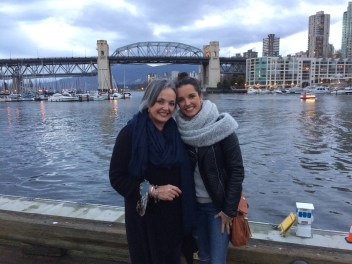
I have just had the gift of spending time with my eldest daughter in Vancouver before coming to Victoria where she graduates from Royal Roads University today. We laughed and cried and shared. We lunched together, walked together, took photos and made funny faces and laughed some more and even fought and made up and laughed again at our human richness. All of it is part of the rich tapestry of how we love one another because it is the love that carries us through the disagreements and the agreements. It is the love that connects us, shelters us and draws us together.

I may not have been able to create the movie kind of relationship with my mother that I always dreamt of, but with my daughters I have the relationship my heart has always yearned for, always wanted, always searched for in its journey home to Love.

I am blessed.

A chant for Peace

It’s still there.

The conversations. The disbelief. The fear. The uncertainty.

Dang. I thought by breathing into it that it would all just go away or at least settle down into a quiet little burble.

But it keeps frothing up, calling out to be acknowledged, asking to be heard.

Uncertainty does that.

It’s the thing about life, at any time. We want to know the future is certain. We want to know it is predictable.

To a certain degree we can. Feel confident in its certain appearance. Feel certain in its predictability.

Yet, when massive upheavals like Nov 8th’s election result appear, the future feels less known, less certain, less predictable.

And fear rises.

To offset fear, I must always choose to breathe into the moment. Always accept that what is, truly is, instead of giving into my disbelief that it could be so!

And so, I breathe. And share in my wise friend Leigh’s loving-kindness meditation. It is a prayer for peace to begin within me and within everyone around me — those I fear and those I love. They are all the same. Deserving of prayer. Deserving of loving-kindness – no matter my judgments, fears or apprehensions, prayers for peace are my road to peace within and all around me.

Leigh’s Loving-Kindness meditation

Chant for the first 10 minutes for yourself:

  • I am filled with lovingkindness
  • I am well
  • I am peaceful and at ease
  • I am happy

Chant for 10 minutes for ________________ (in this case Trump)  

(As Leigh explains it:  I began it as an affirmation, the way I said it for myself.  Something in me instantly began to fight and I started crying again.  I realized I needed to chant it to the more prayerful form in which it is usually spoken… I could feel my heart expand and I realized saying the chant for someone, while it may or may not also help that person, is something to do for your own peace, to clear your own heart.)

  • May (fill in name Trump)  be filled with lovingkindness
  • May  he be well
  • May he be peaceful and at ease
  • May he be happy

Finish with 10 minutes of chanting for _________________ (in this case Leigh chanted for America — for me it was our leaders).

  • May America be filled with lovingkindness
  • May she be well
  • May she be peaceful and at ease
  • May she be happy

Repeat often throughout the day. Keep repeating. Keeping settling into the prayer to allow grace to enter and let fear and uncertainty go.