Homelessness is the trap. Housing is the door out.

I knew Jack* when I worked at the homeless shelter. In his 50’s, clean-cut, polite, he easily met the criteria of sobriety  necessary to move out of ’emergency’ shelter into short term supportive housing on another floor of the 50,000 sq. ft. building.

That was 4 years ago.

The short term has turned to long. His emergency has become his way of life.

He feels stuck. Trapped. Hopeless.

“The longer I stay, the harder it is to get out,” he said as we stood on the C-train platform where we’d run into each other. He’d remembered my name. I had to ask him for his. He paused and looked at me with his clear blue eyes, shaking his head from side to side. “I wonder now if I ever will.”

He’s working three to four days a week and wants to move out, he told me, if he could just get a place he can afford.

The cost of housing in this city, the unpredictability of his temp work and his fear of falling back should he move out have trapped him. “I don’t want to move out only to move back,” he said. “Done that too many times. It only makes it worse.”

Last October, when Calgary performed a Point in Time Count of homelessness, of the 3,555 individuals counted as homeless on the night of October 16th, 1,292 or 36.3% were living in short term supportive housing. Middle aged men, 45 – 64, comprised 39% of the total homeless population. (source)

Baby-boomers are aging out in homelessness and many of them, like Jack, are stuck in the despair that comes with living on the edges too long.

I didn’t have an answer for Jack. He wanted to know if the Foundation I worked for could help him. “You have housing don’t you?” he asked.

We do, I replied, but our focus is on the long term, high-acuity, chronically homeless.

“Aren’t I chronic?” he said. “I’ve been stuck in it for way too many years.”

And he has, but his acuity doesn’t score high enough on the measurement tool used to determine acuity. “Our resources are limited,” I told him. “To end homelessness on the larger scale we must first house those whose mental and physical health issues put huge demands on public service systems.”

In the context of the Plan to End Homelessness, that means the 16% of the homeless population who account for 40% of shelter spaces and put a strain on public service systems through their high use of emergency services, police interactions and judicial costs.

“You mean I’m not broken enough?”

It was not an easy conversation.

I stood and looked at him and saw a man, broken and dispirited. He isn’t a trouble-maker. He doesn’t break the law. Why wouldn’t we want to help him instead of the guys who are drunk all the time and keep breaking the law, he asked. Why do they deserve so much help?

In Calgary, 86% of those who enter an emergency shelter move on within 3 weeks without any intervention. Men like Jack, once trapped in the system, keep fighting to get out but for whatever reason can’t find their footing beyond the shelter doors. For some, gambling is the culprit. Unseen, it erodes their well-being leaving them continually cycling through a disease others can’t see and they cannot cure.

For others, the cycle of emotional abuse that long term homelessness represents traps them in its maws, forcing their will and their spirit deeply underground. In its wake, it leaves them continually despairing of ever finding solid ground. They work and spend their money, week after week. Some will spend years staying at the shelter, working enough from Monday to Friday to be able to afford a motel room on weekends, only to return on Monday night to the shelter, spent and despairing of ever finding a way out.

For all of them, housing is the way out.

And that’s what Calgary lacks.  At least the kind of housing they can afford. Nothing grand. Nothing over-the-top. Just not too expensive. A room of their own. A small fridge. Hot plate. A place to call their own where spirits mend and they can put their feet up and breathe deeply into the knowing, this is their own place to call home.

“I’d love to have a girlfriend,” Jack said. “But how do I introduce her to my 140 roommates?

And like with so many of his questions, I didn’t have an answer.

*not his real name

And they wait for help to come

He struggles to stand up. Reaches out for support. There is nothing but the sidewalk below him.

He stumbles. Extends one hand out in front, searching for the ground.

And he crumbles. Slowly. Quietly.

I hurry across the street towards where he lays, a silent body on the ground.

When I reach him, I kneel down beside him. I can smell the alcohol before I get close. “Are you hurt? How can I help?” I ask.

He opens one eye a crack, looks up at me. “I need an ambulance,” he mumbles.

I call 9-1-1 on my cell.

As I’m talking to the operator, a co-worker walks up. “Can I help.”

I motion to the phone. She stands in silent support.

The operator asks me all sorts of questions about the man’s condition.

“I don’t think he hurt himself in the fall,” I tell her.

“Yes. He’s conscious.”

“No. I don’t see blood.”

“I think he’s inebriated.”

“He asked for an ambulance.”

She promises help is on its way.

The man lays silently on the sidewalk. Eyes closed. Barely breathing.

I touch his arm.

“Can you hear me sir?” I ask. “The ambulance is on its way.”

He squints through one eye. Examines me. “I don’t want to go to the Emergency room.”

“Perhaps they won’t need to take you,” I reassure him. “But they need to look at you to make sure you’re okay.”

The absurdity of the statement strikes me as I kneel beside him.

He’s not okay.

He’s not been okay for a very long time.

.And I marvel at the human spirit. At its capacity to contain such pain, such sorrow, such sadness and still survive. That it can seek succor even in the darkest places. That it can attempt to drown out its suffering and still search for solid ground to break its fall.

And I marvel at our human capacity to see our fellow humans with so much loathing and disdain we will attempt anything to drown out their culture, their history, their family and spiritual connections.

I have seen many men like this man.

Warriors who have lost the battle.

Warriors who are so lost in the fight to forget the past, who they are, who they could be, they swim in a sea of intoxication, barely breathing, barely able to keep their heads above the water.

And they fall.

Like a flower caught in a spring frost. They fall before they ever have a chance to bloom.

The Aboriginal population comprises 3% of the total population of Calgary.

They represent 21% of the entire homeless population in our city.

Except for the choices we made over a century ago to drag them away from their native culture, to treat them like animals, children, pests, being homeless, being drunk, being lost is not a willing choice.

It is an outcome of more than a century of colonization. Of abuse. Of treatment fit for no one.

It is the result of years of collective abuse against an entire population who did not fit what our forefathers believed was the right way to be on the lands, in our cities, in our society. And we carried our forefathers’ beliefs forward into residential schools, reservations, and other inhuman treatment.

I knelt by a man crumpled on the street yesterday and waited for help to come.

And I wondered, how do we stop the bleeding we can not see? How do we change the course of time so that this warrior does not fall again and again in his attempts to wipe out a past his parents before him and their parents before them never imagined would be theirs or his?

As I waited a police car drove up. An officer got out, walked towards the tableau of me kneeling by the man on the ground, my co-worker standing behind me.

“It’s okay. I’ve got this,” the officer told me before speaking to the man on the ground.

“Are you Brian?”

The man on the ground looked groggily up at him. “Paul.”

“Okay Paul,” said the officer. “Let’s get you up.”

The officer turned to where I waited, still holding my phone. “It’s okay. He’s one of our regulars.”

“I called an ambulance,” I told him.

“You didn’t need to do that,” he replied.

“It’s what he asked me to do,”

The officer laughed. “I’ll call the DOAP team. They’ll come and get him and take him to Alpha House.”

And he tells Paul what’s happening and Paul nods his head and struggles to sit up.

The officer reaches out a hand. He is not gentle. But he is not rough. He is firm.

“Here. Take my hand.”

And the man reaches up and takes his hand.

My co-worker and I hesitate. “It’s okay,” says the officer again. “I’ve got this.”

And we turn and walk slowly away. When I look back, the man is sitting on the bench where I’d first seen him. Shoulders slumped, head nodding forward.

The officer stands beside him, feet firmly planted, hands on either side of his waist, holding onto his belt with its many weapons.

And they wait for help to come.

**********************************************************

If you are in Calgary and see someone who is in distress please call the DOAP Team. they are a compassionate response to people with substance abuse issues on the streets. (403) 998 7388

DOAP — Downtown Outreach Addiction Partnership:  The program has been designed to link Calgary Police Service officers and Emergency Medical Services medics who come into contact with individuals with substance abuse issues in the downtown area with the appropriate social service agency

Alpha House — Alpha House is a non-profit charitable agency that provides safe and caring environments for individuals whose lives are affected by alcohol and other drug dependencies.


Death is not the only route off the street; Home is.

He wheels his wheelchair up to where we stand on the platform waiting for a train back downtown. A co-worker and I have just come from a memorial service for people who have died on the street in the past few months. The man in the wheelchair was also there and as he straightens out his position, I greet him and we begin to chat.

I haven’t seen him a long while. Years ago, when I worked at a homeless shelter, he was walking. Barely. Mostly, he was living tough. Cantankerous. Often under the influence, he was angry, belligerent and difficult to work with. Few believed he could ever be housed. He was one of the marginalized who could never get away from the edges of living on the street.

He’s been housed for four years now. Has a small apartment of his own through an agency working towards ending homelessness.

He’s proud of it. Proud of where he’s at. How far he’s come.

And it struck me as we said good-bye, without the plan to end homelessness, he could have been one of the one’s we were bidding farewell today.

Just like the two other people who stopped to say hello as we walked towards the memorial service.

*Ellen called to me as we walked past. “Louise! Aren’t you going to say hello?”

I stopped and turned towards her voice, saw her and walked back. We hugged and chatted and she shared stories of her life in the past year.

“I’m completely sober now,” she told me. “Had to drop out of school but I want to go back. I want to do some upgrading and then go on to college.”

She’s in her 50s. A First Nation’s woman. A talented artist. Drugs and alcohol played havoc with her life for years. In and out of rehab. Jail. Emergency shelter. Her drug use spiralled whenever the pain inside threatened to consume her.

She’s in housing now. Has a support system. People who care about and for her.

And it struck me as we said good-bye, without the plan to end homelessness, she could have been one of the one’s we were were bidding farewell today.

As *Jake walked towards us on the street, I thought I knew him but wasn’t sure. He looked so calm, so together.

He smiled as we drew near, said hello and we hugged and I told him how good he’s looking and he laughed.

“Clean and sober for 4 months,” he said proudly. “I’m sleeping now.”

Jake’s been housed for 2 years. He’s always told me he wanted to get sober. Need to, he’d say. But was too afraid to try.

After many steps towards rehab, he finally made it.

And it struck me as we said good-bye, without the plan to end homelessness, he could have been one of the one’s we were bidding farewell today.

I thought of these individuals and the thousands of others who have been housed since Calgary implemented its plan to end homelessness. Without housing and support, the trajectory of their journey too often leads to death on the streets. Death inexplicably cruel and senseless.

As I watched the family who had come to the service, I felt the weight of their pain and sadness. “Death comes for all of us,” said Lloyd, the elder who lead the ceremony.

But when death comes to someone living on the streets, it tears away all hope of their ever finding their way back home to where they belong.

There were 11 people’s lives celebrated at the ceremony. 11 people whom death found far from home.

But it didn’t find those I chatted with yesterday. And it didn’t find the thousands of others for whom homelessness has ended because they have found their way back home to where they belong.

I am grateful.  For Calgary’s plan to end homelessness. For those who had the compassion and wisdom to know we needed a plan to shift our focus towards ending homelessness right from street level and continue to support the work we do to keep the plan alive and moving forward. And I’m grateful for the countless people in all the agencies who work so hard and passionately to ensure that death is not the only route off the street; Home is.

Namaste.

*Not their real name.

I heart home: ending homelessness

ihearthome

In her opening remarks, the Honourable Teresa Woo-Paw, MLA for Calgary-Northern Hills and Associate Minister of International and Intergovernmental Relations, identified three words that are deadly to social change.

Can’t. Never. Impossible.

Ending homelessness deserves better than our negativity.

It deserves our best.

Those three words need to be changed, to reframed, be transformed to ensure we never lose sight of our goal of ending homelessness. It’s important for everyone.

Yesterday, 450 people came together to hear and talk and explore our best.

Yesterday, when Calgary’s Updated Plan to End Homelessness was launched, 450 people stood up and said, count me in.

We can do this.

We will always hold the vision, together.

When we work together, everything is possible.

At the launch, we shared the ‘what’ that community identified to make it happen through a year and a half of consultations and over 800 comments from community on what they saw, believed, knew needed to be done.

Diana Krecsy, President and CEO of the Calgary Homeless Foundation, the backbone agency charged with ensuring the Plan continues to move forward and realize its vision, stated in her review of how we got here to this moment today, “In 2008 we believed in the vision. In 2011 we understood a lot more about homelessness in Calgary than we had when we began. Today, we know. We know what’s working and what’s not. And we know we have to do this together, as a community.”

In 2008 (when the plan was launched) there wasn’t a lot of coordination between agencies, or a lot of information sharing. In fact, there was no shared database of who’s who in the system of care, who was receiving service from what agency and where the duplications existed. Today, there is a common information system (Homeless Management Information System). There is coordination and collaboration throughout the system of care.

In 2011, there was a deep understanding of the complexities of homelessness and the need for supports when housing someone directly from the streets. And, there was a deeper understanding of what it was going to take to get the job done.

In 2015, everyone knows it can be done — as long as we work together. As long as we share the vision. As long as we each do our part to make it happen. Not just those working in the sector, but every Calgarian along with government on all levels, faith groups, community associations, individual Calgarians. Everyone.

Yesterday, we presented the Updated Plan and what still needs to be done to end homelessness.

Now, it’s time to get down to the ‘how’.

How am I going to contribute?

How am I going to make a difference?

How am I going to add my voice to the vision of ending homelessness?

There are hundreds of ways each of us can contribute. Whether we live in Calgary or another city somewhere in Canada or anywhere in the world, we can, and we must, do whatever it takes to ensure we remove the less out of homeless so that everyone can find their way home.

As part of the launch, we introduced the idea of “I Heart Home”. In the case of Calgary, “I heart home YYC”. But it could be any centre, any town, anywhere.

No one can argue with home. The value of having one. The need of knowing you’ve got one to come home to. The desire to ensure your children have one. The desire to help your neighbours have one too.

In launching the Updated Plan, we embedded our collective need to understand what home means to each of us at the centre of our work.

So, here’s your invitation. Watch the video, I Heart Home YYC, and, take a video/photo of you, calling out, I heart home because…. and add your voice. And then, share on your social media platforms. Twitter. Instagram. Youtube. Blog..

You’ve be making a difference and you’ll be joining the movement.  Thank you!

ihearthome

The Bird of Time is on the wing

It’s official.

I’m tired.  🙂

Yesterday, AG, my communications team-mate mentioned that he wasn’t sure if it was all the prep work on the Summit next Tuesday, but he sure wasn’t sleeping very well.

I laughed.

Neither am I, I replied.

My mind, full of details not to be forgotten, ideas germinating and sparking new thoughts on how best to present the Updated Plan to End Homelessness to ignite collective impact, doesn’t want to turn off.

Which means, like AG, short bursts of sleep interrupted by wakefulness streaming with ideas.

This morning, as I lay in bed considering the thought of getting up, my critter snuck in and whispered, “You’re too tired to get up. Sleep awhile more. Day has not yet broken.”

But it had. Light slipped through the open spaces between the slats of the blinds, I could see the outline of shapes in our bedroom. There was light out there and it was calling me to rise and shine.

It was time to get up. In fact, it was past my normal time of getting up.

And the critter hissed, “You’re too tired. Don’t do it.”

Swat!

“Ouch!” he exclaimed at the suddenness of my gesture to stomp him out. “You hit me!”

“And I’ll hit you again,” I told him, my voice steeled with determination. “I am getting up. I am not going to let the thought of how tired I am keep me from leaping into my day and setting the world on fire!”

So there.

Take that you pesky critter!

And he lay silently in a sobbing mass, soaking in a pool of self-pity.

Yup. Definitely tired.

But not down.

There is still much to be done and I am later than normal in getting to it!

Gotta run!

The day has begun and there’s adventure afoot.

Sure, I am tired but AG and I have agreed next Wednesday is a day for total, complete rest. Neither he nor I will cross the threshold of the office.

Until then, mission not so impossible is waiting to be turned into the possibility of every Calgarian standing up and stating, unequivocally, “Count me in. I want to do my part to end homelessness in Calgary. I will….”

And then they will state the thing or things they are willing to do to be part of getting it done.

From supporting the idea of affordable housing in their community, to writing letters to the government to ensure funding for essential social programs is not cut to volunteering or donating, every Calgarian has a role to play.

Our job is to ignite their passion to create a Calgary that is great for everyone.

And just thinking about it revs me up and excites me to get to into my day!

Gotta go.

There’s lots to do and to quote my father whose copy of The Rubaiyat of Omar Khayyam, I treasure, “The bird of time is on the wing and the bird has but a little way to flutter.”

Namaste.

Moving past our buts to possibilities — ending homelessness

We are five days away from the Great Big Summit and there is still lots to do.

And it’s getting done.

Yesterday, after one final read through the Plan by a team-member, we pressed send and shipped it off to the designer to tighten up the layout.

I went through my list.

Agenda. Done. Except for tightening up the wording on the last item.

Speakers. Confirmed.

Speaker notes. Sent.

Key Messages. Drafted.

Q&A. Drafted.

Keynote Speaker. Organized.

At a Glance. In review, ready for print tomorrow.

Posters. Order today.

Attendee packages. Final copy ready for printing.

Website. Design approved. Ready for final copy today and tomorrow.

Video. Final shoots today. Edit over weekend.

And the list goes on.

In one month, we have managed to pull together the pieces of what we hope to be an inspiring event on Tuesday. An event that will galvanize community around the vision of ending homelessness, and spark collective impact in getting the job done.

Together we are stronger.

Last night, just before leaving the office, I stepped into the CEOs office to check on the change I’d made on the agenda. “I don’t think I’ve quite got the wording right,” I told her.

She looked at what I’d written and replied, “Hmmm. Let me think on it tonight. Maybe something will come to me.”

“Thanks. I just can’t quite hit on how to phrase this one,” I replied.

And she laughed and said, “Good thing is, you don’t have to do it alone.”

I let my need to find the perfect turn of phrase go.

I’m part of a team.

That’s the beauty of collaboration. Cooperation. Community.

Ending homelessness is a shared vision. It improves the lives of everyone. Not just those living beneath its burdens, but all of us in community.

The other day I received an email from a property manager asking how to deal with ‘vagrants’ hanging around a strip mall they’ve just taken over managing.

In my email response, I did not use the word vagrant and chose instead to educate with words that described homelessness as a societal condition affecting human beings. I also gave her the telephone number of the police district office and suggested she speak with the Community Resource Officer.

I could do that because I know I am not alone.

Ending homelessness is a collective responsibility.

It takes all of us.

Here in Calgary, our police service has taken a proactive approach to working with communities to help mitigate the impact of those who struggle with homelessness in their community and those living with the experience of homelessness in their communities. They don’t take an us versus them perspective. They work inclusively with agencies, communities, businesses, faith groups and individuals to find mutually supportive solutions.

Sure, as I write that someone is bound to say, “Yes but…”

And then rhyme off an incident they witnessed where maybe, compassion and inclusivity were not the key operational terms of reference.

Maybe.

But the fact is, just as I am not alone, and the CHF is not alone in ending homelessness, and the person experiencing it is not alone in ending homelessness, neither is the police service. They too rely on each of us, on businesses, individual citizens, communities, everyone to do their part.

And part of what we  all need to do is recognize our role as a collective. There is power in our shared vision of ensuring homelessness does not continue to destroy lives and undermine community. As long as we get our ‘buts’ out of its possibilities, we can do it.

There are many possibilities in ending homelessness.

The question isn’t ‘Can we?’ The questions is “What can I do?”

The possibilities are limitless when we share in the power of our collective impact and move beyond the reasons why we can’t.

We’re launching the update to the Plan to End Homelessness on Tuesday.

It’s not CHF’s Plan. It’s not my Plan or her Plan or his. It’s ours.

You can play a role. Come to the Great Big Summit on Tuesday and find out what you can do to make a difference.

Everyone is invited. There’s no cost to attend. But there is one if you don’t. And that is the one that costs the most. Your voice will not be part of the agenda. Your difference will not be felt. And we will not have the same collective impact without you.


I changed my glasses. I can see clearly now it was me, standing in the darkness

I changed my glasses last night. I hadn’t realized they were foggy until Mary Davis, the facilitator from Choices Seminars, mentioned in an email, “all these things you have on your plate are really lovely items.”

I had written to apologize for having to back out of my commitment to coach at Choices next week. I hadn’t wanted to, back out. I absolutely love coaching at Choices and am privileged to be able to do it as often as I do. I won’t be there in April because of the wedding, and was telling myself I would be letting the whole team down if I didn’t turn up as I’d committed to this time.

I kept telling myself, “I can do this. All of it.”

And then, lying awake in the dark, trying to rosy up my glasses so I could peer into the darkness of my thinking that I was sinking beneath the juggling of all the things I had to do, I realized, it’s not true.

I don’t have to do it all. Sometimes I can’t.  Sometimes, I have to trust it will be okay.

So I wrote and let Mary know I couldn’t be there.

And still, I worried. What would she think of me? Maybe her disappointment in me would lead her to reject me. Maybe everyone would be mad at me and never want to work with me again.

Ahhh, that critter is such a sneaky fellow. He knows I have trust issues, heck he feeds them all the time! So imagine his glee when he realized I was tripping over myself, lost in a sea of angst? HA! Gotcha! he shouted as he catapulted into a new assault of my senseless worrying about what other people think of me. True to form, when faced with even a glint of what he perceives to be my failure to heed his advice, he morphs into a new and slimy perspective designed to keep me playing small in the eye of his hurricane-force howling telling me I am a failure. I don’t belong.

Gosh, I sure can get caught up in my own darkness, and drama, when I take my sights off the truth. I’m okay. In fact, I’m wonderfully, lovingly humanly okay.

I really did think it was my job to cram it all in, juggle it all and keep the world spinning.

Mary’s gentle and loving response to my email stopped my thinking in its tracks.

I was seeing the totality of all I had to do and losing sight of the loveliness of all I had to do.

I was trapped in the dark side of my thinking it was all up to me and not seeing the loveliness and joy of all I am excited about doing.

I have a lot of lovely things on my plate. Some of them include organizing a media training day for executives in the homeless serving sector in March and working with an amazing team on the launch of a Homeless Charter of Rights in April.

My beloved and I are also planning our wedding for April 25th and over the past few months, I have had an amazing time creating for it.

And, this project of launching Calgary’s Updated Plan to End Homelessness at the Summit on March 3rd. It is exciting, inspiring, uplifting. We are in the throes of paradigm shifts and igniting collective impact. It’s amazing!

And there I was bogged down in the minutia of the ‘I’ve got to do it all’ and losing sight of how I can trust others to be doing their best too to change the world.

My glasses were foggy. I changed them.

I can see clearly now.

It was me, myself and I getting in the way of my seeing the truth — Next week at Choices, there will be a whole team of loving, caring, committed individuals doing the wonderful work of Changing the world one heart at a time.

My difference will be felt here, at the nexus of working towards a goal I believe is important to the quality of life of every Calgarian — ending homelessness.

I am truly blessed to have so many lovely things on my plate. Things that excite me and charge me up, that remind me every day — I can be the change I want to see in the world.

We all can.


Just because I’m homeless doesn’t mean I’m bad.

Mayor Nenshi addresses the crowd

Mayor Nenshi addresses the crowd

While each of us is unique, there are no unique circumstances in homelessness. No matter who you are, or how you got there, homelessness harms everyone. It destroys dignity. Breaks down self-respect. Rips apart self-worth.

Discrimination is a common occurrence when you’re homeless. People look at you as less than, other than, something different than a ‘regular’ human being and not worthy of common decency.

People drive by and spit at you out car windows. They call you names. They cross the street to avoid walking on the same side as you are on.

When you’re homeless, instability is the foundation of your life. Will there be a bed for me tonight? Will I get robbed of my few possessions? Will I get beaten up for taking up someone else’s space I didn’t know was theirs? Will a gang of kids think it’s a cool idea to throw gasoline on me and watch me burn? Will someone decide they don’t like the way I’m looking at them and decide to teach me a lesson?

When you’re homeless, there are no written rules of engagement except the one that says, you must survive.

When you’re homeless, you don’t have the luxury of depending upon each breath following the next. You never know when the breath you just took will be your last.

I am always amazed when people in the broader community tell me they are afraid of people experiencing homelessness. “What do you think they will do?” I ask.

“They’ll attack me. Take what I’ve got because they want it more.”

“That’s unlikely to happen,” I tell them. “When did you last hear of someone iin homelessness randomly attacking someone on the street?”

“Well…” They usually pause here to search their brains for a memory of a story about such a situation. They come up blank.

It just isn’t the way it is.

What is true is that when you’re homeless, you are vulnerable. No matter the colour of your skin, your faith, your culture, homelessness is a vulnerable state of being and while someone may not be stalking ‘normal folk’ to attack, they are at risk of being attacked. Both by ‘normal folk’ and those in the homeless community.

Keeping a low profile is essential when you’re living the homeless experience. It’s important to not attract too much attention because attention gets you in trouble. Attention leaves you exposed and visible. And being visible is not a healthy state of being in homelessness.

On Friday, we held a World Homeless Awareness Day event here in Calgary. Our Mayor came and gave an impassioned speech talking about the need for affordable housing. Affordable Housing is The Key our posters read.

And it is. You can’t end homelessness without a home to go to.

The challenge is, people often don’t want people with lived experience of homelessness living in their communities.

My property value will drop, they tell me. Crime will rise. Parking will be a mess.

I show them the research. Talk to them about the right of everyone to have a home. The need for diversity in our communities.

And still, underlying it all is the fear that because that person is different than me, because they carry a label I’m unable or unwilling to see beyond, they will harm my way of life. They will want what I’ve got and take it from me.

Homelessness is not the issue. Our misconceptions, our perceptions and our judgements are.

In his speech, Mayor Nenshi stated, “Homelessness sucks!”

He’s right.

It does.

And you know what else sucks?

Our belief that those who are living in homelessness are different than, other than you and me.

The only difference between us is that their issues are on the surface. They are visible for all of us to see that life is fragile. Life is unpredictable and the only way through it is to count on one another, hold true to our belief in the dignity and majesty of the human being and celebrate our differences and our similarities.

And we can’t do that when we cross to the other side of the street to avoid walking past someone whose pain is visible on our streets.


Westjet rocks the skies — and customer service!

“I went to Vancouver,” my co-worker, Aaron tells me when I ask him about his Thanksgiving weekend.

I am surprised. I don’t recall him talking about plans to go away.

He laughs. “I was only there for twenty minutes.”

It was just one of those things.

His sister and two friends had gone for a ‘girls’ weekend away, leaving their husbands at home for a couple of nights with their small children. At the airport, all set to board the plane for their return flight home, his sister discovered her wallet had been stolen.

Panic set in.

Tearful, angst ridden phone calls. Cries of help. Brother and father converge at the Calgary airport in a desperate attempt to get their loved one home to her family for Thanksgiving dinner. Enroute to the airport, the father picks-up his daughter’s passport from her husband while Aaron checks out options to fly to Vancouver to deliver it. At this point, they’re not thinking about the cost. It’s all about getting her home to her family.

Westjet was amazing,” he tells me.

Who knew they have a 25% policy for situations such as this?

“I couldn’t believe how understanding they were,” he says. Not only did they give him a 75% discount on the fare, they put him on the next flight and upgraded all four return tickets to business class for the return flight home, which happened after Aaron’s 20 minute stop-over.

Way to go Westjet! It’s no wonder you were inducted into Canada’s Most Admired Corporate Cultures Hall of Fame.

Who wouldn’t be proud of working for a company that treats distressed passengers with such good care?

As for Aaron, it gave him an even greater appreciation of what happens to people on the margins. “My sister had options. She had people jumping in to help her. When I got off the plane, they were all three standing at the gate waiting for me, crying. Her friends wouldn’t leave her alone and Westjet didn’t insist they catch their original flight. They rebooked us all together on a different flight, without charging them. But, even though my sister knew I was bringing her passport, she still felt lost and really scared. What if she never got home?”

I remember when a mix-up with my passport left me stranded in New York City for a couple of days. When the Canadian consulate told me  they couldn’t help me, I started to cry. Even though I had my wallet, credit cards and money in my bank account, I still felt lost and alone. I feared they’d never let me out of the country, even though they deemed I was there illegally.

At the time, I wandered the streets of New York feeling hopeless. I tried to visit a church, it was locked. I stopped for a tea and when the waiter asked if he could get me anything else, I started to cry. I remembered all the people at the homeless shelter where I worked at that time. How they continually came up against doors closing, people telling them, no, we can’t help you get ID without a fixed address, or open a bank account, or get government assistance. No, you can’t go there, do that, sit on that, talk like that.

It was a reminder of how blessed I am, and how fragile some people’s lives are.

Aaron’s sister never planned to have her wallet stolen. She never planned to need the help of her family to get her home. And she never anticipated that an airline would step in and do whatever it could to help her through a situation they had no part in creating.

Yet, there they all were. Her family, friends, and an airline that wouldn’t leave her stranded.

For those on the margins, stranded in that place called homeless, without resources, at a loss on what to do next, sometimes, the only people standing by to help are in places called Emergency Shelters. In the emergencies they find themselves lost within, it is in those places where caring people reach out to say, “Here, let me help you shoulder the load,” that they find themselves again on the road of life, taking those first steps back to where they belong, that place called home.

Aaron’s sister made it home, just as I did long ago.

For the thousands who have not yet found their way, I am grateful there are places such as the Calgary Drop-In & Rehab Centre and the Mustard Seed and Alpha House and a host of other agencies filled with caring people committed to ensuring that those who are stranded with no way home, are not lost forever on the streets of Calgary.

Homelessness Sucks: Homeless Awareness Day 2014

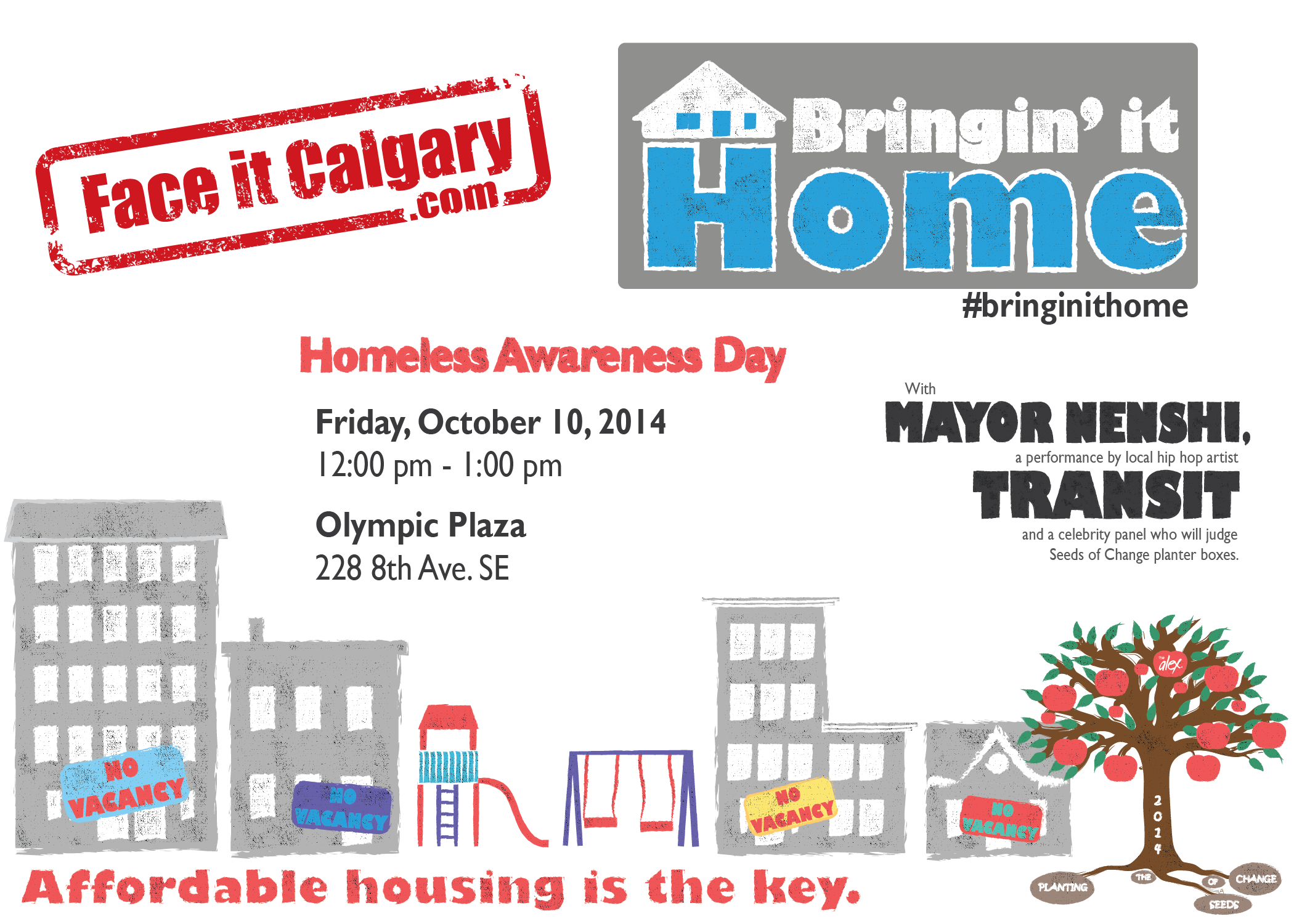
Bringin-It-Home-Homeless-Awareness-Day-InvitationToday is World Homeless Awareness Day. Around the world cities and communities will be marking the day with events designed to focus our attention on what it means to be homeless and what it takes to end it.

Here in Calgary, we are holding an event at Olympic Plaza at noon. Mayor Nenshi will be saying a few words as will the Calgary Homeless Foundation CEO, Diana Krecsy. There will be performances by rapper, Transit and a young man, Austin, who he’s been mentoring. There will also be an opportunity to see the decorated patio-sized planter boxes that The Alex has created as part of its Planting Seeds of Change initiative. Fifteen agencies have painted and decorated the boxes which will be auctioned off online in the coming weeks.

While the event is designed to be fun and interactive, let’s make no mistake about it. Homelessness Sucks.

We’ve got suckers to hand out to prove it. Youth with lived experience of homelessness will be handing them out to passers-by. On each sucker is a statement a youth from the sector has written about what it means, or feels like, or is to be homeless.

Statements like,

You got no friends and family

You’re always dirty

People think you’re lazy or just don’t work hard enough to get a home

Nobody cares

It’s a dog eat dog world out there and you just can’t trust nobody.

It ages you real fast.

Someone asked me if events like this make any difference. I replied that doing nothing makes a difference, so doing something will as well. If all we do is get the media to keep the focus on homelessness, and the dire need for affordable housing in our city, we will have done something to make a difference. And that counts.

Because, that’s the key message of the event. Affordable housing is the key.

To end homelessness and to prevent it, everyone needs affordable, safe and secure homes to live in. Here in Calgary, that’s hard to come by. Rents continue to rise, availability of housing continues to lessen. We have more people moving to the city everyday. The last stat I saw said that approximately 375 people move to Calgary on a daily basis.

Where are they going to live?

It’s a tough question to answer if you don’t make $17.29 per hour, the living wage in Calgary. (Based on 35-hour work week, the “living wage” works out to $31,470 annual salary.) And even then, in a city with a 1.2% vacancy rent where average rents have increased by over 5% in the past year, there’s still no guarantee you’ll find a place to live that you can afford, in the neighbourhood you want with the amenities you desire. (Source) 

Calgary’s lack of affordable housing is evident in the homeless sector. Where once, an individual could enter the system of care and be housed within a month, it now takes at least 6 months for housing locators to find housing, and there is no option. The individual either must take it, or wait again.

Affordable housing ends homelessness. Without it, people will continue to filter in and out of emergency shelter. They will continue to sleep in parks and on benches, in doorways and alleys. They will continue to live beyond the margins of everyday existence, falling further and further away from that place they never once imagined they would never have, home.

If you’ve in Calgary, please come down to Olympic Plaza today and support the agencies and hundreds of workers and people with lived experience who will be there to ensure we don’t lose sight of the truth too many youth, adults and families are living today, Homelessness Sucks.