Silly statements and other limiting words

I am talking with two of attendees at an event. They are both Indigenous Peoples. Both well-versed in sensitivities around Indigenous issues.  Both have been discriminated against. Branded as ‘other’. Felt the disdain of those who call themselves ‘white’.

I tell them about my awakening at an Indigenous training course I took a couple of weeks ago.

“I have never stopped to think about the richness and depth of Canadian culture as being grounded in Indigenous Peoples,” I tell them. “I have fallen for the discourse that our history as a nation began when white man arrived.”

It didn’t. It began thousands of years ago with a culture that is deeply connected to the land, the elements, nature and a desire to walk softly upon the earth.

“Discrimination and ‘other’ thinking is pervasive,” I say. “I participate in it without even recognizing I am participating in it.”

One of the men mentions the statement we make as a Foundation at the beginning of all our events acknowledging that we are standing on traditional Treaty 7 land.

“You know that calling it ‘Treaty 7’ land is a reference to colonization,” one of the individuals mentions. “For many of us, it is a reminder of all that has harmed us, not strengthened us.”

I am taken aback.

It is subtle this discrimination, this ‘other’ thinking.

Later, I am at a roundtable discussion on the National Housing Strategy the Federal Government is currently in the process of drafting.

Our host is a public figure. An elected official. Well-respected. Well liked. He has always been conscious and considerate in his approach to homelessness.

I am listening to the conversation. To my peers around the table talking about the content in the documents before us.

On a page referring to the themes to be covered by the Strategy is a list identifying those who need extra consideration due to the specialized needs of their demographic/human condition. ‘Homeless, seniors, youth, families, people with disabilities’. There is no mention of Indigenous Peoples.

Someone mentions the omission. The elected representative is surprised there is no mention. He comments that he doesn’t see how it could have gotten so far into development with such a glaring omission.

“Perhaps it’s like the language we use without thinking,” I say. And I ask him about a comment he had made earlier in the session. “You said, ‘We are not going to make silly statements like, we’re going to end homelessness. We know we’re not.”

How is that a silly statement, I ask. It is aspirational. Forward-thinking. But silly?

There is a pause and then they talk about how they were referring to the timeline. He tries to justify the statement until someone else around the table also speaks up in support of my question. “If the government plans on ensuring everyone has access to housing, won’t that mean we end homelessness?”

Another pause.

I stand corrected, the elected official says.

Language.

We get hung up in our words. Use them to divide and conquer. To separate and clarify.

We make words the ground upon which we stand, the positions we will not cede, the space we will not move from.

And in the process, our language becomes the battlefield upon which we stake our claim to be right. It becomes our battery of defenses against another so that we don’t have to give up our right to stand our ground.

It was a short week and a tough one. A week where words spoken awakened my consciousness to injustices caused by the language of Treaties that continue to define and marginalize an entire Nation. A week where language failed to inspire by its use of silly statements about what we can, or cannot do, amongst a group of people passionately committed to ending the very thing they called silly.

I believe passionately in our human capacity to create possibility from the seemingly impossible.

I believe we are all one humanity. One human race.

But the words I heard this week, and the ones omitted when they needed to be spoken, are cause for concern.

How can we stop discrimination? How can we end homelessness when the very words we use continue to mire people in the limited thinking of the past? How can we inspire one another to do better when the words we use build walls and tear down confidence in our ability to contribute our best?


Where Mother Nature’s concerned, every jar counts.

I know it’s not headline making, but I’m going to share it anyway.

I cleaned out my fridge.

I know. I know. Not the earth-shattering news you were expecting, but if you’d seen the inside of my fridge, you’d understand why it’s such a monumental feat! (and yes, Alexis, I did it without you!)

I was ruthless.

Out of date? Gone.

Only a dribble left in the jar? Gone.

Don’t know what it is, even if it’s not expired? Gone.

Know what it is but have no idea when I’ll use it next? Gone.

It felt great to clear out those clogged up, cluttered shelves. But in the end,  it wasn’t actually the cleaning of my fridge that became the big deal, with the BIG LESSON attached.

It was deciding to clean out and recycle the 30 some jars I tossed.

I admit it. I threw them into the garbage can first.

And then I thought about cleaning them out and recycling.

“But that will take foreeever!” my critter mind hissed.

“Don’t you think you’re exageratting just a little bit?” my voice of reason responded.

“No!” inisisted my critter mind. “You don’t have time. You’ve got better things to do than clean out jars. And anyway. Who cares? What difference are a few jars from you going to make?”

Fact is. Those few jars could make a world of difference to the world.

And therein lay the debate.

To ignore my worldly impact in even the smallest things I do, or to accept my responsibility and the fact everything I do has an impact on the world.

Was I going to take the easy route out, or do the right thing?

In the end, ‘the right thing’ won. As it should.

Because to have thrown out those jars full of moldy, hardened and mostly unidentifiable substances would have been to contribute to fodder in the landfill. It would have meant I carried with me the knowing that I did not take the time to do the right thing by Mother Nature, the environment and my fellow human race. It would have meant carrying with me the shame of giving into the easy route, the downhill path, the road of least resistance.

I spent an hour scraping out and cleaning the jars. Some went into recycling and some to a girlfriend who likes to make jams and jellies. And BIG BONUS!  I also gave my conscience a clean bill of health. What could be better than that?

I cleaned out my fridge on the weekend and in the process, cleared out some old and hardened thinking about the impact and capacity I have to make a difference.

It may not sound like a lot, but every jar counts where Mother Nature is concerned.

Namaste.


Give Thanks | 52 Acts of Grace | Week 28

acts-of-grace-week-28-copy

It was Thanksgiving weekend in Canada. It snowed here in Calgary.

Lots of it.

I am thankful. (Even if it did look more like Christmas than Thanksgiving).

I am thankful for the moisture, the beauty of the snow covering the earth, the golden leaves sprinkled like confetti on a white blanket.

I am thankful for our family and friends who gathered round our table, sharing companionship, fellowship, good food, laughter, wine and bread and turkey with all the fixin’s.

I am thankful for new friends and old. For a young boy who joined us who, at 10 years of age, reminded all of us to be open and present and willing to participate and give thanks. Just before we went around the table to talk about the things we are grateful for, I had created feathers for everyone which had a word on it that they were to express their gratitude for) he came to my side and whispered into my ear, “When we are going around the table can we also say ‘what we like best about Thanksgiving?'”

And while sometimes, there is a bit of a groan, a bit of an ‘oh dear what am I going to say?’, when he announced what we were about to do, and added his request, everyone joined whole-heartedly in the conversation, sharing their gratitude and their favourite thing about Thanksgiving. And it wasn’t all about the turkey.

It was about gathering together, sharing, connecting. About family and friends present. Family and friends absent and the fullness of our lives because of their presence on our paths.

It was about taking time out to give thanks. To savour the moment, and to appreciate all we have in our lives and those who make it so rich.

It snowed this weekend. I am thankful for the snow. It reminded me to be aware, be present, be in awe of nature — and to not count on fresh parsley from my garden in October.

The Naked Truth of Letting Go

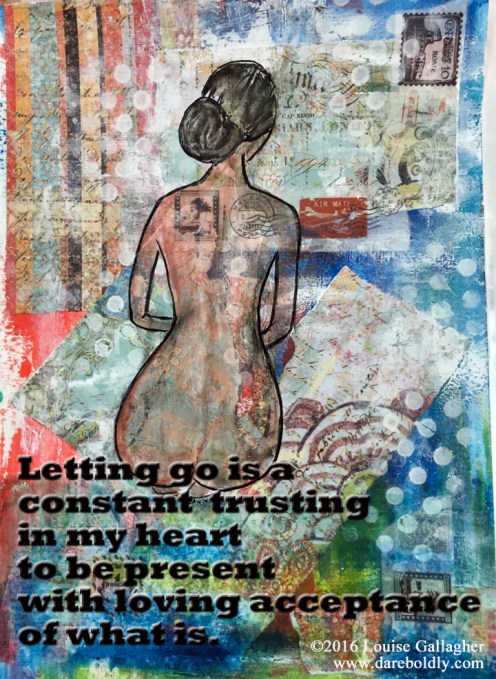
Journal entry Mixed Media | Naked truth of letting go | ©2016 Louise Gallagher

Journal entry
Mixed Media |
Naked truth of letting go |
©2016 Louise Gallagher


Thanks to Val Boyko at Find Your Middle Ground for this morning’s inspiration in her post, The Gift of Letting Go.

The Art of Journalling: Start Here.

The photos above are three different paintings from my art journal. For  me, art journalling is an experimentation and exploration of thoughts and techniques. It’s about free-flow art-making that loosens up my creative muscles, leaving me free to express myself without fearing judgement, criticism or ‘getting it right’.

I art journal because it feels good.

I love how art journalling gives me space to create uncensored.

How to begin.

change-copyThere is no right nor wrong way to begin to art journal. There is only the way you choose.

To read the rest of the article on Art Journalling, please click HERE. It will take you to the complete article I posted on my website.

The Art of Journalling.

Happy Journalling!

How to get anywhere: Start from where you’re at.

So often we look for the path by thinking we need to know it well before we step on it. We need to get more experience, learn more tricks of the trade, gather up more ideas, investigate more possibilities.

Fact is, the best way to get anywhere is to begin from where you’re at, and keep moving.

But, what if I don’t know where I want to go? you ask.

Start from where you are by asking yourself (and writing the answers down) the follow 3 questions:

  1. What brings me joy?
    • Write a list of all the things you can think of that bring you joy. It doesn’t matter how short or long your list, you need to have at least one thing on it that brings you joy. And, if you can’t think of anything, make finding what brings you joy a priority. Watching the sunrise. Sunsets. Walking in the park. Being with my friends. Running. Skiing. Writing. Volunteering at the animal shelter. Soaking in a bath. Playing my guitar. Taking photographs. Listening to music…
  2. If anything were possible in my life what would I be doing?
    • Write a list of all the things you think you might want to be doing. Write a novel. Sail the Pacific. Work for a humanitarian cause. Be an actor on stage. Find a cure for a mysterious disease. Adopt a child. Adopt a dog….
  3. What’s holding me back from starting on a path to doing at least one of those things?
    • Write another list with all the things that come to your mind — don’t judge your answers. Just write your list. My 9 – 5 job. My family commitments. Lack of money. Lack of education. I don’t know how. I’m afraid. It’s a stupid idea. People will laugh at me if I…

Now, for every thing listed on your ‘what brings me joy list, answer the following question inserting each one of the answers you gave to Question No. 3 ‘What’s holding me back. (write your answer down)

“How does my _[9 – 5 job]____________ hold me back from ____[watching the sunrise]___.

“How does my _[9 – 5 job]____________ hold me back from ____[watching the sunset]___.

“How does my _[9 – 5 job]____________ hold me back from ____[Walking in the park.]___.

There are 2 possible responses here. 1. It does hold me back. 2. It doesn’t hold me back.

Either way, answering the question for each thing that brings you joy will identify your excuses, or the fact you don’t let excuses keep you from experiencing joy.

Cause, here’s the thing. If you know what brings you joy and take steps to experience it everyday, you are already on the path. And if you let your excuses keep you from experiencing joy, once you’ve identified that they are just excuses, stepping onto the path is accomplished by — letting go of your excuses.

Acknowledging that experiencing joy in our lives is not hindered by our list of excuses, helps us connect to the possibilities.

Conversely, we can’t get to ‘possible’ if we’re stuck in believing our life makes possibility impossible. If we believe we can’t do the things that bring us joy — simple everyday things that surround us always and are easily accessible just by doing, we can’t get to the bigger possibilities — because we’re stuck in ‘it’s impossible thinking’. We’re trapping ourselves in messages that say things like, “I can’t do that because…” and then we let the list the 101 reasons why we can’t, go back to school, get a new job, quit our job and travel the world, become our reality.

Our impossible thinking stops us from seeing possibility is always present. To open the doors of possibility, we need to step through our fears through the gateway of joy. From that place of knowing joy in everyday things, we become open to seeing possibility for greater things to be possible.

Start where you’re at. Name what brings you joy and then do the things that bring you joy. Let the path appear as you keep stepping through your fears into joy and possibility.

Namaste.

Create Better | 52 Acts of Grace | Week 27

acts-of-grace-week-27-copy

I wrote this post after spending the day yesterday updating my website.

I didn’t consciously give a lot of thought to how what I was doing was going to ‘create better’ for the world around me, and those in it, yet, intuitively, at the foundation of everything I did to update my website was the desire to create opportunities for all of us to live with grace and find our inherent magnificence. And thus, to create better for all.

It is fundamental to the work I want to do in the world.

To create better. To touch hearts and open minds and set spirits free to dance fearlessly in a world of love, joy and harmony.

For me, ‘to dance’ doesn’t meant how I move my feet or stay in time to the music. It means letting my spirit soar, setting my heart free, giving my soul free rein.

It means fearlessly listening to the voice deep within me calling me to untether myself from social constraints and be. Me.

Be Me so you can Be You and together we can BE all the world needs to let go of fear and trauma, anger and abuse, violence and war.

It is not an easy task but I believe we are capable of doing it.

We are discovering cures for intractable diseases. We are discovering ways to explore Mars, the deep, deep sea. We are tunnelling to the centre of the earth, building skyscrapers that defy gravity, surely we can create better for all mankind too.

For this week, ask yourself, “What am I doing to create better in this world?” And do it.

Namaste.

Growing Tolerance @CalgaryKeys to Recovery

keys logoHe is quiet spoken. Humble. 

He is a landlord who works closely with Keys to Recovery, a not-for-profit agency that provides supportive housing for formerly homeless Calgarians who are exiting rehab and treatment with no fixed address.

He talks about his understanding when first he began working with Keys.

How he became aware of his lack of tolerance, understanding, compassion.

And why tolerance is so important to create a better city for everyone.

He is dynamic. Humble.

He is the former Chief of Police of Calgary, or as the MC, the brilliant and compassionate Jonathan Love, Mr. @JLoveNotes describes him, Our Forever Chief.

He too mentions tolerance. Talks about when he first became a cop in 1975 how little he, or anyone, knew or understood about homelessness, addictions, abuse, family violence. How so seldom there were any answers, or any compassion, to provide those on whom they called to provide support.

How tolerance as a society is so vital to creating a just society. A city where everyone has a place to call home.

He is calm. Humble.

He talks about his life before homelessness. His successes. The company he built. The family he held dear.

He talks about the impact of his addiction. The trauma of homelessness, of being lost and intolerant of any offers of help.

And he talks about going to treatment. Twice. How the first time, coming out and only have the street to greet him, he couldn’t tolerate the shame and trauma. He fell back. Hard.

And then he talks about getting straight, going back to treatment and finding a home with Keys.

They’ve given me my grandkids, he says.

Once upon a time, we were a city that did not tolerate the presence of people with mental health, addictions, physical disabilities well.

We are learning.

The value of tolerance. Compassion. Empathy. Caring about one another, no matter where we are on the street.

We are learning to celebrate the work of being there to support those who fall, and to celebrate those who do the work of being there to help them find their feet again.

Last night, Keys to Recovery , along with many supporters, staff and board members, celebrated our growing tolerance for one another, our growing capacity to look compassionately and act with kindness and consideration with those who have lost their way.

We are learning to tolerate the spaces between what we believe is ‘the right way’ to live and ‘the real things’ that happen to people along the way.

We are learning to be more compassionate, caring and considerate of one another. And in that space, we are learning to celebrate baby steps and giant leaps forward as we create a world where all of us can live our own unique human potential, without fearing the intolerance of others.

It is a good thing.

Namaste.

Dare boldly.

Perhaps it is that I have run out of words, or maybe just energy. Perhaps my psyche is telling me I have nothing new to say, or that everything I’ve said stands as true today as it did when I wrote it. Perhaps it is just I need a change of pace. That in order to get a fitness routine cemented into my daily schedule, I need to make space in the morning and not leave it until after work when it’s easy to talk myself out of going to the gym.

Or maybe, it’s just time for a reboot, refresh, renew.

Whatever the reason, I’m looking at ways to refresh my blog. To refocus it so that it feels more organic to my daily life.

I have been writing a blog almost daily since March 2007. On that blog, Recover Your Joy, I wrote 1,730 posts.

I have been writing here at Dare Boldly, originally called, A Year of Making a Difference, since January 1, 2012, a total of 1,213 posts.

Which means, over the past 9 and a half years, I’ve published, 2,943 blogposts. If I break it down by an average of 700 words a post (which is probably short for me) I have written over 2 million words.

That’s a lot of words.

A lot of thoughts.

A lot of ideas.

Which raises the question for me — what’s my focus?

Originally, on my Recover Your Joy blog, my intent was to take every day situations and show people how to find the joy in everything. That included the many stories of homelessness I shared, the trials and tribulations of healing from life’s traumas, and the realities of being a single, working mother.

When I started A Year of Making a Difference, it was with the specific intent of figuring out how to make a difference ever day, even when I wasn’t working at a homeless shelter. It morphed into Dare Boldly in 2014 as I got clearer on what I wanted to inspire in other people’s lives, as well as my own: to  Dare Boldly. Live Bravely

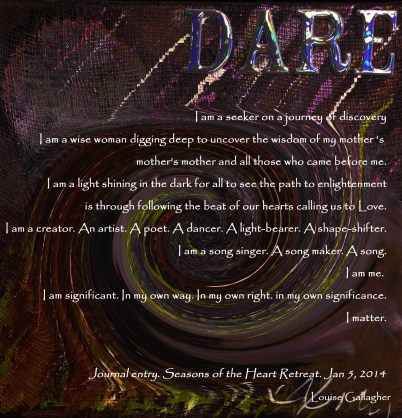
It started as Dare Boldly after I wrote a poem called DARE and a dear friend, Max Ciesielski, sent me a track of music he wrote to go with the poem — and asked me to record it.

seasons of the heart retreat copyYou can hear it HERE.

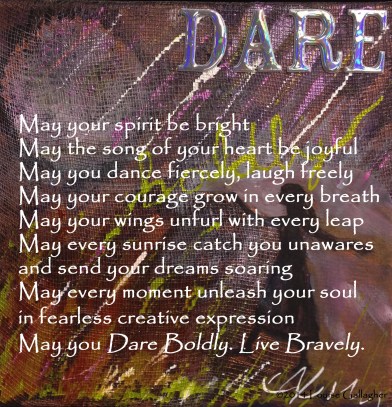
That poem evolved from a painting and blessing I used to announce the new name of my blog, Dare Boldly, on January 1, 2014:
dare boldly 1 copy

And I continue to evolve.

All this means is that I am reassessing my online presence, the purpose of my writing here, the value of maintaining a daily schedule and the alternatives. It means in the coming weeks I probably won’t be appearing every weekday with any predictable schedule and it means, you’ll be seeing some changes as I adjust my theme, look, feel and direction.

It’s all good. All exciting. All important to me.